
AgentSTH V7
AgentSTH is our agentic CPU benchmark. It leaves the LLM out and measures the work around it: orchestration, tool calls, parsing, and moving context around. There are 18 weighted subtests across Throughput, Coordination, and Memory. We have been working since early this year not just to profile agentic workflows (this really started with OpenClaw in early 2026), but to back-test everything. We tested roughly three dozen architectures over the past 10 years to build a suite that worked across generations. You may have seen AgentSTH V7 on STH for some time, and may also notice we have a number of other workloads that have now made it through the profiling process, so it is likely we will be transitioning to V8 in 2027.
AgentSTH V7 Single Core
First, we ran on a single core to see how it performs with relatively little load.
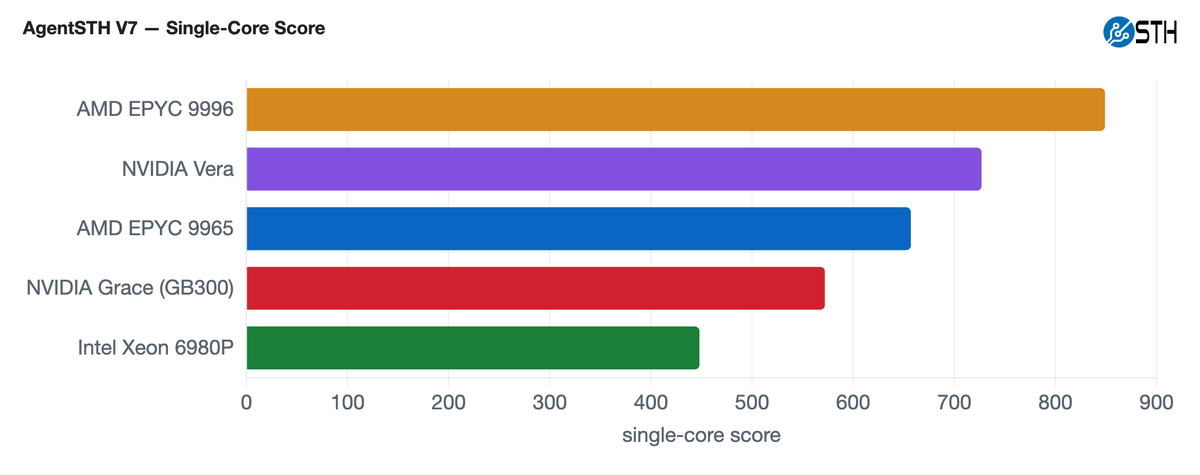
The EPYC 9996 has the fastest single core here at 849 points. That is 17% ahead of Vera at 727 and 29% ahead of the EPYC 9965 at 657. Grace is at 572 and the Xeon 6980P at 448.
Here is the same result split by dimension.
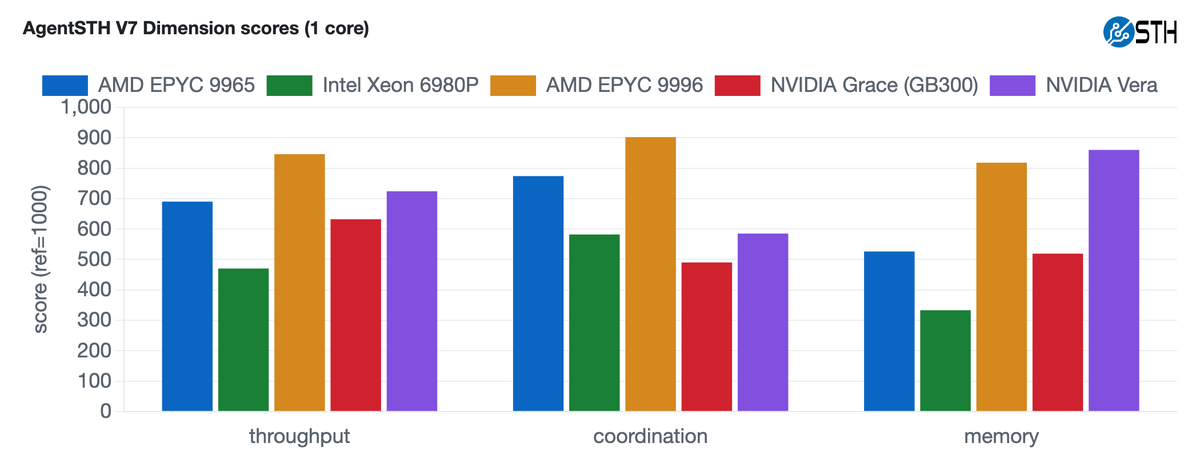
The EPYC 9996 leads throughput at 846 and coordination at 902. Memory is the one dimension it does not win, scoring 818 against Vera’s 860. That is a gap that might close with MRDIMMs, but it is worth reiterating that it is not a pure STREAM-like memory dimension. Instead, it is operations where the memory bandwidth has an outsized impact on the result.
And here is each subtest. If you run one of these workloads, this is the chart to look at.
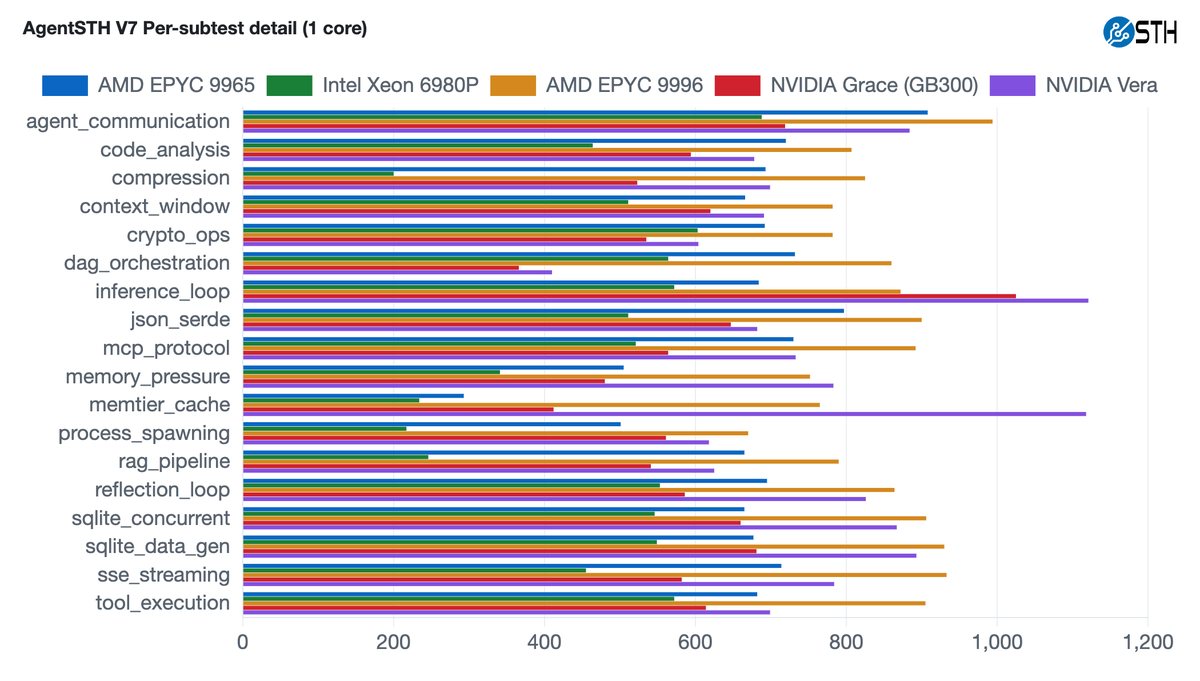
We usually do not post the detail, just because it ends up being an eye chart as well. Still, you can see that NVIDIA Vera and AMD EPYC Venice are a step beyond the PCIe Gen5 parts.
AgentSTH V7 Scaling
Next we add cores and see how much of each one turns into performance. The goal is to profile a single core’s performance, then see what happens if we add more cores. We used to stop this scaling chart at 32 cores, then showed the higher-core-count data in other charts. Since we had the data, we just added it to these charts.
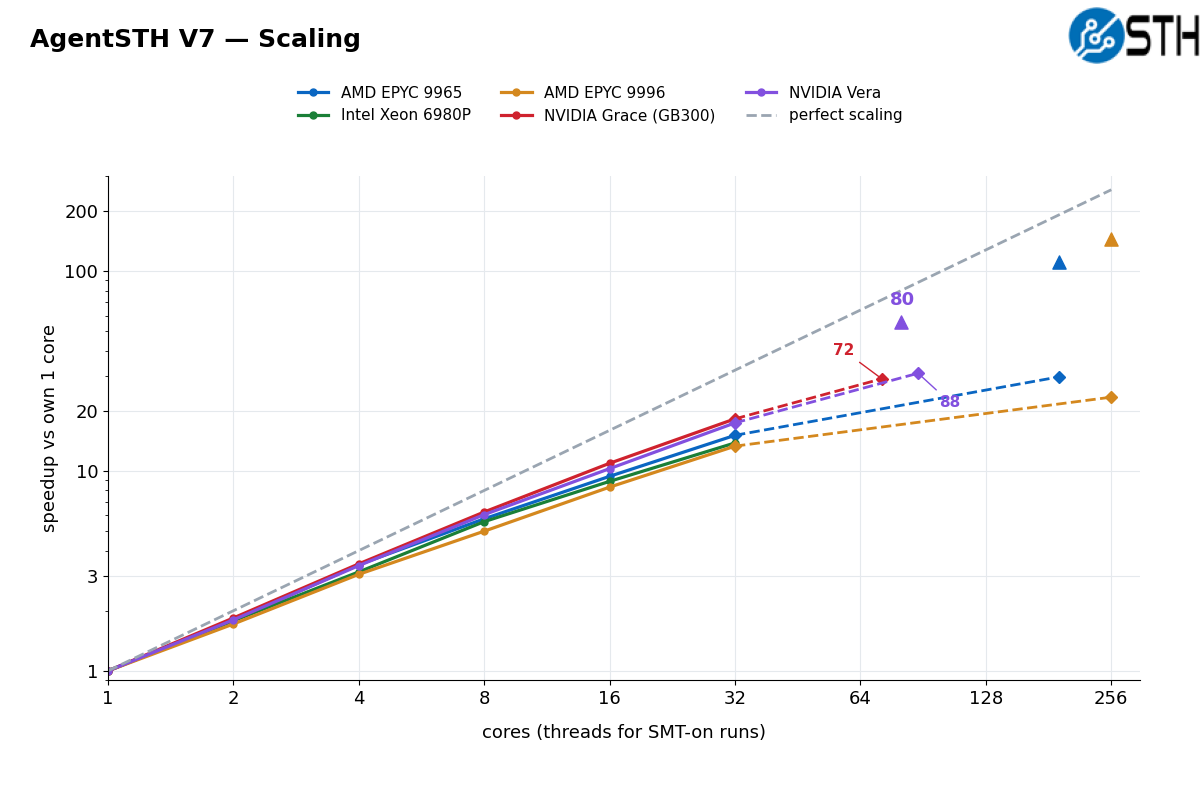
The EPYC 9996 certainly looks like a very high core count part as scaling is a bit more muted once we get to very high core counts. In early 2026, we started using 32 cores as the maximum for our scaling, so we have good data on that.
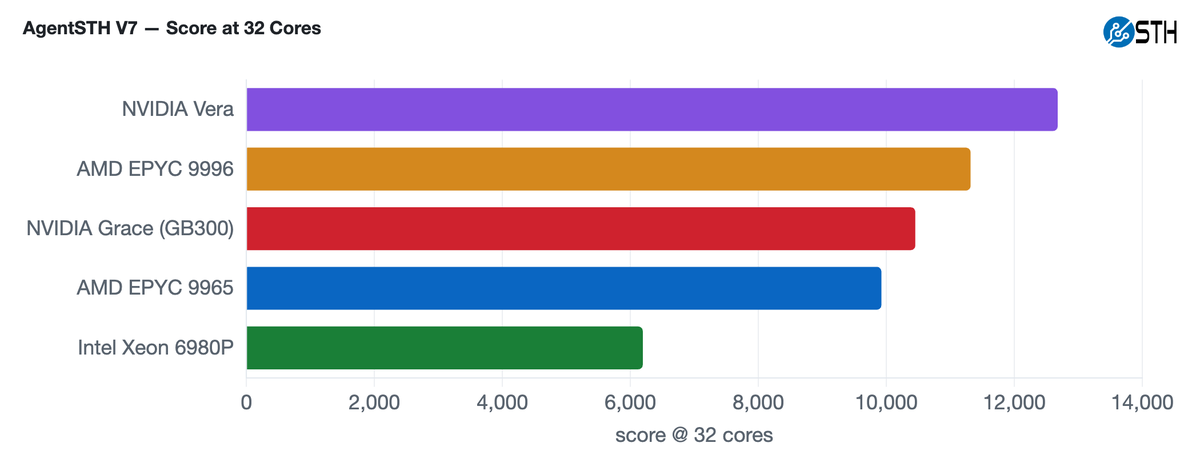
Something notable here is that we can now stay on a single CCD with 32 cores, which is likely one of the reasons we are seeing a double-digit performance gain over the Turin generation.
AgentSTH V7 Multi-Agent Splits
Few people will run one agent container or VM on a whole CPU, and that was one of the driving forces behind developing AgentSTH when we started work last year. We range from one agent per CPU to sixteen.
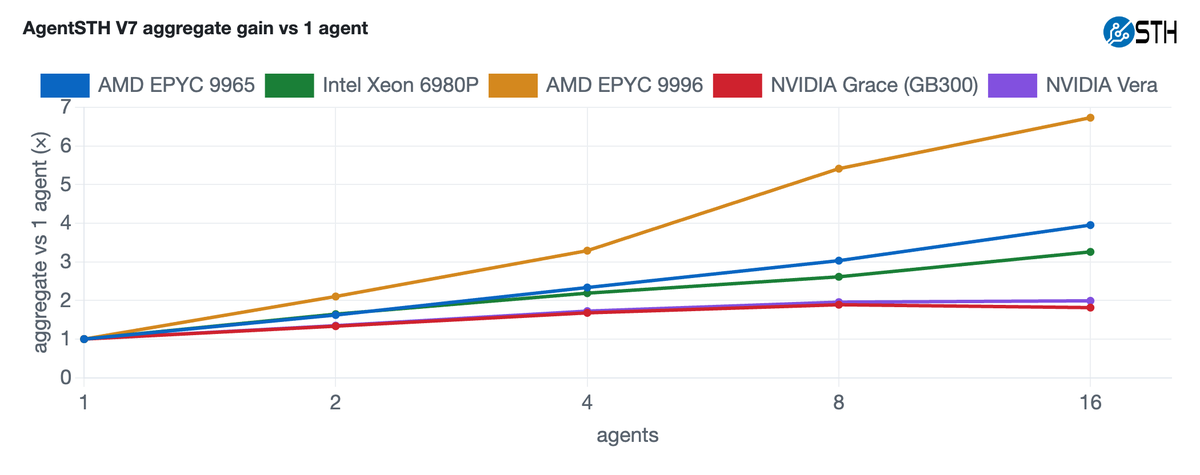
Splitting the EPYC 9996 into 16 agents of 16 cores gets 6.73x the work of one 256-core agent, the most of any chip here. This is really where the high-core-count Venice shines. It is designed to run many workloads at the same time.
AgentSTH V7 SMT Impact
Companies have been using SMT for years to increase performance at relatively low die area cost. While NVIDIA Grace does not support SMT, Vera does, which helps with throughput-related tasks. Notably, if you ask AMD, they say that SMT is a huge performance boost for relatively low cost. Intel had been on that path, but then decided to remove SMT in Diamond Rapids, contributing to Intel’s CEO calling its next-gen Diamond Rapids uncompetitive because it is missing the feature. NVIDIA has many smart CPU designers, and they added SMT. Vendors without SMT usually say it is not useful, highlighting applications where it does not help. Then when it comes to marketing, you often see vendors who do not focus on SMT compare “threads,” which is one of two on the core. If the core without SMT was 1, and with SMT it was 1.3, then the thread can be called 0.65, which is great math if you do not have SMT. So we just run both cases which lets us see something neat since it gives us a SMT uplift number on the core.
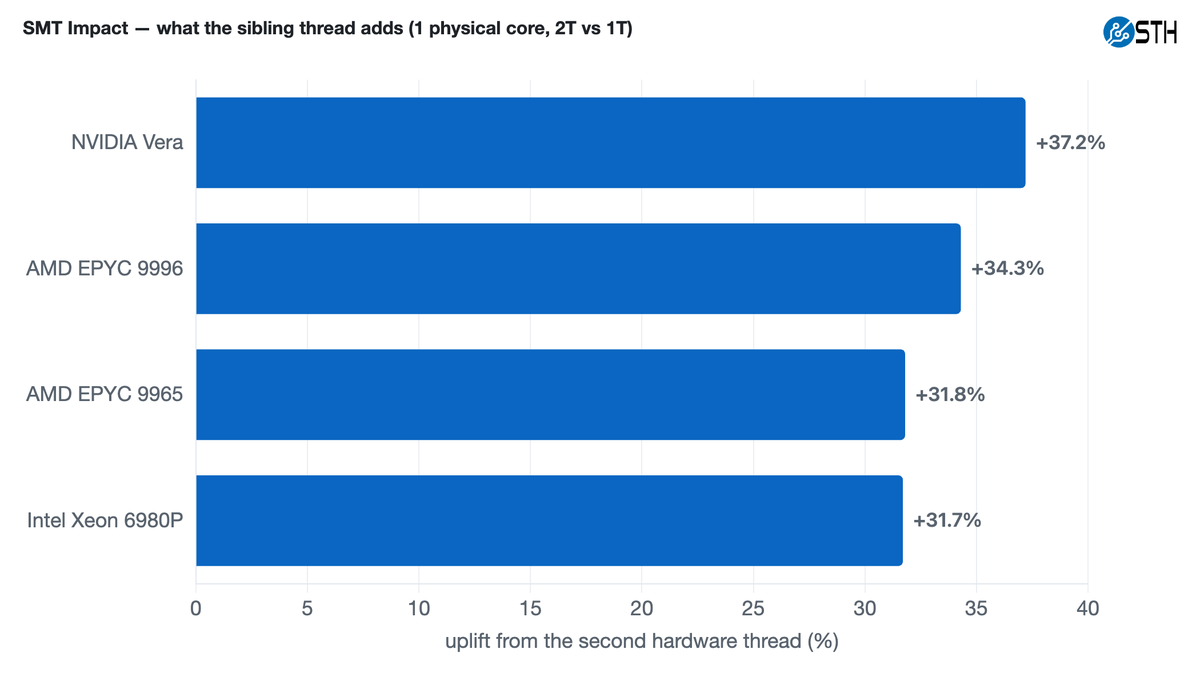
The second thread adds 34.3% on one EPYC 9996 core. That is in the same range as Vera at 37.2%, the EPYC 9965 at 31.8%, and the Xeon 6980P at 31.7%.
There are cases where you want to turn off SMT, but if you need throughput, then turning it on seems like a solid choice.
Next, let us get to SPEC CPU2026.