

Dell VEP4600 Performance
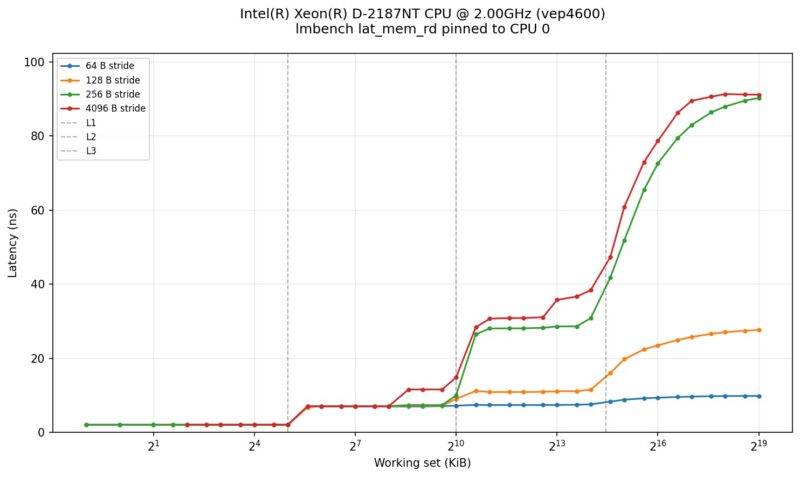
Our Dell VEP4600 came with the Intel Xeon D-2187NT, a 16-core 32-thread processor that was launched in early 2018. As an older processor, the per-core performance is significantly lower than today’s offerings, but we still wanted to provide a profile of what this offers. Here is the lmbench look:
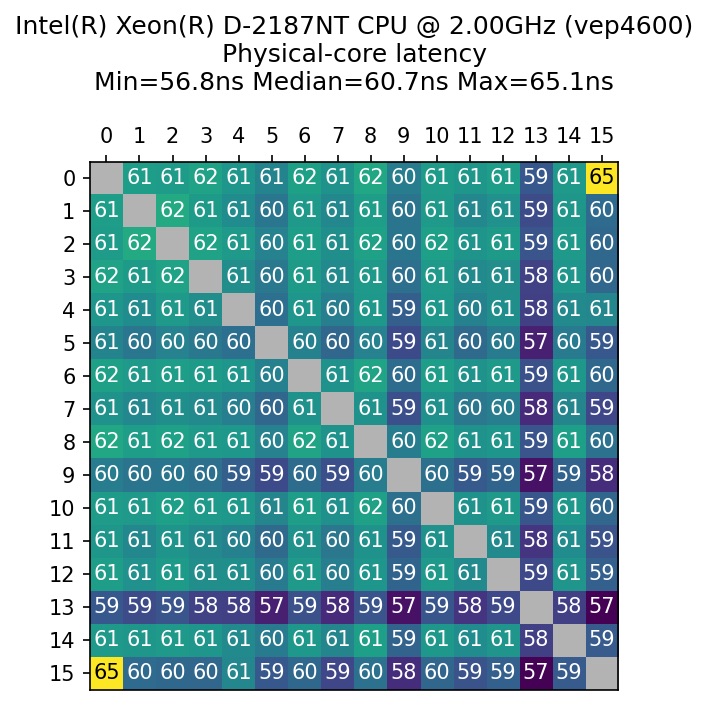
We also ran core-to-core latency on this CPU. For some context, this was a smaller topology, but it was also the first generatio nthat Intel switched from the old ring on Broadwell-DE to the mesh on Skylake because of the increased core counts.
Here is a quick Geekbench 5 run:
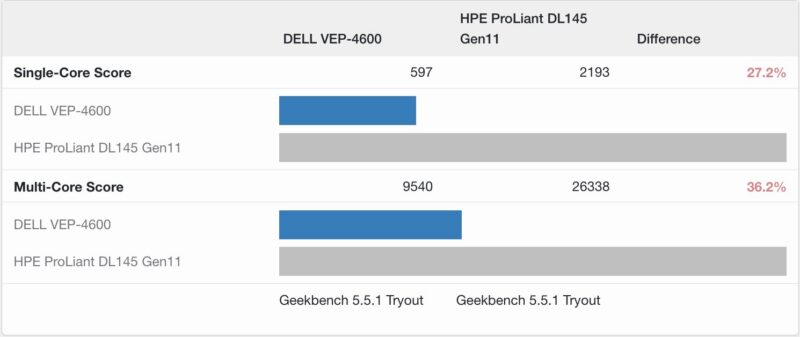
As you can see, the AMD EPYC 8125P, as the more modern part, is roughly 3x the performance of the Intel Xeon D-2187NT.
Estimated STH SPEC CPU2026 Performance
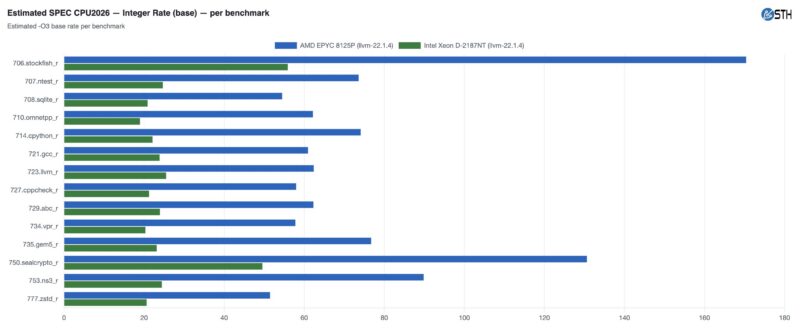
SPEC CPU2026 is the company’s new benchmark suite. Its predecessor, CPU2017, was a de facto industry standard in the server industry. We are running this using open-source compilers at -O3 optimization levels, so our results should not be directly compared to the official numbers on the SPEC website. Instead, these are benchmarks at lower compiler optimization levels and should only be compared to STH results.
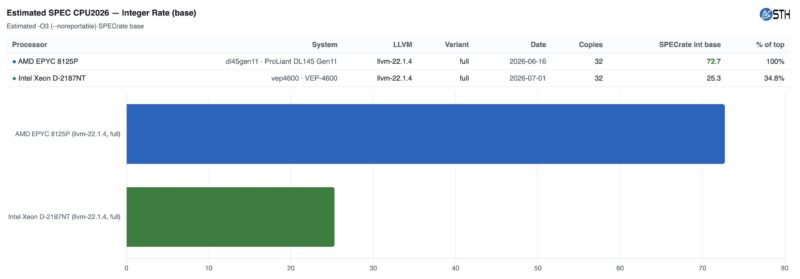
We start with the estimated STH SPEC CPU2026 int rate results:
Here are the detailed sub-test scores:
Most folks for a machine like this will care more about integer performance, but the floating point tests show a similar pattern.
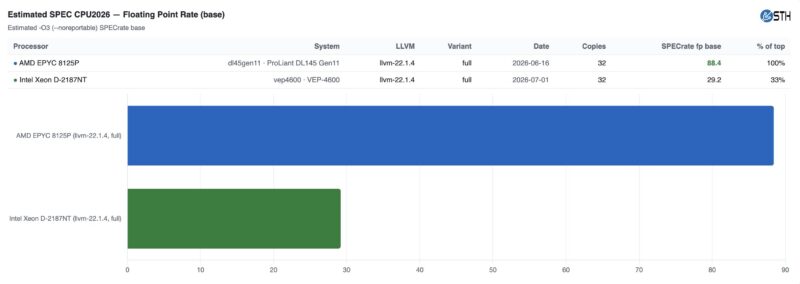
Again, with higher levels of optimization, we would expect the EPYC to perform better than this. Still, this is a widely used benchmark suite, and newer cores from the 2024 era in a 2026 chip are running at roughly 3x the performance per core of the 2017 cores in a 2018 chip.
Dell VEP4600 AgentSTH V7 Performance
After months of profiling agentic AI workloads and systems, we developed AgentSTH V7. This is a suite of tests that represents the type of agentic AI workloads we see running on many trace runs, doing real-world tasks ranging from coding to infrastructure management to creating financial models, and more. We also focus on running different shapes on processors to stress the CPU in ways that traditional benchmarks do not. Since we are not testing the LLM side here, it turns out that a lot of this actually looks very similar to how multi-tenant server CPUs are used outside agentic AI workflows.
Let us start with single-core results:
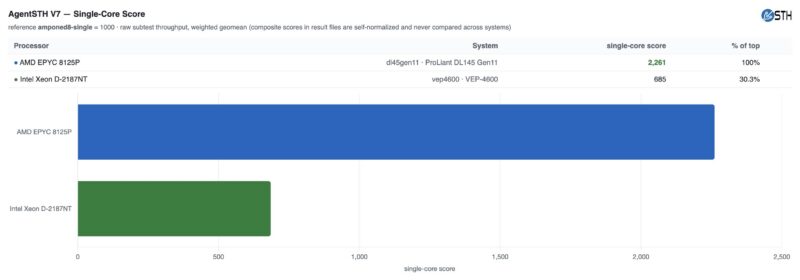
Perhaps we should have expected this, but we are close to 3x the performance on a modern Zen 5 core over the older Skylake generation core in our Agentic AI CPU benchmark.
Just to confirm a lot of this is not just due to the upgraded memory subsystem, here are the higher-level buckets for the subtests.
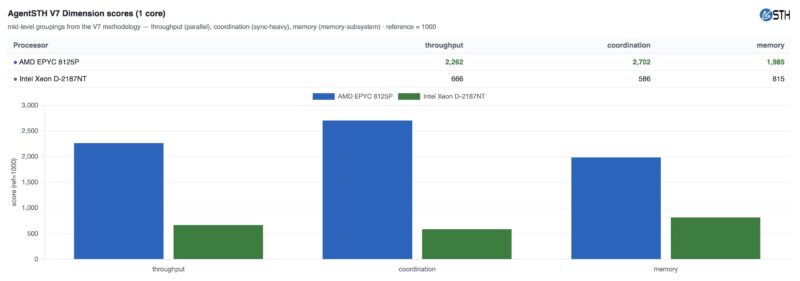
Since the roughly 3:1 ratio is throughout the data, perhaps the more interesting figure is what happens when we run multiple agents simultaneously on the chip:
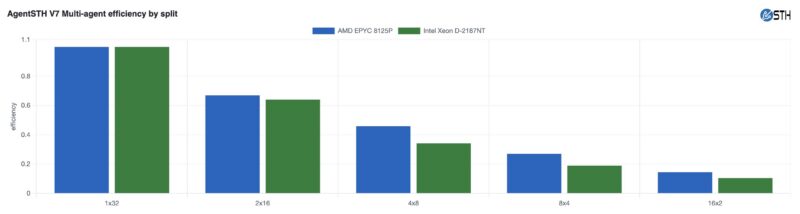
When we split the chip into multiple sub-agents running simultaneously, the Intel Xeon D-2187NT clearly lags behind the newer EPYC 8005 series. This is using the single-core baseline, but it is just a neat piece of data we are generating today, since modern CPUs often run multiple workloads simultaneously. The VEP4600 arrived with VMware ESXi installed, and VMware had a version of this system, so it was intended to run multiple workloads simultaneously.
Network NAT
We set up Linux to NAT between pairs of ports just to see the throughput we could get from a box like this:
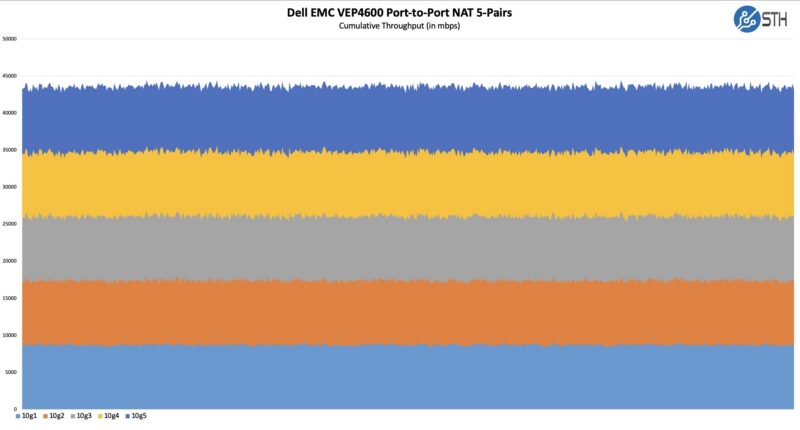
That is not what we would expect from a switch, but it also has very reasonable performance. Hopefully, we will get to higher-end network testing on NICs pretty soon to match the switch/ firewall side. Also, we did not run this on the 1GbE ports, but to be frank, I have very little doubt that the Intel i350-am4 ports on a Xeon D can NAT dual 1Gbps traffic if it can do pairs of 10Gbps.
Next, let us discuss power consumption.



the only thing I find for that price is the 4-core version of this, not the 16 core
A really interesting hands-on review of the Dell VEP4600. I liked the personal perspective combined with the detailed look at its networking capabilities, making it easy to understand why this system stands out.
It looks like Dell are flogging the last few units before they are gone for good.
Nice to see home lab style kit on STH again :)
What the heck is this thing supposed to be? Is it a server or a switch or something else altogether? The article doesn’t seem to make that clear. Can somebody answer this for me? Thank you.
@Stephen either a lower power server, or more likely a router/firewall
@Stephen these boxes are made for Velocloud SD-WAN, so they’re essentially a networking appliance. In the end they are essentially servers with a switch chip linked to some of the PCIe lanes to provide additional connectivity.
So is lack of HTML5 iKVM a license issue, or is it just plain not provided in this model?