

Dell Pro Max 16 Plus Performance
Under the hood, the Pro Max 16 Plus is driven by an Intel Core Ultra 9 285HX processor, which is part of the Core Series 2 Arrow Lake-HX family. This is Intel’s high-performance mobile silicon, and is essentially a desktop chip in a mobile soldered (BGA) form factor. As a result, the Arrow Lake-HX gets the same 24 CPU cores that Intel’s desktop chips get – though it also comes with the more limited Intel Graphics (Xe-LPG architecture) integrated GPU. Thankfully, it also comes with the same I/O capabilities of the desktop processor, meaning there are more PCIe Gen5 lanes to work with than Intel’s true mobile silicon.
As the full-fat and flagship version of the Arrow Lake-HX chip, the 285HX gets access to all the hardware offered in Arrow Lake, with the eight performance (P) cores topping out at 5.5GHz. Meanwhile, backing P cores for highly threaded workloads is a further sixteen efficiency (E) cores, which have a peak clockspeed of 4.6GHz.
With the RTX PRO 5000 Blackwell installed as a discrete GPU, this laptop relies on a combination of NVIDIA’s GPU along with Intel’s integrated GPU for graphics. The integrated GPU itself is rather unremarkable at just 4 Xe cores (again, this is desktop silicon), but the system can composite in the frame buffer from the RTX PRO whenever the latter is assigned an application to run. This is NVIDIA’s fastest mobile graphics offering, but a 120Hz 4K display is still going to put it to the test for anything graphically demanding.
Finally, typical for Dell’s professional offerings, the company ships the Pro Max 16 Plus with a choice of either Windows 11 Pro or Ubuntu 24.04 – assuming you want a pre-loaded OS at all.
CPU Performance: SPEC CPU 2026
For this one, we already featured this in our SPEC Consortium Releases SPEC CPU 2026 Benchmark Suite and subsequent The Case For Compilers: A Look at SPEC CPU 2026 on LLVM 22 pieces.
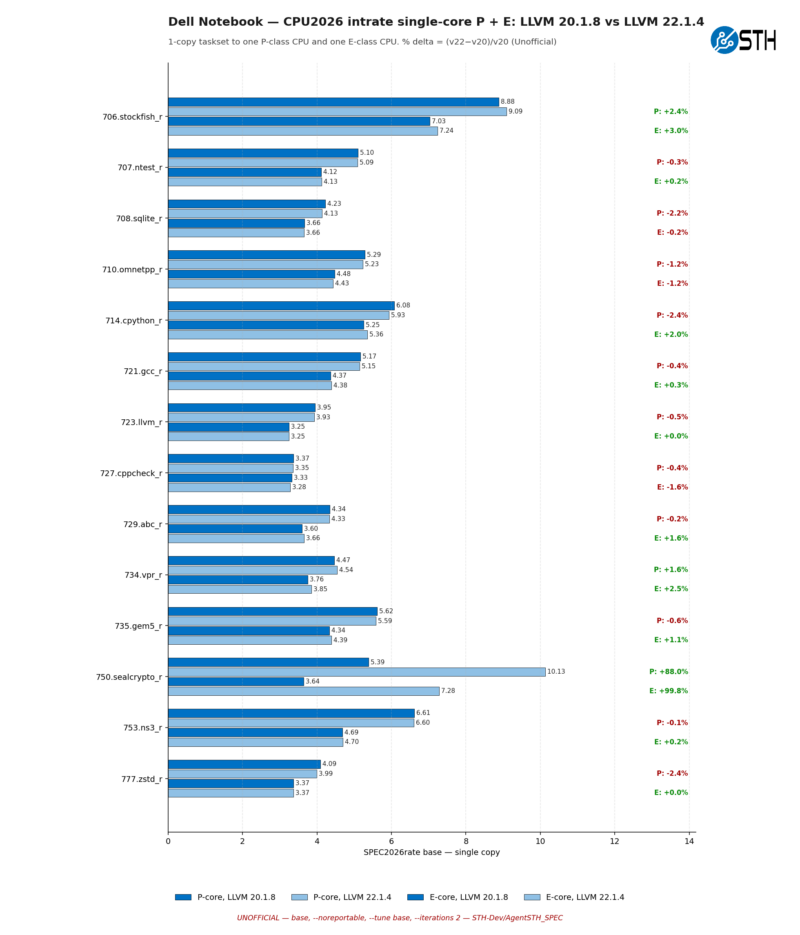
We have a ton of benchmarks done here just because of doing a 2×2 testing matrix with CPU 2017, CPU 2026, and then LLVM20 and LLVM22. Please note that we did not use the highly optimized compiler (and flag) setups you would normally use for official SPEC submissions. We are using a lowest-common-denominator setup to perform cross-architecture comparisons and clearly differentiate our unofficial results from the official result set.
Geekbench
For our Geekbench performance comparison, we are going to use Lenovo’s ThinkPad P16 Gen 3, a similarly equipped professional DTR laptop that we recently reviewed. Though not quite identical to the Dell Pro Max 16 Plus – most notably, the Lenovo features a Core Ultra 9 275HX instead of the 285HX – it features the same RTX PRO 5000 Blackwell video card, making the two machines quite similar in scope overall.
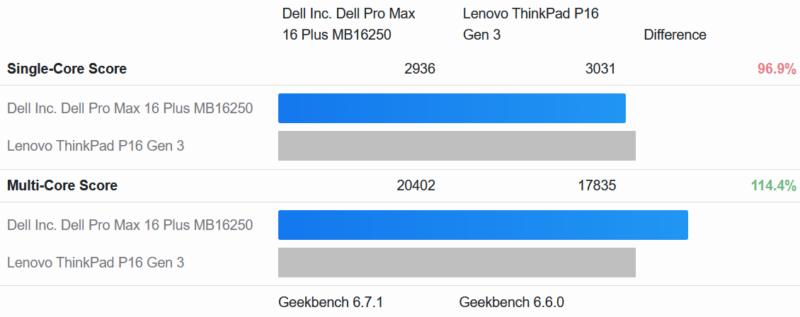
Starting with CPU performance, interestingly enough, we find the Dell system coming out just a bit behind in single-threaded performance, with a score of 2936, landing 3.1% behind the Lenovo system. For two identical systems, this is right at the edge of expected run-to-run variation, but the Lenovo system also has a slightly slower CPU, which is clocked 100MHz lower. So this is an unexpected result. Perhaps Dell has their CPU tuned a bit more conservatively than Lenovo.
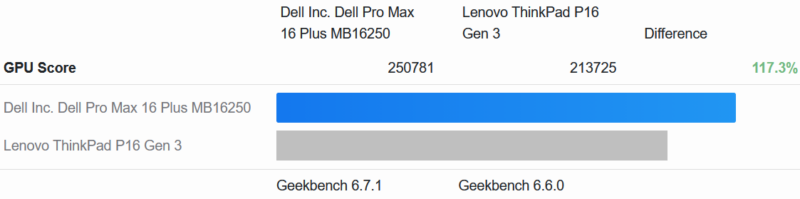
Conversely, the Dell system has no problem rushing right past the Lenovo system in multi-threaded testing, delivering about 14% more performance. Besides the marginally higher clockspeed, the Dell system also features significantly more memory bandwidth (DDR5-6400 vs DDR5-4000, for 60% more bandwidth), and we would expect multi-threaded testing to be more likely to load down the system enough to be sensitive to those differences.
For GPU performance, despite the identical video cards, the Dell system is well in the lead here, delivering about 17% more performance. Even more so than the CPU, OEMs can configure NVIDIA’s laptop GPUs to their liking when it comes to TGPs. So it is not clear if this is even an apples-to-apples comparison as far as TGPs go. Regardless, the result is that the Pro Max 16 Plus has the fastest RTX PRO 5000 Blackwell implementation that we have seen to date.
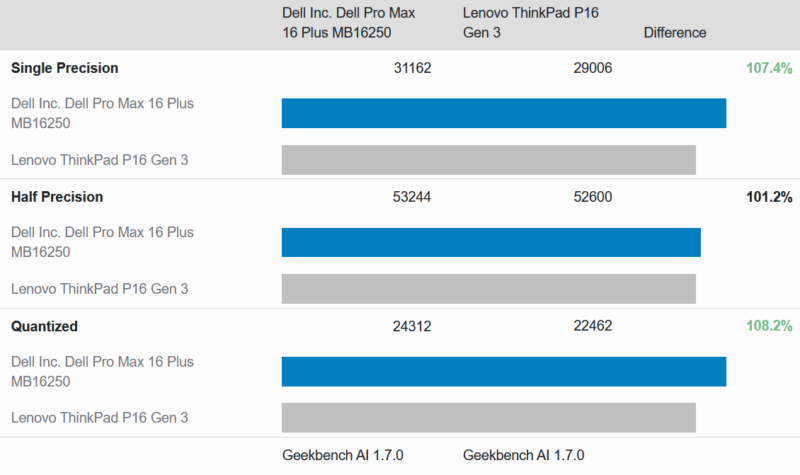
Geekbench’s AI test also finds the Dell system in the lead, though not by as much.
MLPerf
Since we have a high-end GPU installed in the Pro Max 16 Plus, we also went ahead and ran the latest version of the MLPerf Client machine learning benchmark.
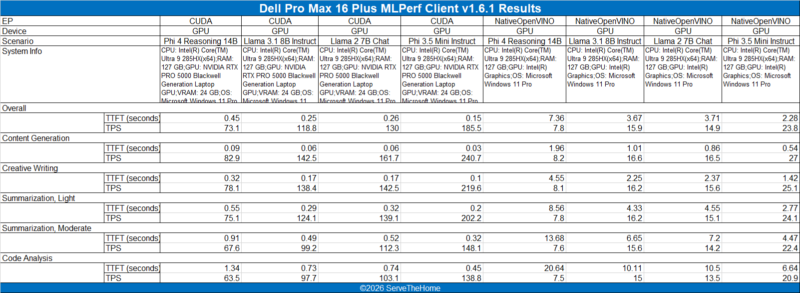
In short, the RTX PRO 5000 Blackwell does exceptionally well in this test, easily tearing through a workload that is light enough to be used on mid-range systems. This also shows the extreme performance gap between the system’s discrete GPU and the integrated GPU.
Next, let us discuss power consumption.



Is that an OEM panel gap on the center of the bottom chassis in the “ Front Angled 1” shot? Absolutely brutal for $15,000.
I have Dell Pro Max 16 for almost one year with Core 7, 32 GB RAM and Nvidia 2000 Blackwell. During this time, I have 5 replacements of motherboard, two replacements of power board and one replacement of GPU card. This laptop series is not reliable as previous models and maybe this is the reason why Dell brings back Precission naming of newer laptop/workstations.
Who needs all of this in a laptop???
This thing is overpriced and too huge/heavy to be reasonable.
Its the cybertruck of laptops.
All 3 of the SSD slots are PCIe Gen5 x4. Slot 0 seems slightly slower than the others (I see up to 12.5 GB/s from slot 0 but up to 14.5 GB/s from the other slots.) The GPU runs at x8, not x16, so two of the SSD slots appear to be using the other 8 lanes.