

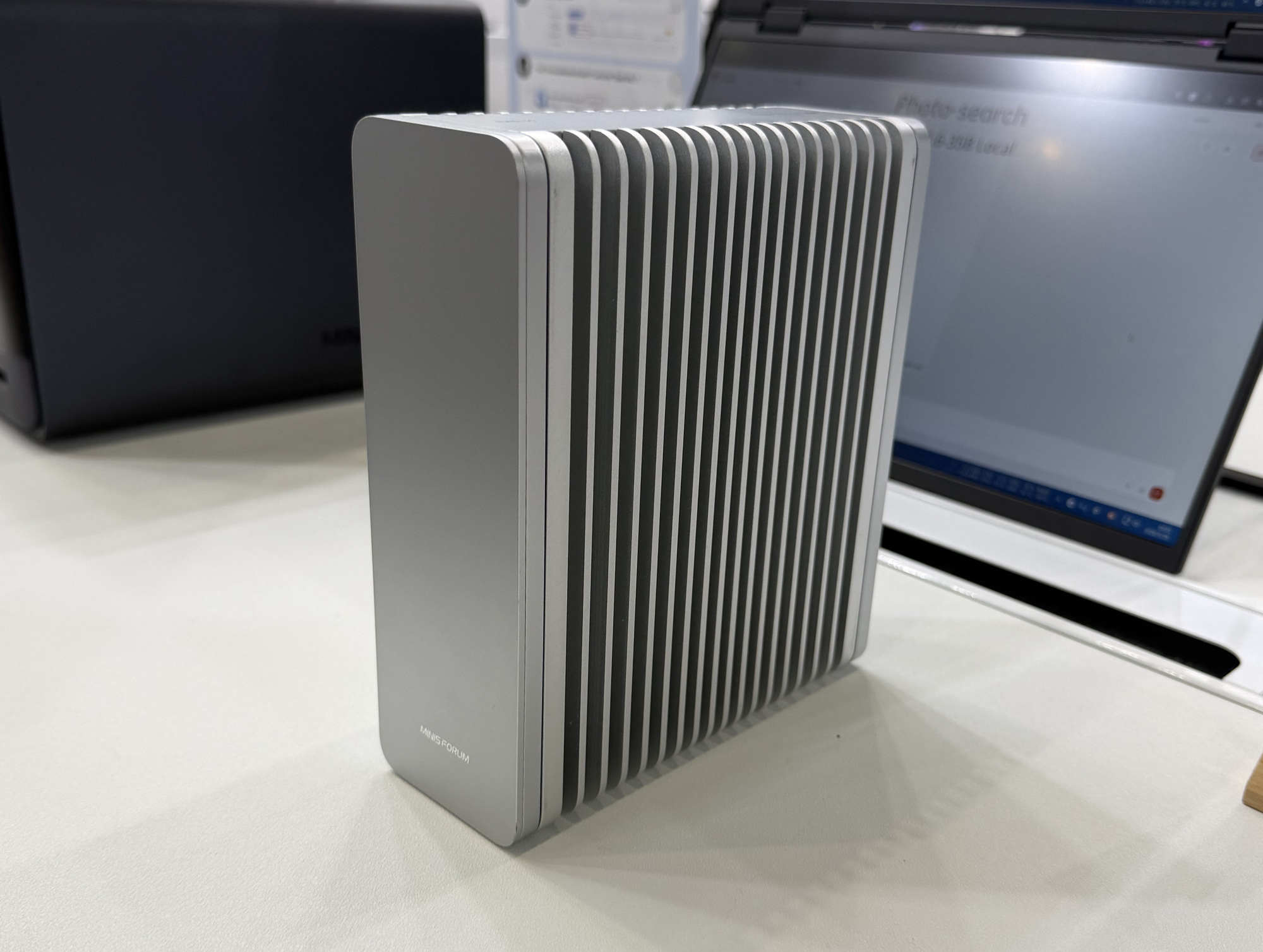
While crawling the Computex 2026 showfloor, we came across the Minisforum booth. One of our favorite small form factor PC builders, Minisforum, had a couple of upcoming PCs on display, both based on Intel’s latest-generation Core Series 3 and Core Ultra Series 3 platforms.
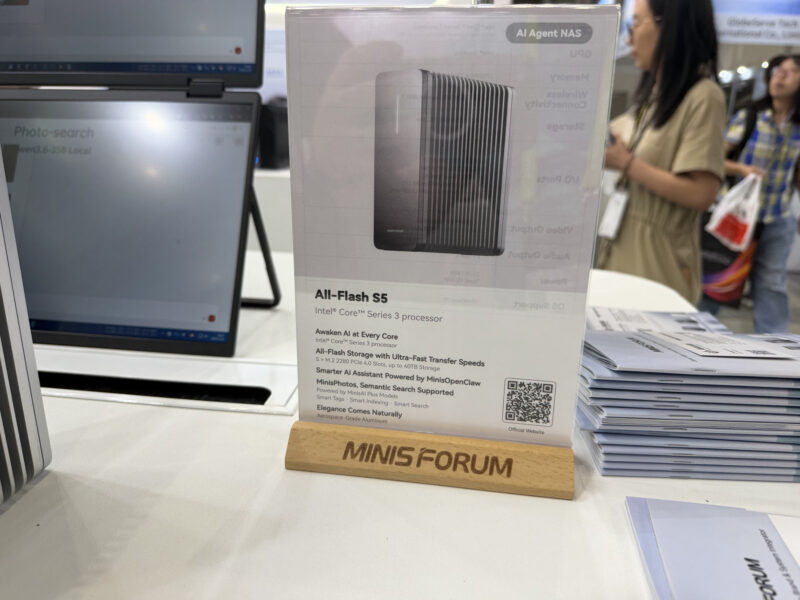
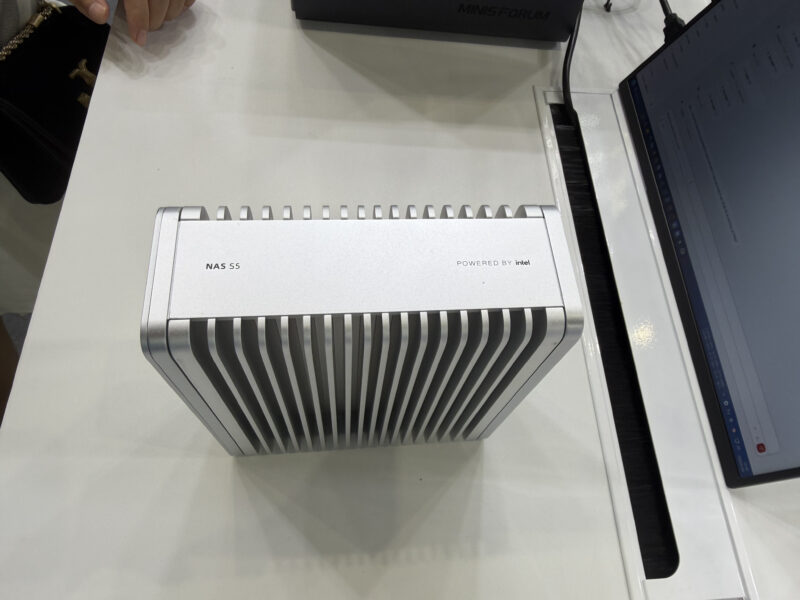
The first of these is a new all-flash NAS from the company, which is going by the S5 designation. The S5 is designed to be an ultra-compact and ultra-silent NAS, relying entirely on M.2 SSDs and a low-power laptop chip to keep size, heat, and noise to a minimum. Despite the focus on compact designs, Minisforum has some AI ambitions for the system, leaning on Intel’s platform and pre-loading it with agentic AI software.
Minisforum All-Flash S5 NAS
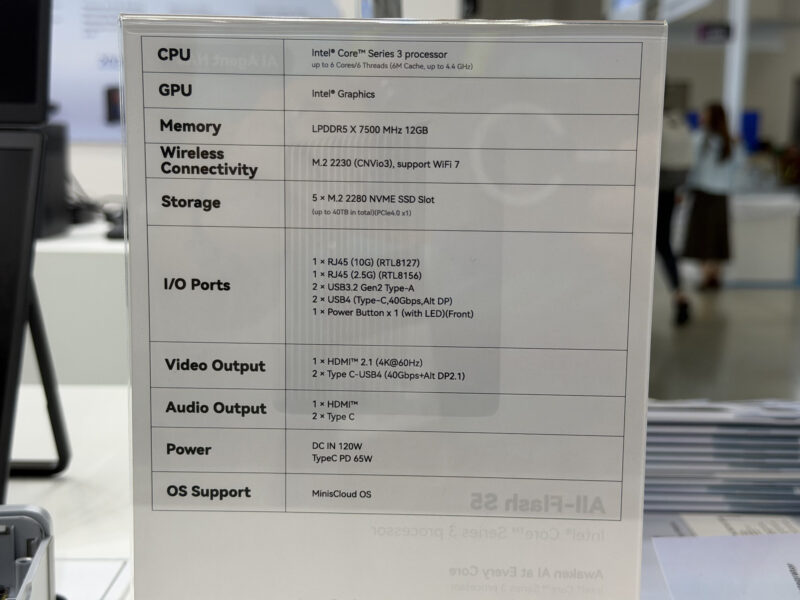
Previously announced at an event in China back in early May, the S5 is an all-flash NAS based around Intel’s Core Series 3 (Wildcat Lake) platform. Minisforum has not determined which specific SKUs they will use yet, so CPU and GPU performance figures are all “up to.” But no Series 3 chip features fewer than 5 CPU cores (1P + 5E).
The Series 3 chip will be joined with 12GB of soldered-down LPDDR5X-7500 memory. Meanwhile, the OS will be stored on a 64GB UFS 2.2 chip, which is separate from the M.2 slots used for the system’s NAS capabilities.
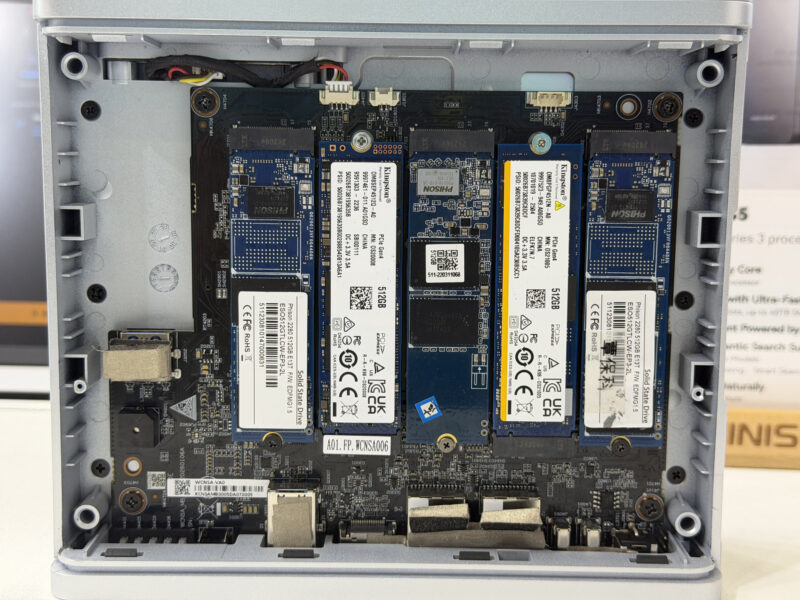
Internally, the NAS features 5 M.2 2280 slots, each connected via PCIe Gen4 x1. The name of the game here is favoring storage capacity over storage speed, so Wildcat Lake’s scant 6 PCIe lanes are divided up very carefully to drive as many SSDs as possible, with roughly 2GB/second of bandwidth going to each of them.
Minisofurm is pitching the system as a mid-range all-flash NAS, splitting the difference between budget systems based on Alder Lake-N and similar platforms that have rather significant I/O and performance limits, and more expensive NASes that offer heaps of I/O but drive up the build costs in doing so. Minisforum is able to pull this off because the Series 3 platform already provides most of the I/O they are after, including 40Gbps USB4, Wi-Fi-7, and 2.5Gb Ethernet – as well as modern features such as AV1 hardware encoding.
The piece de resistance here is that Minisforum has spent its final PCIe lane on adding a 10Gb Ethernet controller (Realtek’s RTL8127), giving the NAS enough network bandwidth to better match the performance offered by the installed SSDs. Combined with the native USB4 support from Intel’s integrated Thunderbolt 4 controller, this gives the S5 an ample amount of I/O bandwidth for both Ethernet and USB networking.
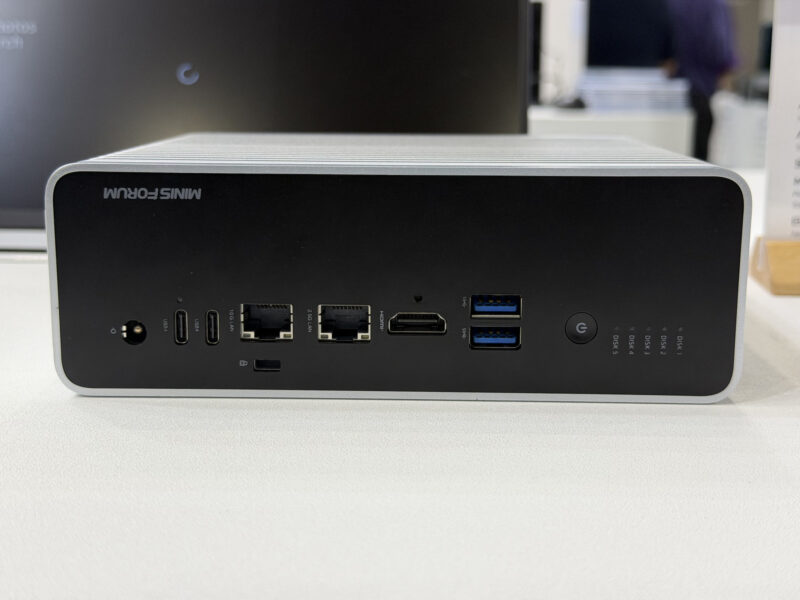
On the back of the system, we can see Minisforum putting the Series 3 platform to good use, driving a pair of 40Gbps USB-C ports, 2.5GbE and 10GbE ports, an HDMI 2.1 port for displays, and a final pair of 10Gbps USB-A ports.
The company is also leveraging the low power consumption of the Series 3 platform and M.2 SSDs to make this a purely fanless platform. The entire system is passively cooled via its aluminum case, which has fins integrated in order to better dissipate heat. The idea being that the system can be stowed virtually anywhere thanks to its small size and silent operation.
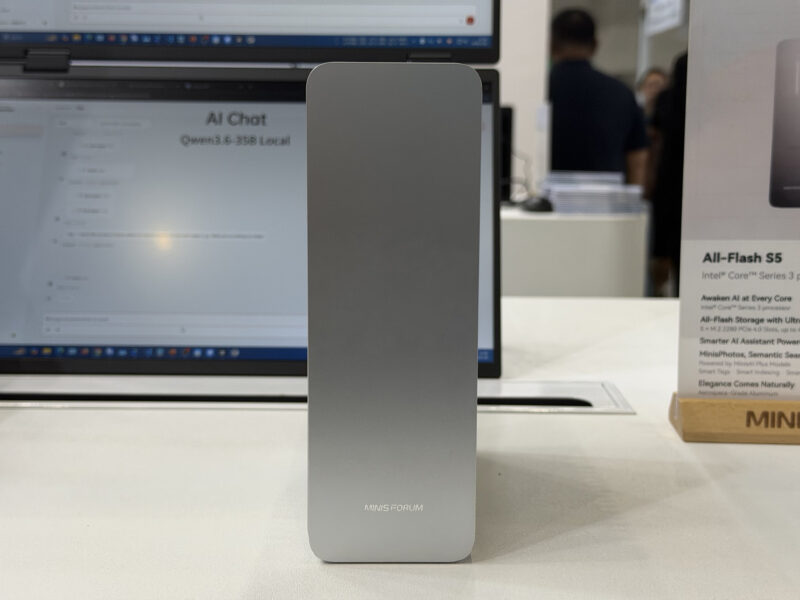
Finally, the S5 will be running Miniforum’s MiniCloud OS. Besides serving as a pre-installed and stripped-down OS for NAS usage, the company is also pre-loading the system with some basic AI software, with the aim of offering limited AI capabilities on the system. This includes a custom OpenClaw distro called MinisOpenClaw, as well as a photo cataloging and tagging program called MinisPhotos. The Series 3 platform has fairly limited AI performance compared to Intel’s more powerful chips, but Minisforum says the combined NPU and iGPU should offer enough performance to handle the kind of lightweight workloads they have in mind.
Final Words
Intel’s Core Series 3 platform has been eyed as a proper replacement for the 4-year-old Alder Lake-N platform, and it is easy to understand why. The budget-priced platform offers a major jump in virtually every respect, from CPU and GPU performance to PCIe bandwidth and external I/O. As a result, device makers are eyeing replacing some of their long-in-the-tooth budget devices with something more modern and capable across the board.
Minisforum’s S5 is a good example of what the Series 3 platform can do in a NAS. Even a single PCIe Gen4 lane provides more bandwidth than a 10GbE network can fill. And it is low enough in power needs to allow for a passively-cooled system even in a smaller design. NAND/SSD pricing will be a thorn in Minisforum’s side for the short-term, but in the long-term, the S5 is going to be well-positioned to succeed as a next-generation all-flash NAS by delivering a relatively cheap NAS that can still saturate a SoHo network.




I’m glad to see the device, but a “mid-range NAS” in my book needs ECC.
What a mid-range NAS is depends on whether you’re talking to a child interested in streaming cartoons or IBM. In the latter case, mid range is the FlashSystem 7600 (formerly StoreWize V7000) which scales from 7.2 effective petabytes to a whole lot more in a grid configuration.
Practically speaking, due to all the chatbots, it’s not possible to market an all flash NAS as low end. Whether the appliance also has ECC or a built-in AI security risk, the price of the flash memory is not low end.
I think it would be interesting to compare the Minisforum S3 and an Odroid H5 single board computer. The H5 still has 10GB ethernet but only four m.2 slots (without an expander).
I don’t understand how they think they can run “lightweight” AI on 12GB of RAM. Does every vendor need to shovel AI into every product?
Do any of the laptop parts with thunderbolt support allow you to neatly reallocate the PCIe lanes they use for TB to internal PCIe use instead?
Obviously, worst case, you could just slap a JHL9580 or whatever an inch away from the CPU and feel really bad about how wasteful your BoM is; but if you had the option of just cutting the TB controller off the PCIe root and routing those PCIe lanes directly that would make things considerably more flexible without the cost of essentially soldering an external cardcage to your motherboard.
@Barry, NPU models are going to be int4/8 Quant4/8 models are very compact.
You can get a 10B Q8 or 20B Q4 model in 12gb ram, but I suspect for performance reasons you would want to run a model distilled to 3B for vision analytics of your security cams. That is what edge ai looks like. Person detection at your front door… that is lightweight ai.
I basically lose all interest in these small NAS boxes when I see they don’t support ECC RAM.
@Fuzzy
No. The TB controller is integrated into the SoC. So there are no options to reallocate it (and no spare pins to support such a thing).
Absolutely pointless, when will these companies learn that NVME over a 10 Gigabit NIC is pointless.
10 GbE it’s equivalent to 1.25 GB/s, this device has 10 GB/s combined NVME speeds, which means the NAS is only capable of delivery 12.5% of the speed.
They would be better of making a DAS using TB5 which is 64 Gbps, exactly 8GB/sec which is at least 80% of the speed of the Gen 4 Nvme slots combined.
@Simonhater
This has been the case for a very long time. People use NVME because it’s low power and because SATA SSD is on the way out. Now with current NVME prices nothing makes sense anyway. Also 100 gig network at home is not very practical for most people (and again 100gig sucks more power than most people want for their NAS system)
Cool to see NAS designs going this modern. SSD-only storage plus low-power chips is definitely the direction things are heading.
No ECC in 2026, that’s wild.
This sounds near perfect. I just wish it had SFP+ (or even SFP28) instead of the 10 Gbit RJ45.
Imagine being able to afford ram and NVMEs in 2026. Tone deaf.