
Supermicro Super AI Station NVIDIA Blackwell Ultra Performance
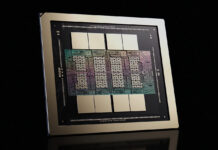
Now, it is time for the big show, the NVIDIA Blackwell Ultra or B300 GPU.
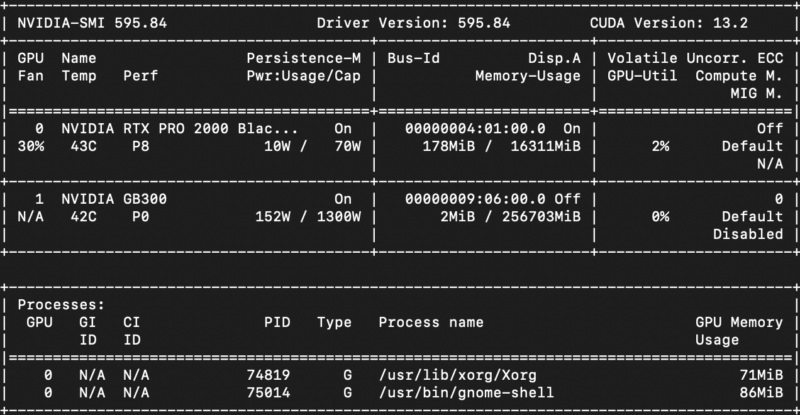
We generated a ton of data across different models. Originally, we planned to run a few big models, but that quickly led us down the rabbit hole of trying different draft models. In this review, we wanted to give you some sense of what that looks like. You may wonder why we are not running models on the RTX PRO 2000, but with only 16GB of memory, that card is more designed to drive display output. Even smaller models like Qwen3.8-27B at 4-bit quantization do not really fit in 16GB.
NVIDIA GB300 on Multiple Models
For this one, we took a decently optimized Qwen3.8 Flash Next model and compared it to the model folks were excited about a year ago, GPT-OSS-120B, and a test we were using roughly a year ago. This is for two reasons. First, it just gives a then-and-now comparison. Qwen3.8 Flash Next is just a bigger, better model. Perhaps the key is that if you invest in something like a Super AI Station, you want a system that will be useful for a longer period of time.
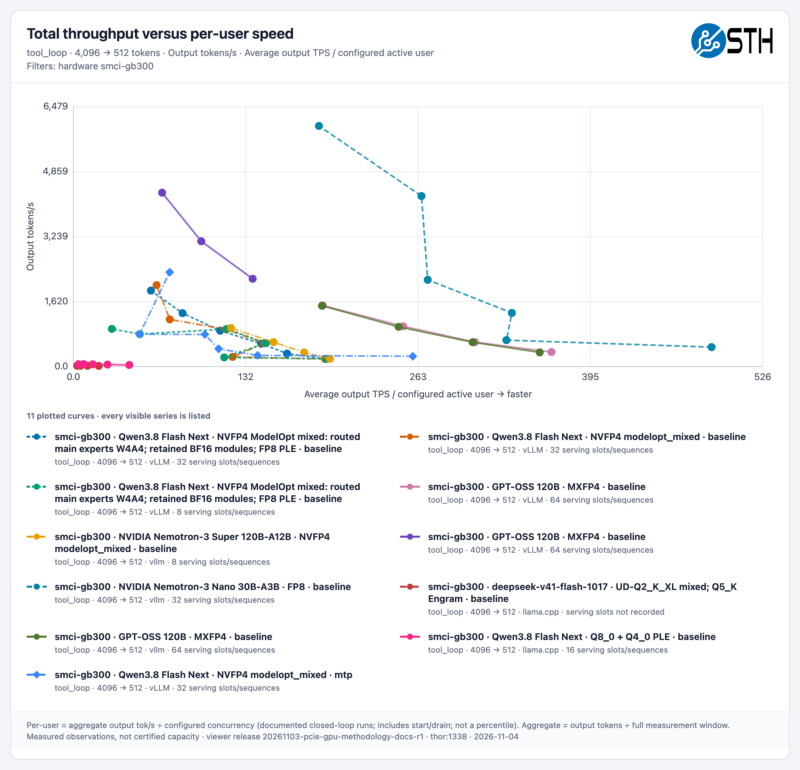
Here is a quick look at the TTFT figures compared with throughput.
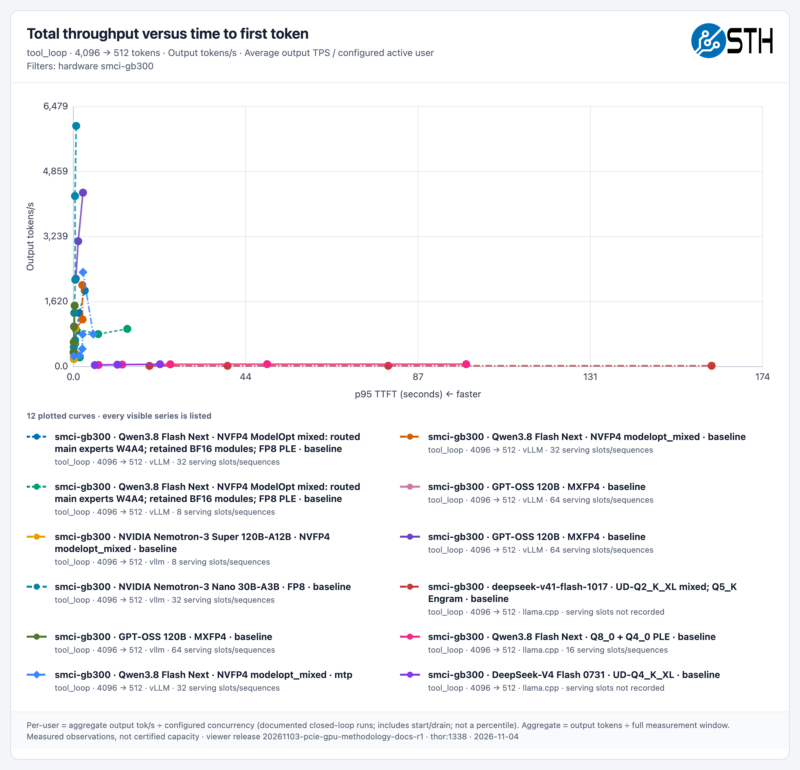
Instead of showing you Qwen3.6-35B-A3B again at 26,000 tokens-per-second on a short 24-30 input length, 1024 output length, we wanted to give you some other interesting data points.
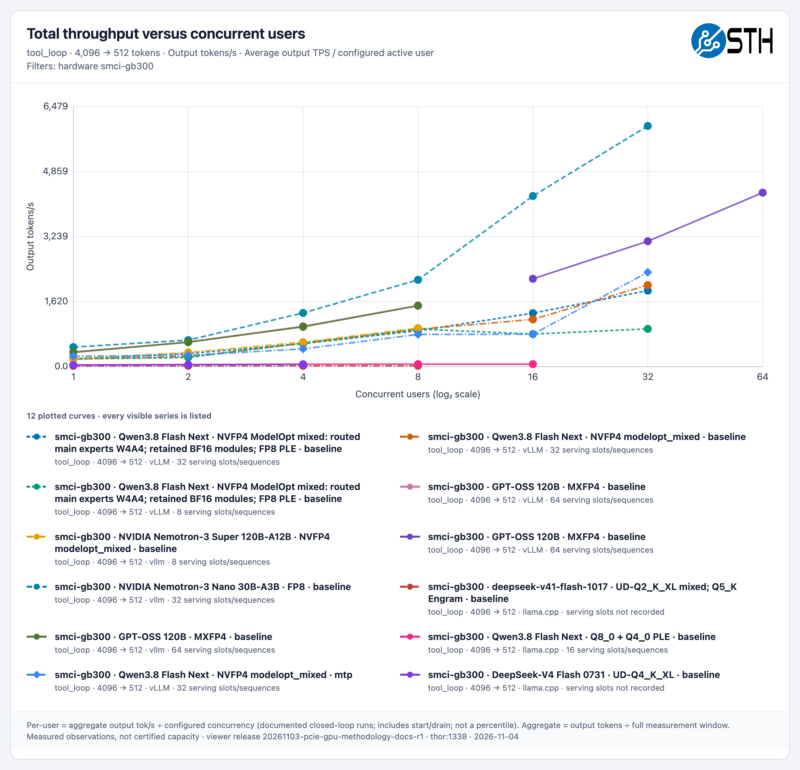
32 concurrency is a decent little agent swarm that can run on a system like this, and it performs well. Of course, MTP really helps results here.
NVIDIA GB300 Qwen3.8 Flash Next Performance
We wanted to test a newer/ larger model than we have in the past, so we are using Qwen3.8 Flash Next on this machine. This is a great model that does some excellent work.
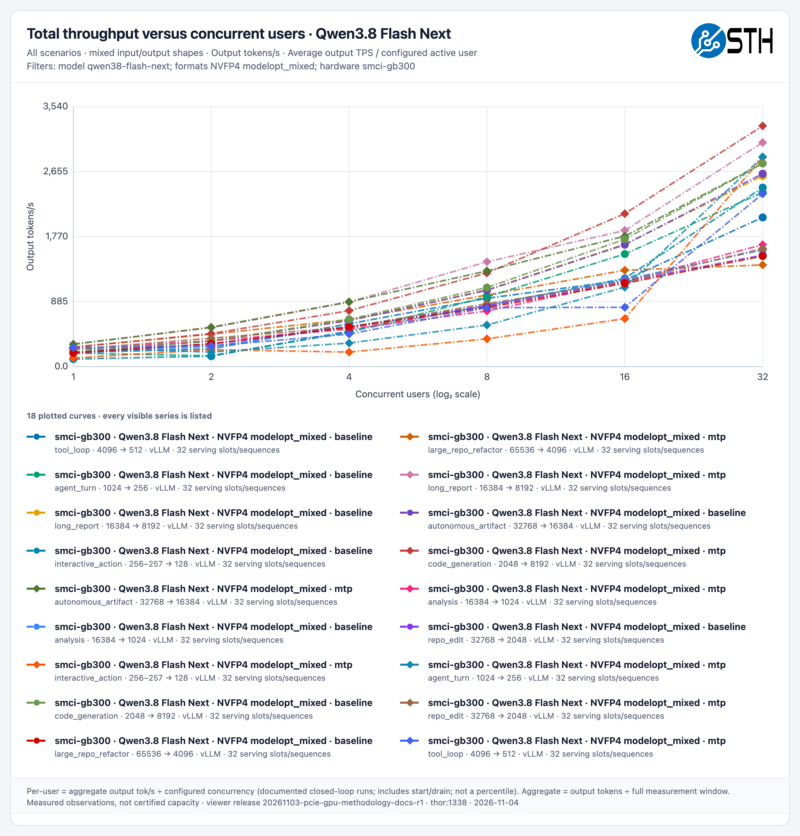
We did different tool call input/ output patterns with MTP and without MTP turned on, and then did a sweep of c=1 to c=32.
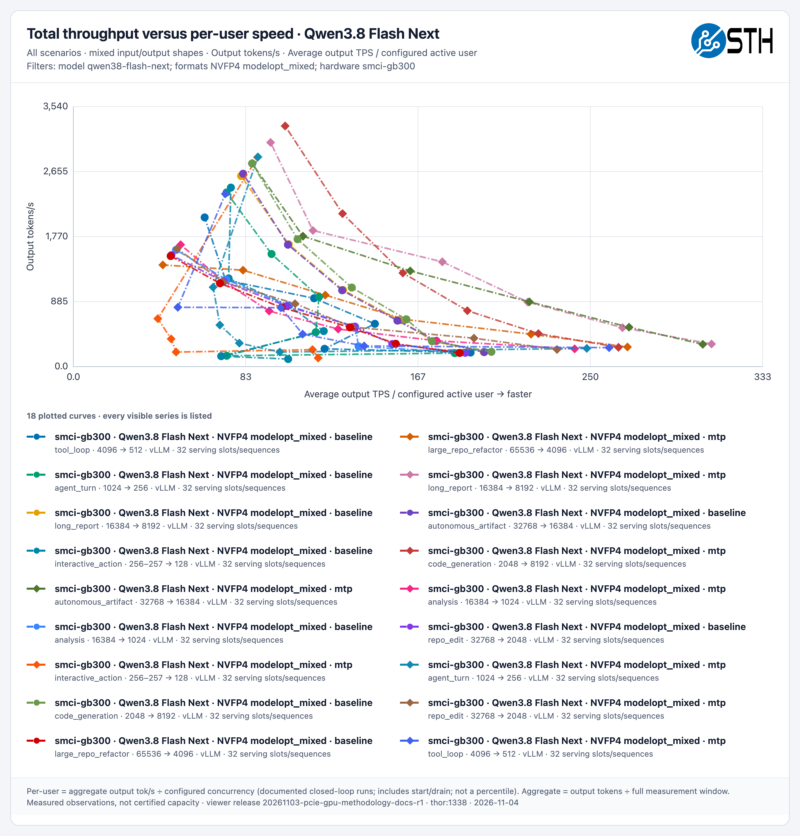
Several scenarios we tried exceeded 3000 Tokens/second at c=32, and the numbers were still rising.
Hopefully this gives you at least some sense of the performance of these systems. We have a few thousand data points now, and one of the fun areas is that usually by the time we have tested a new optimization for a model, there is a new model or technique to optimize an existing model.
Graphics Performance: SPECviewperf 15.0.1 Linux Edition
As our Super AI Station review sample also included a proper video card pre-installed, NVIDIA’s RTX PRO 2000 Blackwell, we are also able to run graphics benchmarks on the Super AI Station. This marks the first time we have been able to run graphics benchmarking on a DGX Station system at all. To be sure, NVIDIA and Supermicro are still primarily pitching these systems as server-like AI systems, but if you need a proper desktop and good visualization, the DGX Station can do that as well with the addition of a video card.
Since this is a workstation system, we will turn to the de facto standard for workstation graphics benchmarking: SPECviewperf. Version 15.0.1 was recently released for Linux and added support for Arm AArch64 processors for the very first time, landing at a great time for the release of DGX Station systems.
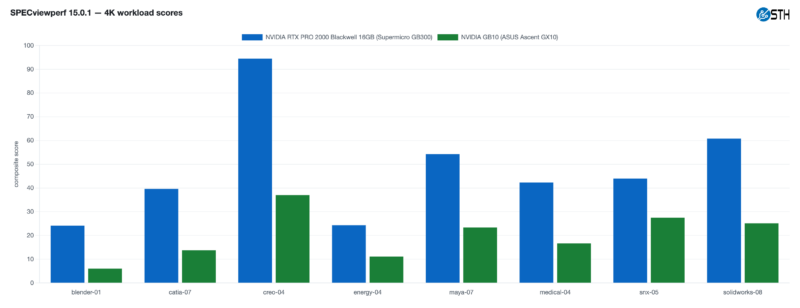
There are a million ways to slice the data, but let us start by answering a simple question: how much faster is a DGX Station system than a DGX Spark-alike (GB10) box? The integrated GPU in NVIDIA’s mini-PC workstations is powerful, but it is still just a fraction of the performance of their discrete video cards, even a mid-tier card like the RTX PRO 2000 Blackwell. Overall, at 4K resolution, the RTX PRO-equipped Super AI Station is anywhere from 1.75x to 4x faster than the GB10 system. A faster RTX PRO card, such as the 4000, would widen the gap even further.
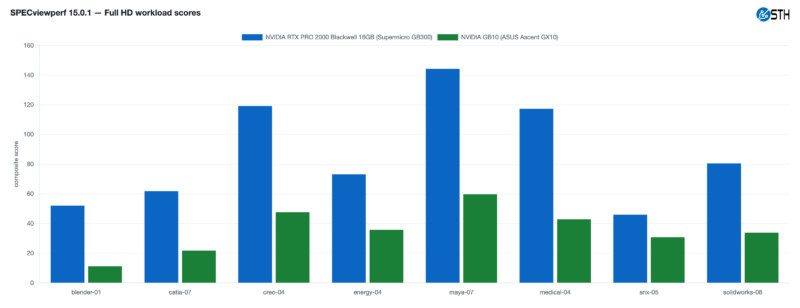
Meanwhile, even at just an HD/1080p resolution, the performance advantage is generally the same. Outside of the Siemens NX (SNX) workload, the Super AI Station is upwards of four times faster than the GB10 system. We would not expect anything less from a DGX Station system, but this shows the DGX Station can run circles around GB10 systems like the DGX Spark in any workstation task, whether CPU compute, AI, or graphics. That has folks working in areas like physical engineering design, medical, and creative spaces very excited about this platform. Also, remember, we tested this with the lower-end dGPU offering, and so there is a lot of room to scale in terms of display GPU performance.
At this point, you may be wondering about networking, so let us get to that next.