
Supermicro Super AI Station Grace Performance
Since we have recently done a couple of big deep dives into NVIDIA DGX Station performance, we wanted to share similar numbers so you can compare reviews. We will start with Grace, NVIDIA’s 72-core Arm Neoverse-V2 CPU. We will start with core-to-core latency.
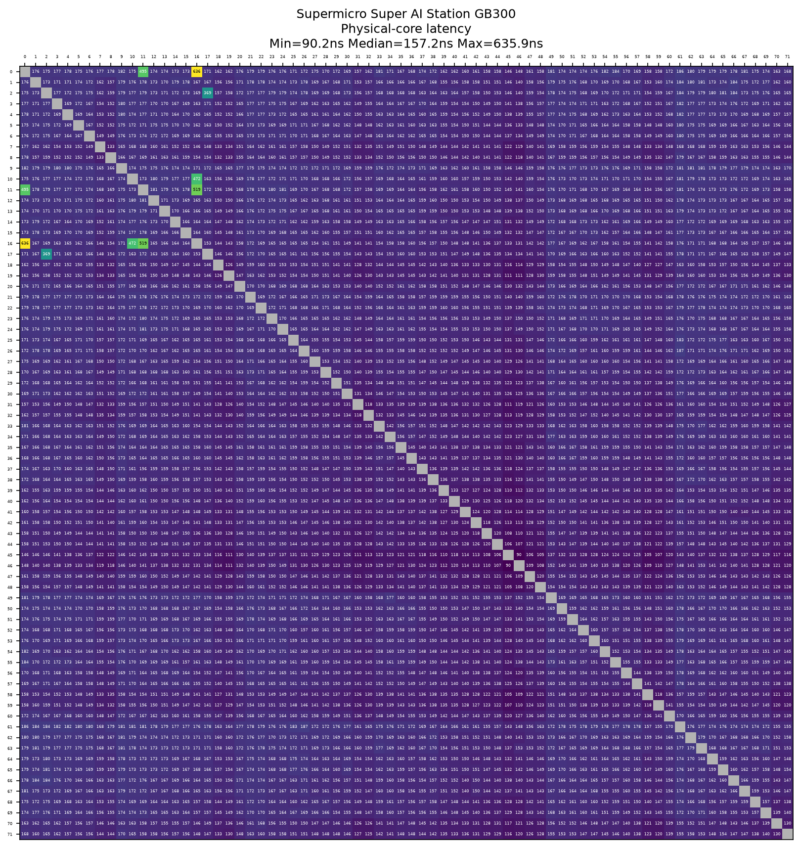
The Grace CPU is a monolithic die, so we get a fairly predictable pattern. These charts, even at 72 cores, are getting enormous. Now imagine dual 256-core parts, which we will see in 2026, so we will change the visualization. We already have other interesting ones, from Vera servers to new x86 CPUs, that we have not shown yet, but the topologies are getting very large.
One major difference between this system and the other systems we have tested is that we tested this one with a 70W GPU installed. That may not seem like a lot, but it means that in a 1.6kW power-capped system, some power needs to be reserved for the GPU.
Supermicro Super AI Station AgentSTH V7 Performance
NVIDIA’s flagship agentic AI CPU is soon to be the NVIDIA Vera, but for NVIDIA Grace we still get very good performance. Let us start with some of the per-core performance of workstation CPUs.
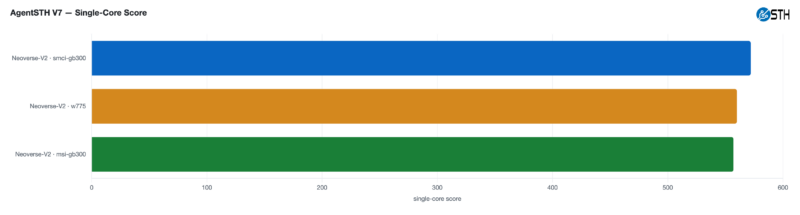
With three DGX Station systems now through our labs, we have developed an increasingly comprehensive collection of performance results. And at a high level? Things are extremely similar. The Supermicro system (in blue) gets the honor of topping our single-core AgentSTH chart with the best performance yet for a DGX Station system. With that said, the overall variance between DGX Station systems is less than 3%. The systems are effectively tied, which goes to show how much of a standardized experience NVIDIA is aiming for.
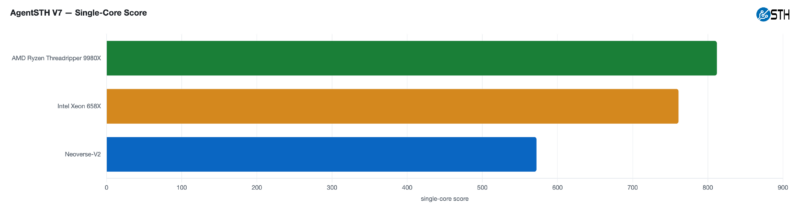
To learn something more interesting about the hardware, we instead turn to a comparison against AMD Threadripper and Intel Xeon CPUs. Compared to those parts, the weaker per-core performance of Grace and the Neoverse-V2 CPU core becomes more evident, delivering about 70% of the Threadripper 9980X’s performance. Grace is meant to work through a lot of threads; if you cannot fill it up, then it is a lot of silicon (and performance) that is left on the table.
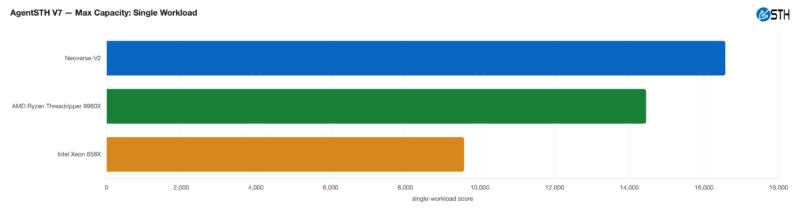
But if you can fill it up, then Grace shines. Compared to AMD’s 64-core and Intel’s 24-core parts, the 72-core Grace CPU has little trouble blowing past both of them in total throughput. SMT helps the x86 on a number of tasks (but not all), but not enough to make up for a 72-core design here.
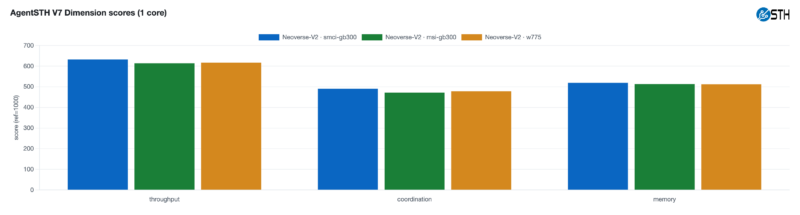
Meanwhile, here is a quick look at the dimensional performance of our three DGX Station systems. As with the overall score, everything here is very consistent and very close together.
72 cores is a lot, and more than most agentic AI workloads will use. Usually, larger AI shops tell us they target 2-4 cores for AI agents, so the Grace CPU’s architecture scales very well. Here is what that typical 2-4 core range looks like, but expanded to the full range of 1 to 72 cores to see how well each chip scales out to its limits.
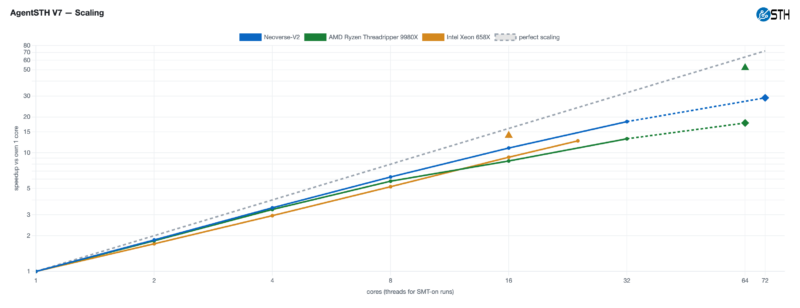
What you can see here is that the NVIDIA Grace Neoverse V2 cores are out-scaling the AMD and Intel chips in this test. That is part of the design, since we do not have chiplets like on the Threadripper (you can see the boundary get crossed in the data), and there is no SMT.
Some will notice this is a minor shift in this chart, since we added full core-count scaling to each dataset.
Supermicro Super AI Station Estimated SPEC CPU2026 -O3 Performance
Since these designs have been on the market for some time, you can look up many standard benchmarks that are highly optimized. Vendors are very good at optimizing compiler flags and systems for the official SPEC CPU runs. At the same time, we wanted to offer a different view by targeting a lower optimization level using an -O3 flag instead. Our goal is to create something different from the official results by removing many common optimizations. Starting with the SPEC CPU 2026 integer rate base estimated result, here is what we saw:
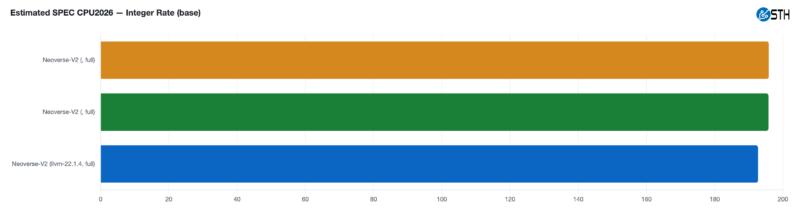
Given what we saw comparing DGX Station systems with AgentSTH, we will not dwell on comparing them too much with SPEC CPU2026. All three systems are within a hair of each other in the Integer Rate workload, though the Supermicro system does slot in last in this specific benchmark suite, but these are all very similar.
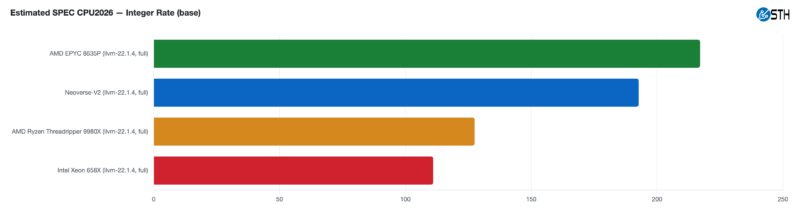
But if we look at a wider field of processors, the Super AI Station and its Grace processor stack up pretty well, thanks in large part to this workload scaling so well with the number of CPU cores. The only chip it loses to here is AMD’s 84-core EPYC 8635P, which we have included to get something a bit closer to the spirit of what the NVIDIA Grace CPU was designed for.
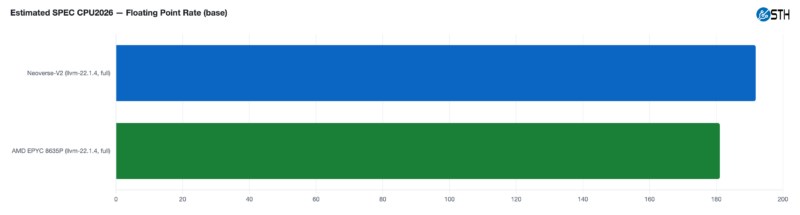
Stripping things down to just our top chips, NVIDIA does well, really well, here, partly due to the memory hierarchy. That is part of the reason we picked this comparison point, since this is one where AMD’s Zen 5 cores and the Arm Neoverse-V2 CPU trade places in the integer and floating-point tests.
On that note, let us get to the GPU.