

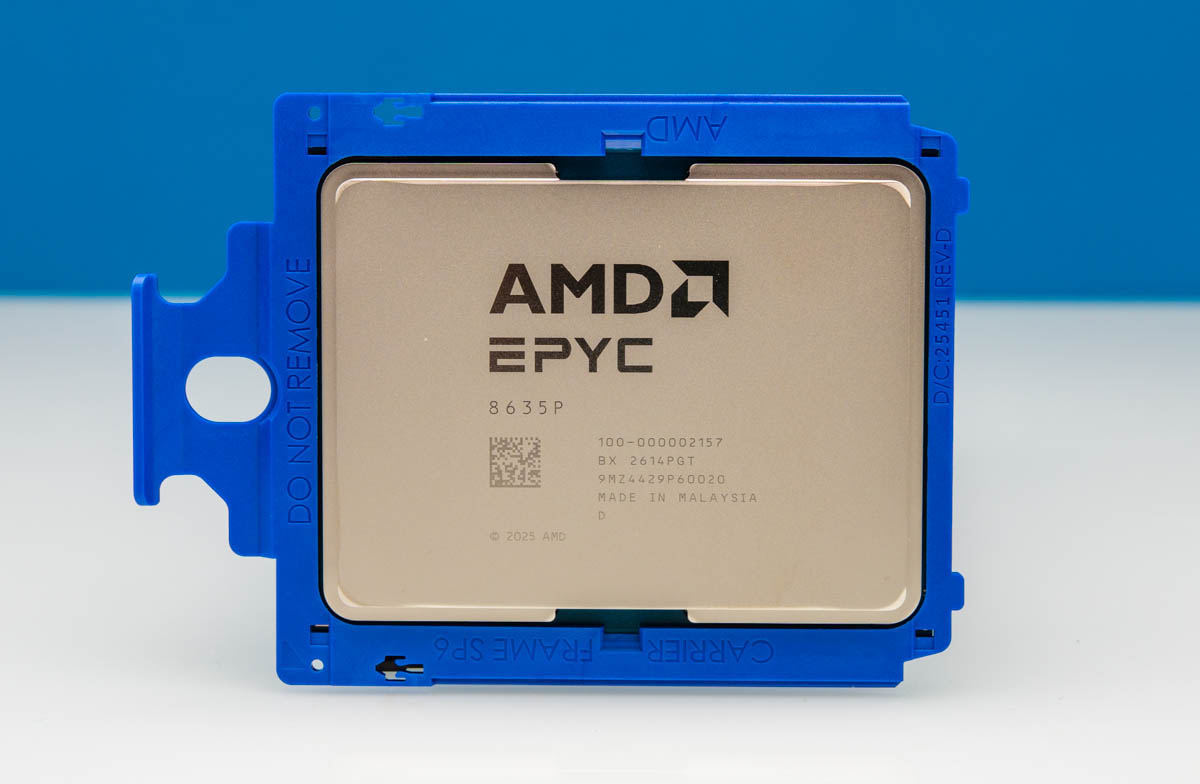
Today, we are finally getting into what might be the biggest upheaval of a server product line, or a server socket, since the AMD EPYC 7002 “Rome” launch. The AMD EPYC 8005 “Sorano” uses the same AMD SP6 socket as the EPYC 8004 “Siena,” but it completely changes the performance profile within the socket. As a fun one, we are also showing our AgentSTH V7 benchmarks to give a sense of overall performance, along with several other tools.
Let us get to what AMD did to change the line. Then take a look at the performance impacts from those changes. We did not purchase the SP6 platforms. AMD sent us the CPUs. We need to say this piece is sponsored.
AMD EPYC 8005 “Sorano” Overview
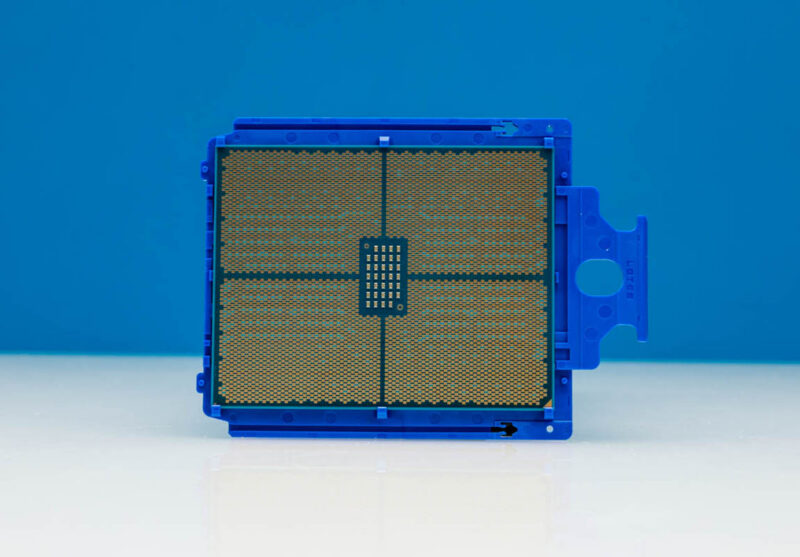
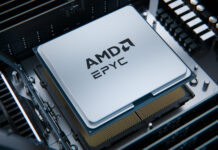
The AMD EPYC 8005 “Sorano” comes in AMD’s mid-sized CPU package. It is a SP6 package roughly the size of current Threadripper processors and older AMD CPUs, such as the EPYC 7000 series and the EPYC 8004 series.
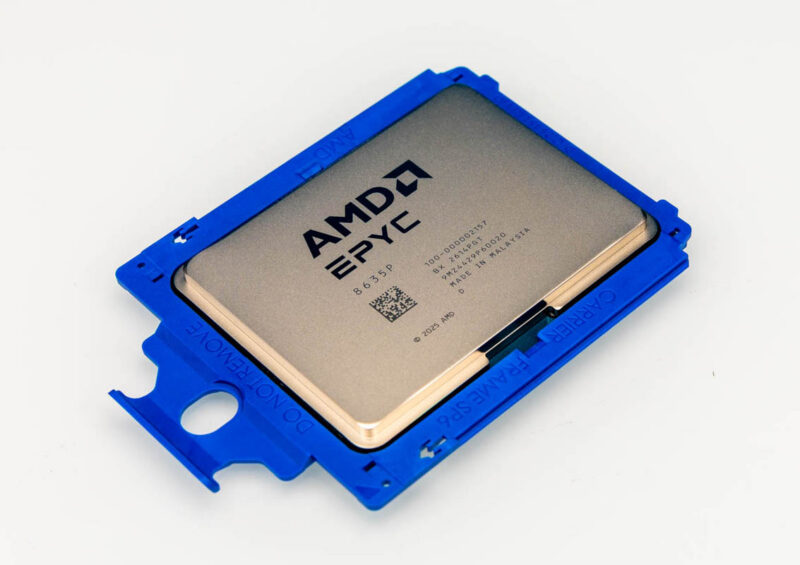
Now, we get up to 84 cores in that same package size, but we get plenty of I/O as well.
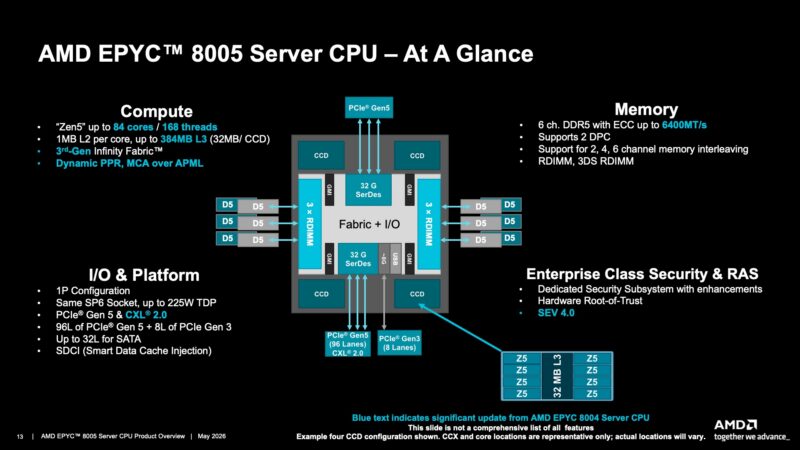
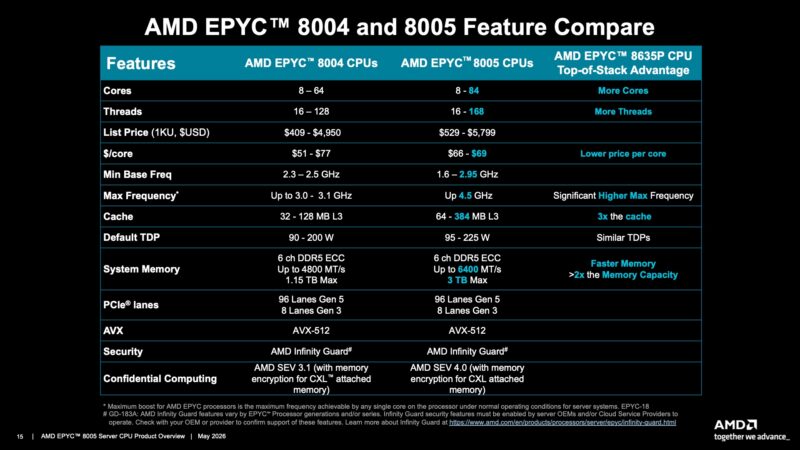
The new EPYC 8005 series is slated as a drop-in replacement (with BIOS update if the platform supports it) to the EPYC 8004 “Siena” series. Here is the quick overview slide for the series that says it goes up to 84 cores/ 168 threads and 384MB of L3 cache. Memory is now up to DDR5-6400, and we get CXL 2.0.
Doing a direct comparison between the EPYC 8004 series, there are a few other items that stick out. For example, the default TDP range increases by 25W to 225W (12.5%), but we also see max frequencies that are much higher. While folks may fixate on the 25W higher TDP, at a system level, it ends up being closer to 30-34W higher power consumption at 100% utilization, which is under 10%. You are getting more cores, a newer core architecture, faster memory, and, at the system level, a real delta of under 10% in power.
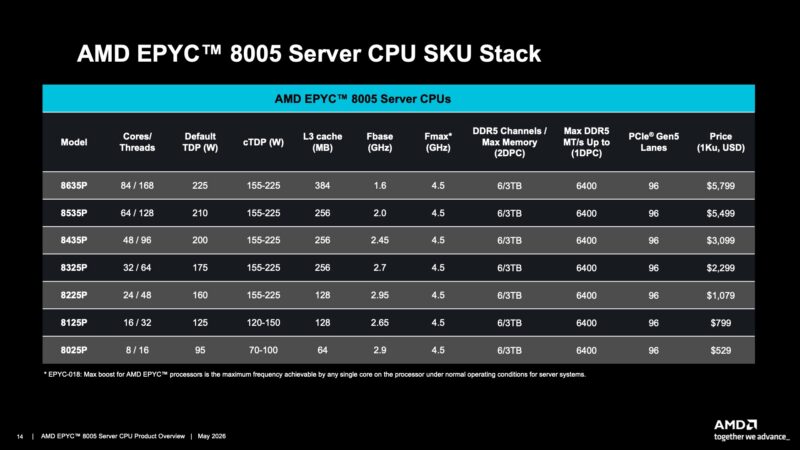
In terms of the SKU stack, the new series ranges from 8 to 84 cores. Something really interesting is that the 84-core SKU is only slightly more expensive than the 64-core SKU. Perhaps most interestingly, it now goes from $529 to $5799. The increase in the top-end price also comes with more cores, so AMD is focusing more on the $/core metric.
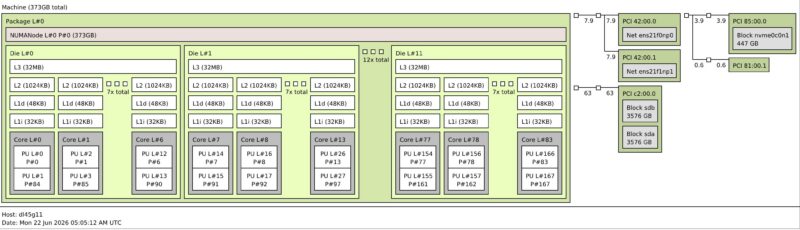
Perhaps the big change is not just a few more cores here and there. Instead, the AMD EPYC 8005 series uses Zen 5 cores, whereas the EPYC 8004 uses Zen 4c cores. That means we get much larger L3 caches, in addition to the standard Zen 4-to-Zen 5 core updates.
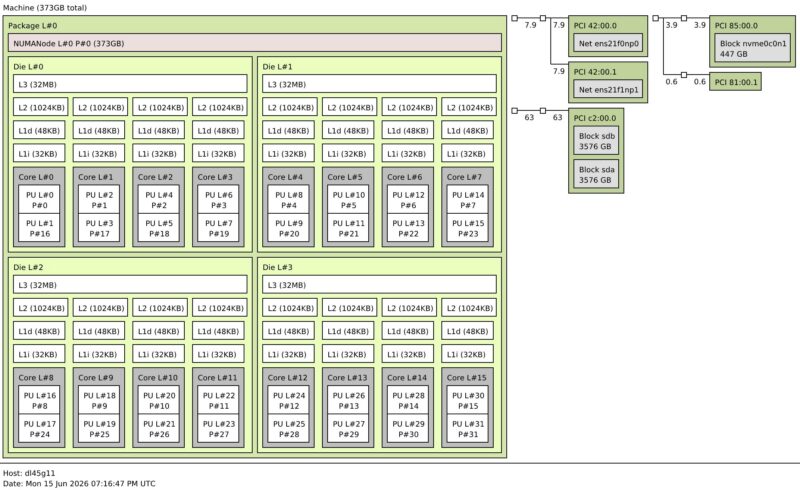
To me, this is one of those technical changes that will also border on the psychological. Now the EPYC 8005 series is using the same full cache Zen 5 cores that the EPYC 4005 series is using, as well as the EPYC 9005 “Turin” series (save the Turin Dense parts). In the previous generation, there was a difference between the EPYC 8004 and Zen 4c. Now, that gap has closed. AMD may have done this simply at the request of its customers in certain segments, but it feels like a big change offering multiple parts and sockets with the same core architecture.
What does that even mean? What does any of this mean? In terms of performance, it can be a lot, and so we got the chips into systems and wanted to find out. Let us get to that next.

I like AgentSTH, but I’d like to see more details. Also, I’d like to see colors consistent. Great data. Also, thanks for covering not just the high-end but also the lower-end part that is $799. That’s a very reasonable cost
How hard is it to type the sku? How many times 8005 Series…. and no SKU for what the review is about. WTF?
The article states “AMD EPYC 8635P shows 0.88ns L1 latency and 7.2ns deep-memory latency”.
The latter figure is complete nonsense, and honestly you really should have caught that. What must have happened is you didn’t reconfigure the benchmark to account for the massive L3 cache. So that 7.2ns is reflecting L3 cache performance, not RAM. True deep-memory latency will be somewhere between 75 and 90 ns, assuming optimal in-spec RAM configuration.
It would be nice if you could update the article with the actual figure.
“The single-core performance uplift is borderline crazy.” Not at all, if you’re idling all but one core, you can run that core at max. And since the 8xx4 are Zen 4c cores, their max performance is far below the Zen 5 not-c cores, simply because of the clocks.
What’s really interesting here is that AMD didn’t go with 5c cores for these chips.
A higher TDP and unlocked version of this would probably make a more affordable and interesting base Threadripper platform than the current non-pro Threadripper platform.
It kinda shows platform transformation. Siena is a platform originally meant for telco – no turbo, no overallocation, low latency.
Sorano looks much different, more general purpose and kinda sets a tone for Verano that is meant to come next year.
Up to this point AMD did not really have a proposition for the segment of the small enterprise servers – machines in 16-32 core range. Genoa and Turin with their 12 memory channels are bit expensive, especially with the current memory prices. With Venice it will be even more visible. Hence the need to transform the platform.
@Patrick – It’s good you removed the incorrect text from the article but it still has bad data in the chart and table right above the text.
Man, the evolution of this SP6 socket is exactly what my rack needed. Sorano seems like a massive leap for power efficiency at the edge. I run many lightweight backend services and web endpoints from my home lab, mostly handling database saves for a few viral Games I recently developed. Keeping power draw low while maintaining high core counts is my biggest bottleneck right now. This EPYC 8005 lineup looks like the absolute perfect server upgrade. Great read today!
I think this is the best platform. I wish they were going Zen 6 (even with PCIe 5 would be enough)…