

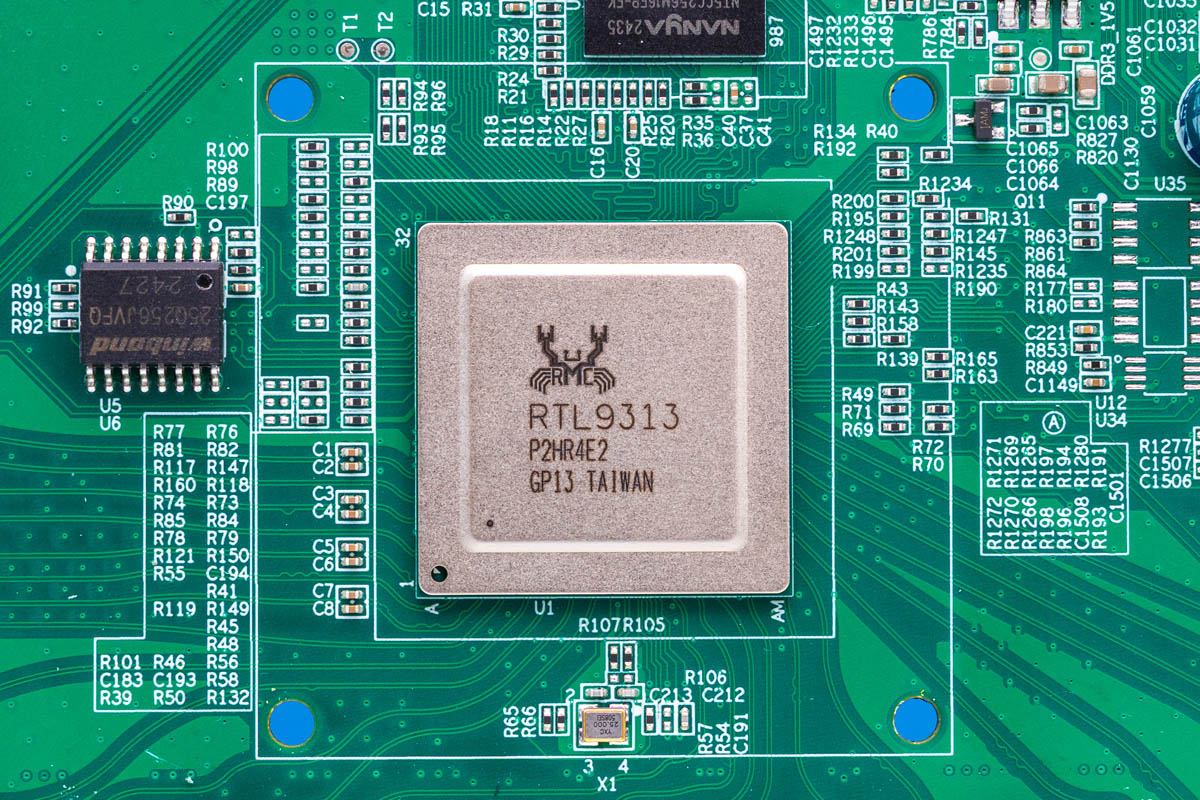
Over the past few weeks at STH, you might have noticed that we are ramping up our 10GbE coverage. There is a good reason for that. 10GbE has become so inexpensive and so easy to integrate that we are set to see a tipping point in the industry. We ended up putting together a quick video on the topic that you can find here:
The video touches a number of products we have already looked at on the STH main site, and some that we have yet to publish. I wanted to go over a few of the key points for our readers as well.
10GbE in 2026: The Controllers
A huge change in 2026 is that the market for 10Gbase-T controllers is heating up. 10Gbase-T is more challenging because the links tend to be noisier and thus more processing is required to get the signal. There have been 10Gbase-T NICs for generations, but two new contenders are set to shake things up.
Realtek RTL8127: A New Low-Cost Contender
First, we featured the Realtek RTL8127. This is Realtek’s new 10Gbase-T NIC that we have been told is somewhere just north of $10 per controller. Realtek is not doing the sub $1 NICs like it had in the 1GbE era, and is charging for the additional capacity. We have been told by folks that these may cost a bit more than the AQC113C’s, but nowhere near as much as the Intel E610.
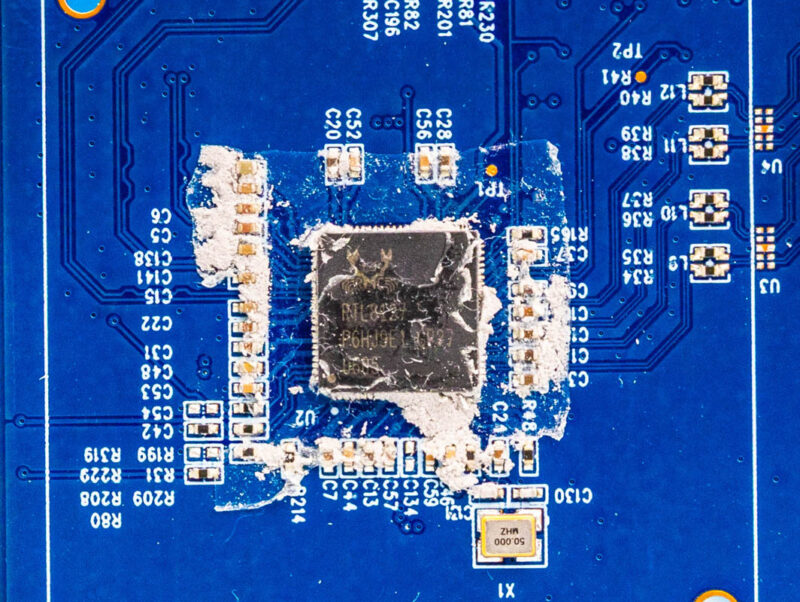
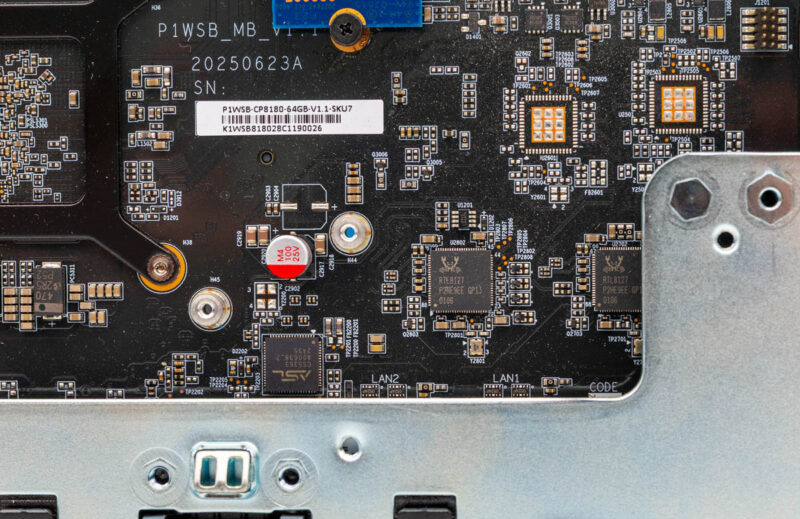
An advantage of the RTL8127 is that it can utilize a PCIe Gen4 x1 link to the CPU or chipset. That means it efficiently uses lanes and is easy to integrate into even low-cost platforms, like the Minisforum MS-R1. Instead of using a Gen4 x1 link to a RTL8125 for 2.5GbE or RTL8126 for 5GbE, that same link can be utilized for a few dollars more per NIC chip to deliver 10GbE.
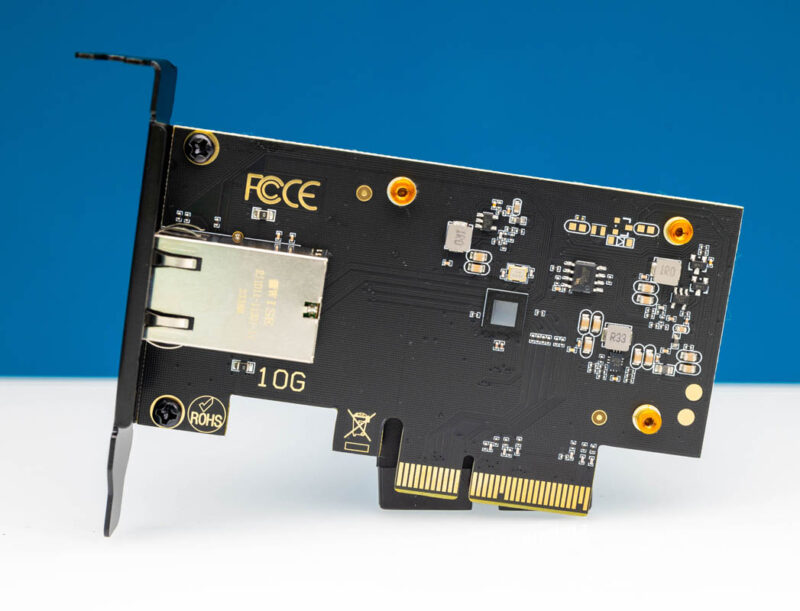
This is enabling sub-$50 10Gbase-T adapters (Amazon Affiliate) that fit into PCIe Gen4 x1 slots and we are already seeing prices substantially lower in places like China where the cost of moving cards through the supply chain is lower.
Marvell AQC113/ AQC113C: The Longtime Favorite
Marvell purchased Aquantia years ago, and one of Aquantia’s big product lines was its line of low-cost integrated PHY 10Gbase-T adapters. Like the others we are focusing on, these adapters also do 2.5GbE and 5GbE speeds, but the big draw is the ability to cheaply add 10Gbase-T networking. Here is an example of the QFly 10Gbase-T Marvell AQC113 Adapter we reviewed almost two years ago.
Marvell’s Aquantia-lineage product line has been a go-to solution for companies like Lenovo, Apple, and others to add 10Gbase-T networking to their devices for generations.
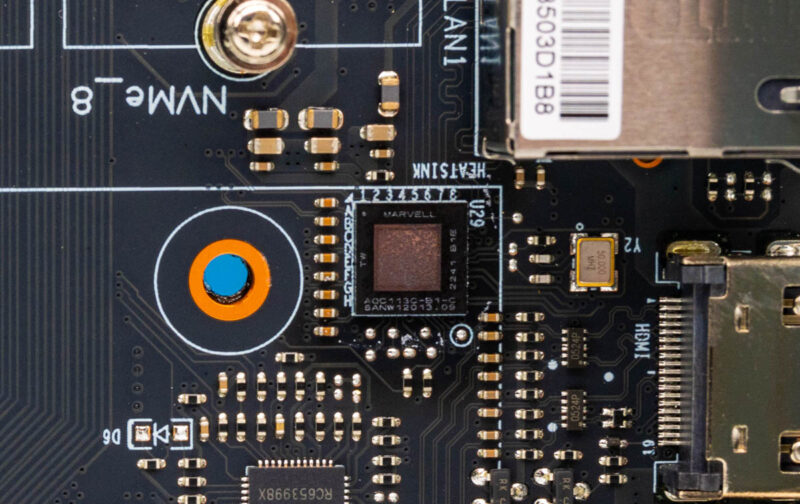
We have even seen them in low-cost NAS devices like the TerraMaster F8-SSD Plus NAS to add low-cost 10GbE connectivity.
Intel E610: The New Server Adapter
On the Intel front, the big new one is the Intel E610 launched in 2025. Those NICs are starting to make it to the market.
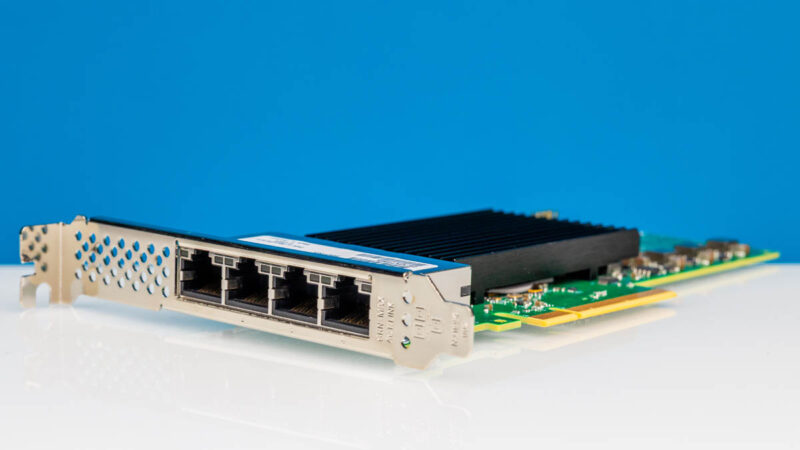
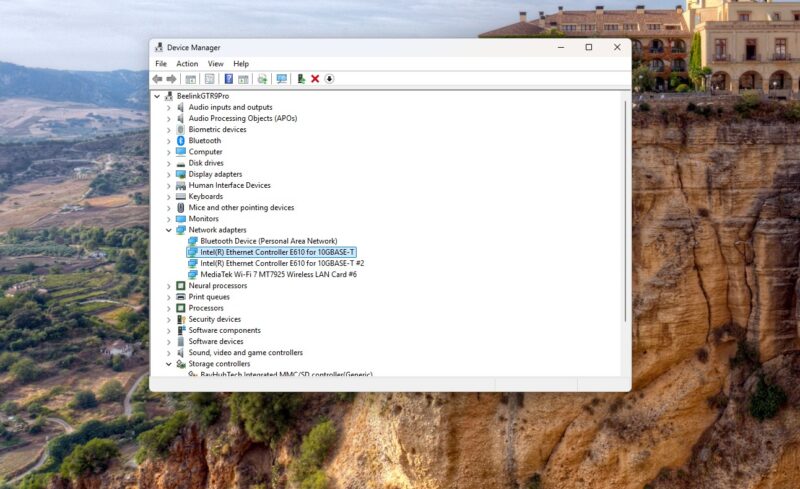
One bit of feedback that we have seen, such as with the Beelink GTR9 Pro is that there have been challenges. Another mini PC vendor actually told us at CES 2026 that they had a design with the E610, but the cost and early bugs led them to switch to Realtek in a system they were showing us.
My sense is that over time, this will become a go-to server adapter since it sips power and is easier to cool. At the same time, we have heard that, since these are server products, the per-port cost can be more than 2x that of the Realtek and Marvell solutions.
Intel X710-T4L: Keep an Eye on This Adapter
Intel has its X500 series of 10GbE adapters, but the newer X700 series arrived for an era of 40GbE/ 10GbE networking. There is one adapter series that many miss, and that is the Intel X710-T4L (4-port) and the X710-T2L (2-port.) We reviewed these adapters 4-5 years ago, as you can see by the early Austin, TX photography, but they offer a newer feature set, and importantly, the ability to run Nbase-T speeds of 2.5GbE and 5GbE.
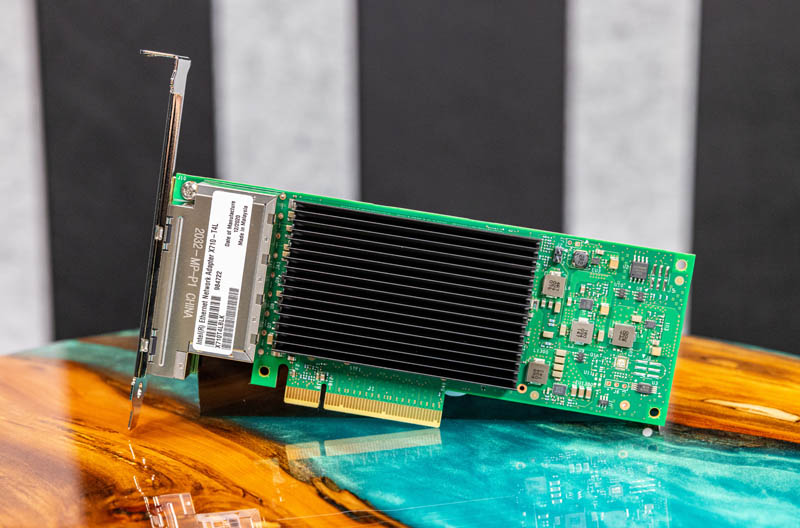
This can be confusing for folks since there are cards like the Intel X710-T4 (note without an “L”) do not support those 2.5GbE and 5GbE speeds. The Intel E610 will likely be the go-to going forward, but if you want the no/low hassle cards that support multi-gig speeds, then the X710 L/ refresh series is the way to go.
NICs are great, but we also should chat about what is happening with the switches.


there is enough interest
nice summary to start the year!
I have been a frequent visitor at STH web site for a number of years and I enjoy your work.
Recently there has been a large focus on AI and the very advanced and pricey servers and their different components. However out of the question for a SOHO/Homelab, the techology is very interesting.
I myself, use mostly Supermicro servers and different network switches (A Netgear M4300 10G 48-port and a MikroTik CRS518-16XS-2XQ 25G 16-port).
I recently purchased a new 10G switch for my desktop. The QNAP QSW-L3208-2C6T 10G 6/8-ports. I got the switch from QNAP’s EU store for €451,00 which is somewhat pricey for a homelab switch, but I think it’s worth the money. (https://eustore.qnap.com/qsw-l3208-2c6t.html).
Ports:
6 ports are 10GbE BASE-T (RJ45) supporting 10G/5G/2.5G/1G/100M.
2 ports are 10GbE SFP+/RJ45 Combo Ports supporting 10G/5G/2.5G/1G/100M.
Management: It uses lite-management for Layer2/3. You can use the nice web GUI for management or the RJ45 console port on the backside for management with CLI.
Noise: It has one fan for cooling but it’s barely noticable in my office.
I noticed that you had a picture in this review on page 2 of the QNAP QSW-L3208-2C6T switch. Have you considered doing a review of this switch in the near future ?
The big challenge for people new to 10G, a lot of the time, is that the cabling isn’t really right. A short cat 5e cable that worked for 1G might work for 10 also, but longer runs that were perfectly good with 1G (or 2.5G) will not work for 10 at all, or not reliably.
For people still fairly new to 10G copper networking, an explanation of the different cable types (categories) and a practical guide to what you can likely get away with, even if out of spec, would probably be very helpful. Explain DACs while you’re at it, and maybe even talk about the cheapest ways to go fiber (or PoF? – if that’s even a thing outside of cars these days).
Yes, yes, we would like a deeper dive into the testing setup, maybe a video.
I don’t really care about the testing, but I’m seeing a Cisco switch. I’m also seeing that QNAP QSW-L3208-2C6T that Robert Linden is talking about in the testing section
There’s also a RTL8127-based card out there which provides an SFP+ Port rather than RJ45. I got one on order, but according to some Chinese reviews, that one apparently achieves even lower power (some report < 1W with a DAC) than the RJ45 variant.
There's also a single M.2 variant available (although from Germany and relatively pricy at 110€), which is great for TinyMiniMicro machines with multiple M.2 slots, given that many older machines are 1G only.
I’m thrilled to see how it’s finally becoming mainstream. How do you think this will impact network infrastructure for small businesses?
@Robert Linden That Qnap switch is interesting, it’s on my radar for my home but at least on my market it’s about the same price than the Ubiqiti Pro XG 8 PoE that at least on the surface offers similar specs with POE as a bonus.
I’d be curious to be the two compared.
Looking forward to 12-16 port MultiGbE capable 10GbE unmanaged/lightly managed switch reviews.
I’m looking to replace the core switch of my home network with something that will allow easily upgrading endpoints as needed. Currently my whole network is on an unmanaged trendnet 16-port 2.5GbE switch. Which was a great upgrade from 1GbE.
But I’d like the options for 5GbE and 10GbE as the endpoints get upgraded.
The one thing I was hoping to see from CES 2026 would have been some 25GbaseT news. I would not expect these adapters to be cheap or lower power, it would provide a bandwidth increase in many situations using existing cabling (presuming the existing cabling is high spec).
I’m very curious to know how much of the 10Gb the management port utilise!
I was curious. You had spoken about the pcie 4 x1 with a single port being a good thing (Which it is) but if my math is correct a gen4 x1 can do up to 4GB which means could we see gen4 x1 with at least 2 10gig ports on them? Is this what is happening in the Minisforum in the picture or am I mistaken.
I’ve got a bunch of the new Realtek USB 3.2 10GbE, that I’m now using as my main NICs on a Proxmox+CEPH cluster… , even on standard USB 3 ports, I’m getting 8Gbps, and they remain relatively cool. But the killer part is the price, I paid £36 for the first couple, which makes them a fame changer! (Though i have seen some shops trying to sell them for 2x that, give it a couple of months.. these will flood the market and scalpers will get blitz out!)
Honestly I’m so bottlenecked by 10g right now, I’m hitting line rate pulling 85gb AI models across network, big torrents etc, I need 100gb to even attempt nvmeof, but 400/800gb would be preferable. I can saturate 10gb link just with samba and nfs without RDMA, it really is horrible bottleneck for 2026. Problem is all these 100gb + cards need a x16, so unless you rocking a threadripper on your windows PC, you are going to have a horrible time with a GPU and nic.
@Kelv1n, Care to share a link to those £36? The cheapest Realtek RTL8159-based ones I can find on Aliexpress right now are €62 (£54).
10Gbps is old news, I’m on 100Gbps for my home setup.
At the (small to midsize) organization I work for, we use the Cisco Catalyst C1300 series a lot for edge & campus (and the predecessors CBS350 or SG350X). I’m interested in a review and test about that line-up of Cisco SMB devices.
Also interested if anyone has reviewed or has experience with (bad or good) 10/25G PicOS switches from FS. Two of the collapsed-core 25G switches with PicOS are getting installed next month for our new 3 node PVE cluster.
“25GbE is better for PCIe lane usage, but it is not as good for the biggest driver for 10Gbase-T: Existing wiring.”
This is true, but if there is fiber or cat5, so you have to replace it, then installing fiber is just as easy as new cat6. Many who rewire&new build put in fiber for the main arteries. Is there a difference between 10g and 25g fiber?
SFP+ and SFP28 are like 10 base-T as its mostly backwards compatible.
As Wendel from Level1 says, the 25g gear is almost as cheap as the 10g. I wanted a x710-da2, for my home server, and router, but the E810XXV-DA2 came in cheaper. I live in a condo, and have used DACs for SFP+. Those are also the same. So for many its an easy upgrade, and a 1/10/25g port will talk to your 10 SFP+ uplinks.
I will be looking forwardt too
So while its not easy for datacenters, its easy for SOHO use, and low power, as more light is not much energy demanding.
The Mikrotik CRS 309 with 8 ports SFP+ was tested in 2019 for 250€. Which is what it still cost. While 10g will increase this year, we should also see the first simple 8-port 10/25g fiber switches in a not-so-distant future.
If I had to use more W7 APs and IPcams, then a 8-12 port 1g PoE, 4-6 2.5g PoE and 4-5 10 or even 25g SFP28s switch could be interesting, as then it can replace more smaller switches.
Looking forward to it all.
Could also be when there is time, STH should do an article on 25g SFP28 in general later this spring.
If we can get a 8 port 10g SFP+/BaseT now for 130€-150€ we should also see an 8 port 25gb SFP28 for something 350-400€.
Kind of annoying how we’ve been clamouring for decent cheap 10G stuff for years, yet they only realise and start bringing out affordable 10G stuff just as we’re all planning our migrations off 10G (if we haven’t already) and over to 25G and beyond.