
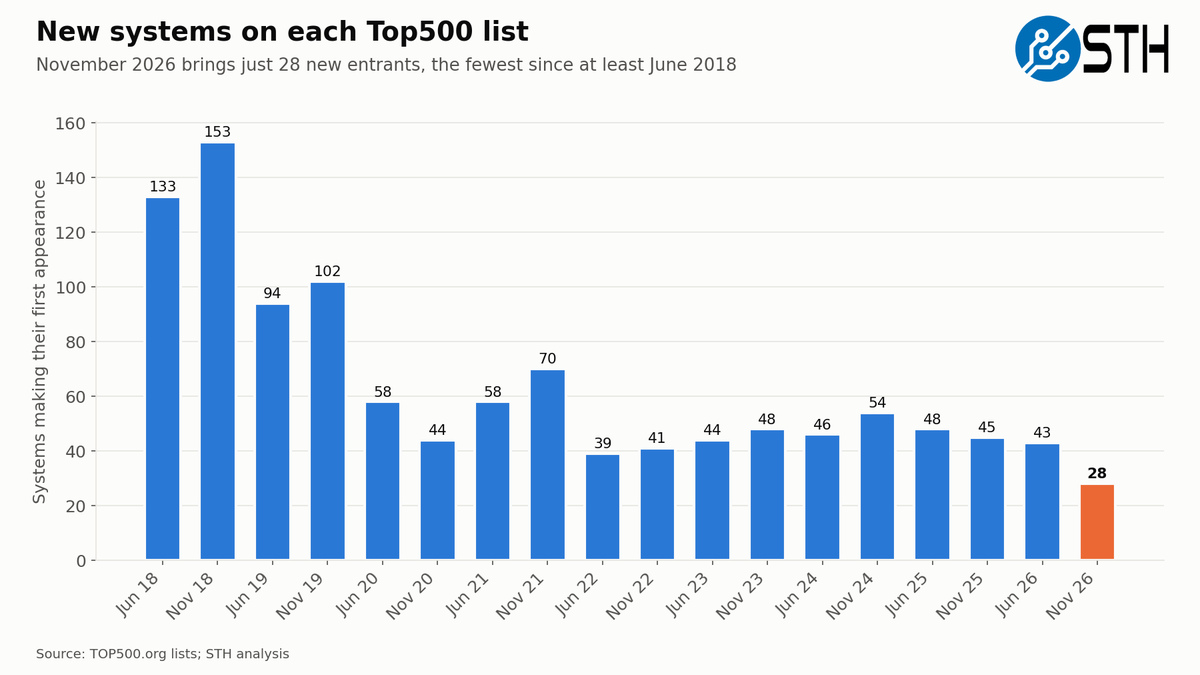
The November 2026 TOP500 list has only 28 new systems, the lowest count in our tracking series going back to June 2018. This dramatic slowdown from previous editions marks a significant shift in how often the list turns over with fresh hardware.
New System Counts Hit a Series Low
Just as a quick note, the official Top500 post says there were 27 new systems, but when we filtered the list on First Appearance 68 (with 68 being the November 2026 list), we got 28 new systems. We will use these new systems for our analysis. The 28 new systems on this November 2026 list mark the lowest count in our series since June 2018, dropping from 43 in June 2026. The previous low was 39 in June 2022, and while November 2024 rebounded to 54, this edition represents a clear step down.
The June 2018 list had 133 new systems, and November 2018 had 153. Those days of roughly a quarter or more of the list turning over with each publication are long gone. Today’s 28 newcomers represent 5.6% of the full Top500.
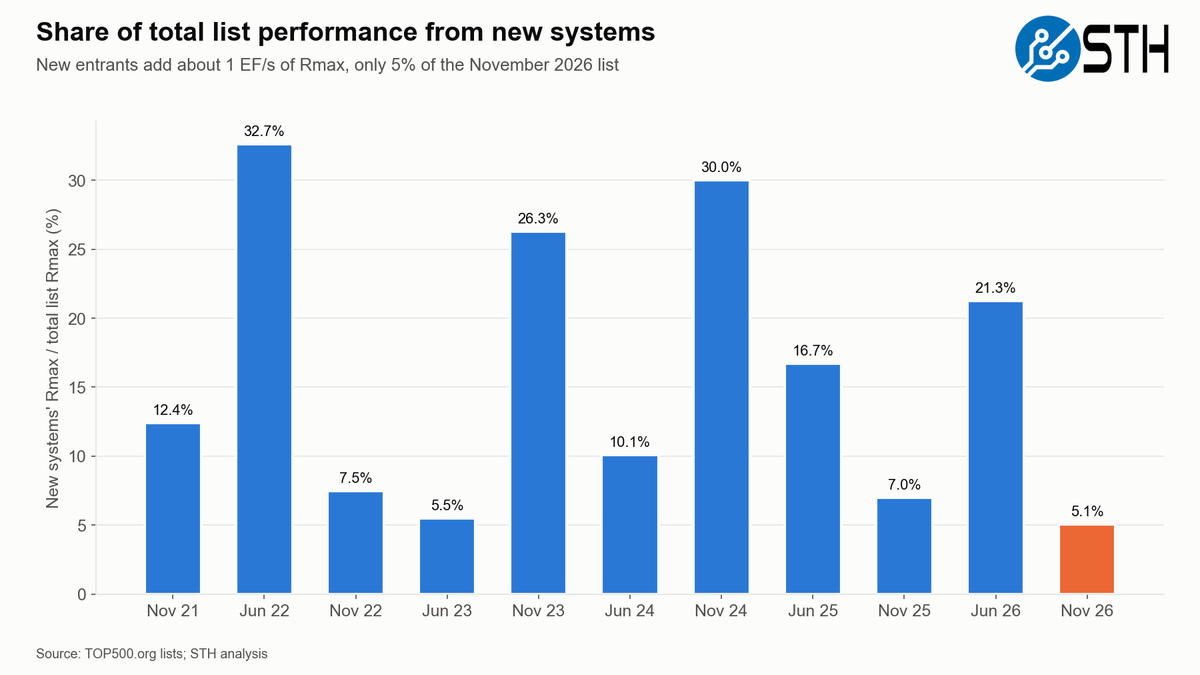
The 28 new systems together contribute about 1.0 EF/s of Rmax, or roughly 5.1% of the list’s total performance. That is the lowest share since at least November 2021, when new systems contributed over 12%. The prior low was 5.48% in June 2023, so this continues a pattern in which even the systems that do get submitted add little aggregate HPL capability. Part of that is because LineShine was added to the list in June 2026, so a recent new #1 tends to SKU the aggregate addition numbers.
Only five new systems made the Top 100. The highest-ranked newcomer is KISTI’s HANGANG at #12, an HPE Cray EX254n system using NVIDIA Grace CPUs and GH200 Superchips with HPE’s Slingshot 400 interconnect. No new systems made the Top 10. LineShine remains at #1, holding its position from the June 2026 list where it debuted with 2.198 EF/s of HPL performance using custom Arm-based LX2 processors.
With so few new systems and modest newcomer performance, total list Rmax grew from roughly 18.7 EF/s in June 2026 to approximately 19.7 EF/s now. That compares with nearly 25% growth on the previous list, which was driven largely by LineShine’s debut.
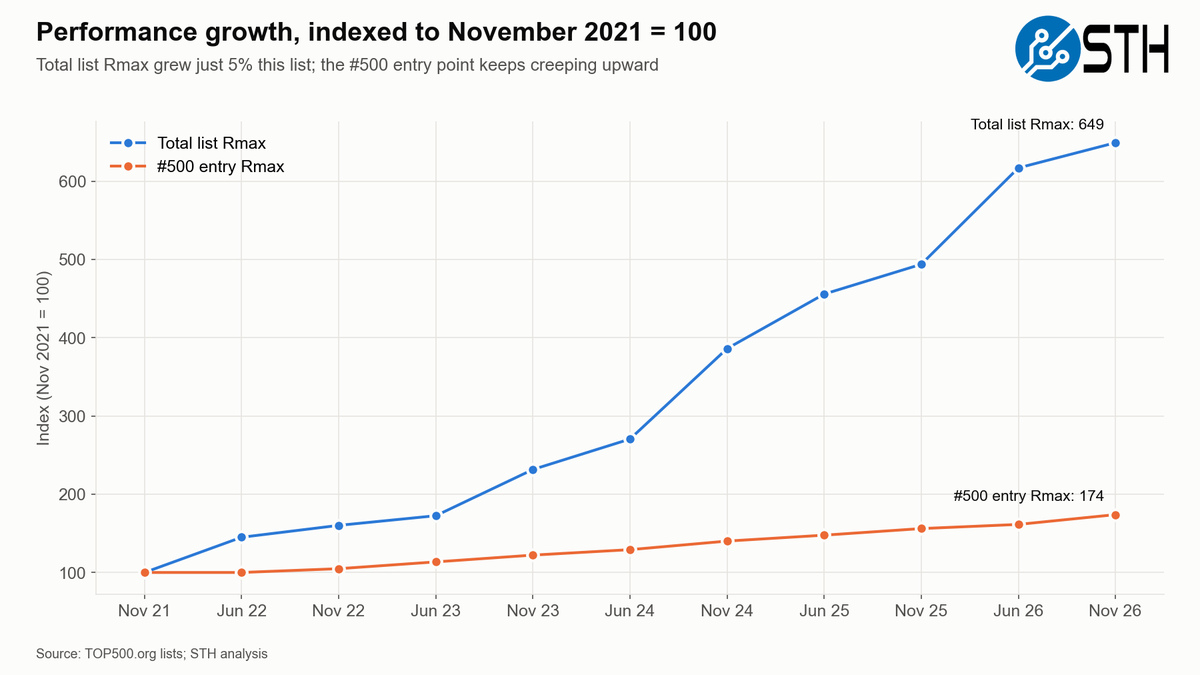
The #500 entry point rose from about 2.66 PF/s in June 2026 to roughly 2.87 PF/s now, an increase of around 8%. For context, the November 2021 threshold was just 1.65 PF/s, so the bar has been relatively low to enter the list. Just on a CPU basis, that was when a 64-core AMD EPYC 7003 “Milan” CPU was state of the art. Now, we have 256-core AMD EPYC 9006 “Venice” CPUs. CPU performance has gone up by more than a factor of four (since we get more performance per core), but we have only seen a roughly 74% increase in the “get-in” performance number.
The List Is Aging Rapidly
With only 28 new systems replacing 28 that fell off, the average system on the list has now been there for approximately 3.2 years. That is the highest in our tracking window, up from about 2.2 years in November 2021 and roughly 3.0 years as recently as June 2026.
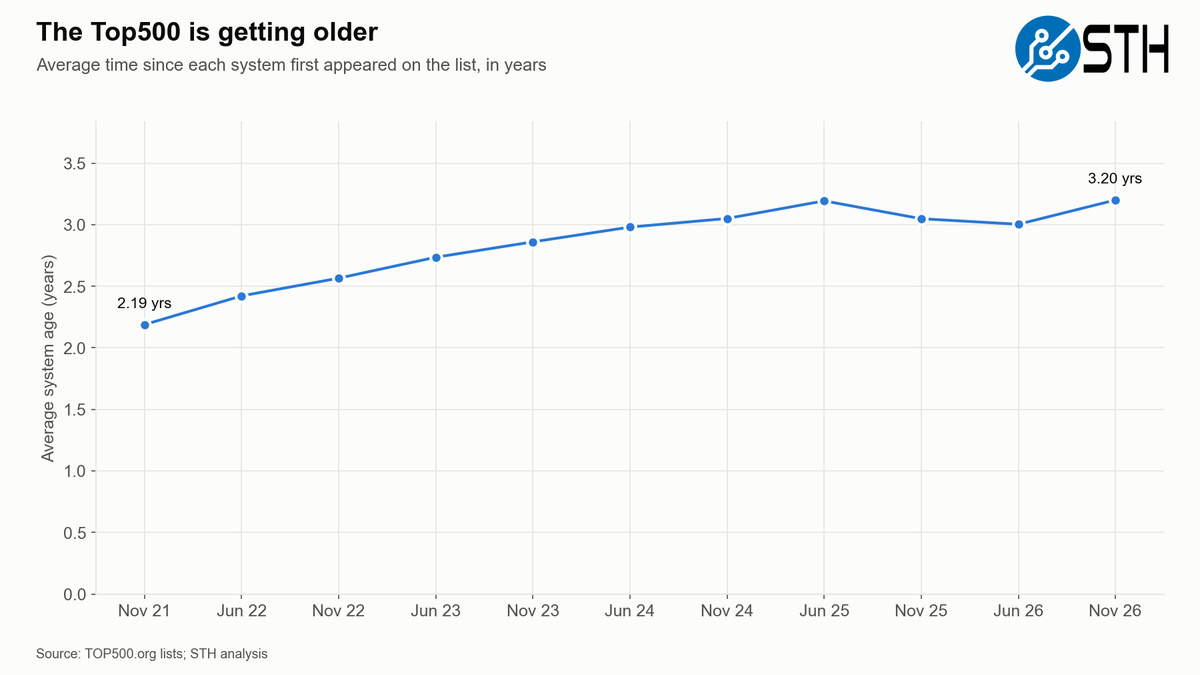
The systems that dropped off this list had been on it for an average of about 5.4 years, measured as of the current list date. That is a long tenure in terms of list appearances, and it highlights how established these departing clusters were.
There is a stark contrast between what fell off this list and what came on. Of the 28 systems that dropped, 24 were CPU-only, with most using Intel Skylake or Cascade Lake processors from roughly 2017-2019. Seventeen of the departed systems were in the Industry segment, 17 were built by Lenovo, and 14 were located in China.
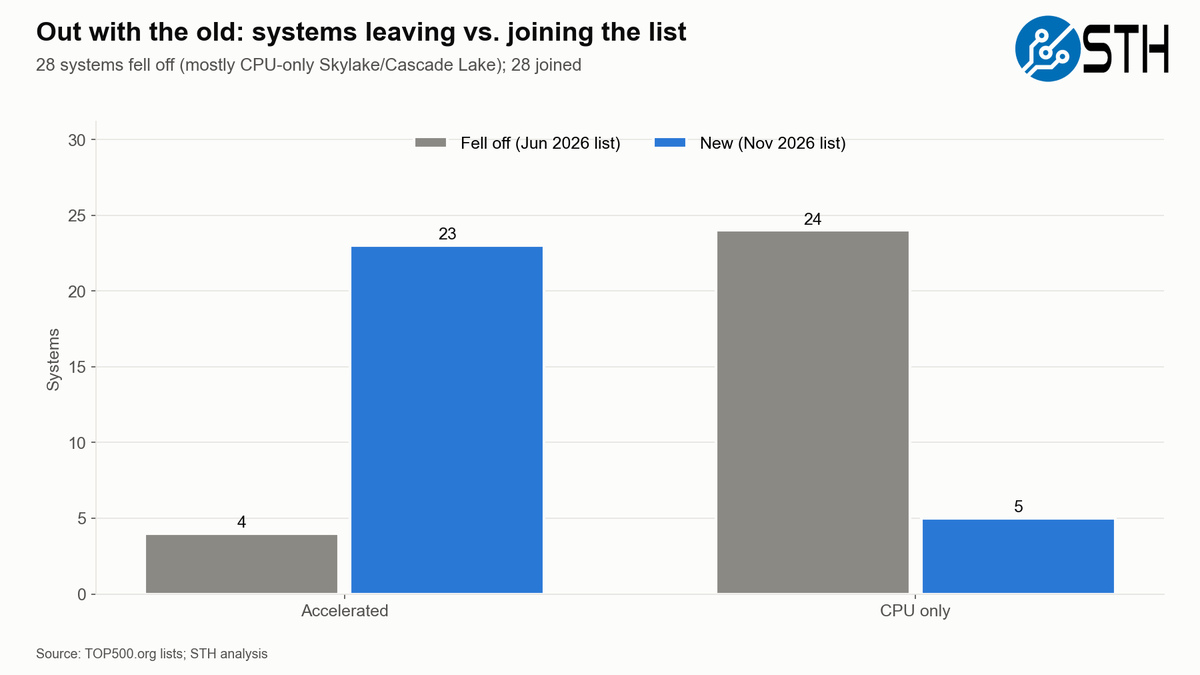
By contrast, 23 of the 28 new systems are GPU- or other accelerator-accelerated. The churn is slow as well as turning over from old CPU-only commercial clusters to newer GPU-accelerated research and academic systems.
China and Industry Submissions Have Collapsed
Chinese service-provider submissions and commercial Industry clusters have nearly disappeared as sources of new entries. Systems in China fell from 173 on the November 2021 list to just 18 now. China still holds #1 with LineShine, but it has otherwise largely stopped submitting at volume. The country added only one new system this edition: CTyun HPC – shanghai15, an eSurfing Cloud entry using a MetaX C588 accelerator and China Telecom C86 CPUs.
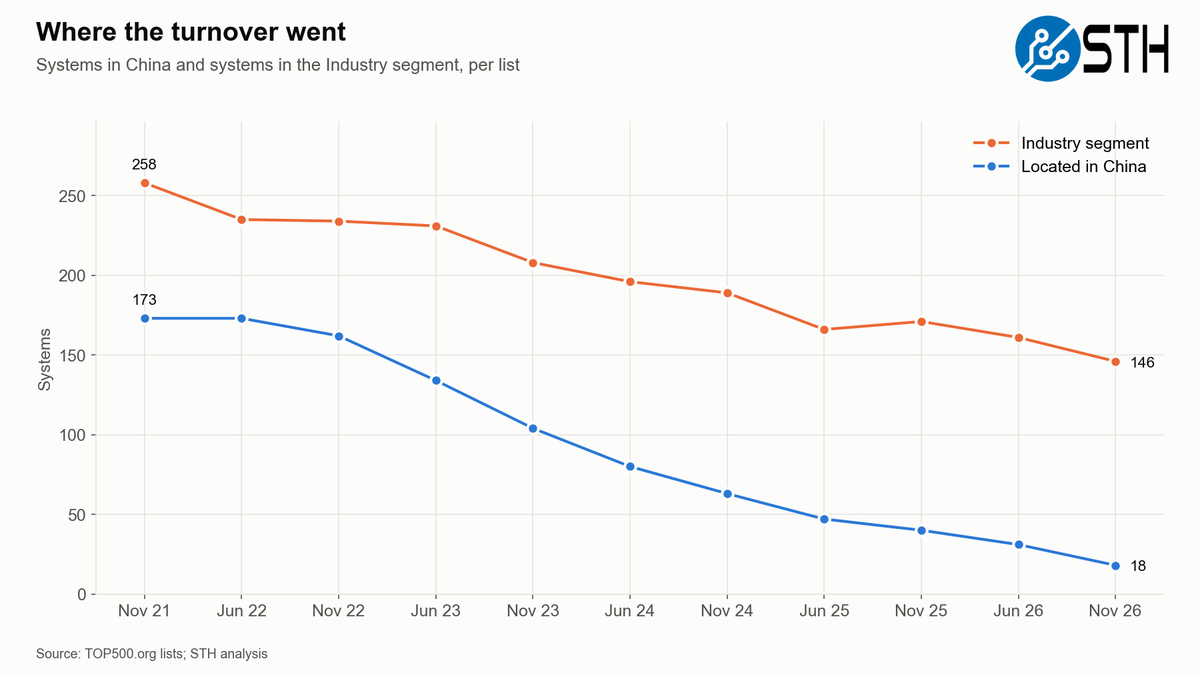
The Industry segment has fallen from 258 systems in November 2021 to 146 now, and only two of the 28 new systems are classified as Industry. The rest break down as 12 Research, 12 Academic, and 2 Government.
This is the same theme we raised in our June 2023 analysis. It feels like the Top500 submissions are not a census of all HPC or AI deployments, and the commercial systems that used to populate the list have largely stopped appearing.
Who Built the New Systems
HPE leads this edition with 8 new systems and by far the most new Rmax at roughly 615 PF/s. That total is dominated by HANGANG at #12 with 342.6 PF/s and ORNL’s Lux at #14 with 220.79 PF/s, an AMD EPYC 9575F system using Instinct MI355X accelerators.
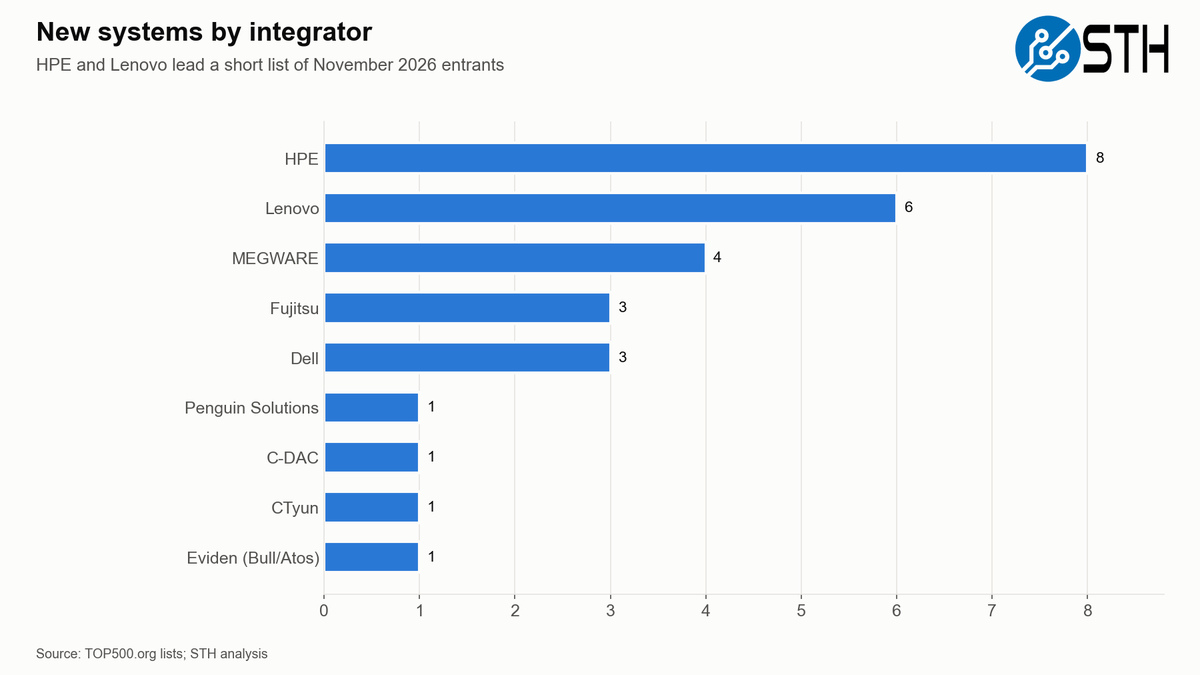
Lenovo has 6 new systems, MEGWARE has 4, and Dell and Fujitsu each have 3. Notably, all three of Fujitsu’s entries are Supermicro-based platforms, including the RIKYU system at RIKEN using GB200 Superchips and Nagoya University’s Flow 2.0 subsystems.
By geography, Europe leads with 11 new systems, followed by Asia with 9 and North America with 8. Germany added 6 new systems, nearly matching the United States’ 7.
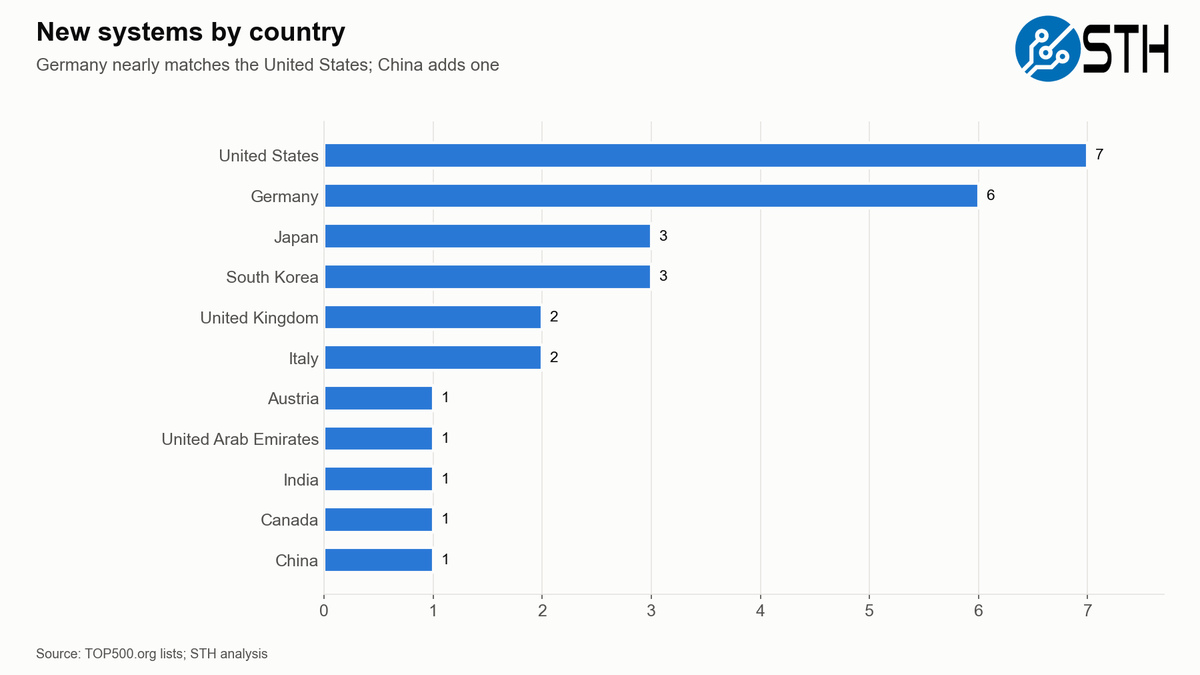
South Korea has 3 new systems thanks to HANGANG and its CPU companion system at KISTI, plus a Dell PowerEdge XE9680L with B200 accelerators at Elice Inc. Japan also added 3.
CPUs: Grace Ties Intel as AMD Leads x86
Among the 28 new systems, AMD leads with 13, while NVIDIA Grace and Intel each account for 7. The remaining system uses a China Telecom C86 processor.
All five of the new CPU-only systems are AMD-based, and four of them use Turin Dense (Zen 5c) parts: HANGANG-CPU at KISTI, Manta CPU at Navy DSRC, Nagoya’s Flow 2.0 Type I subsystem, and Lichtenberg NHR-1 CPU at TU Darmstadt. The fifth, ERDC’s Barfoot, uses Genoa.
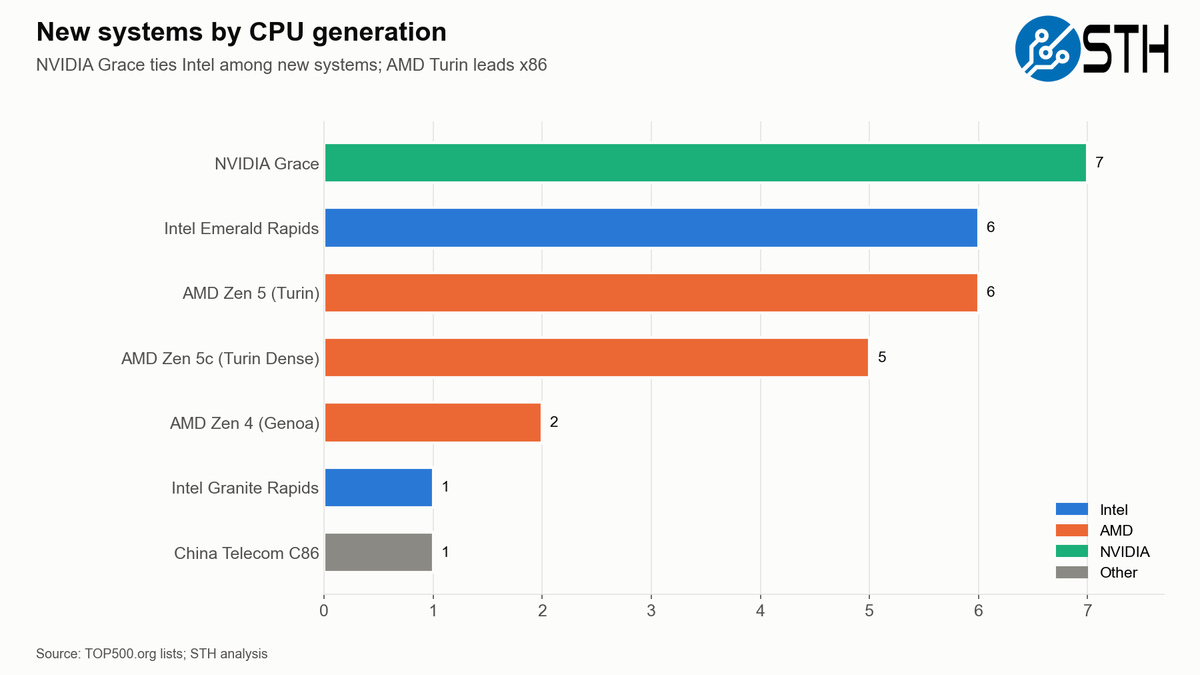
All seven new Intel systems are GPU hosts. Six use Emerald Rapids and one uses Granite Rapids. There are no new Intel CPU-only systems on this list at all, which is a notable shift for a vendor that has historically dominated the Top500. Maybe more telling is that in the latest (pre-Venice/Vera) generation, Intel has only one Granite Rapids CPU system, while AMD’s Turin has 11 systems.
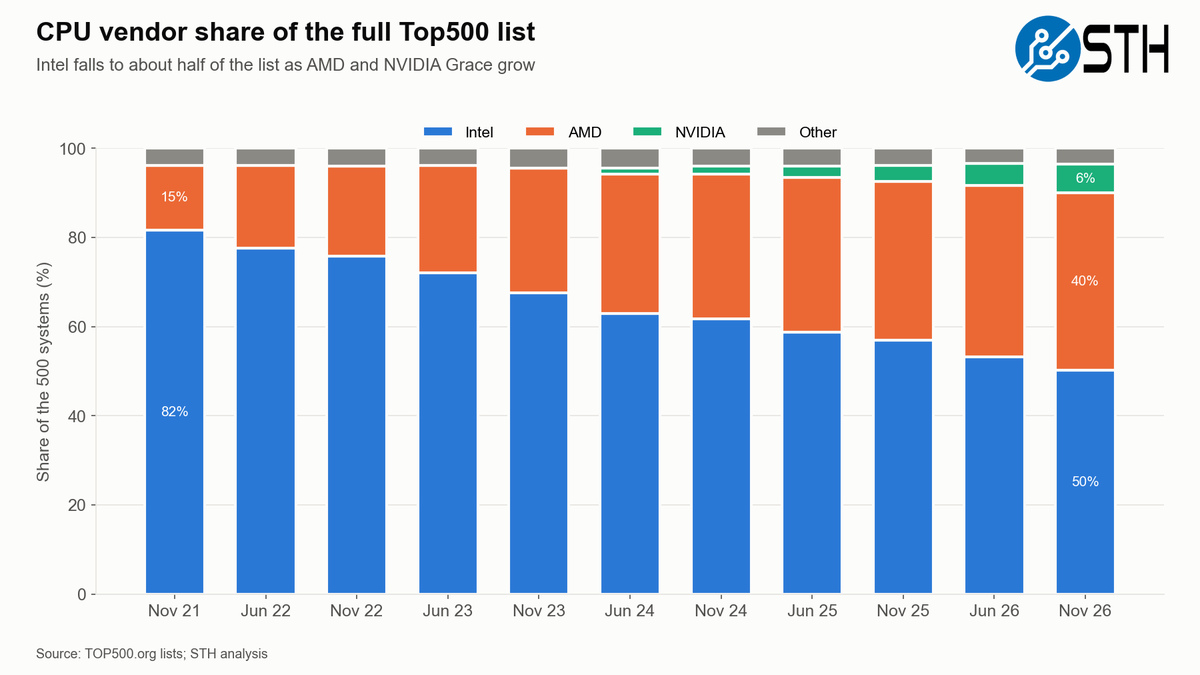
Across the full list, Intel’s share has fallen to 50.2%, down from 82% in November 2021. AMD sits at 39.8%, and NVIDIA Grace now powers 6.4% of systems with 32 entries.
NVIDIA Grace is the most common CPU among new systems with 7 appearances, all in GPU-host roles. Next comes the AMD EPYC 9655 with 3 systems, followed by several SKUs at 2 each, including the EPYC 9965, EPYC 9654, Xeon Platinum 8568Y+, and Xeon Platinum 8570.
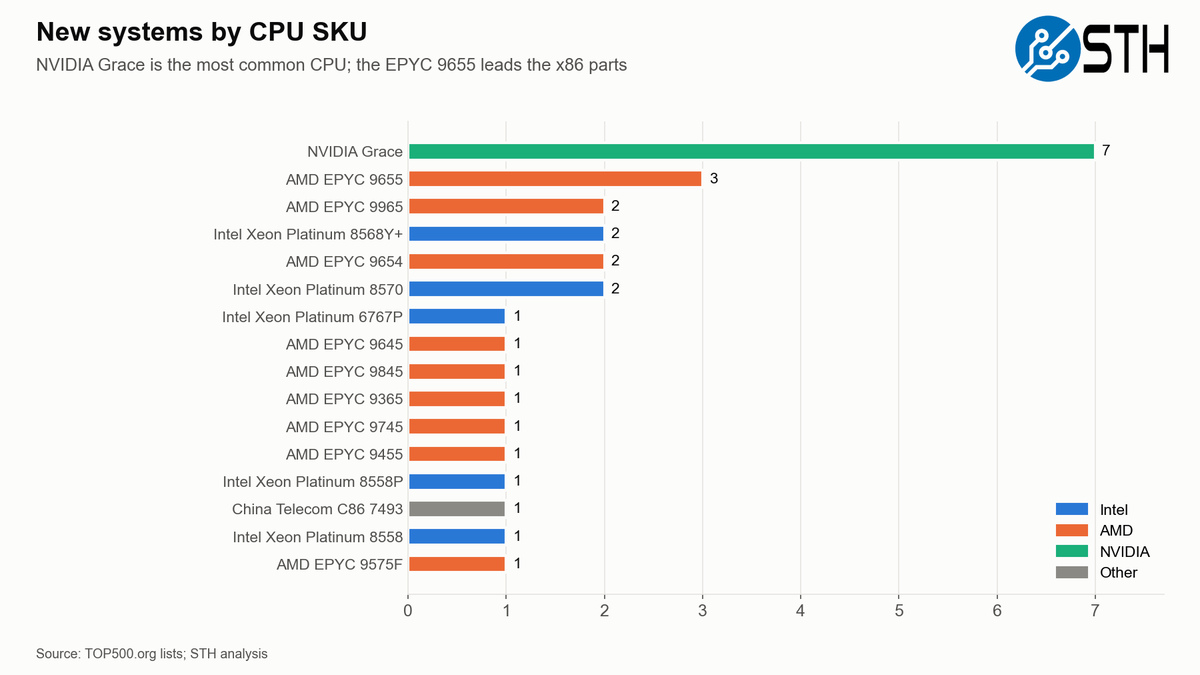
The 28 new systems use 16 different CPU SKUs total. On the full list, however, the story is very different. The AMD EPYC 7763 from 2021 remains the most common SKU with 34 systems, and NVIDIA Grace is close behind at 32.
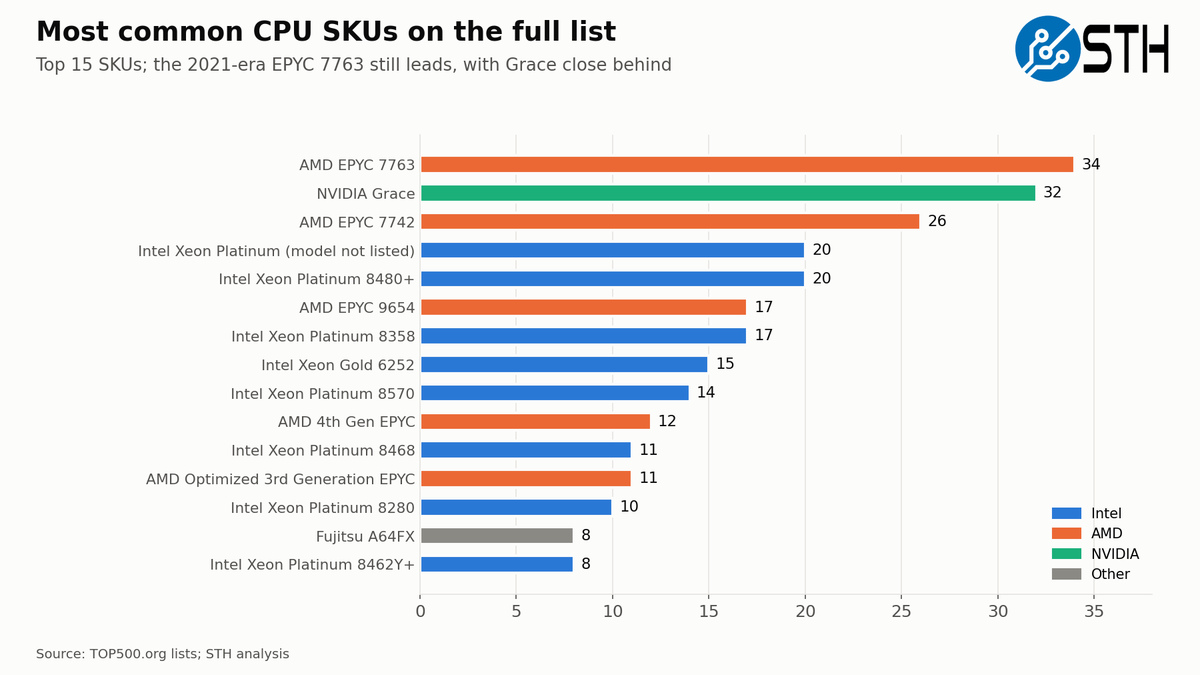
The EPYC 7742 has 26 systems, and the Xeon Platinum 8480+ has 20. These older models from roughly 2019-2023 still hold significant presence on this list, even as newer SKUs dominate among the latest additions.
Core Counts Split by Role
Most GPU-host CPUs have between 36 and 72 cores per socket. Grace has 72, Emerald Rapids hosts typically run 48-56 cores, and five GPU systems use 96-core EPYC parts.
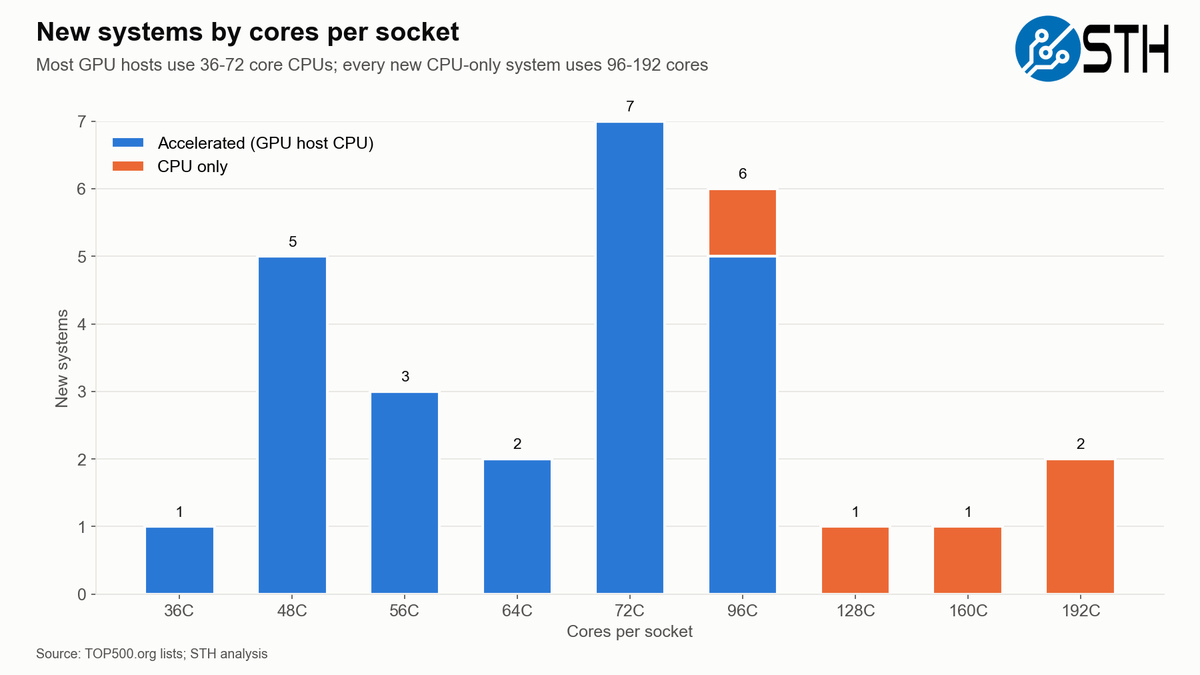
Every new CPU-only system uses a part with between 96 and 192 cores. That includes the 96-core EPYC 9654 in Barfoot, the 128-core EPYC 9745 in HANGANG-CPU, the 160-core EPYC 9845 in Manta CPU, and two systems using the 192-core EPYC 9965.
The median new system has 72 cores per socket versus 52 for the full list. Five years ago, the full-list median was just 20 cores per socket.
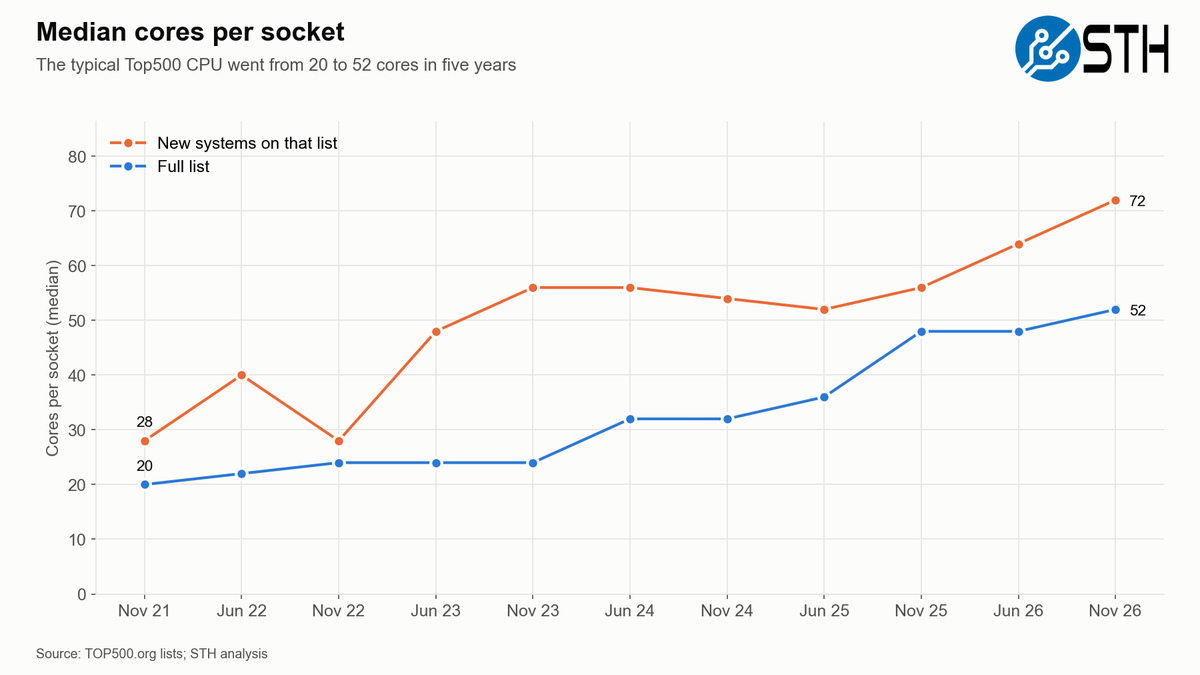
Systems using CPUs with 24 or fewer cores have fallen from 75% of the list in November 2021 to just 19% now. None of the 28 new entries use such low-core-count processors, indicating a distinct shift in the CPU mix appearing on the TOP500.
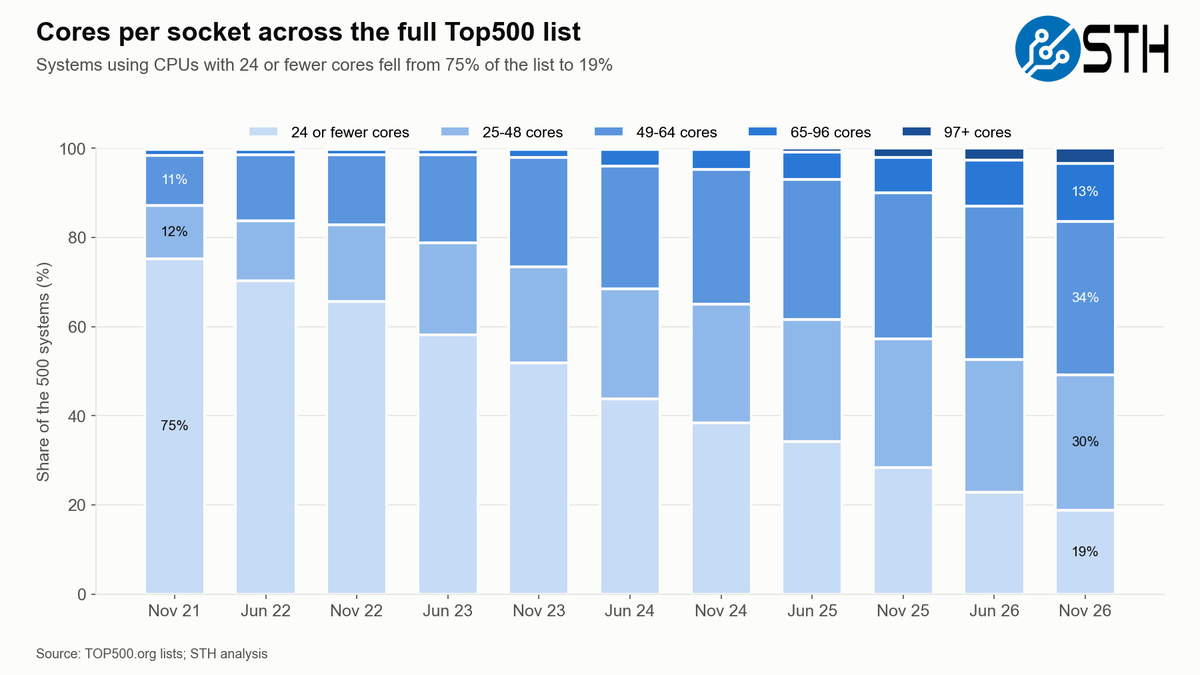
The shift toward higher core counts reflects a clear division in new system design. GPU hosts typically use moderate-core CPUs, while CPU-only systems leverage high-density EPYC parts to maximize compute throughput per socket.
Accelerators: NVIDIA Blackwell Arrives, but Hopper Is Still the Installed Base
Fourteen of the 28 new systems use NVIDIA Blackwell accelerators, split between 12 with B200 and 2 with GB200 Superchips. Hopper accounts for another 6 systems across H200, GH200, and one remaining H100.
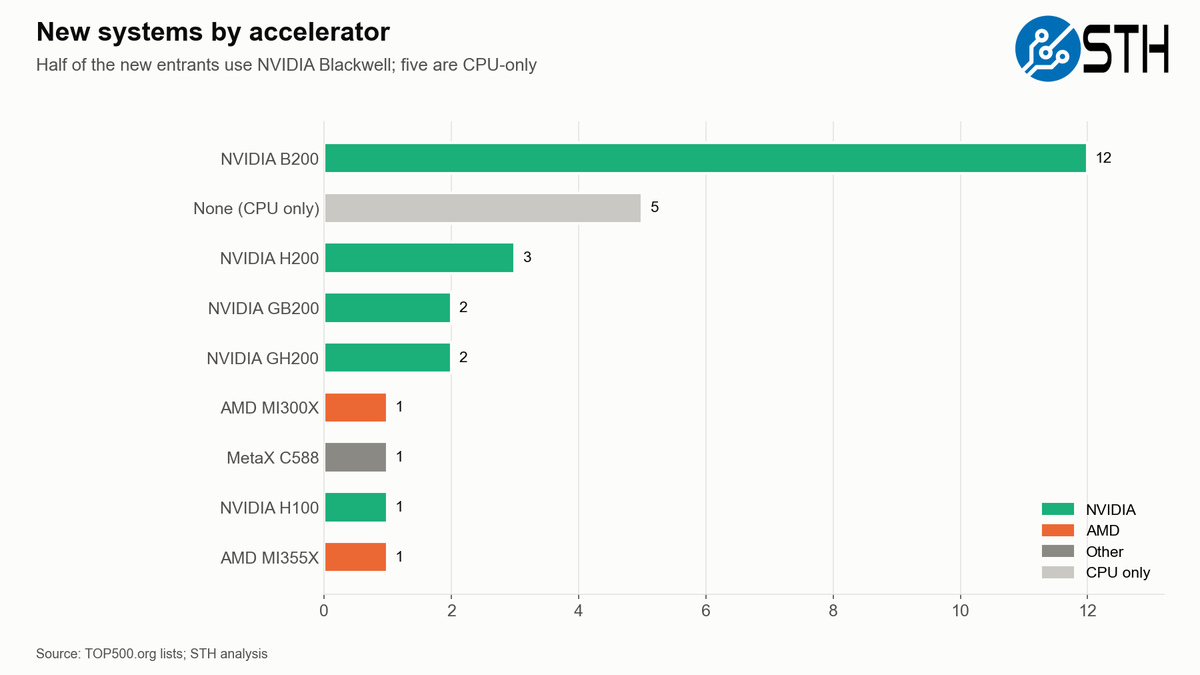
AMD has two new accelerated systems: ORNL’s Lux on MI355X at #14 with 220.8 PF/s, and C-DAC’s PARAM KAVERI in India using MI300X. MetaX has one entry with its C588 accelerator in the CTyun system.
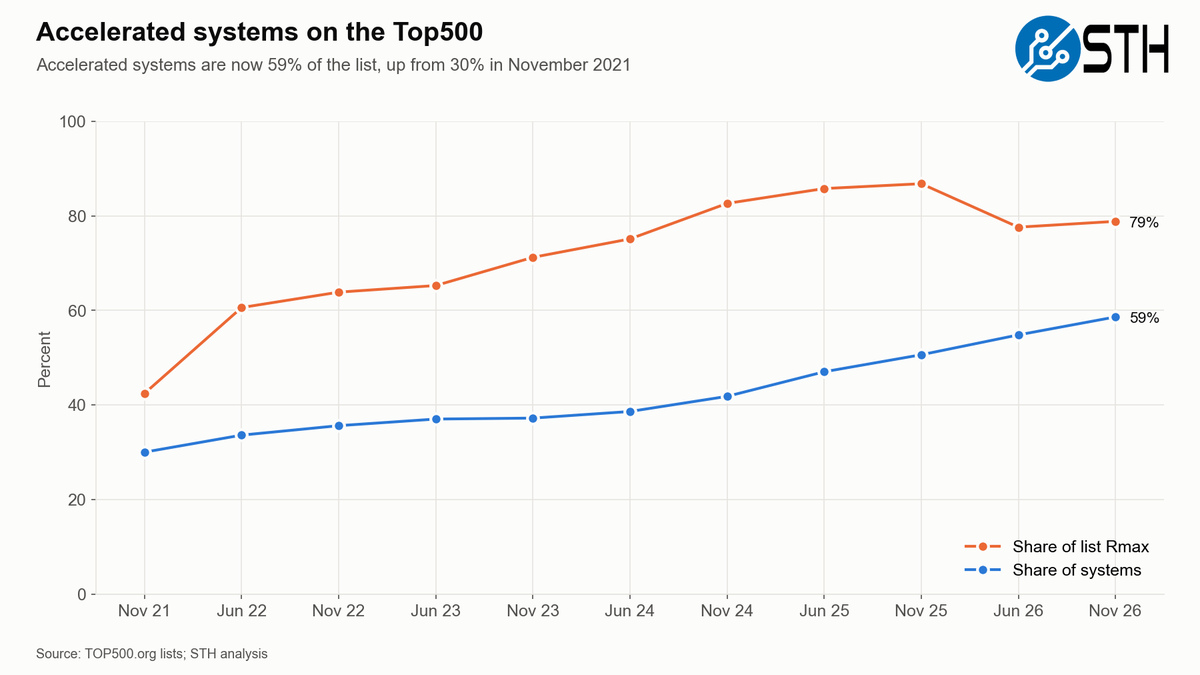
Across the full list, accelerated systems now represent 58.6% of systems and 78.8% of Rmax. That compares with just 30% of systems being accelerated back in November 2021.
Blackwell systems nearly doubled from 18 to 32 since the June 2026 list, while Hopper reached 137 systems. In terms of system count, AMD Instinct across all generations is still roughly at Blackwell’s level.
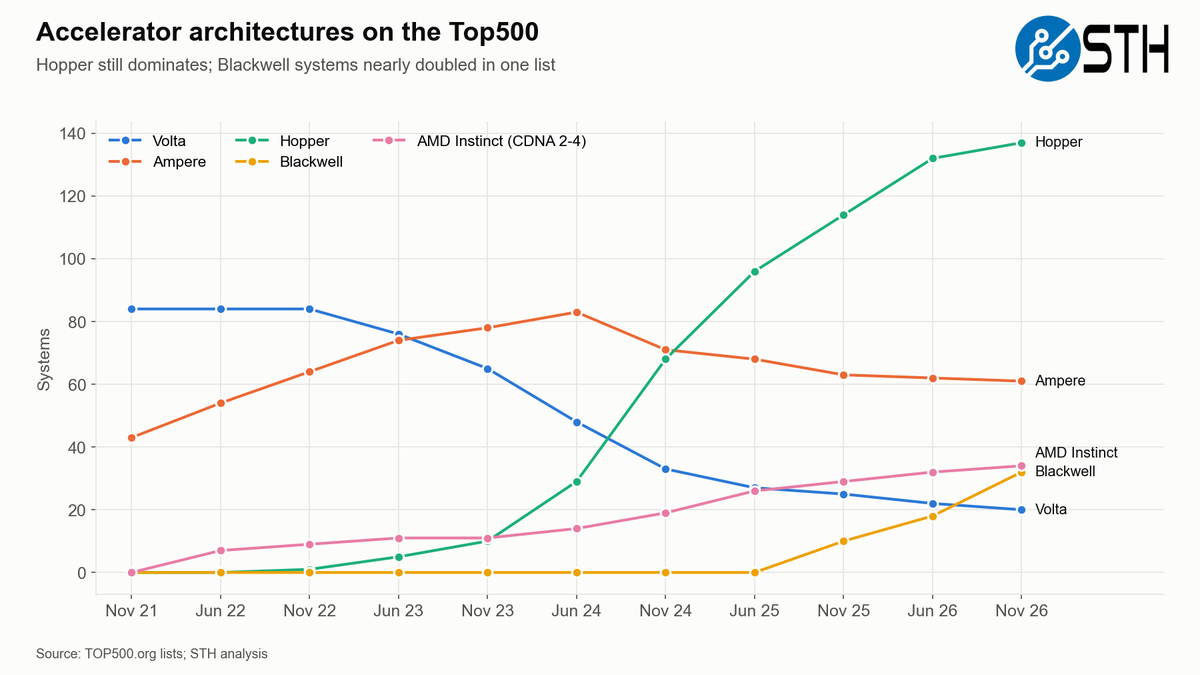
The installed base story matters here. Even though Blackwell dominates new submissions, the full list still has more Hopper systems than anything else, and 61 Ampere-generation systems from the A100 era remain on the list.
Interconnect: InfiniBand Keeps Taking Share
Among new systems, 19 of 28 use InfiniBand. That breaks down as 14 with NDR, 2 with XDR, 2 with HDR, and one unspecified generation. Five new systems use HPE Slingshot, including the first Slingshot 400 systems on the list: HANGANG and its CPU companion at KISTI.
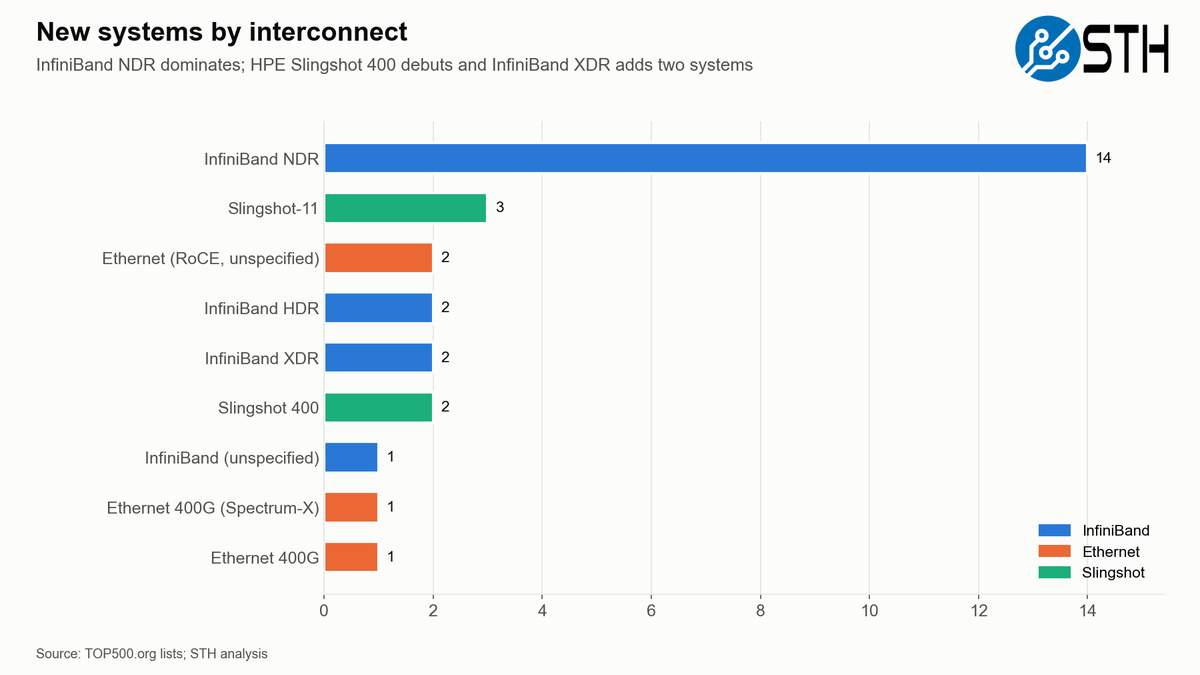
Four new systems use Ethernet. Two are RoCE-based, one uses NVIDIA Spectrum-X (the MEGARIDE system at CINECA), and ORNL’s Lux uses HPE Juniper with AMD Pensando 400G Ethernet.
Half of the new systems run 400Gb/s per port, and two run 800Gb/s XDR InfiniBand. These are nominal per-port line rates rather than achieved throughput, but they show where high-end cluster networking is heading.
Across the full list, Ethernet has fallen from 45% of systems in November 2021 to just 18% now. The old 10/25/100GbE commercial clusters that drove those numbers have largely aged off the list. InfiniBand now sits at 60% and Slingshot at 15%.
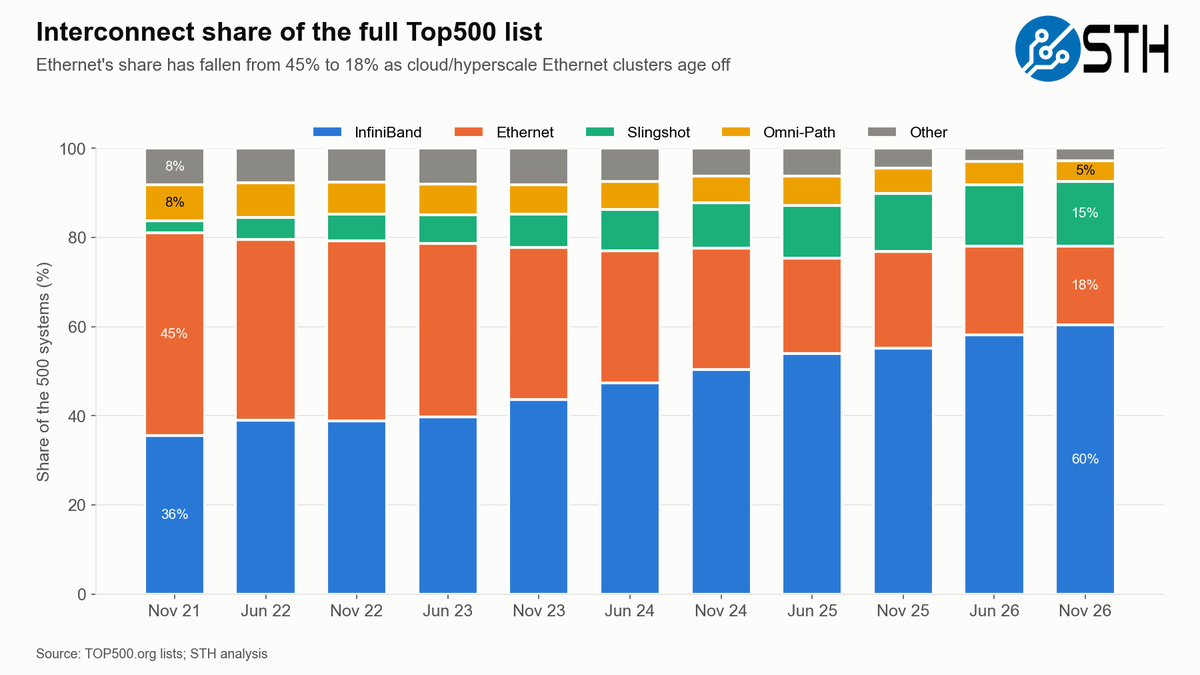
InfiniBand leads new submissions with 19 of 28 systems, while Ethernet accounts for only 4. Across the full list, InfiniBand has grown to 302 systems versus 88 for Ethernet and 73 for Slingshot, showing a clear shift in the reported interconnect mix.
Final Words
The November 2026 TOP500 shows a list with limited turnover, featuring only 28 new systems and roughly 5% performance growth. The average tenure of listed systems has approached 3.2 years, marking the slowest update rate in our tracking window. China’s presence dropped to 18 systems from 173 in November 2021, while the Industry segment fell to 146 from 258. Of the new entries, 23 are accelerators.
New hardware on the list highlights specific architectural trends: Blackwell accelerators appear in 14 systems, all CPU-only newcomers use AMD EPYC processors, and NVIDIA Grace matches Intel’s count among new entrants. The Top500 remains a useful gauge for tracking declared HPL system configurations and platform trends over time. However, it does not capture the full scope of current HPC and AI compute investments, which often prioritize different benchmarks or deployment models.