
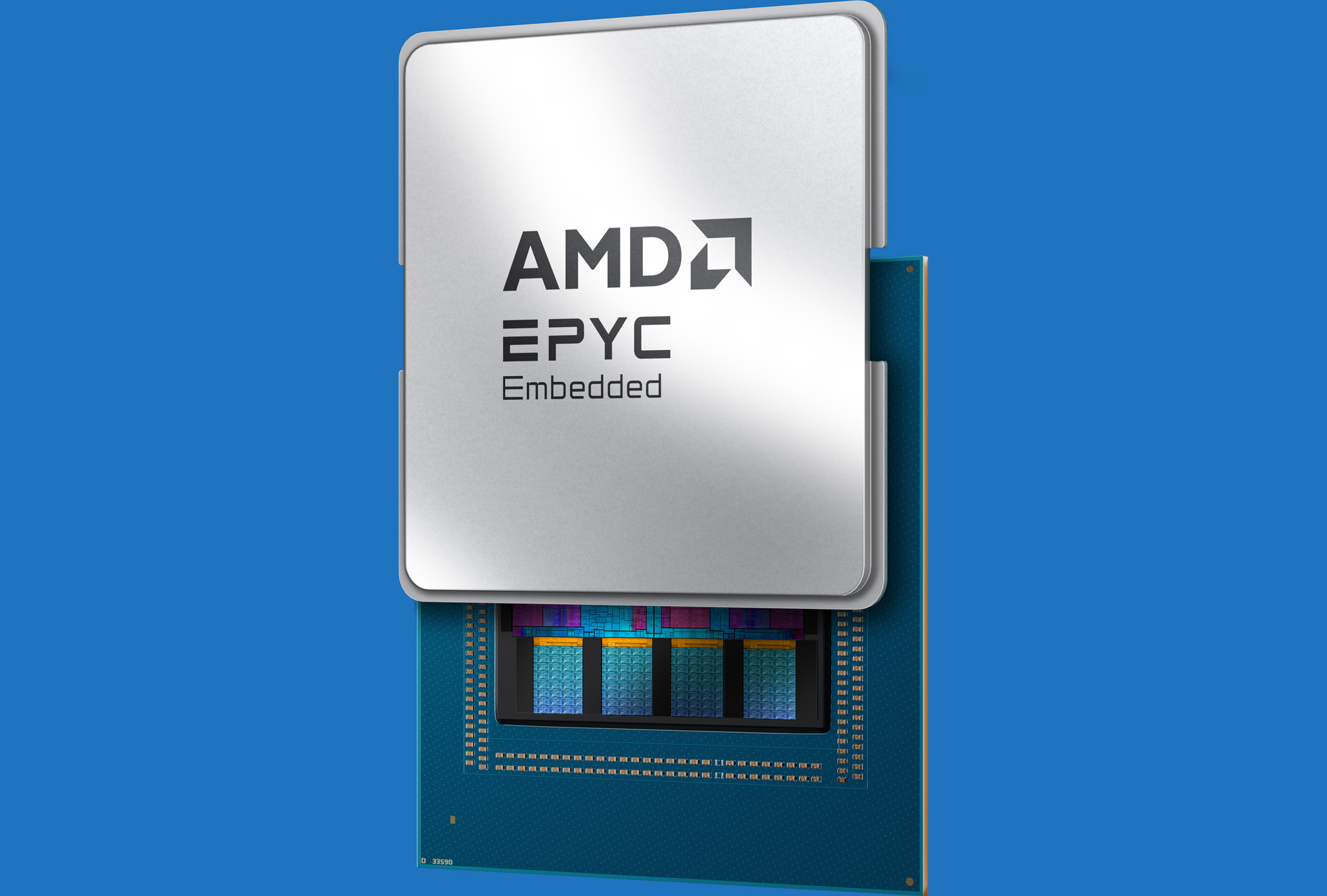
Last week we witnessed the launch of AMD’s EPYC 9006 “Venice” series of server CPUs. AMD’s latest generation of server chips, the Venice launch marked an important inflection point on AMD’s server CPU business for a few different reasons. Not only was it the company’s first Zen 6 architecture chip family with all of the performance and feature benefits that entails, but it also marked a larger shift in AMD’s business. For the Zen 6 generation, at least, servers are now coming first for the company – and what was once one of the last products to launch with a new architecture is now the first.
That shift towards prioritizing servers was not just for AMD’s commercial operations, either. Alongside the company’s standard EPYC 9006, AMD went one step further and launched their EPYC Embedded 9006 chip family as well. The highly validated variant of AMD’s server chips that is meant for more foundational roles has never before launched at the same time as the traditional commercial chips, underscoring just how much things have changed for AMD in the past couple of years.
It also means that we have a whole other EPYC product stack to talk about, and one that is aimed at a somewhat different market segment to boot.
Though whether it is commercial EPYC or EPYC embedded, AMD’s technical strengths remain the same. The Venice SP7 platform brings with it significant increases in core counts, energy efficiency, I/O bandwidth, memory bandwidth, and more. And AMD expects that its embedded customers are just as much in need of the extra performance as the rank and file (and AI) customers who have been scooping up standard EPYC chips.
AMD EPYC Embedded 9006 Overview
These days, AMD’s complete EPYC embedded portfolio stretches from chips with a handful of cores all the way up to 256 cores, reaching parity with AMD’s best server chips. The higher-end chips have always been derived from AMD’s server and desktop platforms, and that has not changed for the EPYC Embedded 9006 series.
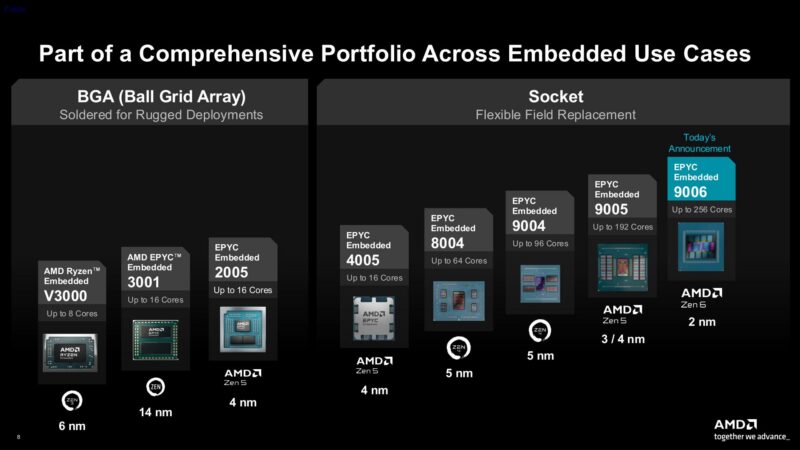
In this case, the embedded version of the 9006 Venice family is adopting the SP7 platform wholesale. Which means it gets access to features such as 16 channel DDR5-8000/MRDRIMM-12800 support, 96 lanes of PCIe Gen6/CXL 3.1, the Zen 6/Zen 6c architectures, and AMD’s suite of security features for enterprise computing.
| AMD EPYC Embedded: Generation on Generation | |||
| Embedded 9004 | Embedded 9005 | Embedded 9006 | |
| Codename | Genoa | Turin | Venice |
| Microarchitecture | Zen 4 | Zen 5c | Zen 6c |
| Core Manufacturing | 5nm | 3nm | 2nm |
| Max Cores/Threads | 128/256 | 192/384 | 256/512 |
| Core Complex | 16 + 32MB | 16 + 32MB | 32 + 128MB |
| Memory Support | 12x DDR5-4800 | 12x DDR5-6400 | 16x DDR5-8000 / MRDIMM-12800 |
| Memory Capacity | 6TB | 6TB | 8TB |
| PCIe (1P) | 5.0 x128 | 5.0 x128 | 6.0 x96 |
| Socket | SP5 | SP5 | SP7 |
| Peak Power | 400W | 500W | 600W |
Where the EPYC Embedded 9006 lineup will chiefly differ from AMD’s commercial server operations is in regard to the chip availability and product support lifecycles. AMD will offer the 9006 embedded chips for at least 7 years, and they will be supporting the chips for longer.
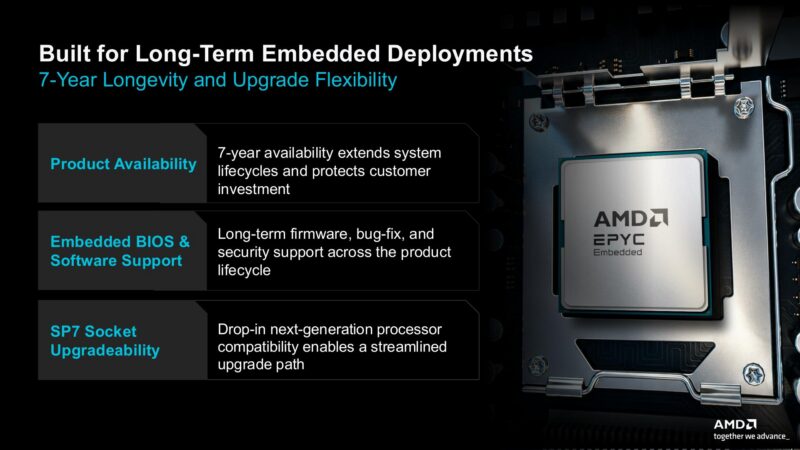
As well, the upgrade to the SP7 platform means that AMD’s embedded customers now get to reset the clock in terms of upgradability as compared to the SP5 platform. AMD will be reusing the SP7 platform for the next generation of chips (codenamed Florence), which means that designs being created today can be reused/upgraded in the future to use the newer chips without having to redesign or revalidate the entire platform.
All of which are important features for AMD’s target market of embedded users, who, even more than commercial server customers, move at a slower, more deliberate and conservative pace with their hardware designs and release cadences. The typical goal being to release a design for years, and support it for even longer.
Target Markets: ATE, Firewalls, and Enterprise Storage
Though the EPYC Embedded 9006 processors are being made available to AMD’s entire embedded customer base, the company has a few specific ideas in mind for what the best classes of products are for the new EPYC chips. Especially with the top-end of the new 9006 stack pushing total compute throughput harder than ever, these are the workloads that AMD (and its marketing arm) have been looking at.
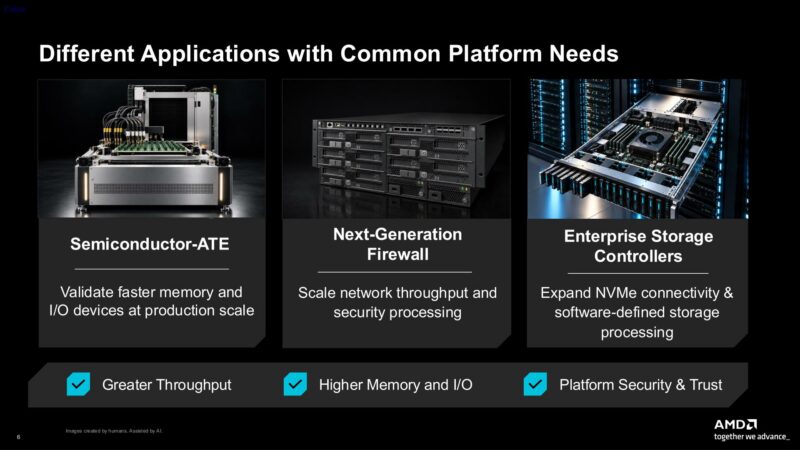
Broadly speaking, AMD is chasing three particular markets with EPYC Embedded 9006: automatic test equipment (ATE) for semiconductor development, high-end firewalls, and enterprise storage controllers. All of which fall under the umbrella of long-lived infrastructure, and all of which are also tangential to the AI market in some form or another.
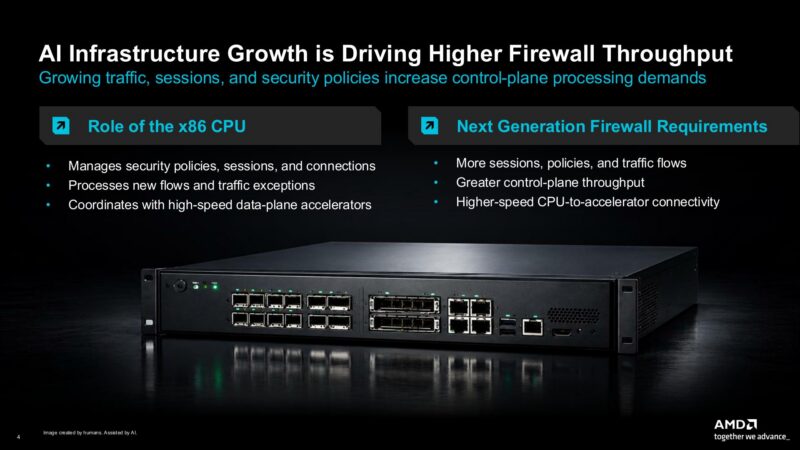
Firewalls are the most straightforward. With agentic AI systems pushing around more data than ever, faster firewalls are needed to keep up, be it by processing more data or being able to handle more complex (and thus CPU-intensive) policies. Even with the significant amount of offload acceleration in firewall appliances, they can still be quite CPU-intensive.
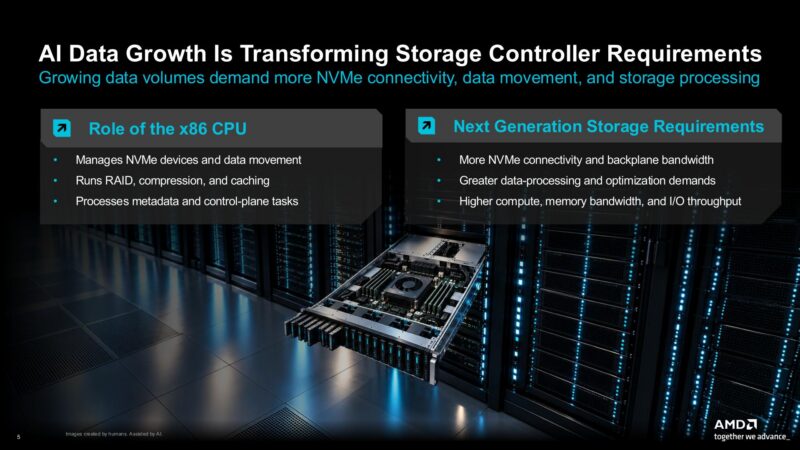
Similarly, AI computing demand is driving up storage demand as well. With rackscale systems making heavy use of dedicated storage boxes, a fast CPU is needed to operate those storage systems – and AMD would like it to be theirs. Coupled with that, the 9006 family marks the introduction of PCIe Gen6 support on AMD’s EPYC Embedded platform, so for storage systems that are not using a PCIe switch of some kind, native PCIe Gen6 support is the key to getting the most out of the first generation of PCIe Gen6 SSDs.
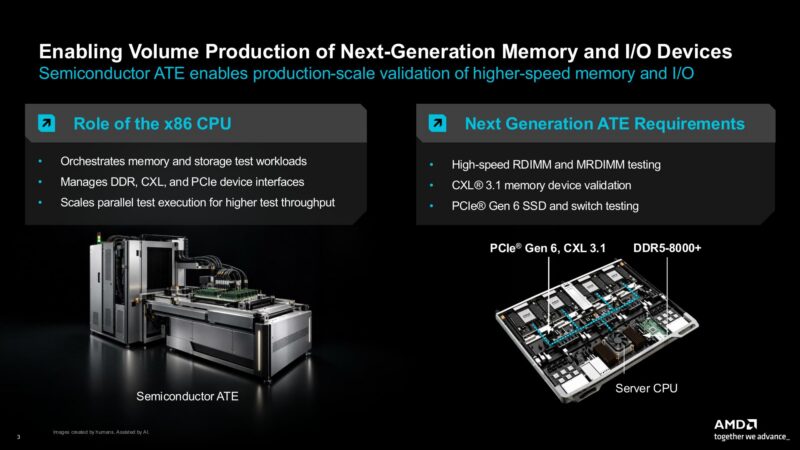
Finally, in a less conventional role, AMD is targeting the ATE market in this generation of EPYC Embedded. Automatic test equipment is not normally a very visible market, as the need for equipment is clustered around engineering firms rather than the hyperscalers, neoclouds, and other data centers that are deploying hardware in large volumes. But according to AMD, they are expecting a fresh jump in demand here due to all of the new technologies in play with this generation of hardware. Faster DDR5 RDIMMs, MRDIMMs, PCIe Gen6/CXL 3.1, and more. All of which will require new component designs and then significant validation of those designs.
More than anything else, this one seems to be AMD flexing at being among the first vendors to make a server processor with all of these features widely available. Intel is months away, and the various Arm-based operations are still ramping up their own hardware.
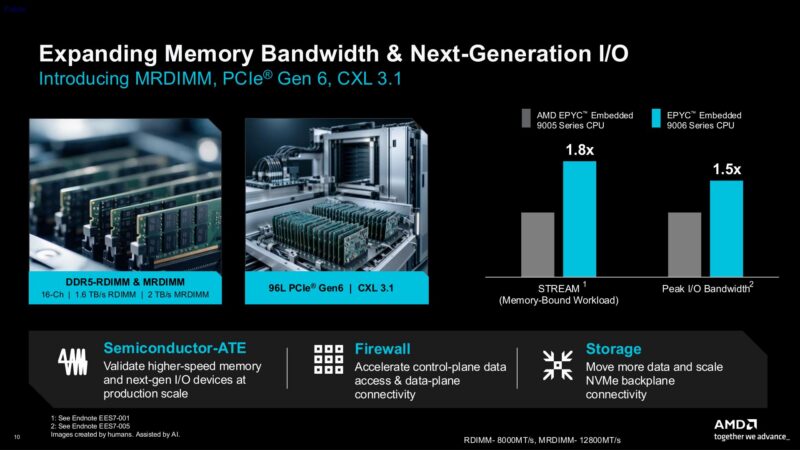
Though for AMD Embedded customers who are making heavy use of PCIe connectivity, they will have to contend with a bit less of it overall. While the SP5 platform supported 128 lanes of PCIe Gen5, the SP7 platform only supports 96 lanes of PCIe Gen6 – so while the lanes are faster, there are fewer of them overall.
Final Words
Wrapping things up, with this month’s launch of their Venice server chips and their related EPYC product lines, we are seeing first-hand how AMD’s processor releases cadences have shifted significantly. With an emphasis on getting server processors out the door first, the lead products for a new CPU microarchitecture have become the EPYC family. And not just AMD’s standard commercial chips, but their EPYC Embedded chips as well, bringing the latter line from one of the last to launch to one of the first. It is a major change that goes to show just how important the EPYC Embedded lineup has become to AMD’s overall plans.
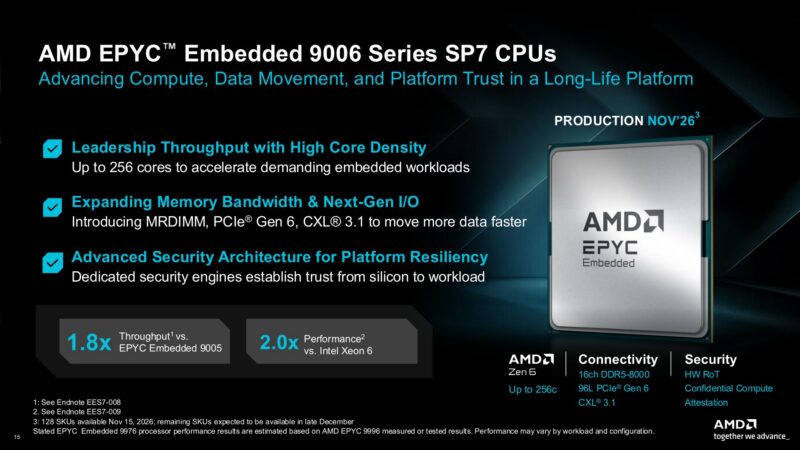
As for how AMD’s embedded customers will put the new chips and all of their new features to good use, the wait should not be very long, either. AMD is already making the 128 core EPYC Embedded 9756 available this month. The other 5 chips will quickly follow in late December.
| AMD EPYC Embedded 9006 SP7 SKUs | ||||||
| CPU Cores | Threads | Max Boost Clock | Base Clock | L3 Cache | TDP | |
| Embedded 9976 | 256 | 512 | 4.1 GHz | 2.55 GHz | 1024 MB | 600W |
| Embedded 9966 | 192 | 384 | 4.1 GHz | 3.05 GHz | 768 MB | 600W |
| Embedded 9846 | 168 | 336 | 4.1 GHz | 2.9 GHz | 768 MB | 500W |
| Embedded 9756 | 128 | 256 | 4.1 GHz | 3.2 GHz | 512 MB | 500W |
| Embedded 9656 | 96 | 192 | 4.1 GHz | 2.85 GHz | 512 MB | 400W |
| Embedded 9556 | 64 | 128 | 5.1 GHz | 3.6 GHz | 192 MB | 400W |