

AMD EPYC 9006 Series in Storage
Storage has become a hot topic lately. Agentic AI is creating so many logs and artifacts. KV cache is the technique to handle many sessions and help alleviate HBM costs (more on that tomorrow). Traditional storage backing applications and databases is being used more. Even cold storage nodes have become more popular to hold large data pools.
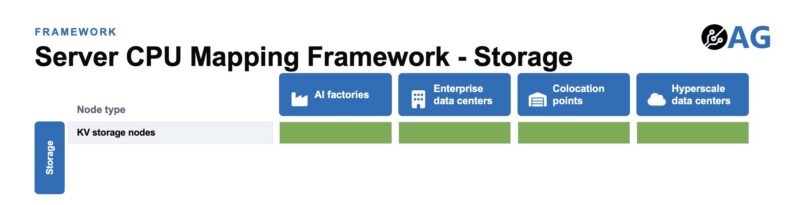
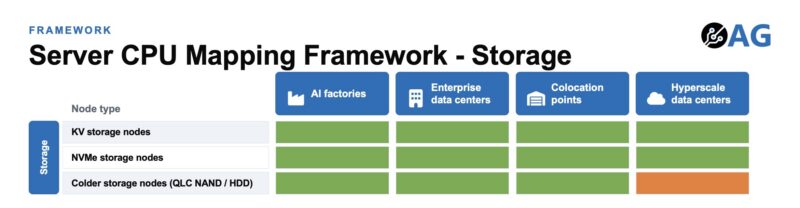
Starting with the KV storage nodes, this is one of those where, again, I think AMD will compete, but solutions like NVIDIA CMX are going to use NVIDIA Vera CPUs.
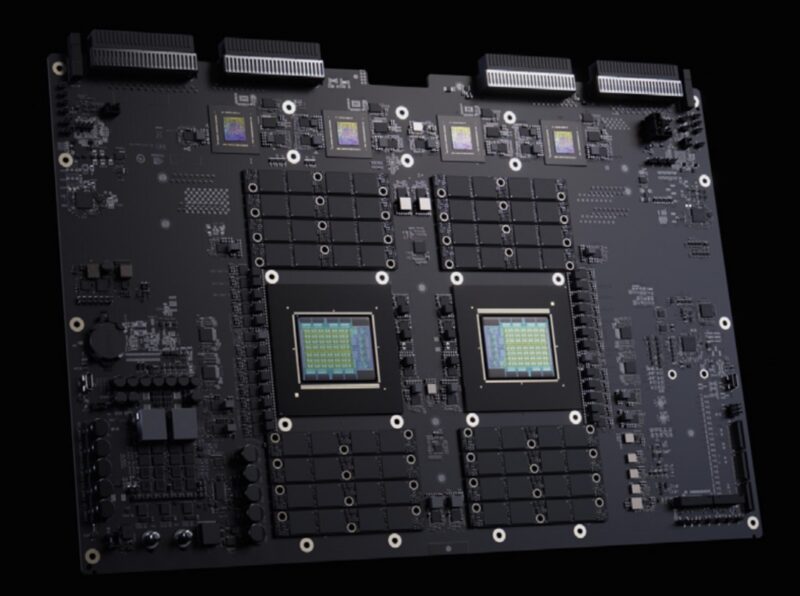
Interestingly enough, NVIDIA says it is using its BlueField-4 DPU there, but the architecture is a dual Vera with ConnectX-9 NICs. We have also heard rumors of a single-CPU version to lower costs. Still, the reference platform looks a lot more like a dual-socket motherboard. Apparently, these can have up to a dual 84-core Vera CPU with 384GB of LPDDR5X memory, a 2TB boot M.2 with room for a second, and four ConnectX-9 SuperNICs. For AMD, this is something that the SP8 socket EPYC 9006 family should slot into, especially for the myriad of companies trying to build better KV cache solutions. I heard someone once say that AMD does not have a hardware answer in this space, and realistically, I would expect AMD’s partners to have dual or even single socket solutions to address this space.
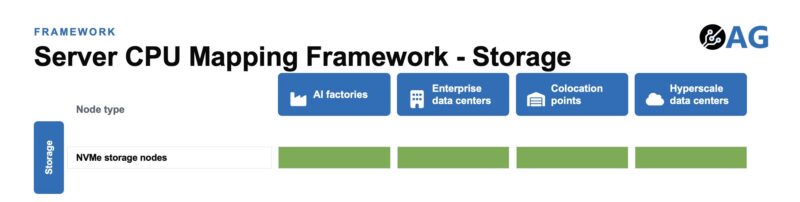
In the classic NVMe storage space, I think AMD has been garnering a lot of backing. In some of our AI data center tour videos, you can see AMD EPYC-powered storage nodes. Of course, this is a competitive space since storage generally requires that you have the latest PCIe spec, a decent number of lanes, and have a decent CPU and memory subsystem. This is also not an area that we often see lower core counts than the densest on the market. Interestingly, Intel Xeon 6 is still a PCIe Gen5 CPU, so until we get Diamond Rapids, Intel will be competing with older-generation hardware. It used to be that NVMe generations would migrate slowly to newer interfaces, but the AI boom is changing that, especially as NAND pricing is going up. For AMD, this is a great market for socket SP8, and even lower SKUs in the stack than the various high-core count and F SKUs.
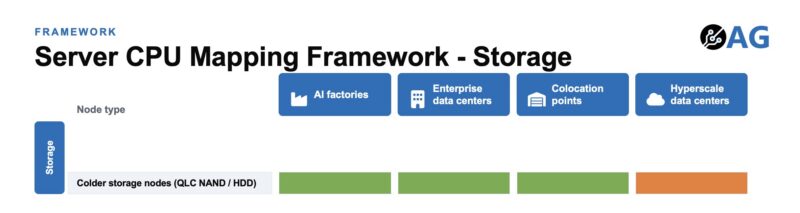
Hard drives had been relegated to relatively slower storage. A common configuration is 80+ drives and a single-socket, 8-channel DDR5 CPU, and sometimes notably fewer on the CPU side. This is a great example of where AMD can compete with the lower-core-count SP8 sockets. The orange we left for the hyperscale data centers, but you could probably make a case for the enterprise and colocation as well since there are sizable portions of these markets that are using embedded or DPU-like solutions, not full server CPUs. We have heard rumors that some large customers are also using the EPYC 8004/8005 series, which might transition to SP8, but might also stay on SP6 for a bit.
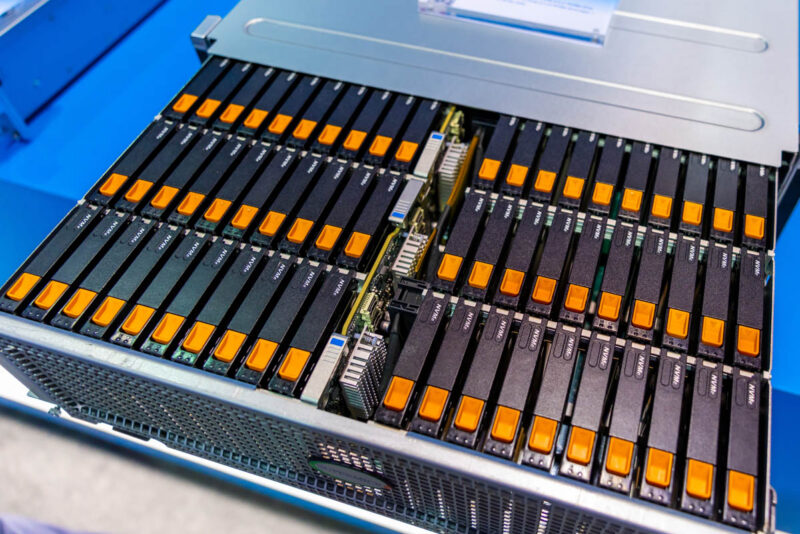
Also here, on the AI Factory front, we recently highlighted the 160-bay NVMe SSD 4U Server Shown at FMS 2026, which is a good example of a single-socket AMD EPYC 9005 that we could see transitioning to SP7 or SP8 configurations in the future as the drives get faster.
In all cases, though, agentic AI is increasing demands on existing storage and adding a net-new workload to the stack. A few years ago, we rarely saw AMD in storage systems. Now, we are seeing AMD-based storage when we check out AI clusters.
Next, let us get to the networking side.

I love these