

Mapping AMD EPYC 9006 CPUs to the Agentic AI Data Center Framework
For this, the idea is to map the processors to the framework we showed earlier.
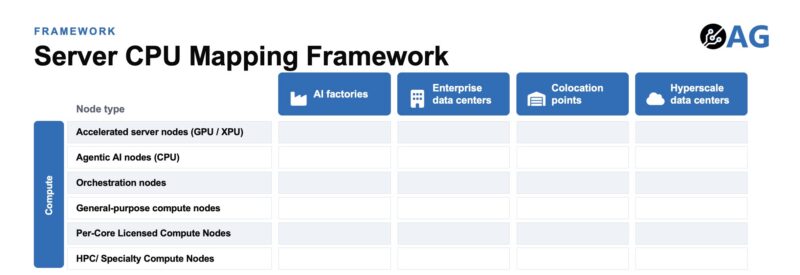
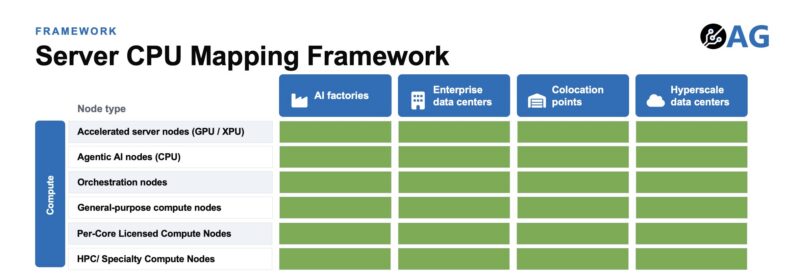
Let us start off with the top one, so that we can get a big caveat out of the way first. The Accelerate server CPU nodes. We have green here because AMD EPYC 9006 will compete across the different deployment types.
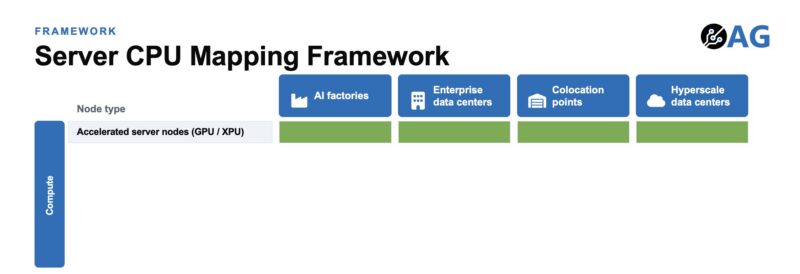
I think anyone deploying a Helios rack will likely use AMD EPYC 9006 processors. Conversely, if you are deploying NVIDIA Rubin NVL72 racks, you are likely using NVIDIA Vera, not AMD EPYC Venice or Verano. That is the big caveat here that I wanted to get to first, which is that, really, when it comes to integrated racks, companies are designing the entire racks and not picking CPUs piecemeal.
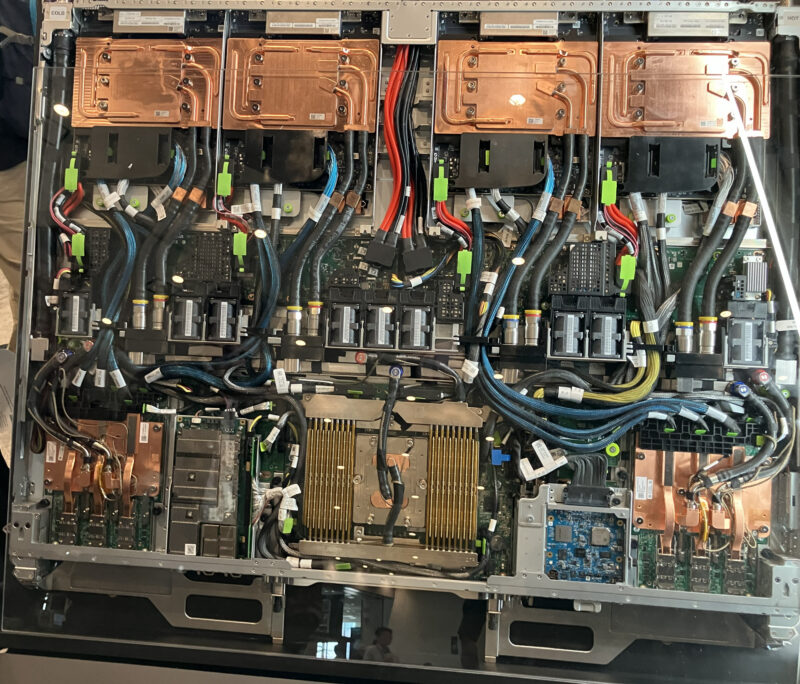
Another important caveat here is that enterprise data centers likely will not have Helios or NVL72 racks. Instead, we expect them to have more PCIe GPUs. We have heard of a few Fortune 50 companies pushing to lead in AI, saying roughly 1000 PCIe GPUs cover their internal load at this point, excluding cloud APIs. When you get to PCIe GPUs, AMD has been very strong. One area where AMD has been a bit more challenged is the 8-channel, 2 DIMM-per-channel format that Intel Xeon 6 has pushed in this generation. With the EPYC 9006 SP8, AMD will have a direct solution for 32 DIMM configurations.
So for the enterprise, and many colocation data centers (perhaps hyper-scale is included here too), having AMD EPYC 9006 attached to PCIe GPUs is a classic form factor that AMD will have two solutions for (SP7 and SP8), which are a better fit than just having the EPYC 9005 SP5 Turin series. Clearly, though, we can count accelerated nodes as part of agentic AI build-outs.
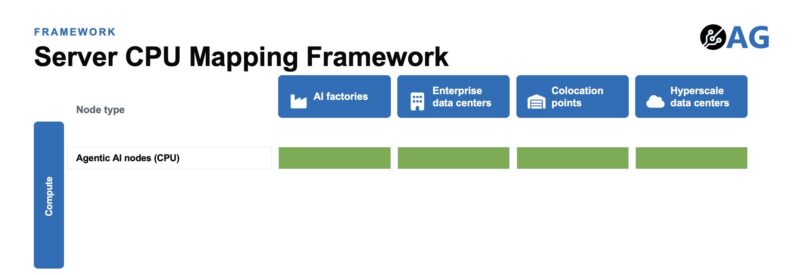
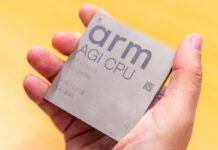
On the agentic AI nodes, this is where we have seen many agentic impacts on compute focus, but also stop. This is an area that AMD will have fierce competition in. It will compete with NVIDIA Vera in AI Factories and even in enterprise data centers, colocation facilities, and hyperscale data centers. It will also have competition from Intel Xeon largely because Intel has CPUs that use its own fabs, which help with supply. It will have competition from the Arm AGI CPU, many hyperscale CPUs, and, looking into 2028, the Qualcomm Dragonfly C1000. In 2028-2030, we expect to see more RISC-V offerings in this space as well, but that is further off.
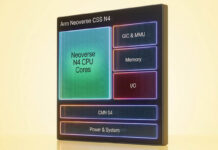
For now, let us take Meta Muse and its 2 vCPU environments. There are really two camps. One is that you pack in cores and are aiming for the lowest cost/ vCPU and the lowest power per agent. For that, the 512-thread SP7 CPUs are what folks are likely looking at since they are just over 2.3W/ core or per 2 vCPUs. Just as some reference AmpereOne M at 192 cores, two vCPUs are roughly 3.6W, and we have Arm Neoverse V2 chips where two vCPUs are closer to 7W. Intel Clearwater Forest with its E-cores is 288 cores/ 450W for just over 3.1W per 2 vCPUs.
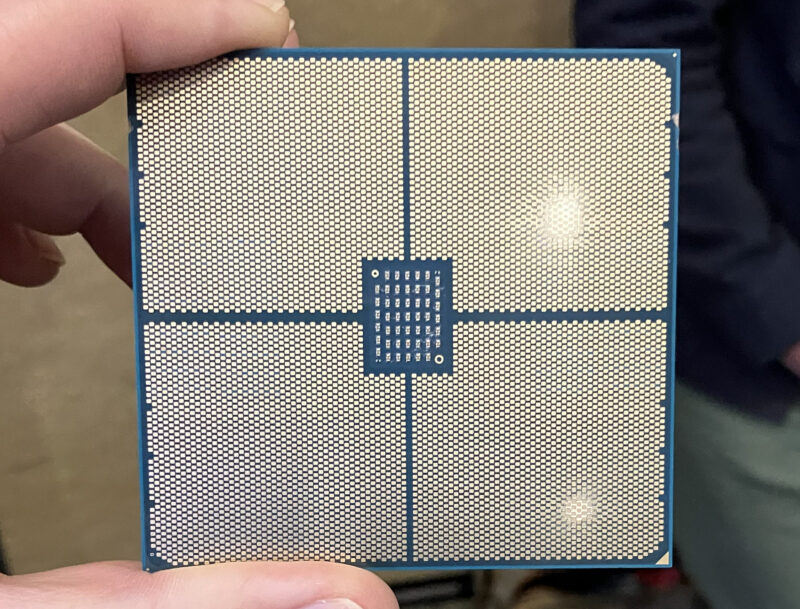
On the other end of the spectrum, some folks think the right answer is to use the fastest CPU cores possible, so you want fewer cores and more memory bandwidth per core. That is really the market the NVIDIA Vera solution targets. AMD will play in this space as well, positioning its 96-core variants there. We are hoping we get the AMD Venice parts soon so we can do direct Vera-to-Venice comparisons using servers in our controlled lab (not remote), and get you more data on this segment because it is fascinating.
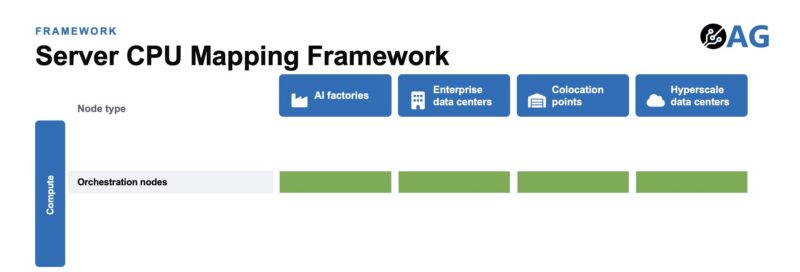
Another segment in the data center is orchestration nodes. I probably underappreciated this, but a lot of hardware is installed to place users on machines, collect billing information, manage Kubernetes clusters, handle workflows, and so forth. These often take many shapes, but they feel like a clear target for the SP8 series in enterprises and colocation, and then either the SP7 or SP8 Venice CPUs in AI Factories and Hyperscale data centers.
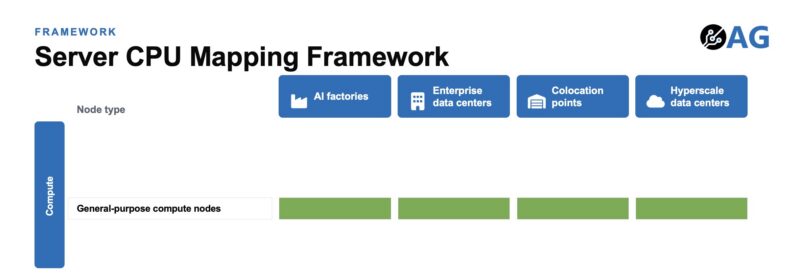
Now for a huge one, and that is the general-purpose compute nodes. We could probably get to Cloud Native, but this goes beyond that and includes many virtualization hosts, for example. Underappreciated these days, but something we have discussed a lot this year, is that agentic AI is going to create a lot of demand on existing infrastructure. Agents hitting services 24x7x365 at higher rates than humans will mean legacy data sources (and storage, which we will get to later) will see significantly more load. It is much harder to think of legacy applications and data sources that will not be impacted by agentic AI than it is to think of ones that already are seeing that load. Eventually, even enterprises that have been stretching CPU-server lifecycles to fund accelerated servers will see the load hit their legacy infrastructure, and they will need to upgrade. That is probably not two years out at the rate we are going. While AMD has a lot of competition in this space, we expect it will have the clear upper hand for x86 software in this generation. The 16-512 thread-count stack gives it a lot of flexibility in competing for sockets.
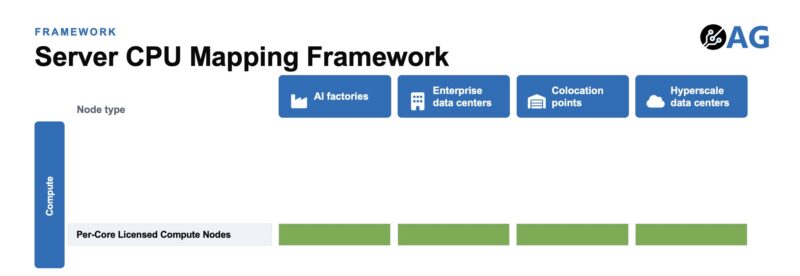
I wanted to pull per-core licensed software out here since it is a distinct case from general purpose. This market is often dominated by x86 software, so AMD EPYC is likely favored here over other options. For enterprises using SQL Server, Windows Server, VMware, and so forth, AMD’s F SKUs are designed for this. AMD also has EPYC SKUs that are very popular in the cloud EDA space, for example, where the goal of getting the highest performance per core is the same as what you would often see a database admin strive for.
We have covered this a few times now, and a great example is Mapping Licensing for Virtualization is Cool Now.
I just wanted to point out here that this is a very 2026 market. I wonder how per-core licensing models hold up in the age of agentic AI. If AI agents desire to consume 5x or 10x pre-agent usage, and licenses and hardware need to scale in current models, I think there is an enormous incentive to move off of per-core licensed solutions. An entire industry will be built around agentic AI workflows to exfiltrate workloads from per-core licensed software when open-source versions exist, and potentially to create bespoke solutions with agents.
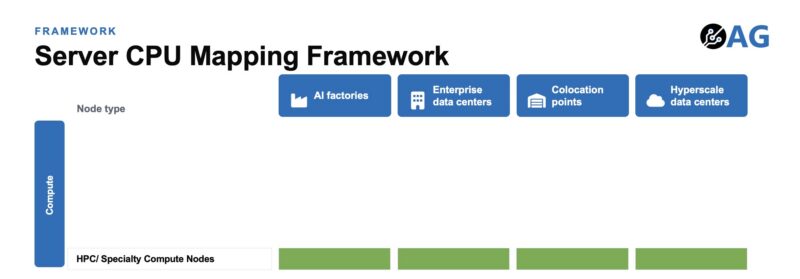
The final compute area is really the HPC and specialty compute nodes. At first, enterprises may seem strange for this, but there are many oil and gas companies and biotech companies with HPC clusters. Those companies are also looking at large-scale AI work, and so while folks often think of HPC as not being in AI Factories and enterprise data centers, I think there is a case to be made here.
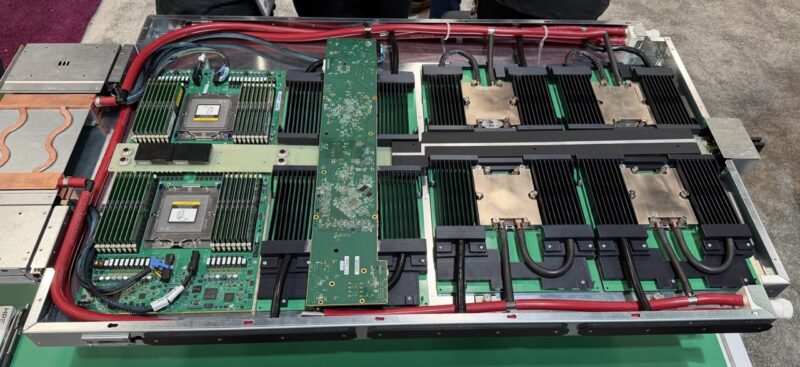
We are already seeing machines for this. We saw that the AMD EPYC 9006 “Venice” series would likely appear in next-generation HPE Cray nodes at SC25. HPC is fascinating because its high-precision roots are almost the opposite of lower-precision AI compute. At the same time, if you can use agents to do domain exploration, you may end up needing more traditional HPC because you can design more high-value experiments faster. The AMD EPYC 9006X is clearly designed for this application space.
So here is what we get to, which looks like AMD will compete everywhere, but, again, let us caveat that with the fact that we are assuming non-NVIDIA GPUs in most cases.
Next, let us discuss the storage space.

I love these