

Supermicro SYS-112D-40C-FN8P Internal Hardware Overview
Getting inside the system, you do not see much because there are two airflow shrouds. The top channels air through the power supplies. The bottom channels air through the CPU and memory with the PCIe cards getting two dedicated fans as well.
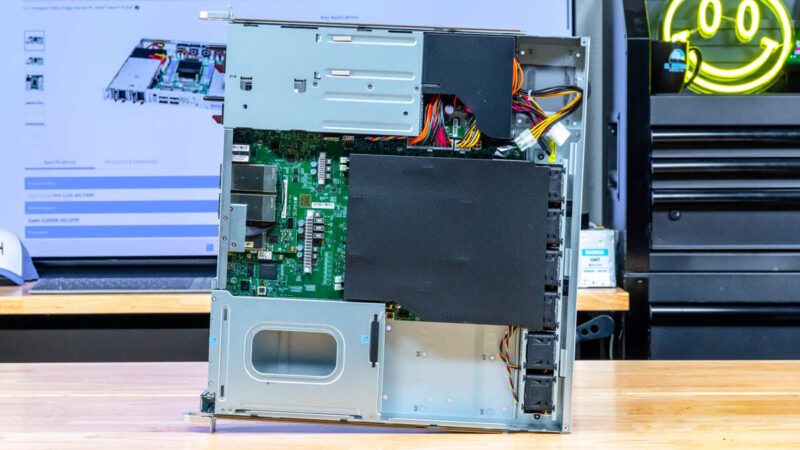
Taking the main airflow guide out, we can see the motherboard.
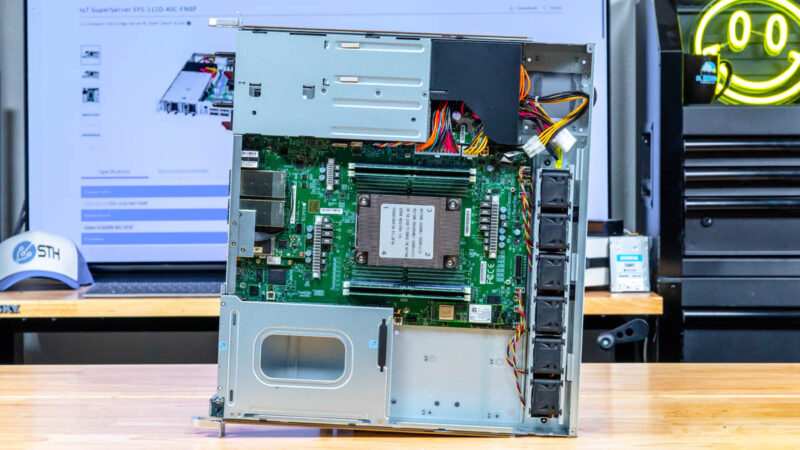
Here is a quick look at the fan partition. These are still cabled fans.
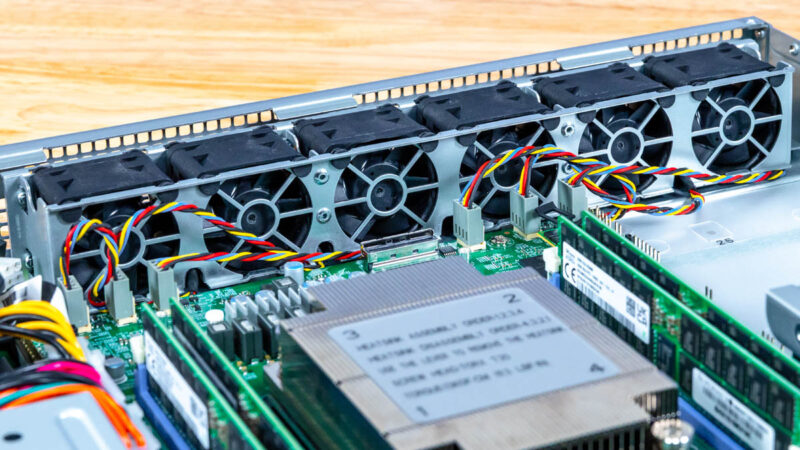
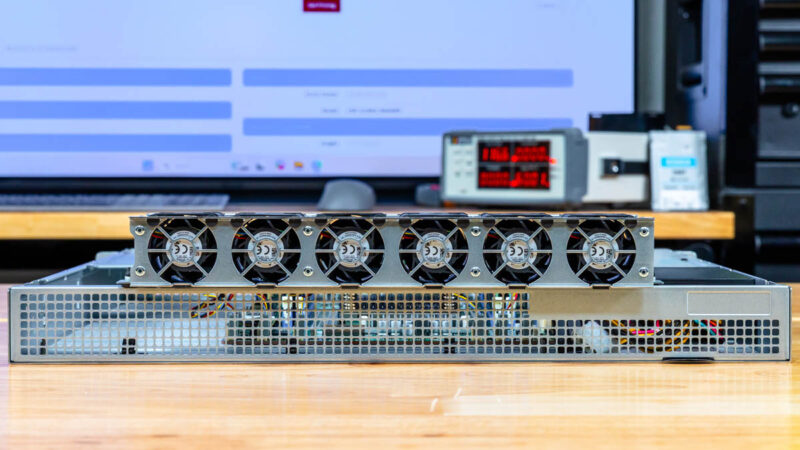
One neat trick, however, is that the entire fan partition can be removed.
On the motherboard, we can see four channels of DDR5-6400 memory, but there are also pads for four unpopulated slots. These are for 8-channel SKUs since the family supports 64 and 72-core SKUs.
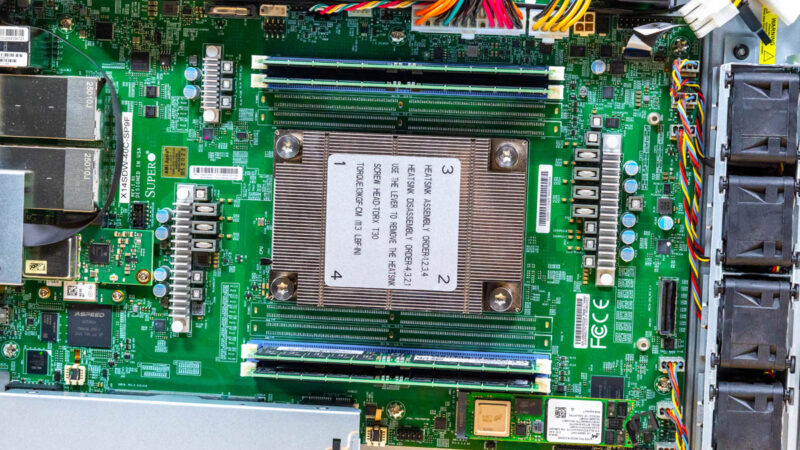
Also, and this might be a small feature, but there is an MCIO connector between the memory and the fan partition. This MCIO connector is what you would use to connect internal U.2 NVMe SSDs. This motherboard does not have legacy SATA ports, which is refreshing to see, but also a trend we are seeing in the industry.
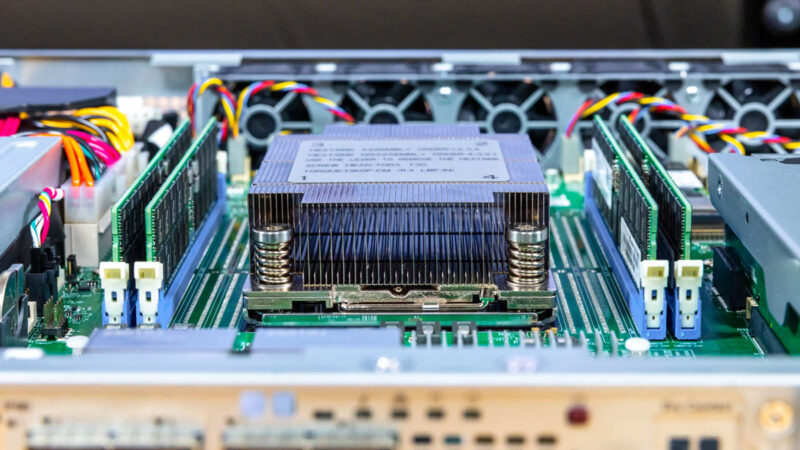
Here is a quick look at the airflow of the system. You can see that Granite Rapids-D is much larger than the Xeon D’s of yesteryear.
Behind the CPU, our system has an optional feature installed. The system we have is an early sample so somtimes they are configured with extra bits.
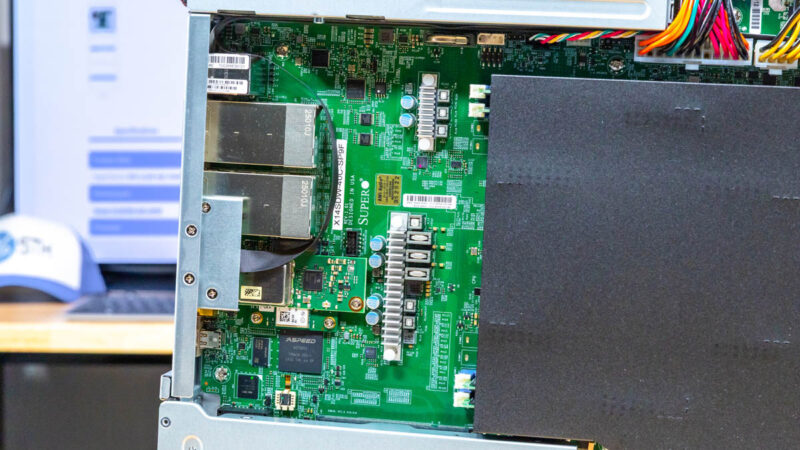
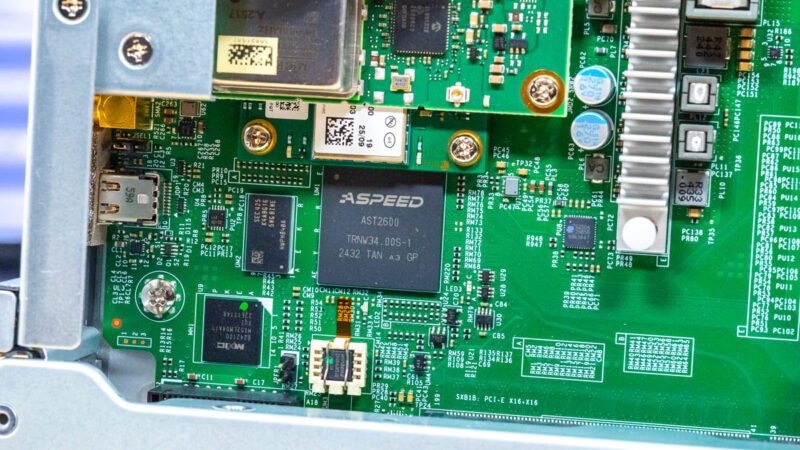
First though, there is an ASPEED AST2600 BMC.
Let us get neat here. This is a Microchip OCXO (OX-228 series) module installed to handle timing. We did not see this in the standard parts list, and so this was likely added to our early sample since it is designed for telco applications. If you are wondering what OCXO is, it is an oven-controlled crystal oscillator. Instead of an atomic clock, this is a lower-cost option that uses a quartz crystal housed in a small, high-temperature oven. The oven prevents external temperature changes from affecting the crystal, giving it a higher reliability, or better said, less drift due to environmental factors. Telecom networks, financial networks, and other highly sensitive networks do not rely on simple time. Instead, have tight, regulated SLAs and standards like IEEE 1588 around accurate timing. That is why our sample server has this.
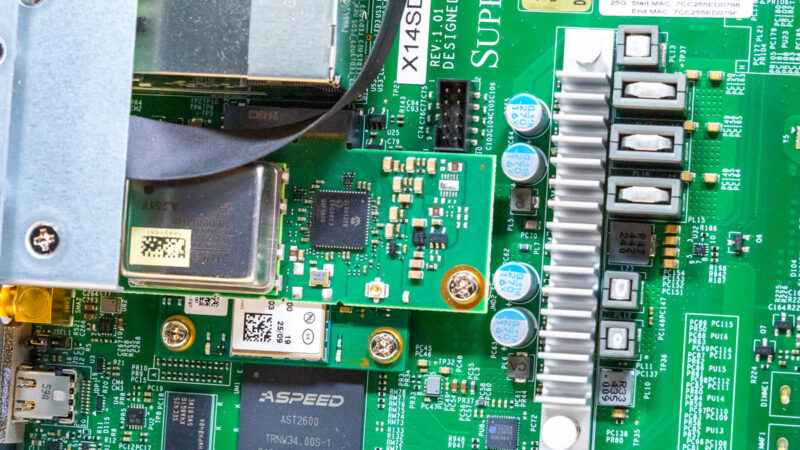
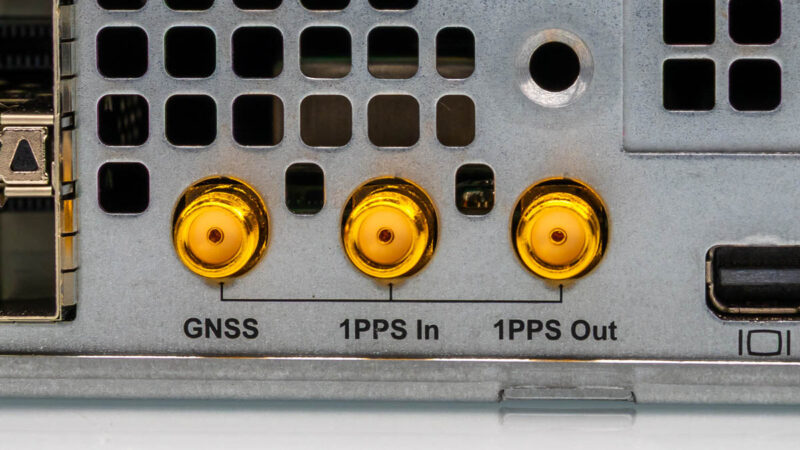
These three SMA connectors are there to connect timing. 1PPS is one pulse per second. GNSS can get time from satellite atomic clocks, often via an antenna on the roof. Another fun fact is that GNSS does not use leap seconds to provide higher accuracy timing. You can see the GNSS module under the OCXO module. If you are wondering why we would need the OCXO module if we are getting accurate time from atomic clocks in space, the reason is that if the external clock signal ever goes down, the OCXO here can keep clock drift to +/- 1.5 microseconds over 8 hours.
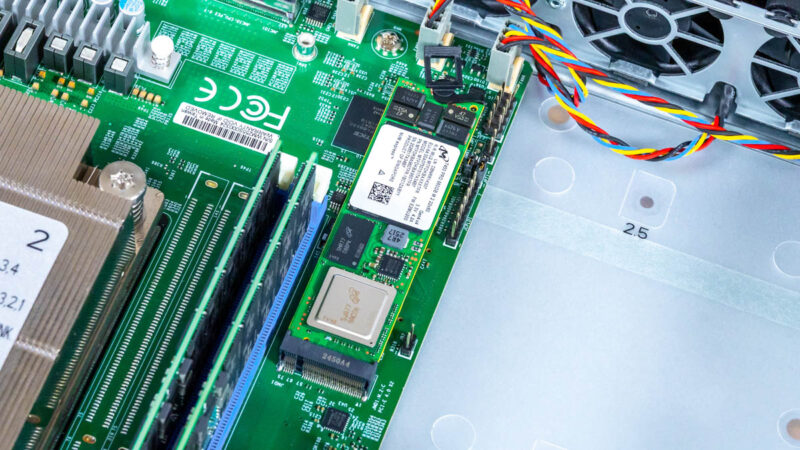
Here we have the M.2 storage. Our system only has the M.2 (PCIe Gen4 x2) storage option. The shipping system also has dual internal 2.5″ NVMe bay points (see where 2.5 is here). Again, we have an early sample, so our system does not have this.
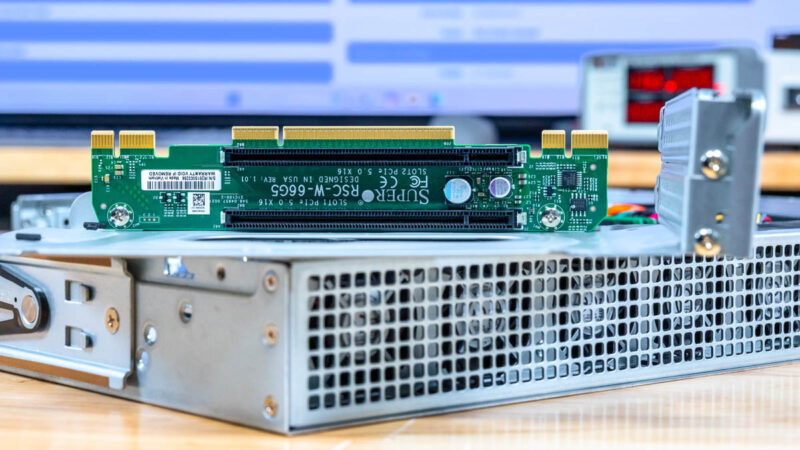
There is, however, a riser slot.
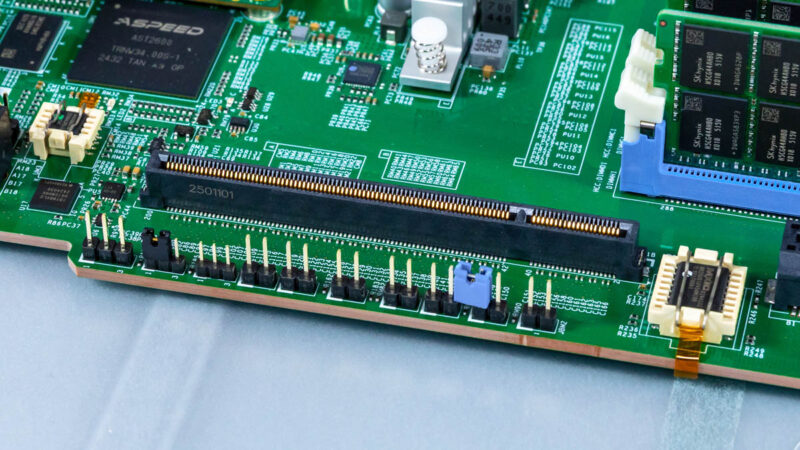
This feeds two PCIe Gen5 x16 slots. These allow you to either install a double-width accelerator or install two add-in cards. We will quickly mention that there is an option for an add-in card with eight additional SFP28 ports for a total of sixteen.
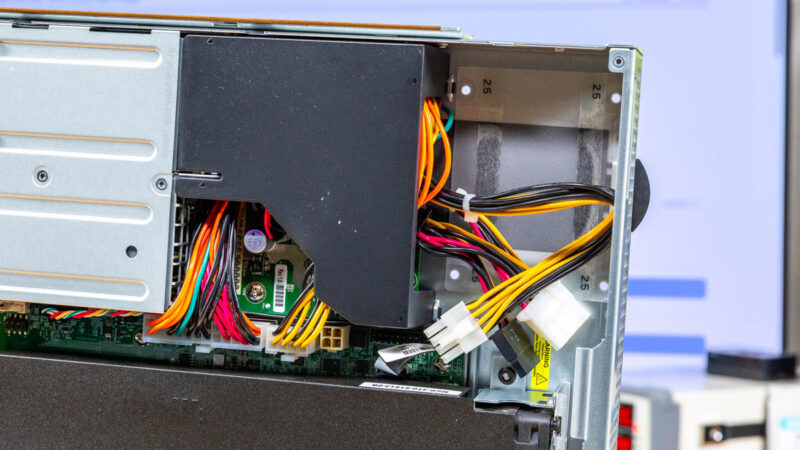
Moving to this side, you can see an additional 2.5″ mounting and some extra connectors for the system.
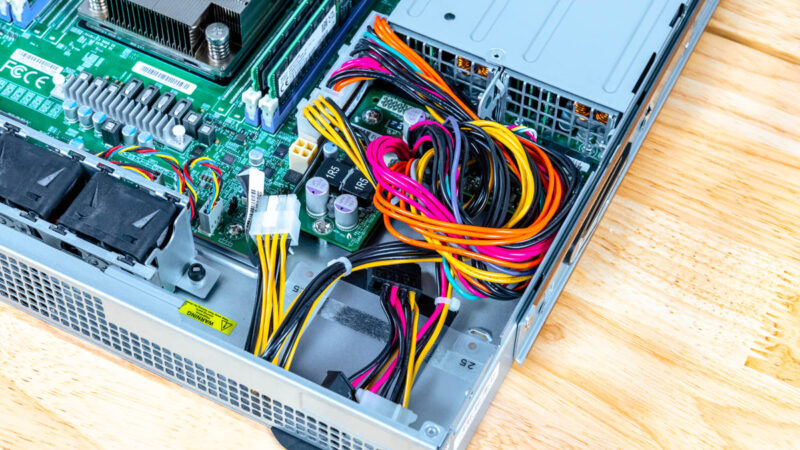
Here is that without the second shroud.
Next, let us get to the block diagram and topology.

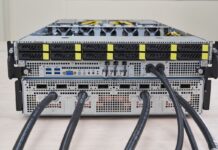
 to provide 8x 25GbE)
This is the best server review you’ve done in the last year
What tool do you use for the core-to-core latency?
@Nikolay it’s an open-source tool called core-to-core-latency written in Rust
On the one hand the 8x25GbE (and a way to expand to 16) makes this seem like an interesting network-focused server — maybe a box doing load balancer duties and firewall for a bunccollection of servers behind it, maybe other tasks like caching/serving static stuff. You can get much better RAM/storage/compute density but you often don’t need that for those sorts of tasks. On the other hand, with 40C it feels like it ought to have more work to do than just that!
Also, the clock stuff is just neat!
@David Thanks for the info!
Is the datacenters also leaving VGA? Wow!
And 25gb/SPF28 NICs
What the world coming to?