

Dell Pro 5 16 (AMD) Laptop Power Supply
While we are looking over the Dell Pro 5 16, here is a quick look at Dell’s included power supply for the laptop.
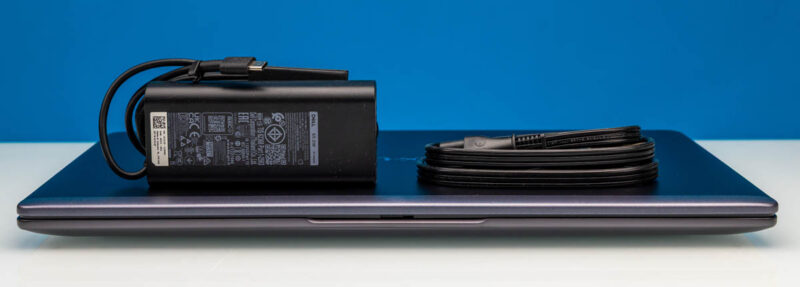
Dell offers a few power supply options for this laptop, and our review sample came with the 65-watt unit. This is a pretty typical 65W adapter, with a maximum output voltage of 20V. It is worth noting, however, that while 65W is more than enough to charge the laptop, when paired with the 70Wh battery it is not a high enough output to support Dell’s fast-charging Express Charge feature. That requires a 100W power adapter, which is an upgrade with this laptop.
Inputs aside, most of this laptop’s power consumption comes from the AMD SoC. With the panel only drawing five watts even at max brightness, the Ryzen AI 9 HX PRO 470 is no slouch. The chip is rated to draw up to 54W at its highest cTDP configuration state. Even with the benefits of TSMC’s 4nm process node, 12 CPU cores and another 16 GPU cores can draw quite a bit of power when everything is running at full tilt.
Final Words
As Dell’s mainstream lineup of business laptops, the Dell Pro 5 series comes close to being a jack-of-all-trades in a lot of ways. These are not systems designed to excel in one specific trait, such as workstation-level performance or working as an ultra-thin laptop, but they are very balanced in their role. That means offering a good trade-off between performance, battery life, size, weight, features, and, of course, cost.
As we have seen with the Intel-based Dell 5 Pro 14 and now the AMD-based Dell 5 Pro 16, no matter whose chip is inside, they hit the mark as mid-tier business laptops. The AMD edition of the 16-inch laptop, in particular, packs plenty of performance and brings a sizeable screen for getting things done. While it is not a full-on desktop replacement, it is still a lot more portable than one.
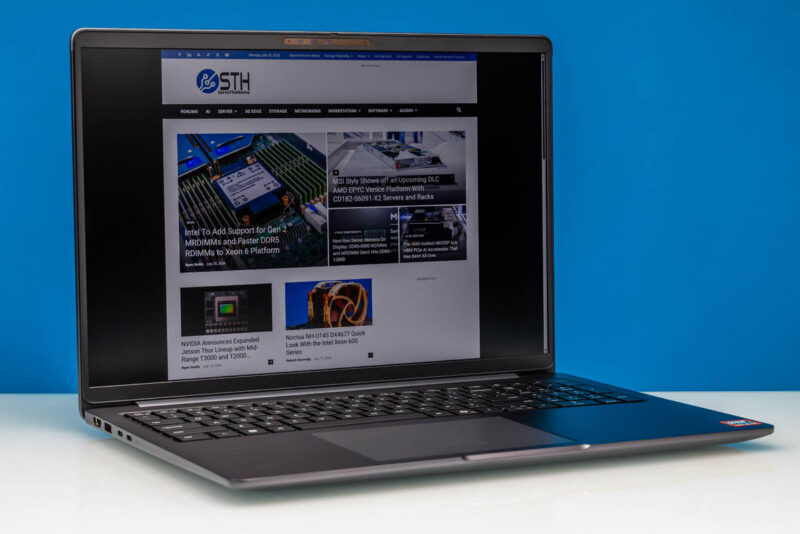
Comparing our Intel and AMD systems, there are limits to how closely we can compare them since the 16-inch AMD system benefits from its larger size. From our data, I do think it is fair to say that the AMD system exists as Dell’s more budget-friendly offering of the two. The Ryzen AI 400 hardware platform is functionally a year older than Intel’s Core Ultra 3, and in heavy CPU and GPU workloads, it shows, with the AMD system trailing by a modest amount. But this 16-inch laptop is nearly $1000 cheaper than the comparable Intel laptop, so that extra performance comes at a not-insignificant price premium. Consequently, AMD’s Ryzen PRO chips still have an important role to play in Dell’s Pro 5 lineup, even if they are not the fastest option.
Performance comparisons aside, the high-level takeaway from reviewing the Dell Pro 5 16 is that it is very much a bread-and-butter business laptop, and it is well-designed for that purpose. Over the years, Dell has developed a tried-and-true corporate laptop design, and the Dell Pro 5 16 is the latest embodiment of it. There is little here that would qualify as flashy, but it delivers plenty of performance, plenty of internal modularity and upgradability, and even plenty of support coverage with a base 3-year warranty. Whether it is an Intel chip or an AMD chip inside, it is a laptop that does everything it needs to, just as a business laptop should.
Where To Buy
If you wanted to find the Dell Pro 5 16 AMD (P516265) online, here is a Dell affiliate link.



LatencyMon results would have been interesting to check whether this notebook is suitable to be used as a DAW for audio processing.
Please add LatencyMon results measuring “interrupt to user process latency”.
Results of a 5-10 minute run with no other applications running.
LatencyMon issues a typical DAW load itself.
The internal layout is a bit disappointing. They clearly used a battery meant for a 14″ device, while they could have very easily fitted in a larger one to improve the runtime and while doing so they also opted for a single 2230 m.2 drive, which is just madness. Also, using SODIMMs with a CPU that could have greatly benefitted from an LPCAMM module or soldered memory is just sad.
It feels like Dell deliberately wants their AMD machines to be inferior to their Intel ones, for some reason, and this isn’t the only example of that. I’m genuinely surprised they included a USB4 controller in the first place.
“Also, using SODIMMs with a CPU that could have greatly benefitted from an LPCAMM module or soldered memory is just sad.”
To note: AMD’s Strix/Gorgon Point SoCs do not support LPCAMM2, unfortunately. They are not quite a drop-in replacement for soldered LPDDR5X, and require some design considerations on the host side. So if removable memory is desired, Dell’s only option here was DDR5 SO-DIMM.
The CPU in this laptop supports two USB4 ports natively. AMDs mobile only silicon has done so since the 6000 series. I’d be very surprised if Dell spent money on an external controller instead of using the native function in the CPU.
@Anonymous
Oh goodness, you are right! This is definitely native. I have gone back and corrected the article. Thank you for pointing that out.