Following Dell’s singular focus on NVIDIA-based client and server AI offerings for the first day of the Dell Technologies World conference, the second round of announcements from the company shifted to the rest of Dell’s server offerings. With an emphasis on what Dell terms the “Modern Data Center,” the company used the second day of their trade show to announce some big updates to their major hardware and service ecosystems, including new PowerEdge compute servers as well as the new PowerStore Elite family of storage appliances.
PowerEdge Gen 18 Gets EPYC
First and foremost, Dell is preparing their 18th generation of PowerEdge servers for launch over the next year. The company’s server arm, which makes heavy use of processors from both AMD and Intel these days, is preparing new generations of servers across its portfolio, based on upcoming processors from both vendors. Overall, Dell is touting performance improvements of upwards of 70% versus their current generation of services.
First out of the gate for Dell later this year will be their first servers based around AMD’s 6th generation EPYC processors, codenamed Venice. Coincidentally, a bit earlier this week AMD announced that they have begun their production ramp of Venice, which is being fabbed on TSMC’s N2 process node. So the pieces are quickly falling into place for Dell’s new servers.
The flagship server out of this new generation of EPYC servers will be the M9825, a high-performance server for high-density liquid cooled installations. Dell is aiming the system at AI users and others who needs as much performance as possible in a fixed amount of space. These servers are designed to be installed in Dell’s existing IR7000 racks, which support up to 480kW of power and cooling per rack.
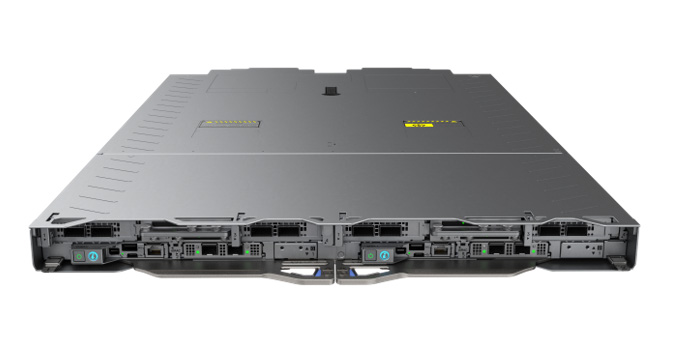
Meanwhile, for customers who need something a little more traditional and a little less dense, Dell is also preparing the R9815 and R9825 servers to market. Based around the same 6th Gen EPYC processors, these are single and dual socket systems that measure in at 2U and 3U in size, respectively. With Venice EPYCs going up to 256 cores, this means that Dell will be able to deploy a 256 core (512 thread) air cooled server in as little as 2U, and 512 CPU cores (1024 threads) in 3U.
And for server customers that need something smaller still, Dell will be releasing a pair of 1U servers also based on the 6th Gen EPYC platform. The R6815 and R8815 will be aimed at enterprise customers looking to consolidate their server offerings, taking advantage of the higher core counts of newer EPYC processors (as well as additional bandwidth) in order to provide the performance of today’s dual socket servers in a smaller and more efficient box.
As for AI customers who need some x86 in their lives, Dell is preparing the XE5845 and XE7845. These are both EPYC-based systems for the accelerated compute market, and will be intended for pairing AMD’s CPUs with NVIDIA Rubin-based accelerators. As with their present-day predecessors, these will be air-cooled systems.
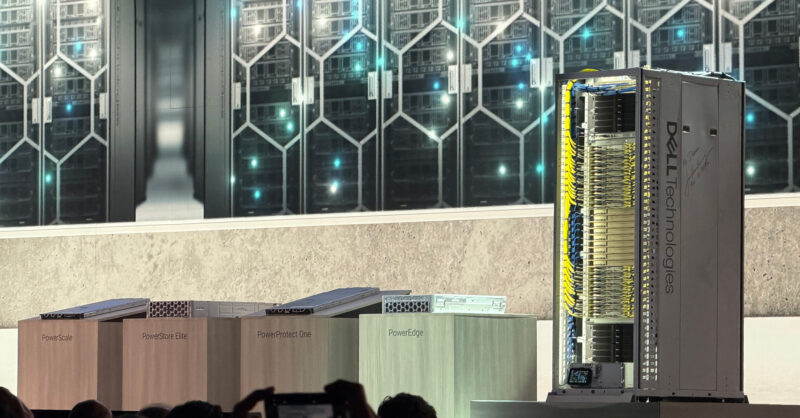
Finally, Dell will also be launching the EPYC-based R7815, R7815xd, and R7825 for customers who need storage and I/O flexibility. The R7815 is a single-socket server, while the R7815xd is its counterpart for storage-dense environments. And finally, the R7825 is a more powerful dual socket version.
Both the M9825 and the R9815/R9825 are slated to become available in the second half of this year, making them among the first wave of EPYC Venice servers to ship. That will be followed up by the rest of Dell’s Venice-based servers, which are scheduled to ship in 2027.
PowerEdge Rides The Diamond Rapids
While the bulk of Dell’s PowerEdge server announcements focused on AMD-based systems (with EPYC Venice seemingly set to be the next-gen chip to ship the soonest), Dell is also preparing at least one server based on Intel’s forthcoming Xeon 7 Diamond Rapids platform.
The PowerEdge R9810 will be a single-socket 2U server for the high-end of the market based around the Diamond Rapids platform. Dell was quick to tout the architectural advancements of Diamond Rapids over the current-gen Granite Rapids hardware, with 50% more CPU cores and upwards of double the memory bandwidth thanks to the platform’s large number of memory channels.
The R9810 is set to ship in 2027.
PowerStore Elite
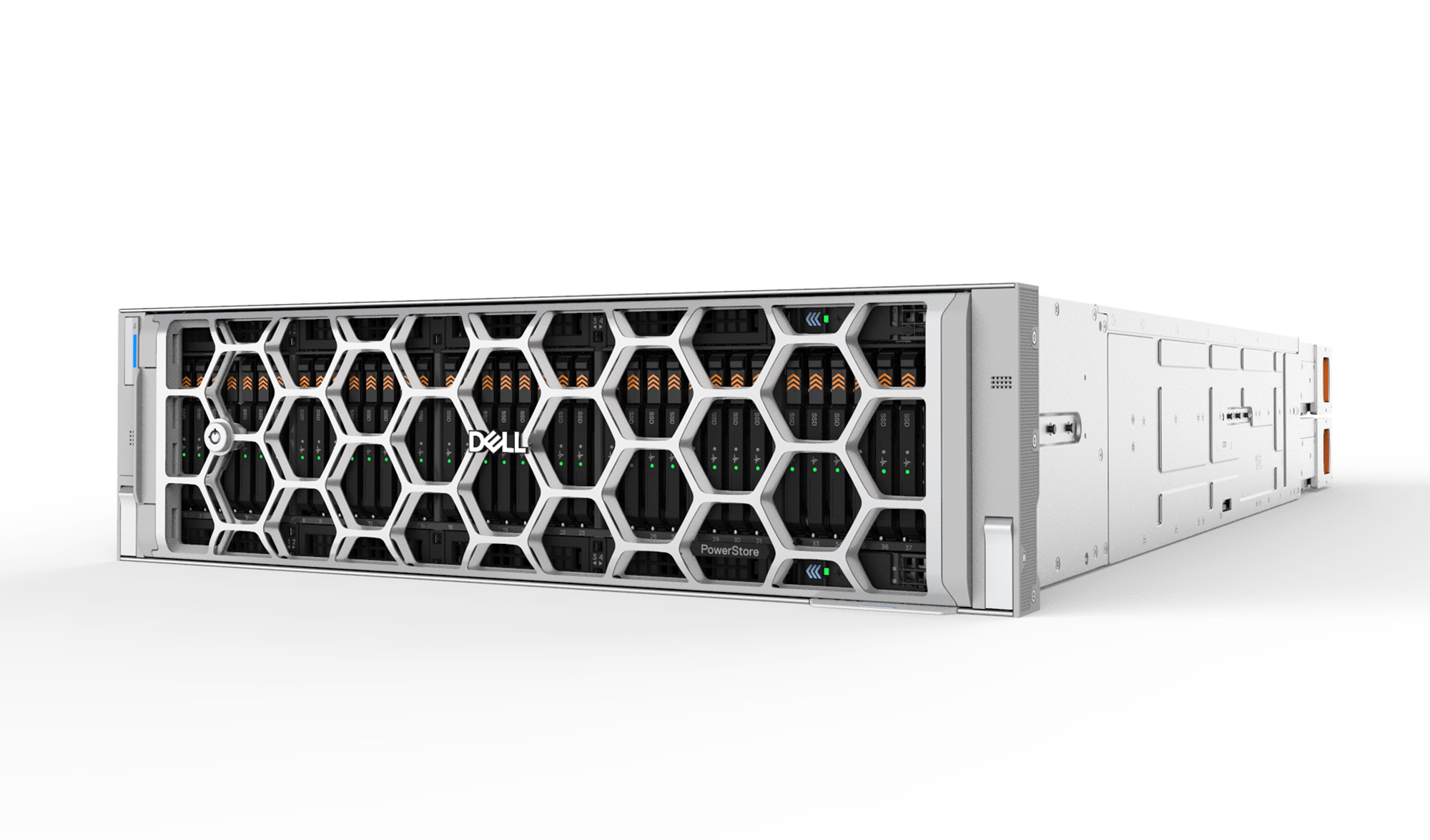
Besides Dell’s compute server offerings, Dell Technologies World also marked the announcement of a new storage server product from Dell, the PowerStore Elite. The third generation of the PowerStore platform, the Elite is an all-new design for Dell, with everything from the internal hardware to the chassis itself getting overhauled.
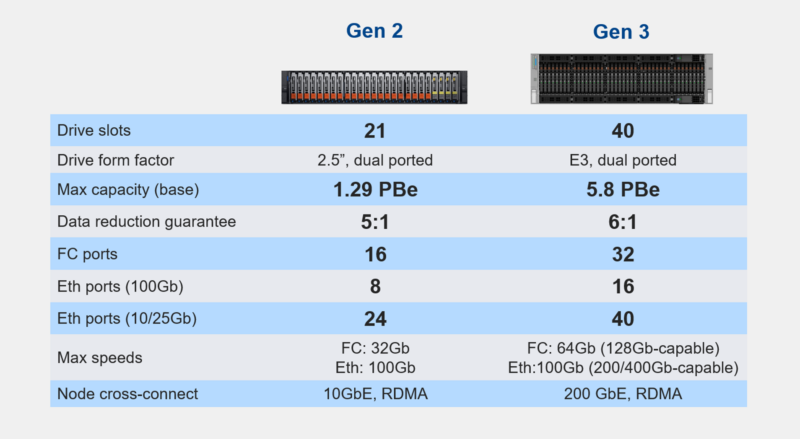
At a high level, the PowerStore Elite is a 3U storage appliance based around Intel Xeon hardware. The sizable storage box has room for 40 vertically-oriented E3 form factor SSDs, allowing it to house as much as 5.8PB of raw storage. And with Dell promising a 6:1 data reduction rate through deduplication and compression – up from 5:1 in the previous generation thanks in part to new features such as unaligned dedupe – the effective storage capacity of the server is even greater.
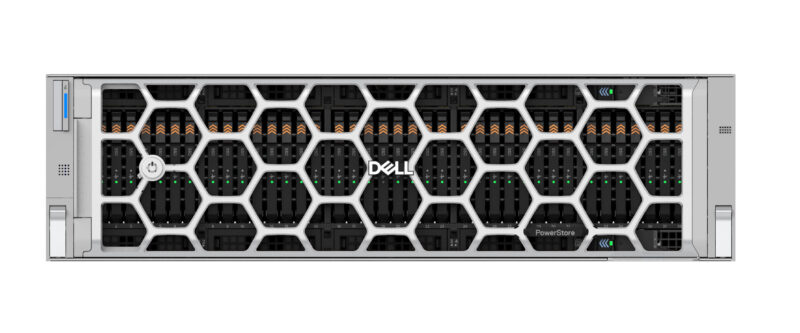
Notably, the Elite is a larger box than its predecessor, allowing for more room for more drives. Whereas the PowerStore Gen 2 was a 2U box featuring 21 2.5-inch U.2 drive bays, the Elite is able to expand this to 40 in-high end configurations thanks to the taller chassis as well as the thinner 7.5mm E3 drives.
Dell will be offering three versions of the Elite: the PowerStore 1500, 5500, and 9500. All will use the same 3U-high chassis, but only the middle and high-end configurations will be able to accommodate a full 40 drives. The key difference between the three is the number of Xeon CPUs installed – and thus the number of available PCIe lanes and compute hardware backing the system – with the 1500 packing one CPU, while the other models will pack two CPUs respectively.
Suffice it to say, a great deal has changed about the storage infrastructure the Elite is built around. Besides the switch to E3 drives, Dell’s updates see the platform make a two generation jump in terms of I/O, moving from PCIe Gen3 connectivity to PCIe Gen5 connectivity for the SSDs and other peripherals. As a result, the system has the potential to extract far more bandwidth from each drive – never mind the fact that there are more of them.
Dell is also taking a rather bold position that they can deliver similar performance with QLC drives as they can TLC, making drive selection a simple choice of cost-per-GB and storage density versus having to plan around drive performance. In effect, Dell is eliminating the idea of QLC drives being a lower tier of storage, putting them on the same level as TLC drives. Dell’s announcement at the show does not go into particular depth on how they are hiding the slower raw performance of QLC drives, but their press release does note that they are relying in part on their Autonomous Data Path technology to use machine learning to optimize I/Os on a per-op basis. As well, the company is leveraging the use of log-structured metadata to cut down on unnecessary writes to high-capacity QLC drives, which further boosts their endurance.
Meanwhile on the compute backend of matters, the new Xeon processors bring a bevy of improvements. Key among this is the additional I/O bandwidth to feed both the drives at the front (one PCIe Gen5 x2 per drive), and the networking hardware that ultimately attaches the storage appliance to other machines. Once it first ships, the Elite can support up to 32 fiber channel ports, 16 100GbE ports, 40 25GbE ports, providing ample bandwidth to other servers, with future headroom for 200GbE and 400GbE connectivity as well. And internally, the cross-node connection is now a 200GbE link with RDMA, up from a 10GbE link on the previous generation of hardware. The newer Xeon also supports twice as much memory, with the transition from DDR4 to DDR5 doubling memory bandwidth overall.
All told, Dell is touting that the PowerStore Elite can reach 3x the density of their gen 2 storage box while delivering on 3x the IOPS and 3x the throughput thanks to a combination of the hardware improvements as well as Dell’s own software.
Finally, it is notable that Dell is going for a highly modular approach for this generation of storage hardware, setting their sights on the platform lasting for a decade or more. The hardware itself is modularized between the drives, midplane, and controller backplane, allowing for the backplane to be replaced as future hardware becomes available. Similarly, the networking modules that go into the server are also modular and can be swapped out. Even the operating system is effectively modular, thanks to the use of containerization, so the software can quickly be replaced and upgraded just like the hardware.
Wrapping things up, Dell expects to begin selling the PowerStore Elite storage servers in July.