This week, I was in Taipei, Taiwan, and I stopped by Gigabyte and saw a working Gigabyte W775-V10-L1. This system is built around the NVIDIA GB300 and a ConnectX-8 NIC, delivering about as much performance as one can get within a 1.6kW power budget. While we were there, someone in the crew noticed that one of the PCIe expansion slots had a black cover. Upon opening the cover, we saw something neat.
As a quick note, this is a system that we covered in our Gigabyte NVIDIA Vera Rubin and More at NVIDIA GTC 2026 piece and in the short above. Still, in Taipei, we saw something extra in the system that had just been powered down from testing.
The Neat Feature Seen in this Gigabyte W775-V10-L1
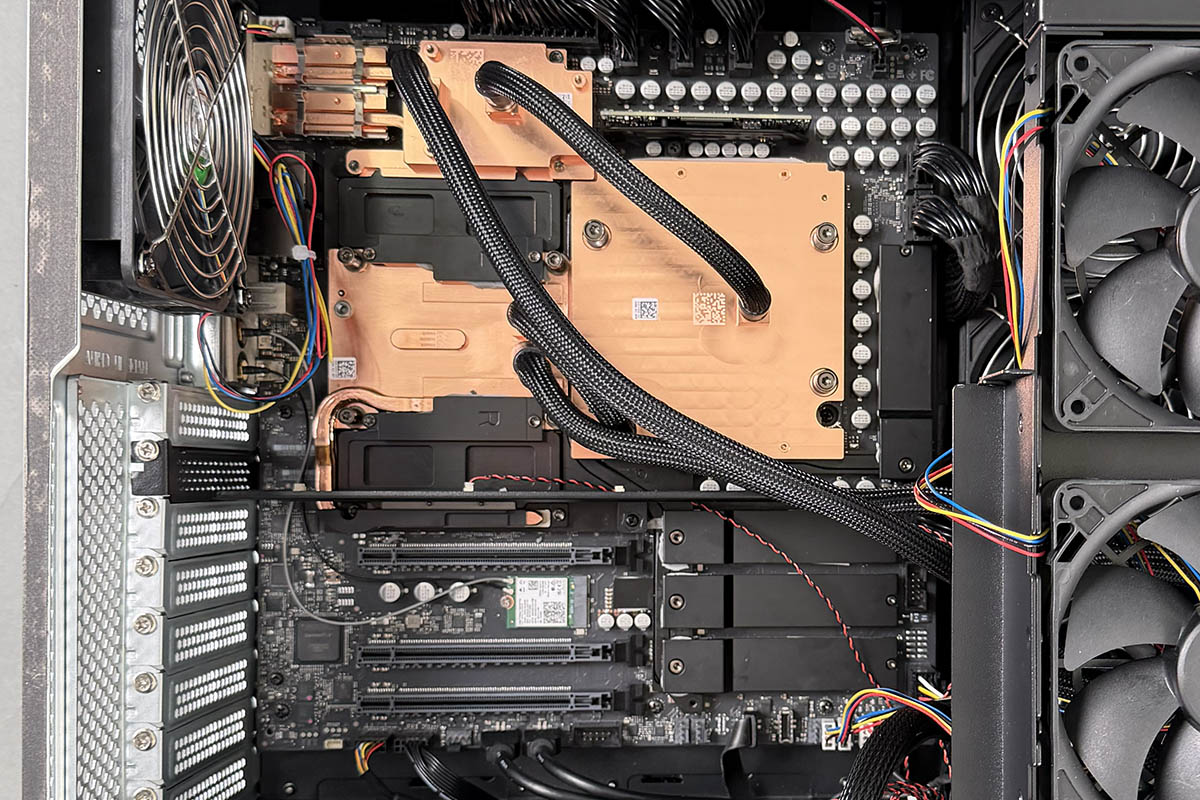
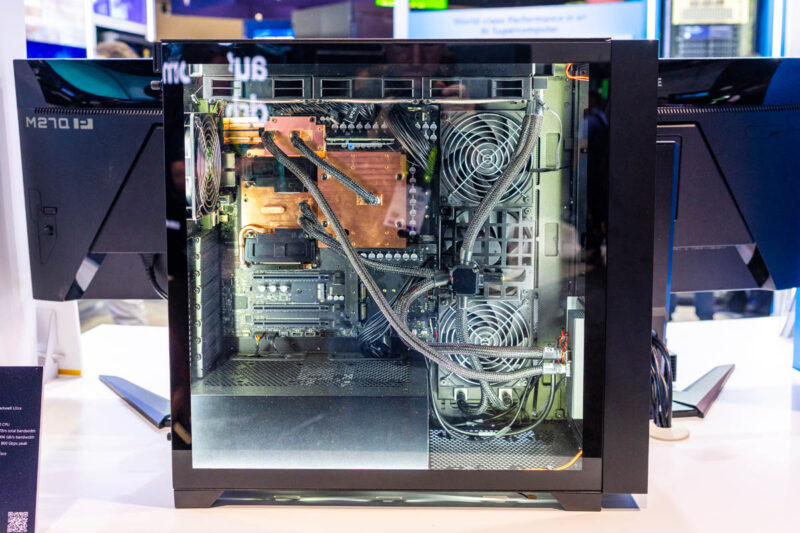
As a quick reminder, here is the system in its tower case. You can see the NVIDIA ConnectX-8 NIC and cooling for the QSFP112 cages on the top, below that is the SOCAMM memory and the NVIDIA Grace CPU. The big copper coldplate is the NVIDIA Blackwell Ultra (B300) GPU.
If you look at the newer image from the Taipei trip below, you’ll see a few new items, including covers for all four M.2 SSD slots (two PCIe Gen5 x4 and two PCIe Gen6 x4), as well as something in the second-from-the-top I/O slot.
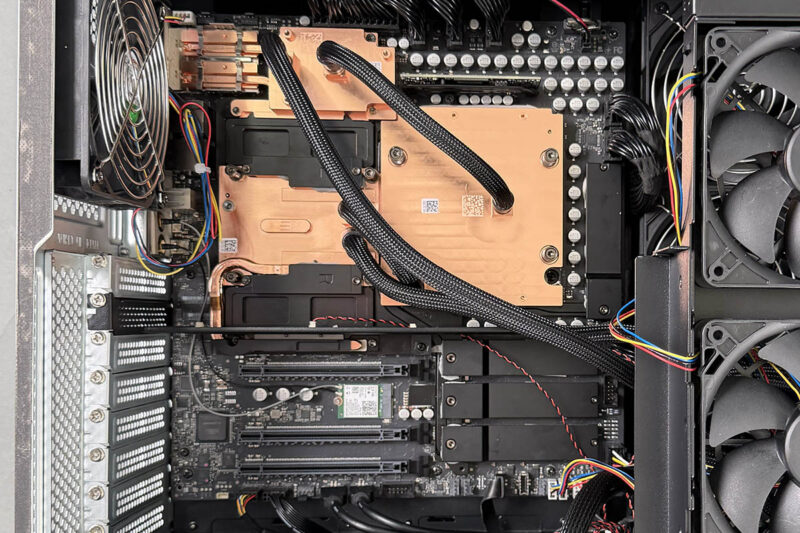
These systems are designed either to run more like servers, using the P3809 BMC (similar to what you would find on GB200 NVL72 systems) for basic management, or to run more like a workstation, with up to high-end NVIDIA RTX Pro 6000 Blackwell Edition GPUs. You might think that the card in the I/O slot is a single-slot GPU at a quick glance. It is not. Instead, as Ada was taking photographs, I snapped this one on my phone:
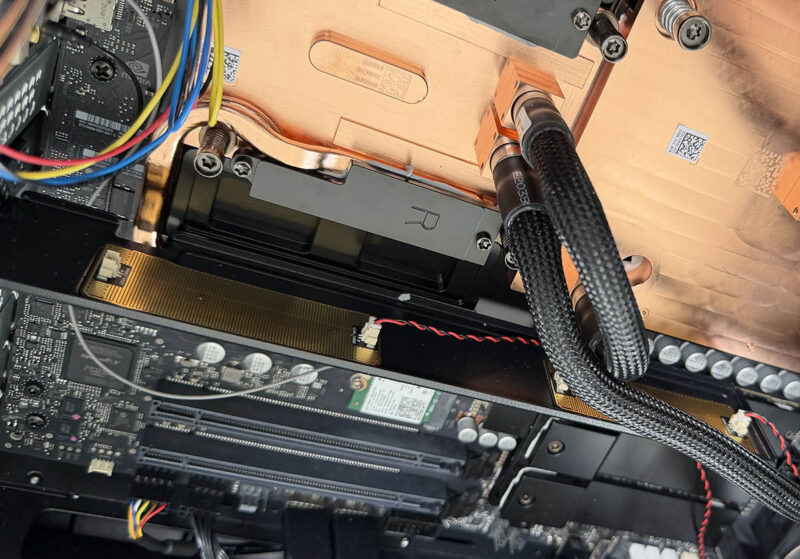
This slender black metal tray was not aligned to any of the three PCIe Gen5 x16 slots (two x8 and one x16). Instead, it is a leak-detection tray that sits under the liquid-cooling connectors in the system. The idea is that if there were a leak, the liquid would go into this tray, and the leak would hit the sensors, triggering automated shutdowns.
Final Words
This is a really neat system. A fun fact is that this is the first workstation we have seen with two PCIe Gen6 M.2 slots, which is unique, though we have not yet seen PCIe Gen6 M.2 SSDs. Still, I just thought this was a neat feature. We see these types of leak detection sensors in higher-end GB300 systems. They are now quite commonplace in AI servers. At the same time, they are not common in DIY workstation liquid-cooling loops. The AI industry is driving liquid-cooling innovation and investment, often from folks who started DIY liquid-cooling loops for their workstations. This feels like the precursor to a tray that could one day be adapted for DIY builds, so folks doing liquid-cooling in their workstations can achieve a higher level of safety.