

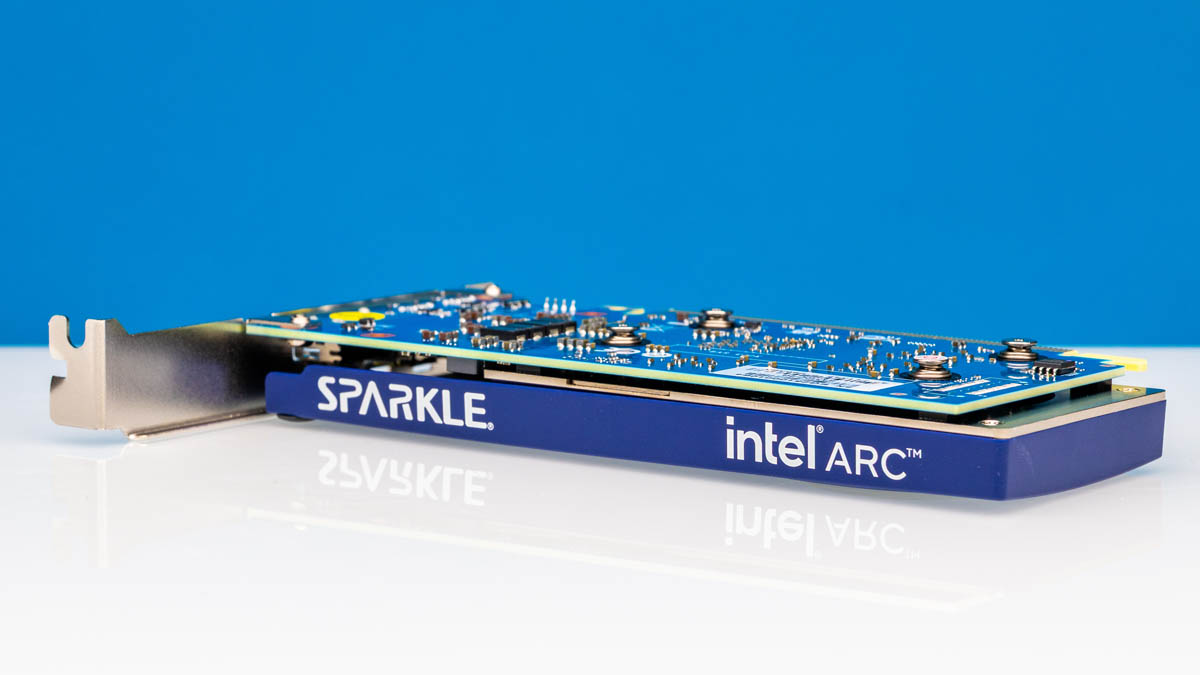
For the holiday weekend, we thought we would quickly cover a card that is not new but does check a couple of boxes. Mainly, it was a low-profile, single-slot, low-power GPU we could add to a server. Here is the deal: this is not the GPU that folks are going to be excited about for high-end AI or gaming with 4GB of memory, but sometimes, you just need a GPU.
We purchased ours, and here is an Amazon affiliate link to what we purchased.
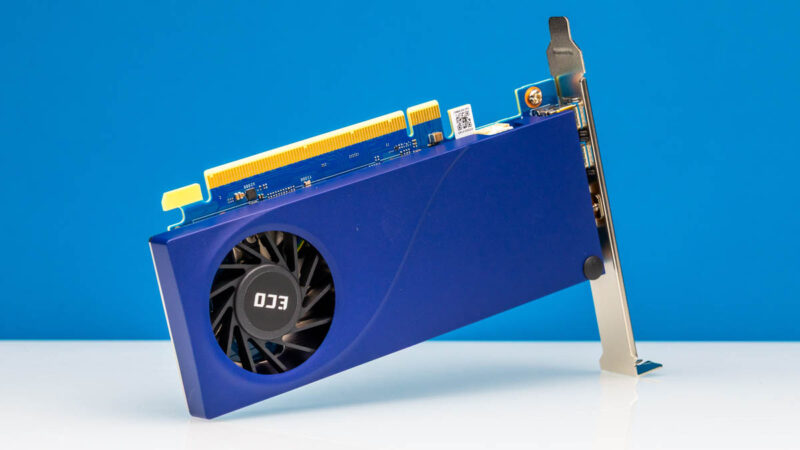
SPARKLE Intel Arc A310 Eco 4GB Hardware Overview
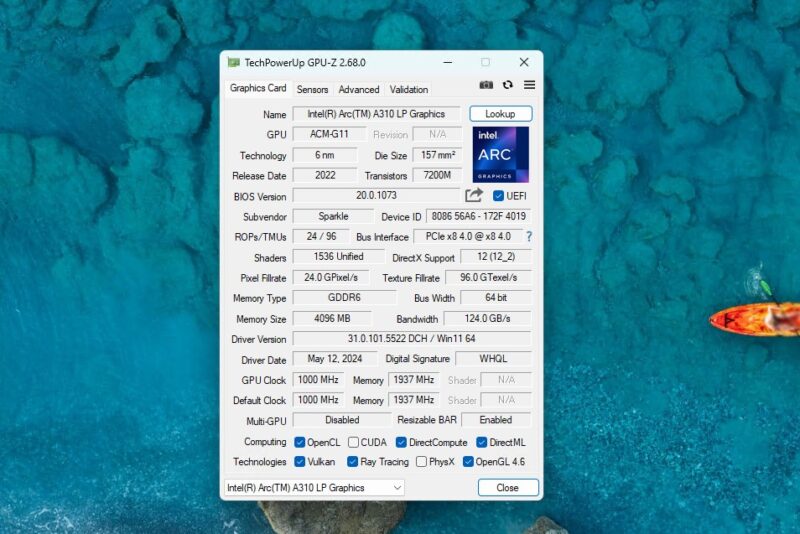
If this was not obvious from the name, the GPU onboard is an Intel Arc A310 based on the Alchemist generation with 6 Xe Cores, 96 XMX Engines, and 4GB of GDDR6.
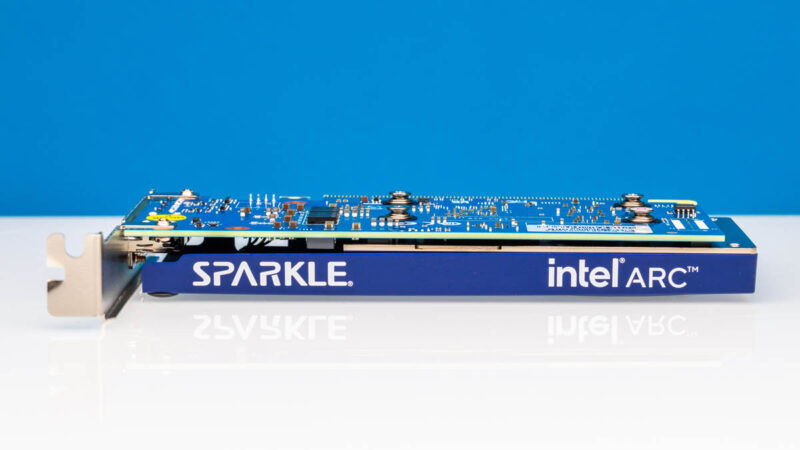
The card is not fanless, and for many applications, that is exactly what folks want. Most modern 1U and 2U servers can cool a 50W low-profile card without issue. On the other hand, some small-form-factor PCs have limited airflow.
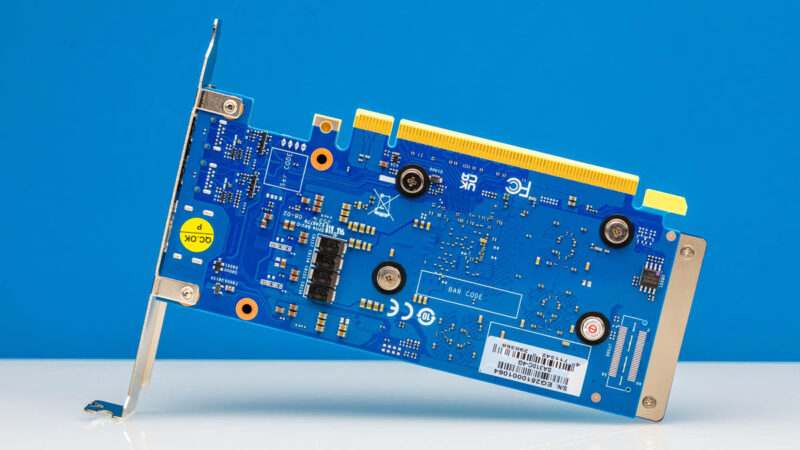
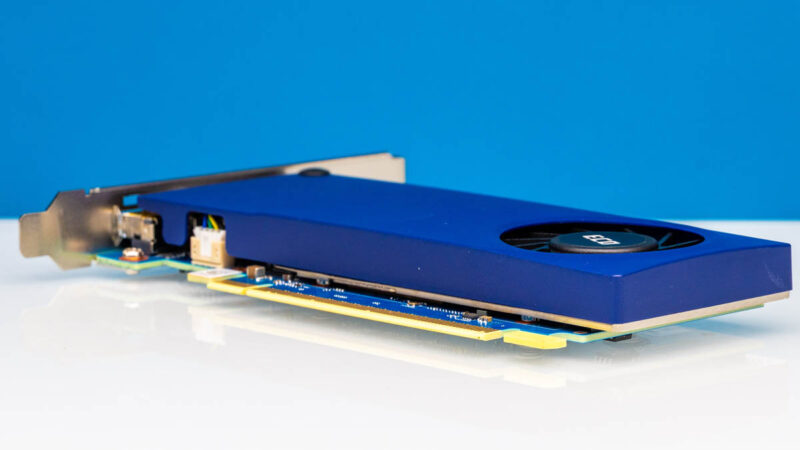
Here is the back of the card. You can see the bracket mounting points that can be used to swap out the full-height and low-profile brackets.
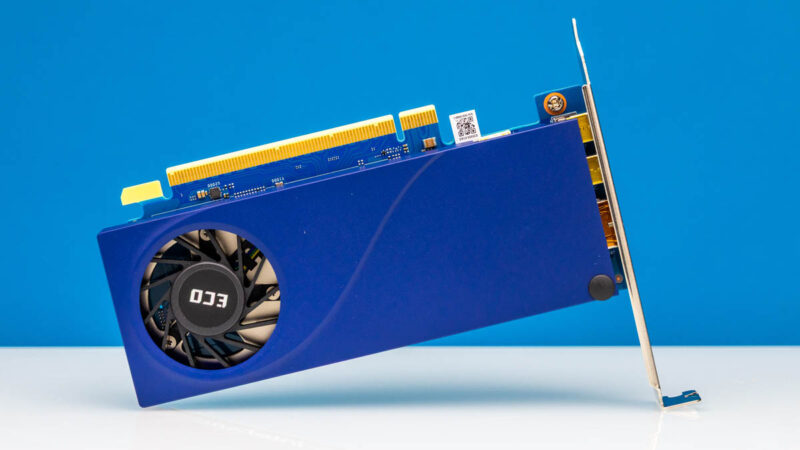
Here is the cooler and airflow from the edge of the card.
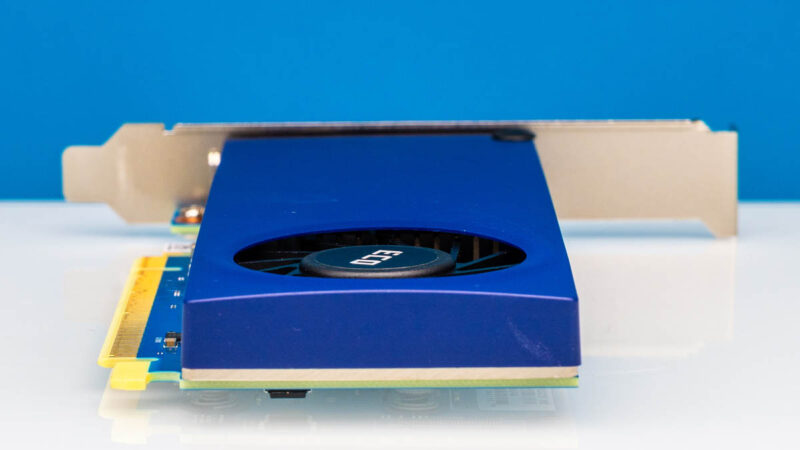
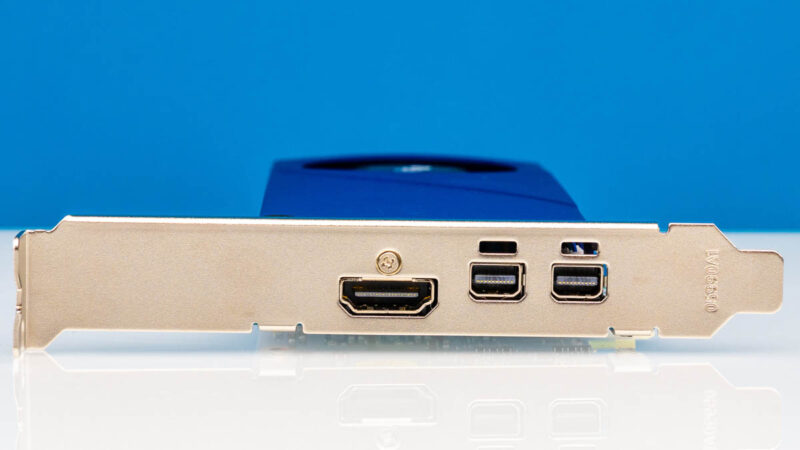
Many cards have large vents at the rear and carefully duct airflow. This is not that kind of design. Instead, on the rear I/O panel, we get an HDMI port and two mini DisplayPort outputs.
From a PCIe standpoint, this is a PCIe Gen4 x8 card, albeit in an x16 connector.
Plugging the GPU in, we immediately fired up GPU-Z. We can see that we have an Intel Arc A310 LP GPU.
We installed this into the Minisforum MS-02 Ultra as an alternative to the higher-power dual slot GPUs so that we could still use the second expansion slot for an additional card.
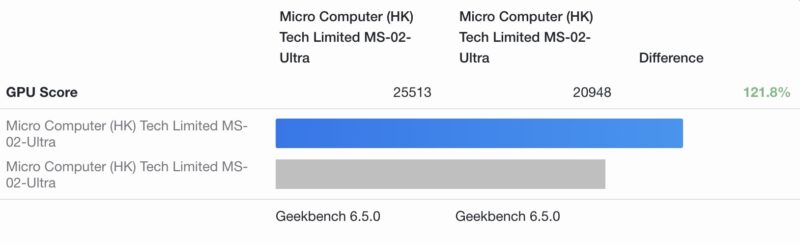
When we fired up a quick Geekbench, the results showed a difference, but it was far from a game changer under Vulkan.
OpenCL showed a similar delta.
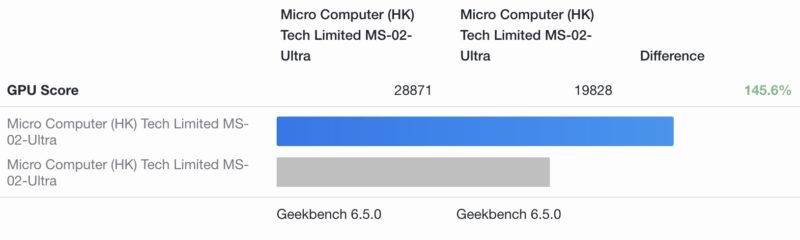
Overall, it makes sense that we are not seeing a significant difference. At the same time, we wish it were a bigger delta over modern integrated graphics.
Final Words
We actually buy a fair number of low-power GPUs for the lab, even if they are not the fastest. Sometimes, just having an extra GPU is useful for a system. A great use case for this might just be adding video transcoding capabilities to a system. This supports h264, h265, and AV1 encode/ decode, which can be useful if you are building a server with server-class Xeon or EPYC CPUs, and yet you need video codec offloading. At the same time, while the NVIDIA RTX 5060 low-profile cards put the GPU performance and capabilities (e.g. CUDA support) into a new level in the Minisforum MS-02 Ultra, the Arc A310 LP is going to be too close to integrated graphics for many. It is also an aging architecture.
These cards were never designed to be the fastest on the market. Instead, these are designed to offer capabilities like extra display outputs, video encode/ decode offload, and moderate GPU performance into a compact, low-power design. While they may not be as exciting as high-end GPUs, sometimes, these GPUs are just what you need.



Could this theoretically function in an x1 slot with a x1 to x16 adapter, or will that be too slow?
I suspect that Sparkle has access to better market research than I do; and is quite possibly correct about the display(potentially read ‘TV’) that the target customer will be using; but I hate to see the big fat HDMI port eating what could be 2 mini-DP outputs(4 displays supported according to Intel’s spec sheet).
It’s not a speed demon or anything; but with what displays don’t cost these days(until you start going above 4k) having inexpensive, reasonably undemanding, fairly well supported with open drivers, choice for just throwing lots of heads at the problem would be attractive.
Unfortunately the AV guys seem to have dug in well enough that HDMI will probably plague PCs for the indefinite future.
This niche may be too small to be of interest to them(even the Data Center GPU Flex” parts have enough GPU for VDI and some ‘AI’ stuff, not sure if there was ever a hyperscaler only oddball with no public release); but, theoretically, I’m curious what an Intel just-our-well-liked-transcoding part could look like.
Is it not as much of a ‘hard’/’fixed function’ block anymore and would actually require dragging along everything from the lowest-end ARC part except the DP outputs, making the savings effectively nonexistent in exchange for ruining it as a normal GPU? Is there a teeny little fixed function block in there that could be neatly sliced off from most of the die area of the full GPU?
Is ReBAR needed for this?
Is this card supports 4K 10bit HDR on mini displayport output?
It sure would be nice if AMD disrupted this segment with a retail release of the RX 7400, or similar RDNA4/5 cards.
@fuzzyfuzzyfungus This isn’t even a professional card, so it’s not a surprise to see HDMI. If it were the nearest equivalent, the Arc Pro A40, you would get 4x mini-DP.
@Carpet Man : sure as an A310 is not suitable for gaming anyway it will work to connect some displays and do officework/development on them
@Francis : No rebar needed. Might help with gaming performance, but then you don’t want an A310.
I use one in my Truenas Supermicro box along with Tdarr to convert video it does quite well and was great that it required no extra power cables.
I have to warn people that this card has the infamous “pulsing/annoying fan behavior” where when idle, the fan never sits still and always pulses/changes the RPM. The bearings are also not quiet and I have my doubts they would last for years to come.
I bought this card a couple months ago to use it for video streaming from linux desktop to another machine using the sunshine/moonlight combo, but it failed there. Generally worse performance then integrated GPU in Ryzen 7700 (which I wanted to replace cause it could not do 4K60 without dropping frames), and I expected better, given that this is supposed to accelerate even AV1 and all that. Alas it has failed me, the video even had a tearing in it which I could not get rid off no matter what, and that was not present on the Radeon. It is usable for content consumption and decoding, yes. As a cheap “additional card for other outputs” yes, but the encoding was a disaster for me.
Too bad Intel blocks the A310’s from being functional to VM’s. There’s some limited work-arounds but the active blocking hurts use for media transcoding vm’s.
@cheezehead works fine in a docker container
I have this card and am able to passthrough it to QEMU guest for transcoding workload. It’s on a desktop / consumer motherboard FWIW.
@JJ If you install the card in a Windows machine and do a driver update, it will install new firmware which fixes the fan pulsing. After I did that I put it back into my Linux box and it’s been working fine ever since, although it’s still a little loud.
@Cheezehead, DaveH is right; mine is allocated to a Jellyfin container in TrueNAS where Jellyfin has sole access to it.