Supermicro SYS-112D-36C-FN3P Power Consumption
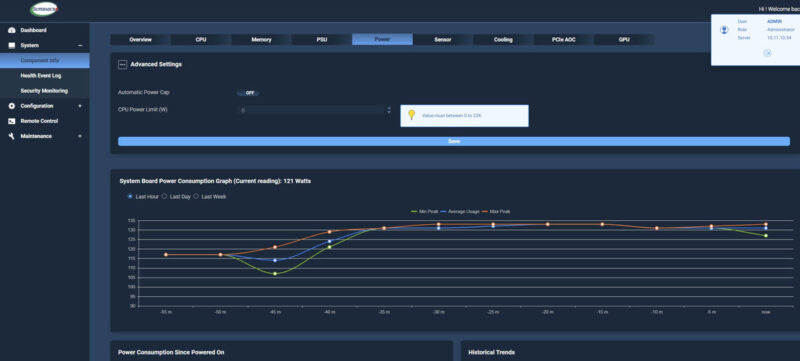
Supermicro offers a number of power supply options, but we have the 800W units designed to power not only the 235W TDP Xeon SoC, but also add-in cards.
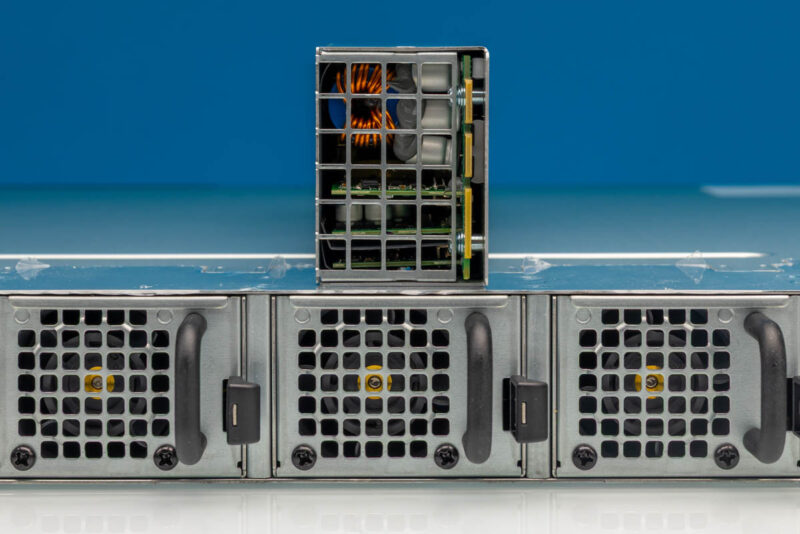
Idle power usage was significant. We generally saw idle in the 105-135W range, and we saw peaks close to 300W. That is nowhere near the power supply limits, which leaves plenty of headroom for adding a large PCIe accelerator card.
Many folks ask about noise in our reviews. We do not publish that for servers. This box is designed to be tucked in a closet and out of earshot. Though it is not quiet by any means (nor anywhere near the loudest server), it is not loud.
STH Server Spider: Supermicro SYS-112D-36C-FN3P
In the second half of 2018, we introduced the STH Server Spider as a quick reference to where a server system’s aptitude lies. For this system, networking and form factor are major parts of the story.
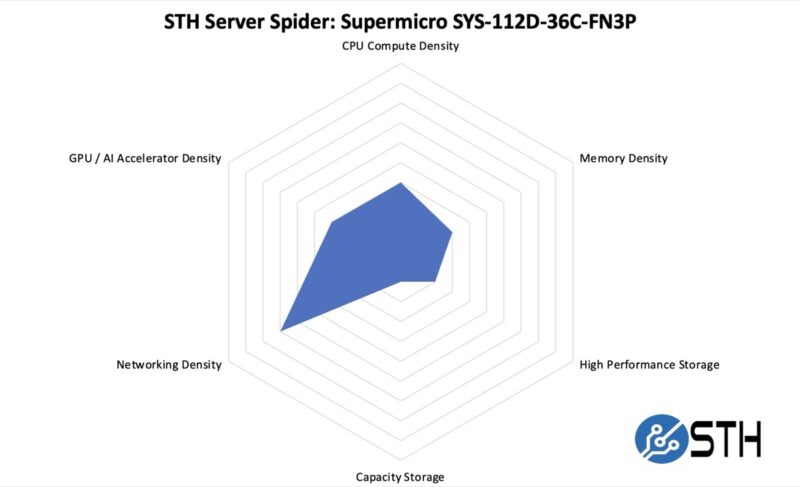
Having the dual 100GbE networking built in, plus an additional expansion slot for more networking, is perhaps the story here. On a core/ U basis, this is much denser than previous systems, but we are also in an era where 1U servers (albeit deeper ones) can have over 10x the core count. Buying this class of server is really done because you want what the Xeon 6 SoC offers in terms of integration.
Final Words
Given how popular 100GbE is, the Supermicro SYS-112D-36C-FN3P’s networking layout will make a lot of sense in locations where that 100GbE networking is needed. For network appliances and CPE gear, having that all built in with a fast processor is very useful. We should probably take a moment here to note that this is just one configuration, and the built-in acceleration varies by SKU, as we discussed in our Intel Xeon 6 SoC Family Overview. While we have one version here, Supermicro designs its line to use different SoCs based on what customers need.
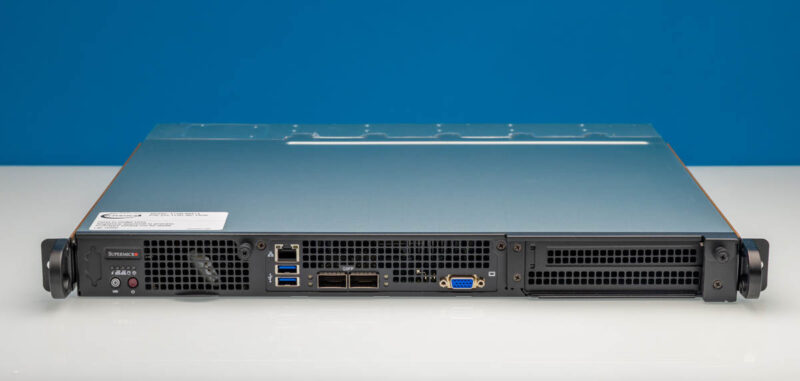
Compared to the first 8-core Intel Xeon D-1540 we reviewed many years ago, 36 cores running at higher clock speeds with much more integrated network bandwidth is a big step up. Another way to look at it is to compare it to systems when the original Broadwell-DE was launched. This chip uses more power, but it offers bandwidth and CPU performance more akin to a Xeon E5 V4 dual-socket server with add-on cards, yet it fits in a short-depth 1U chassis. It is quite amazing to see the generational changes here. At the same time, Intel has moved the Xeon D line to be very focused on edge deployments, so some of the old allure of having a low-power integrated virtual machine host based on Xeon D was lost generations ago. Nostalgia cuts both ways.
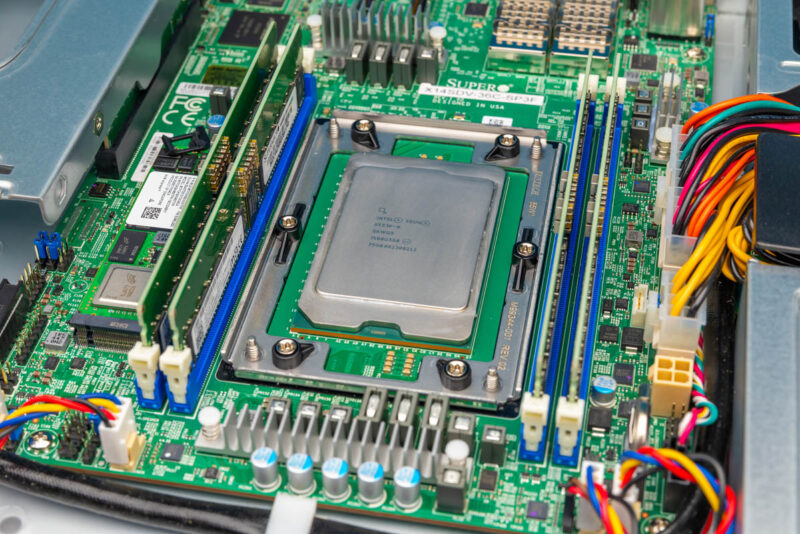
Overall, the SYS-112D-36C-FN3P is a strong reminder that Granite Rapids-D systems are not one-size-fits-all. Supermicro now has a variety of systems that can target different network configurations, core count configurations, accelerator configurations, and even physical environment layouts (e.g. front or rear power.) It was neat to look at two of these back-to-back to see how they differ.