

Qotom Q30952UE Performance
The Intel Core i5-8260U is a 4-core/ 8 thread CPU that is aging at this point. Launched in 2019, it falls into the category of CPUs that are probably inexpensive to build into a system like this. It is probably fair to say that there are newer, faster options, but we are testing another Qotom system at the same time as this one, so we are using that as a comparison point. Plenty of Intel Core i5-8260U benchmarks are out there if you want some other comparison points. Let us get started with latency.
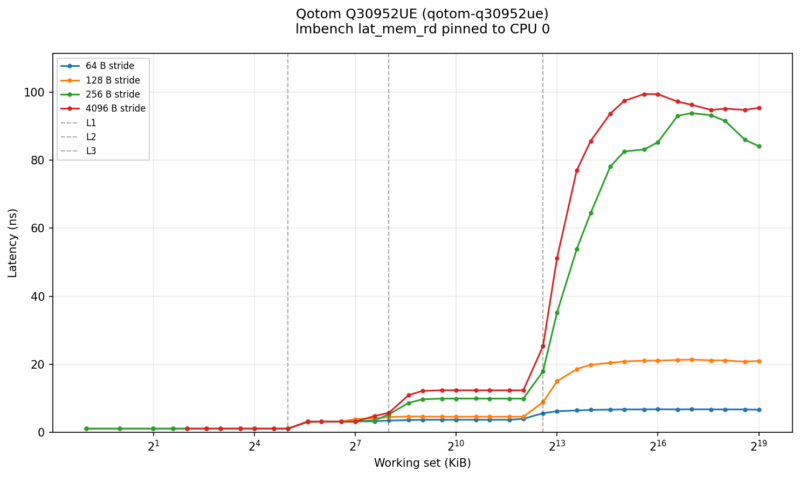
Intel Core i5-8260U Latency
Starting with lmbench, here is what we get:
We also ran the core-to-core latency on this one:
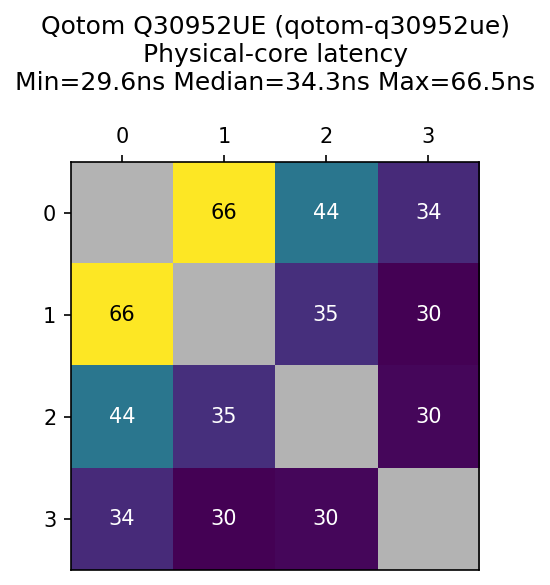
This is one of the smaller CPUs we have tested recently so it was a bit of a throwback.
Geekbench 5 and Geekbench 6 Performance
In terms of Geekbench, here are the two Qotom systems starting with Geekbench 5 single-core results:
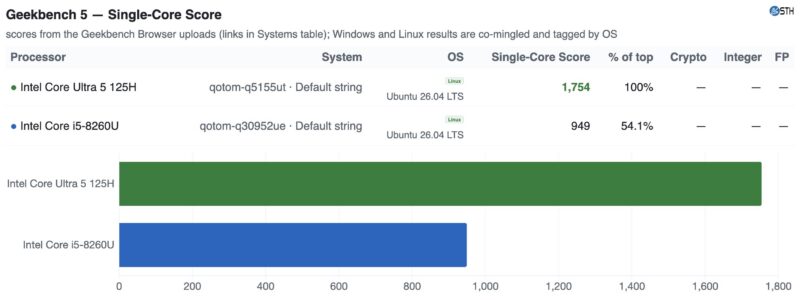
Meteor Lake is faster, which makes sense given that it is a four-year-newer CPU. Here are the multi-core results:
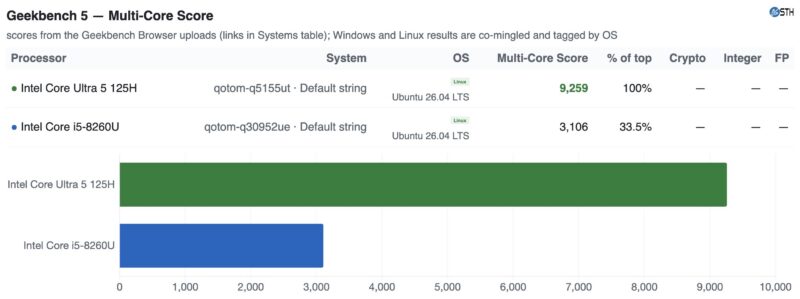
Geekbench 5 tends to have a decent multi-core result, as it is really a throughput result, important for network devices.
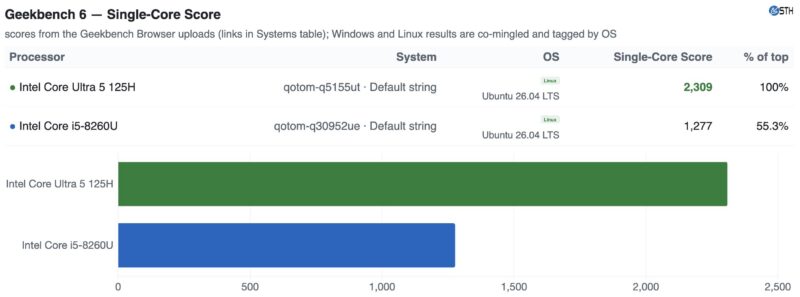
Here is Geekbench 6 single core:
Here is the multi-core score:
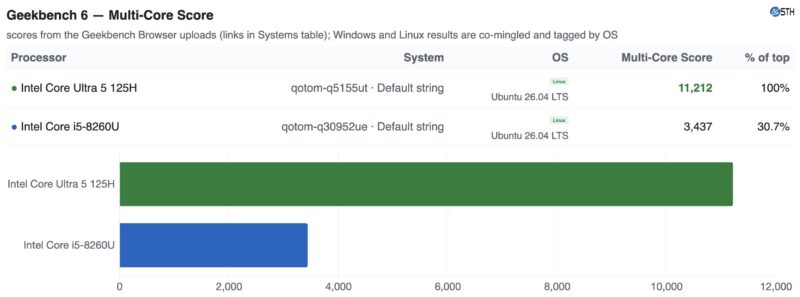
We are just going to note here that, aside from having a newer CPU with more cores and dual-channel DDR5 memory support, the other Qotom system also had more fans so better cooling.
AgentSTH V7 Performance
AgentSTH V7 tests the system in terms of agentic AI CPU performance. Effectively, we are doing tasks in agentic AI workflows without the LLM to test the CPU performance. Starting with the single-core results, here is what we see on these systems, plus some of the more traditional E-core machines.
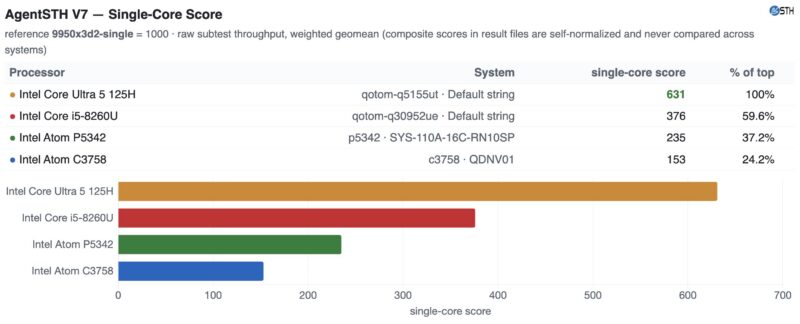
Having the bigger SMT cores helps a lot.
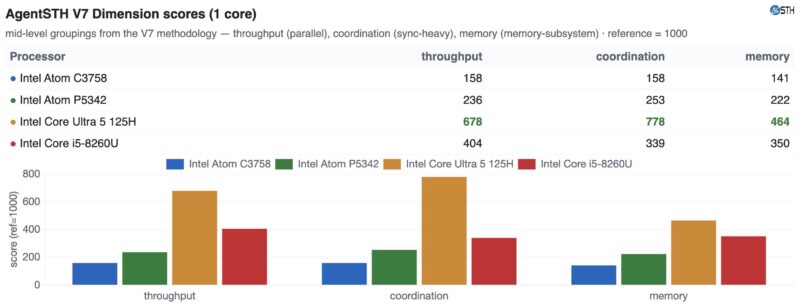
When it comes to scaling beyond the single core, we start to see the limit of the single-channel DDR4 memory and SMT cores.
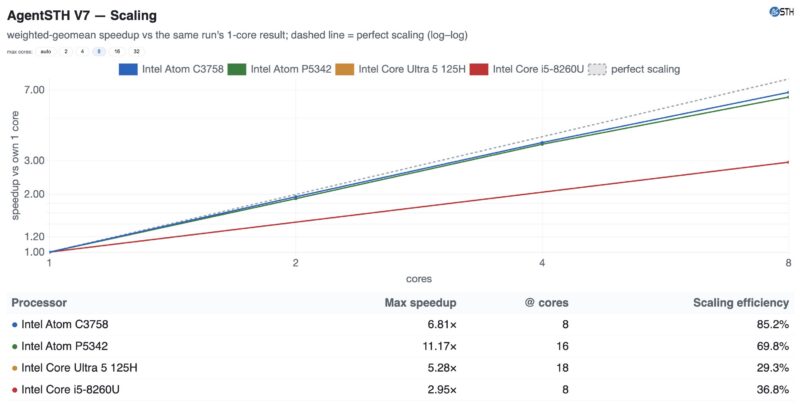
Overall, this was interesting just because of the single-thread results, but with scaling to eight threads, we can see the impact of having only four physical cores.
Estimated SPEC CPU2026 -O3 Performance
We also run SPEC CPU2026 using a low optimization level with just LLVM22 and -O3. These results are estimates and are not the same as those published on the SPEC website.
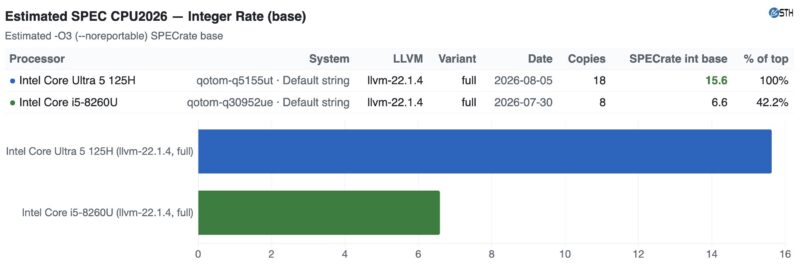
On the integer side, this is what is most relevant for a networking appliance.
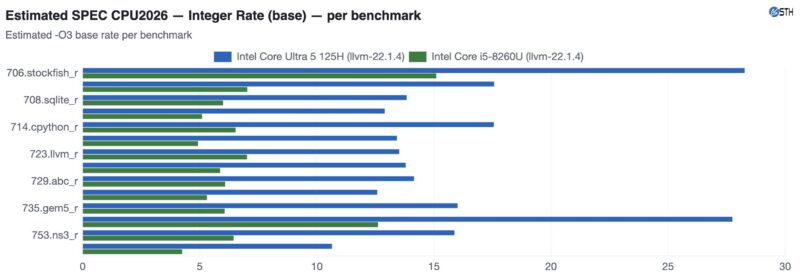
We also test the floating-point performance.
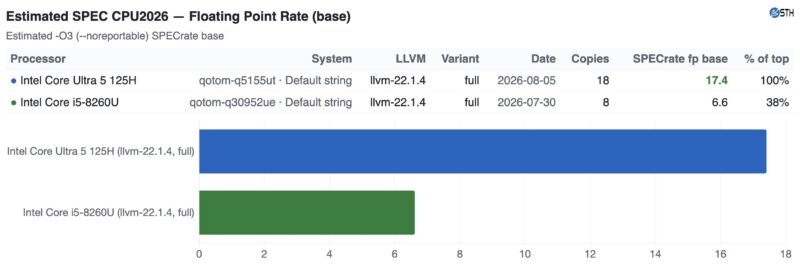
Here is the detail on the FP side.
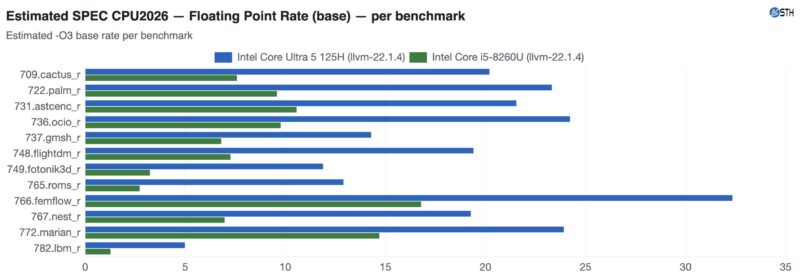
I think the overall takeaway is that the Intel Core i5-8260U is a low-power quad-core CPU, so it just is not as fast as many of the newer options out there.
Next, let us discuss the power consumption and noise.

Your AliExpress link is currently $850 for what appears to be barebones. I found the same thing new on eBay for $500. Single SODIMM is a slight performance hit, but no ECC support. A used Edge SDWAN 640/680 system comes with name-brand industrial 32GB ECC DRAM and 256GB SATA SSD. The only advantage here is 2.5GbE, video output, and maybe 2~3x processor.
Would have been great to see some network performance testing with Vyos installed, in both standard l3 routing, and NAT + stateful firewall.
I wonder why they don’t use DMI data to name the ports,. instead of leaving it up to the slot, port, and function number naming?
If they set their DMI data correctly, they could name the ports eno1 through eno8.
I agree with Alan, this seems like a good firewall unit so some relevant benchmarks would have been great.
For me the noise is a deal breaker though, my firewall lives next to my telly.
It looks like the fan is oriented as an exhaust? If so, it will suck all the dirt through the ports, not a very good decision, but easy to rectify.
“In terms of Geekbench, here are the two Qotom systems starting with Geekbench 5 single-core results:”
This is the first time the article mentions the Q5155UT. Why are you comparing to that model, as opposed to the two other Qotom models you already reviewed (linked in the first paragraph)? Are you planning another article on the Q5155UT?
Daniel – Two reviews were done in parallel, but then got split for publishing.