
Marvell Technology announced today that it has entered into a definitive agreement to acquire Lumentum in an all-stock transaction with an implied value of about $115 billion. The proposed deal aims to merge Marvell’s electrical interconnect and custom silicon portfolio with Lumentum’s high-performance lasers, optical circuit switching (OCS), and compound semiconductor manufacturing capabilities. For AI infrastructure designers facing the physical limits of copper, this combination could drive deeper co-design across the entire signal chain, from distributed data centers to connections within advanced semiconductor packages.
Bridging the Copper Wall with Integrated Optics
The primary driver for this acquisition is the industry transition from electrical to optical connectivity as AI clusters scale. At the Marvell Computex 2026 Keynote, CEO Matt Murphy described connectivity as the next major bottleneck in data center design, noting that compute performance gains are outpacing connectivity and networking gains. Marvell has positioned itself to address this by offering solutions across various distances, from long-haul coherent links to short-reach scale-up domains. However, the “copper wall,” or the maximum distance copper can viably support before signal integrity fails, is moving closer as lane speeds increase. A copper-to-optics transition is underway in the industry, albeit slower than many people thought it would be 10 years ago.
Marvell’s existing portfolio addresses parts of this challenge with products like the COLORZ 800 module, which we examined in Going 800Gbps at up to 1000km with the Marvell COLORZ 800. That module uses coherent detection and a local oscillator to maintain signal integrity over vast distances, packaging complex DSPs and photonics into a standard OSFP form factor. While effective for long-reach scale-across links, the move toward co-packaged optics (CPO) requires even tighter integration between the switch silicon and the optical engine.
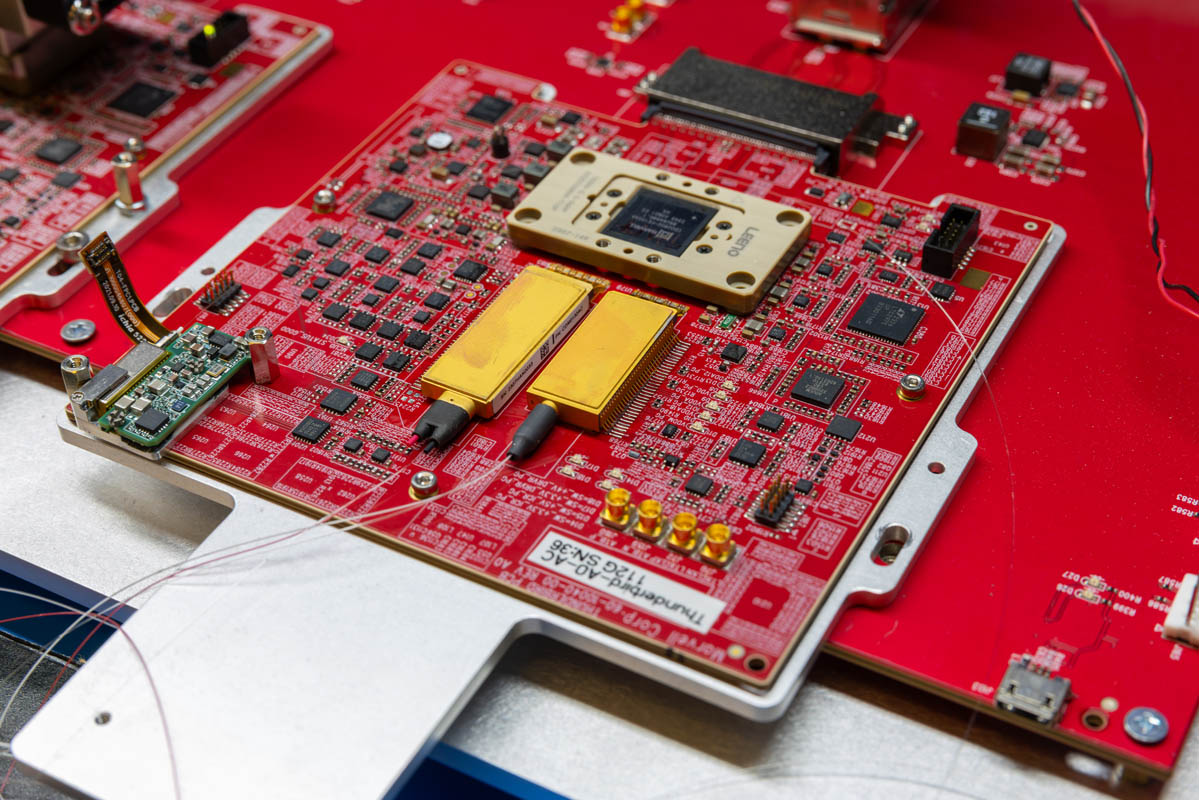
The proposed combination pairs Marvell’s electrical and optical interconnect, CMOS/silicon photonics, switching/custom silicon design, and packaging expertise with Lumentum’s specialized compound semiconductor manufacturing, including indium phosphide (InP), plus high-speed and high-power lasers.
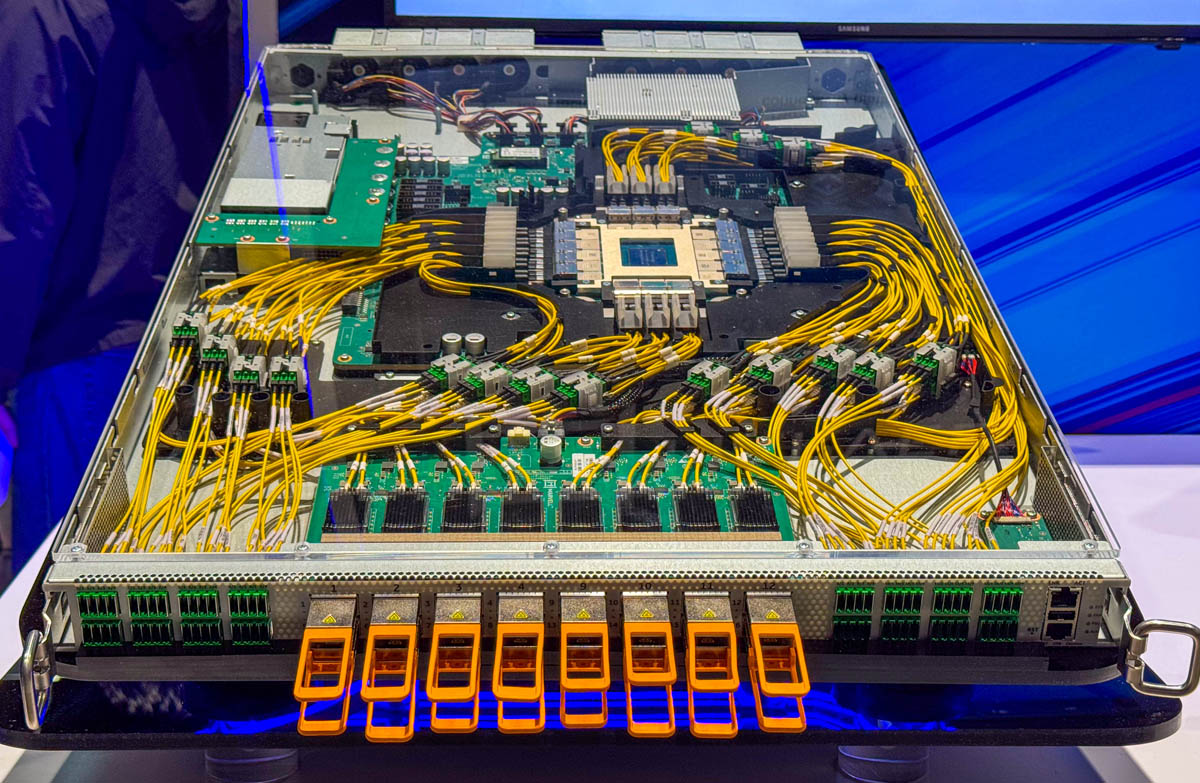
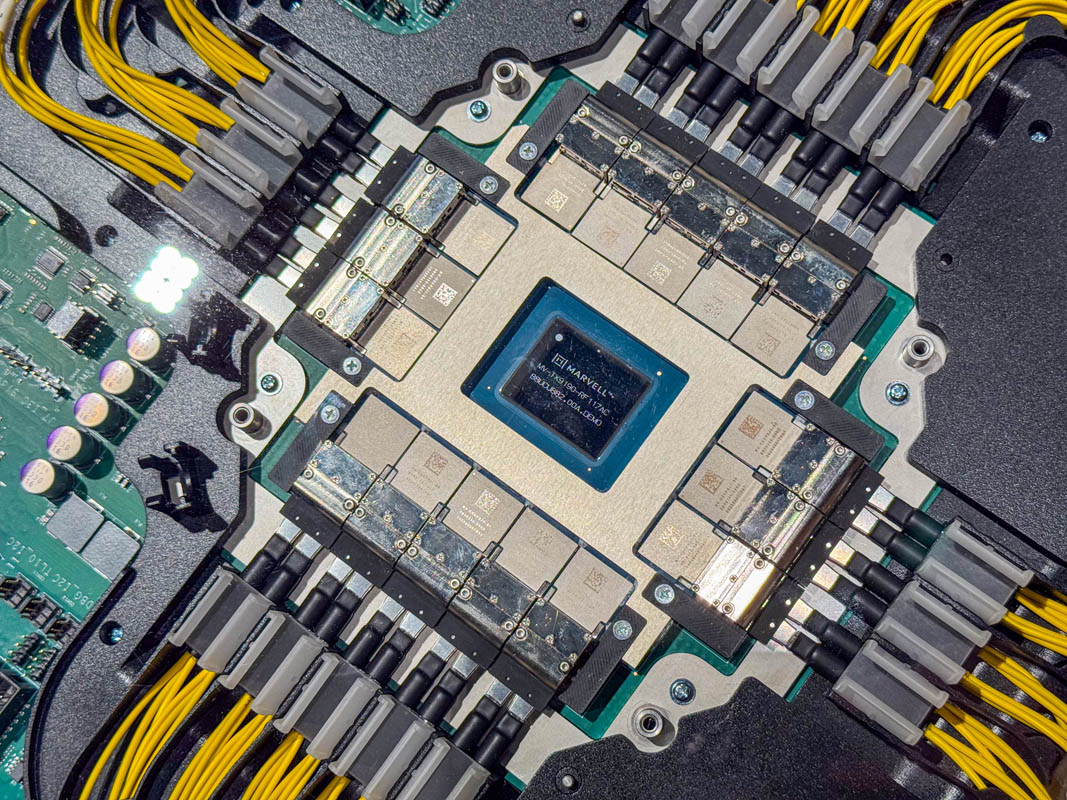
As we saw in our Marvell TX9190 CPO switch coverage from OCP 2025, near-package optical engines shorten the electrical path, with fiber runs and pluggable light sources replacing long PCB traces. We also saw some neat technology on our recent AWS Networking Lab tour.
By acquiring Lumentum, Marvell intends to control more of this supply chain internally and design solutions across a larger domain instead of having to go to different companies for different parts.
Beyond component integration, Lumentum brings optical circuit switching (OCS) to the combined portfolio. The Lumentum R300 OCS establishes direct optical paths between endpoints using micro-electro-mechanical systems (MEMS) mirrors, eliminating intermediate packet processing and optical-electrical-optical (OEO) conversion along those switched paths. Lumentum says this results in dramatically lower latency, higher signal integrity, and significant reductions in network power for large GPU clusters.
Acquiring Lumentum and its technology will not come cheap, however. The $115 billion deal is being financed entirely with Marvell’s stock, significantly leveraging the value of the roughly $175 billion company in order to pay for the deal. In effect, this makes the deal closer to a merger than a buy-out. Following the settlement of the deal, Marvell shareholders will own 67% of the new company, while Lumentum shareholders will own the other 33%. Similarly, the deal will see three members of Lumentum’s board of directors join Marvell’s board, bringing it up to 10 members.
Final Words
This deal, expected to close in the first half of 2028, so some time away, coordinates Marvell electrical and optical interconnect plus silicon design with Lumentum lasers, optical manufacturing, and OCS. The companies intend closer co-design and optimized, pre-validated optical solutions, faster time to market, and high-volume production, but that close is a long way away. This is a huge deal when companies are seeing valuations soar due to AI demand.