Kioxia CM9-R Random 4K Read Latency
Moving on to the latency distribution, we will start with 4K random reads at OIO 512.
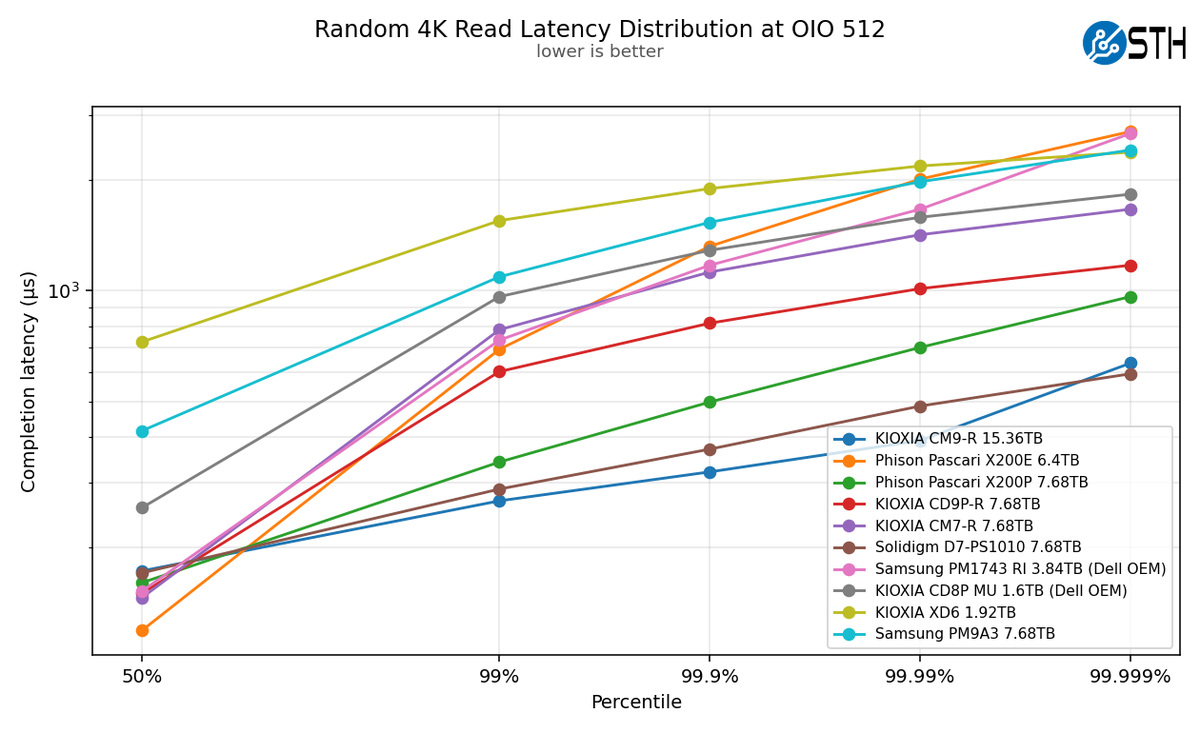
At the 99.9th percentile, the CM9-R recorded 321.5 microseconds, while the Solidigm D7-PS1010 reached 370.7 microseconds. Conversely, at the 99.999th percentile, the CM9-R measured 634.9 microseconds compared to 593.9 microseconds for the Solidigm drive.
Slicing this another way, here is the 99.9% tail latency at different levels of outstanding I/O. We mentioned earlier that we will be increasing our OIO maximum to 2048 from 512.
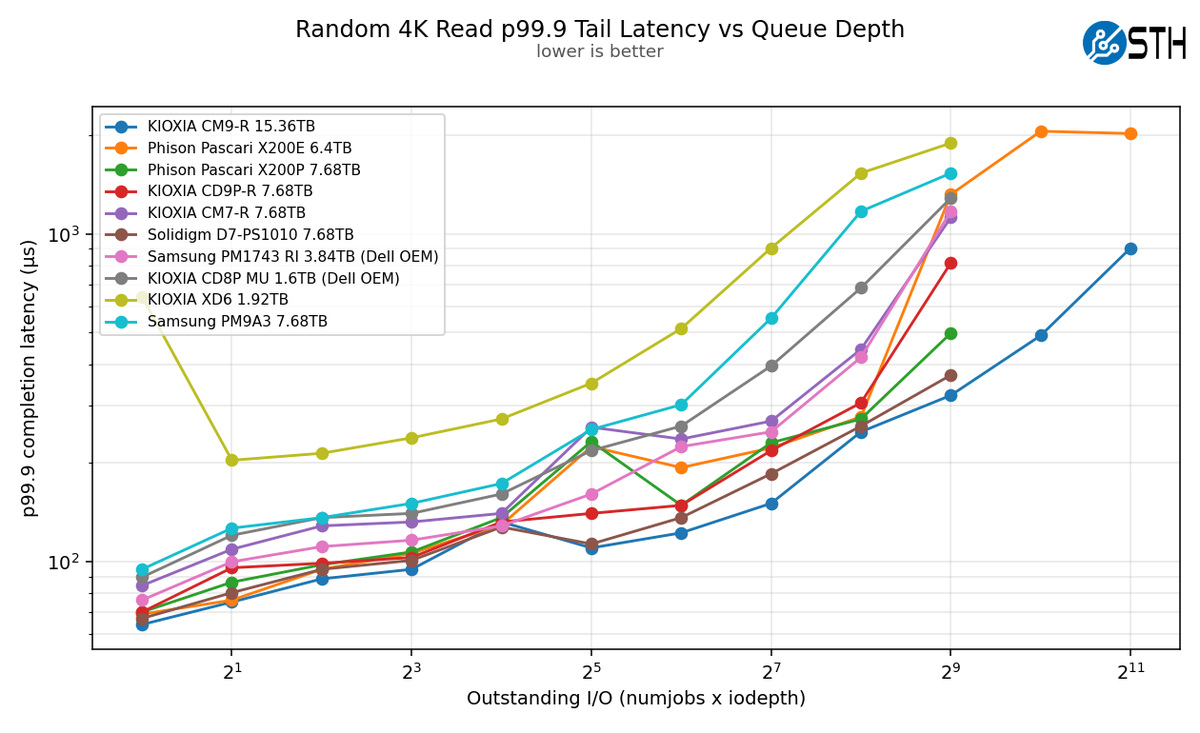
At an OIO of 32, the CM9-R delivered 530,259 IOPS with a p99.9 latency of 110.1 microseconds. Increasing the OIO to 64 raised IOPS to 1,013,238 but increased latency to 122.4 microseconds.
Kioxia CM9-R Random 4K Write Latency
Moving to the write side, here is the 4K latency distribution at OIO 256.
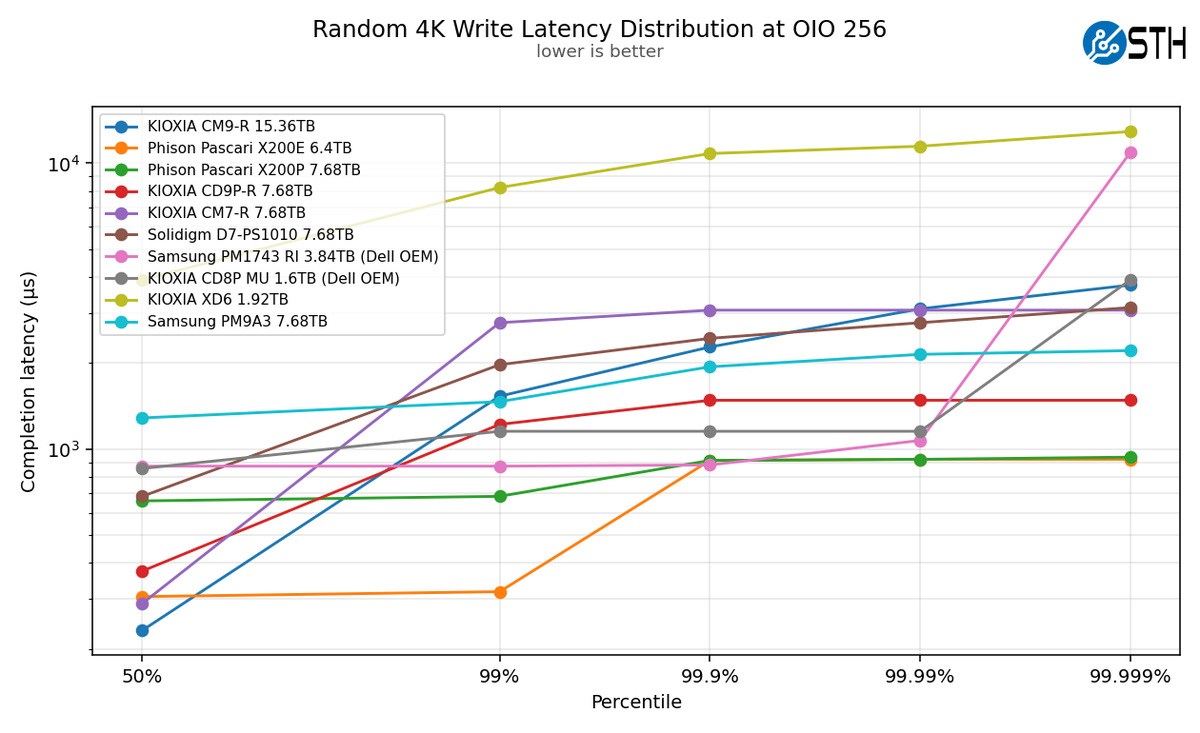
At the 99.9th percentile, the CM9-R records 2277.4 microseconds while the Solidigm D7-PS1010 reaches 2441.2 microseconds. At the 99.999th percentile, we can see the CM9-R at 3751.9 microseconds compared to 3129.3 microseconds for the Solidigm drive. Again, this is a read-focused drive, but it was interesting to see how this drive fared since read-intensive drives have to do some writes as well.
Here is the corresponding 99.9% tail latency across the OIO sweep.
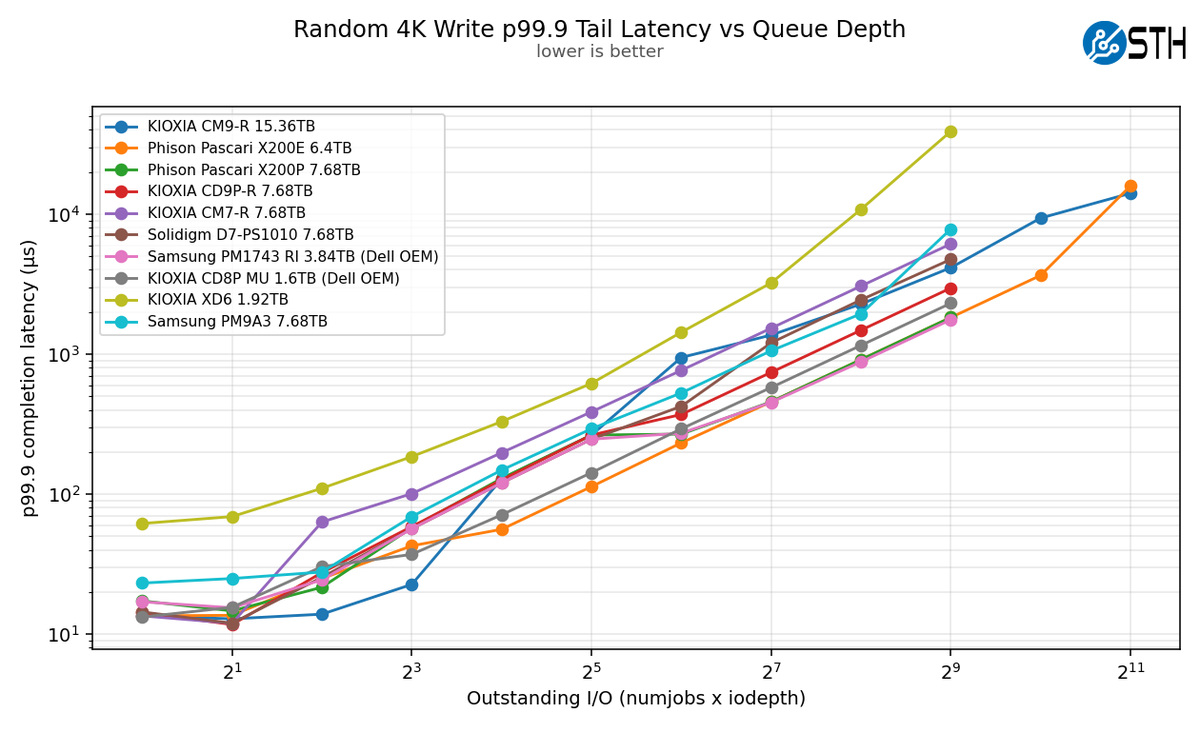
Increasing the outstanding I/O from 64 to 256 raises the CM9-R latency from 946.2 microseconds to 2277.4 microseconds. This shift corresponds with a modest IOPS gain from 487,608 to 514,749. Perhaps the more exciting part of this is that while the CM9-R is in the middle of the pack on this write test, it is blowing away the 2020-2021-era PCIe Gen4 XD6. These latency charts give another neat look at performance gains.
Kioxia CM9-R Random 4K 70-30 Latency
For the random 4K 70/30 read/write mix, here is the read completion latency distribution at OIO 512.
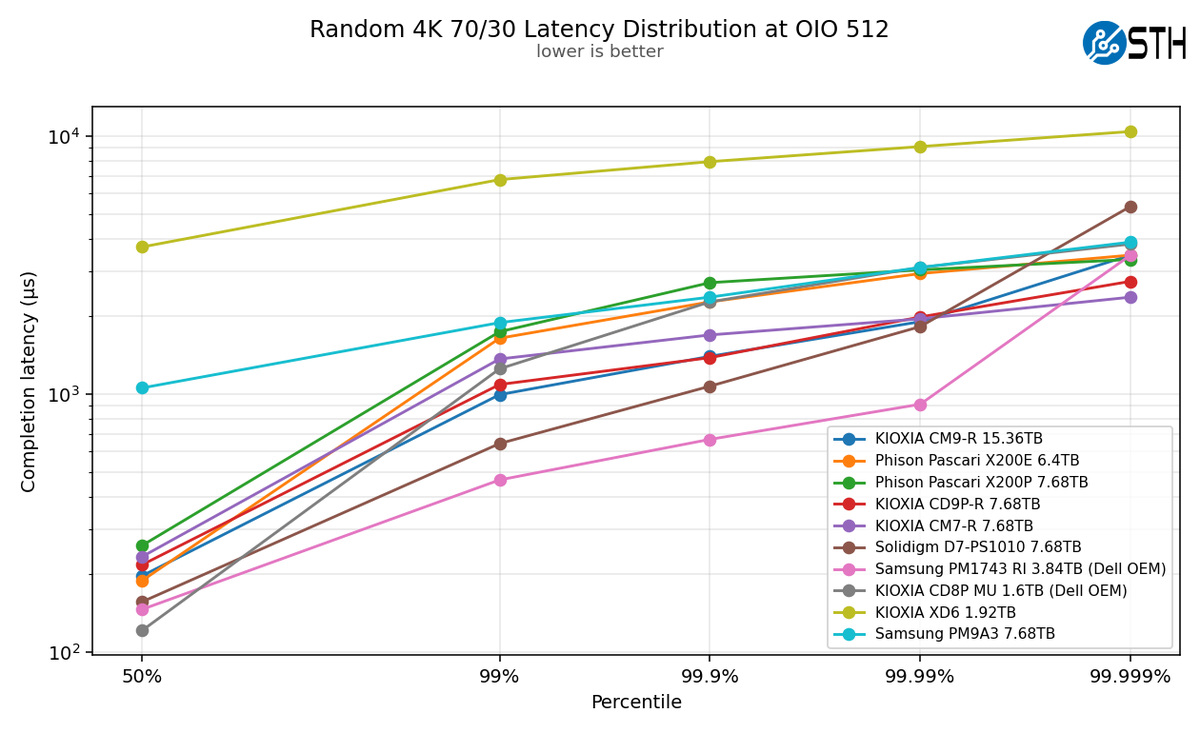
At the 50th percentile, the Solidigm D7-PS1010 recorded 156.7 microseconds compared to 197.6 microseconds for the CM9-R. The gap widens at the 99.9th percentile, where the Solidigm drive achieved 1073.2 microseconds versus 1400.8 microseconds for the CM9-R.
Here is the read-side tail latency versus OIO for that 4K 70/30 mix.
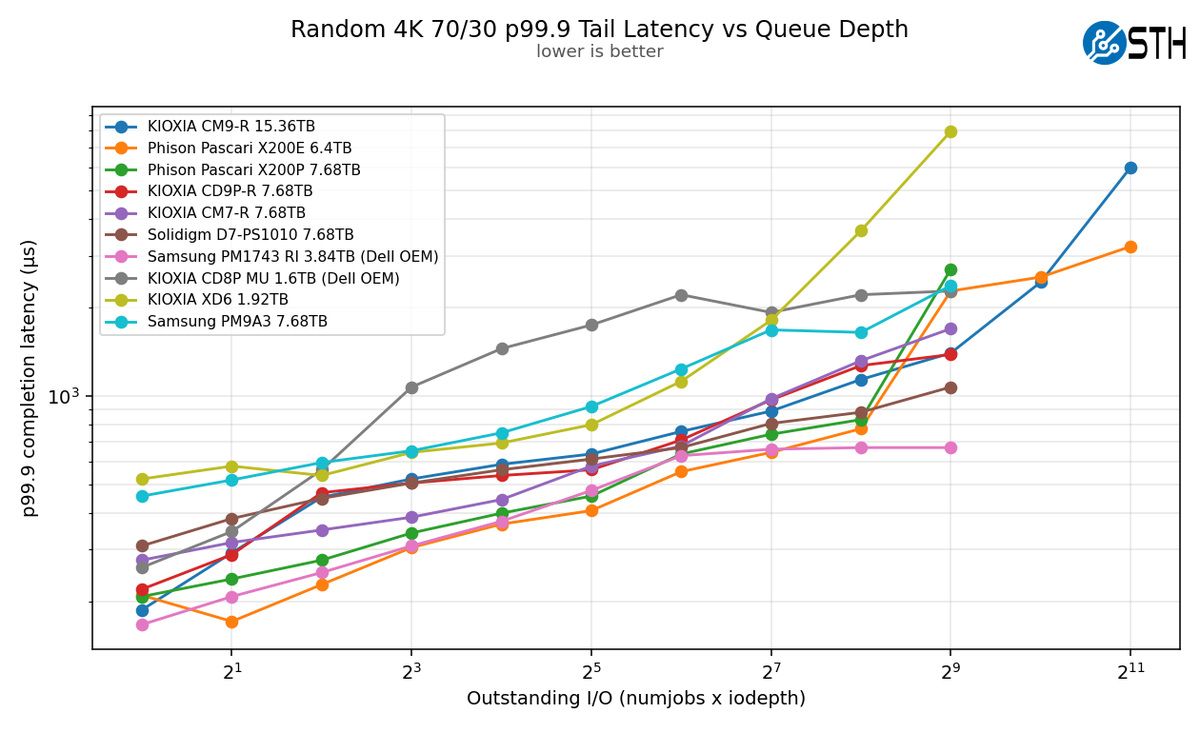
Increasing the outstanding I/O depth from 128 to 512 raised the measured IOPS from 1,256,479 to 1,548,675 for the CM9-R. This increase in throughput came with a corresponding rise in the 99.9th percentile latency from 888.8 microseconds to 1400.8 microseconds.
Kioxia CM9-R Random 8K Read Latency
Moving to a larger 8K block size, here is the read latency distribution at OIO 512.
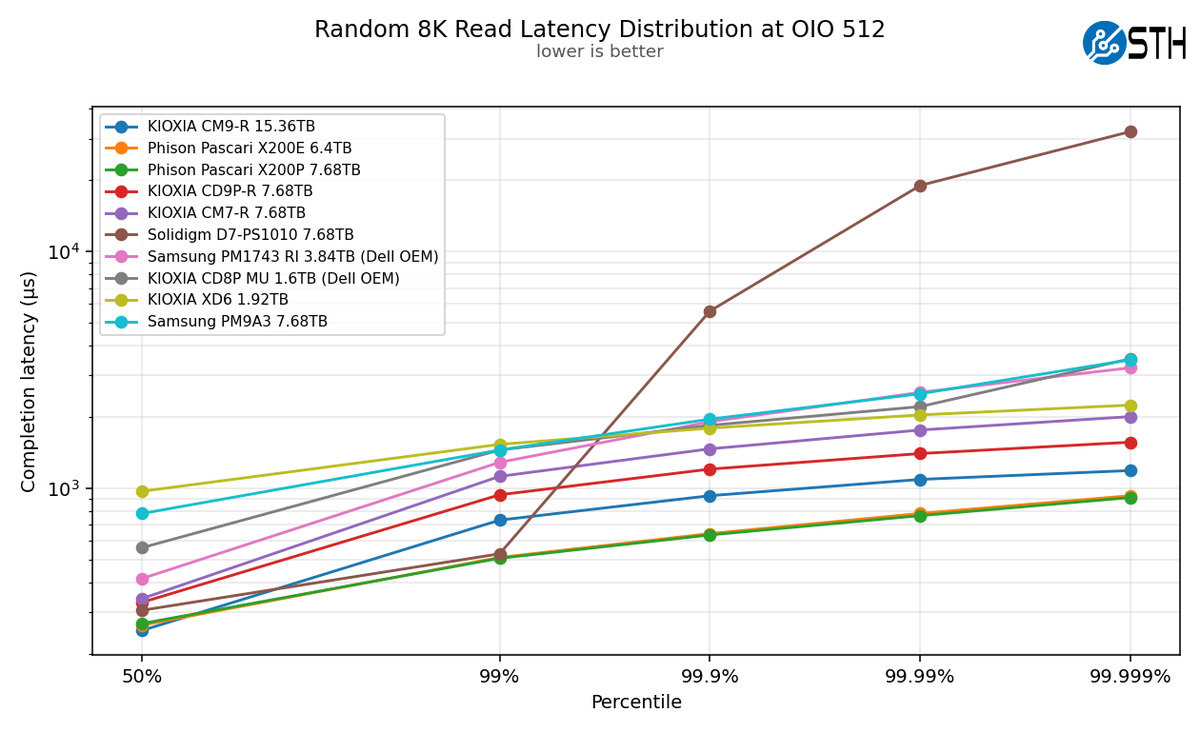
At the 50th percentile, the CM9-R records 250.9 microseconds compared to 305.2 microseconds for the Solidigm D7-PS1010 and a nice win. The gap widens significantly at the 99.9th percentile, where the CM9-R achieves 929.8 microseconds while the Solidigm D7-PS1010 reaches 5603.3 microseconds.
The OIO sweep gives us a wider view of that 8K read tail latency.
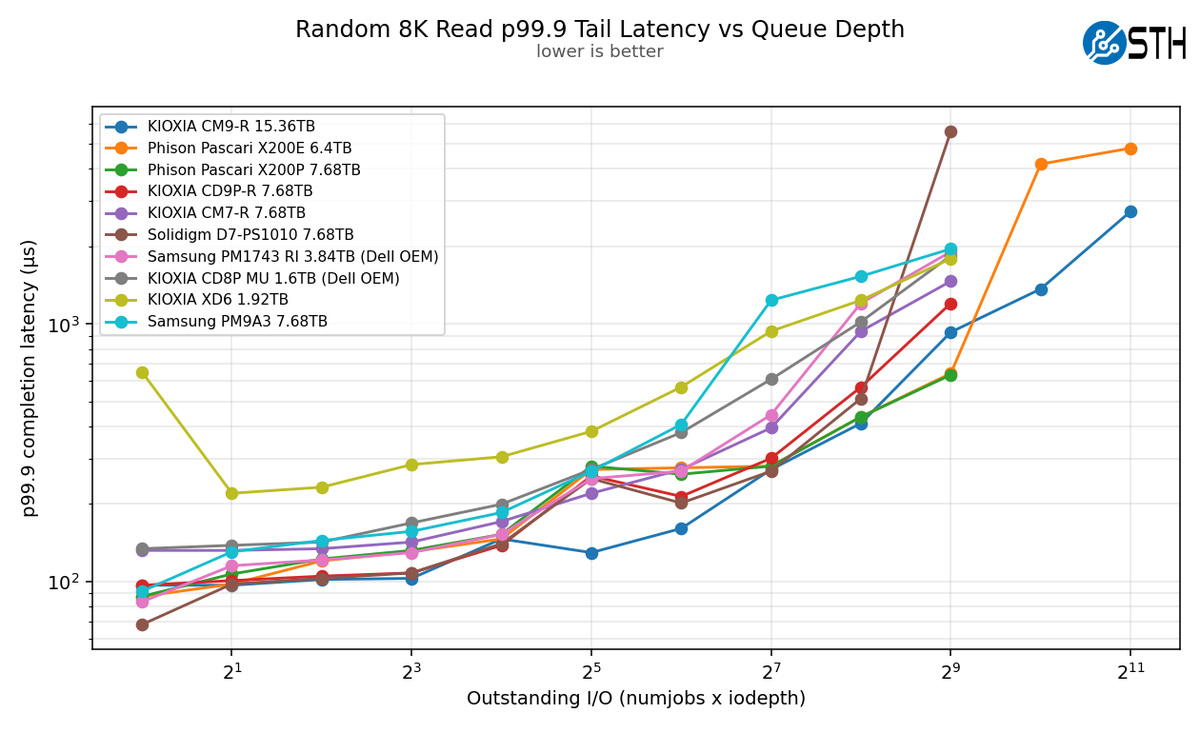
Increasing the outstanding I/O from 256 to 512 raises the CM9-R IOPS from 1,742,565 to 1,768,881. This slight throughput gain coincides with a p99.9 latency increase from 411.6 microseconds to 929.8 microseconds. Again, this is also why we are pushing the drives at higher OIO even though 2048 OIO is probably not realistic for most Kioxia CM9-R drives in the field.
Random 8K Write Latency
Looking at the write side, here is the 8K latency distribution at OIO 512.
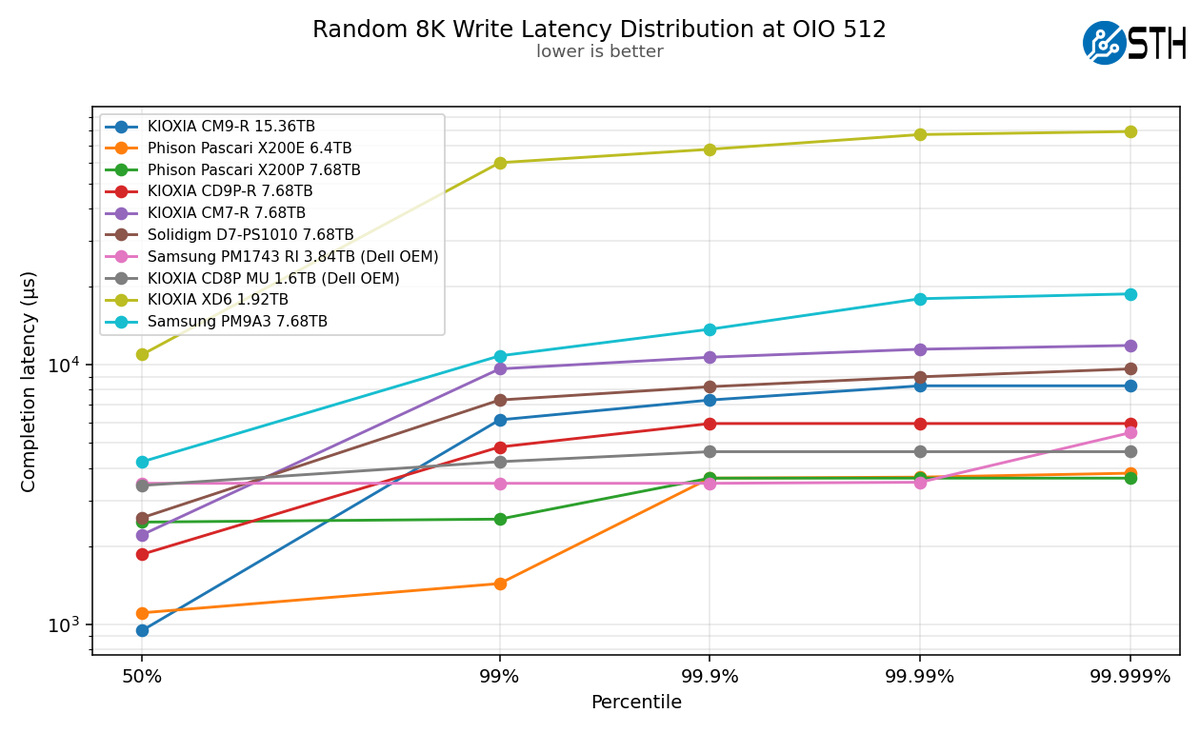
At the 50th percentile, the CM9-R records 946.2 microseconds, while the Solidigm D7-PS1010 reaches 2572.3 microseconds. The 99.9th percentile shows the CM9-R at 7307.3 microseconds compared to 8224.8 microseconds for the Solidigm drive.
Here is the sweep of tail latency and outstanding I/O for 8K writes.
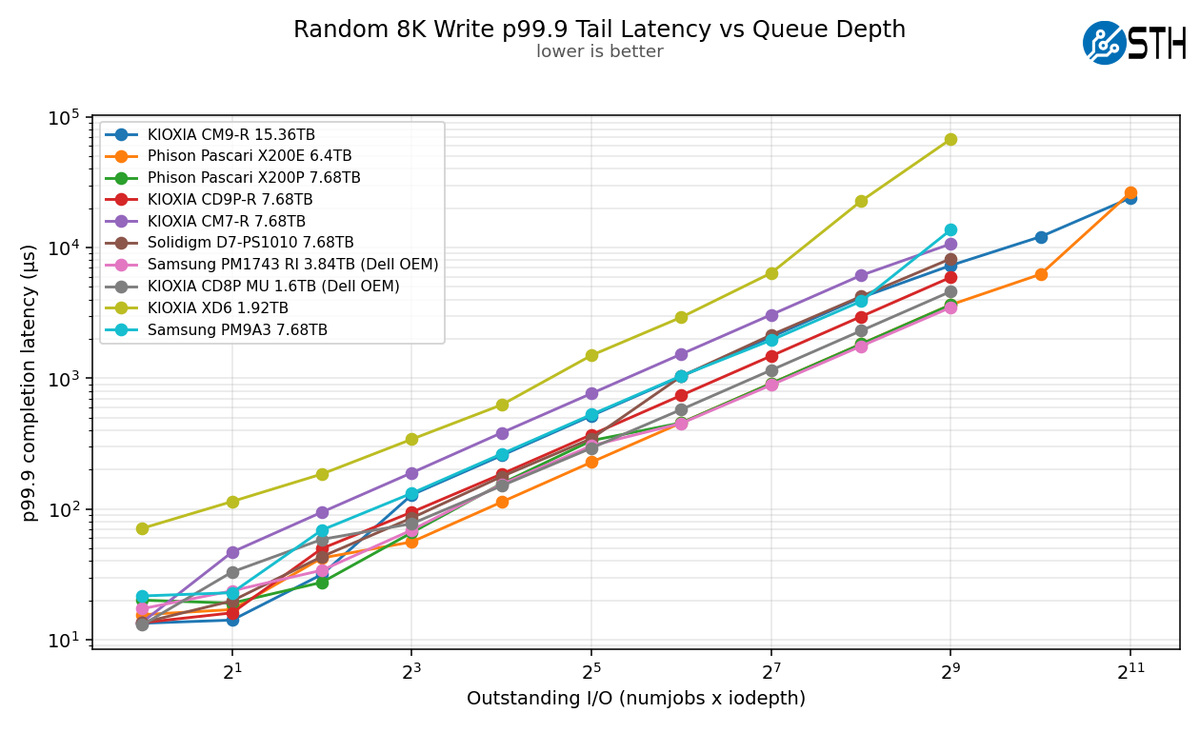
Increasing the outstanding I/O from 512 to 2048 shifts the CM9-R performance metrics significantly. The IOPS rise from 290,018 to 315,911, while the p99.9 latency increases from 7307.3 microseconds to 23986.2 microseconds. This shows the tradeoff between throughput and tail latency under heavier queue depths. Just as an interesting one, all the way out at OIO 2048, the CM9-R caught the write-focused X200E.
Next, it is time for our architecture-focused view.