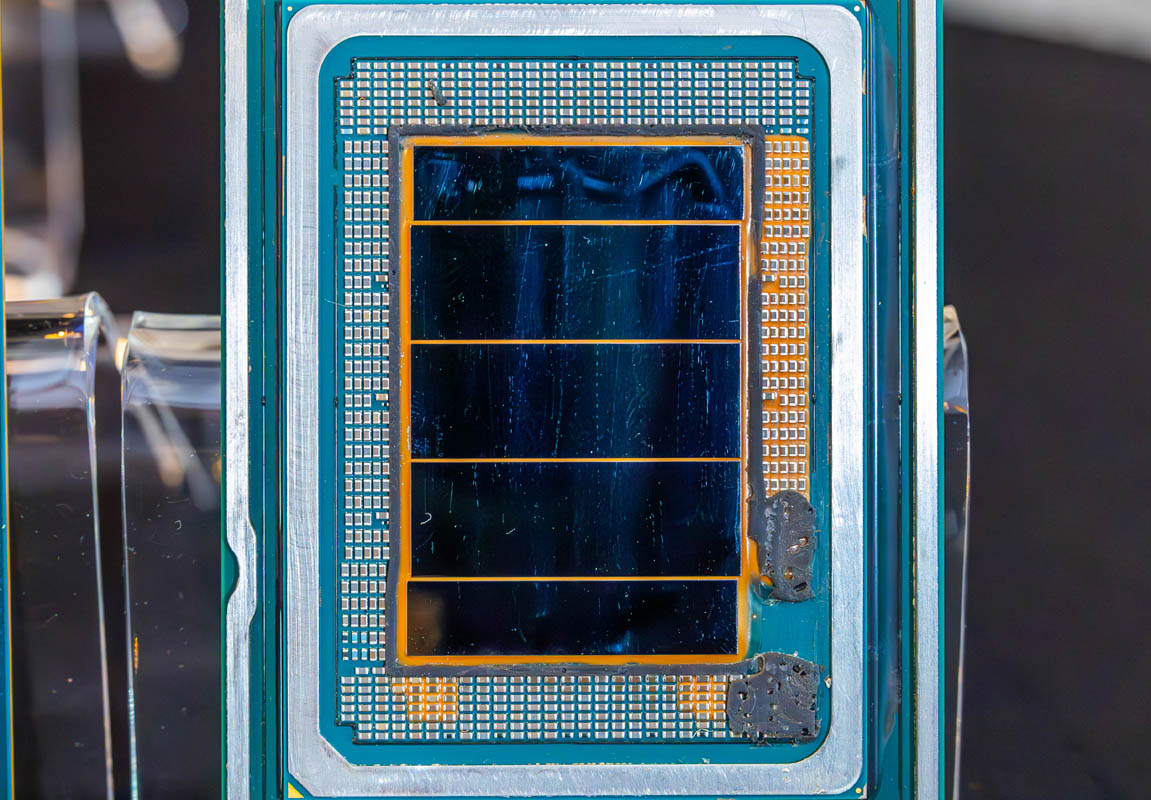
Intel has been shipping its Xeon 6+ “Clearwater Forest” CPUs for just over a quarter now. The first server chips based on Intel’s 18A process node, the Clearwater Forest launch, have been a critical processor bring-up for the company. Not only does the Xeon 6+ chip family help Intel better address the market for high-core-count x86 CPUs, but it also helps fine-tune Intel’s fabs and Foveros Direct 3D packaging lines for what will be the real big test for Intel 18A(-P) server parts: 2027’s Diamond Rapids.
As part of this process, Intel has been ramping up Xeon 6+ chip production as part of the pipe-cleaning process. That means Xeon 6+ chips are finally becoming available to vendors outside the hyperscalers, who often have a quarter-plus lead on chip supply.
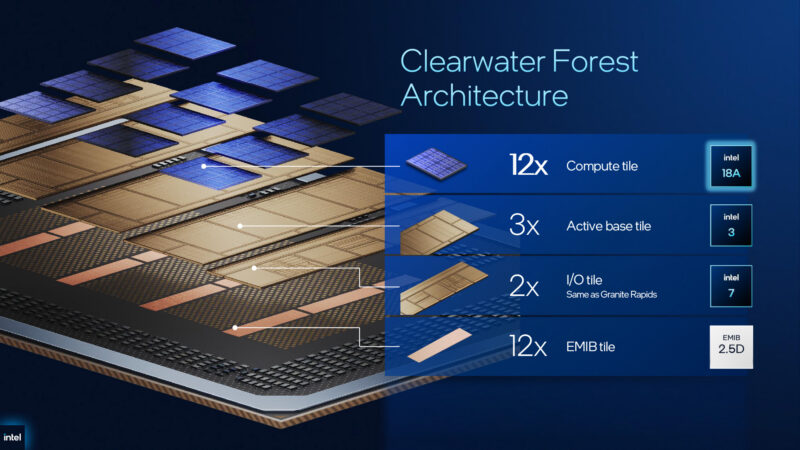
That leaves Intel customers with a simple but important question: which Xeon 6+ chip SKUs should they go with? Clearwater Falls has a rather short product stack, with just 4 physical SKUs. That still leaves several important factors to weigh across different metrics, including total performance, TDPs, and core-to-memory (and core-to-cache) ratios. So here is ServeTheHome’s look at the Xeon 6+ product stack, and what some of the best options are for different scenarios/optimization points.
Intel Xeon 6+ Chip SKUs: 144 to 288 Cores, $5K to $15K
First up, here is the complete list of Xeon 6+ chip SKUs.
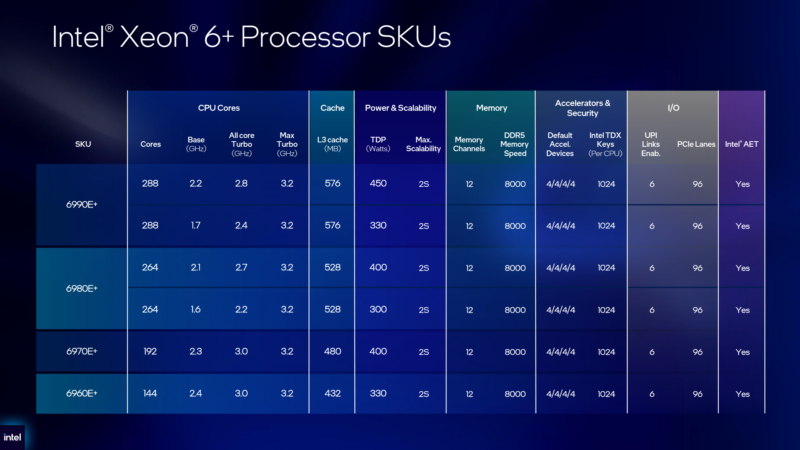
The good news is that Intel is not gating any features behind specific SKUs, which has historically been a chip-differentiation technique they have used heavily in server processors. With the Xeon E-core lineup far more focused on high-core-count use cases than anything else, Intel is not withholding any features from any SKUs. That means customers get it all: 2 socket support, 12 channels of DDR5 (and MRDIMM) memory, 96 PCIe lanes, and Intel’s new Application Energy Telemetry (AET) for per-application core energy reporting.
Consequently, the only real decisions are core counts, power consumption, and all the second-order effects.
On the power consumption front in particular, Intel’s Speed Select Technology (SST-PP) adds an extra wrinkle: it lets select SKUs run at one of two TDPs. Specifically, both the top-tier 6990E+ and second-tier 6980E+ support this feature. Higher TDP modes allow for higher guaranteed base clocks and higher all-core turbo clocks, while lower TDPs keep the chips running cooler and closer to their ideal point on the power/frequency curve.
For a true “all performance at any cost” scenario, the 288-core Intel Xeon 6990E+ in high-TDP mode is the big winner. With 288 cores at an average all-core turbo speed of 2.8GHz, it offers the highest total throughput. The trade-off is that it is also the most power-hungry option at a chip level, with a TDP of 450 Watts.
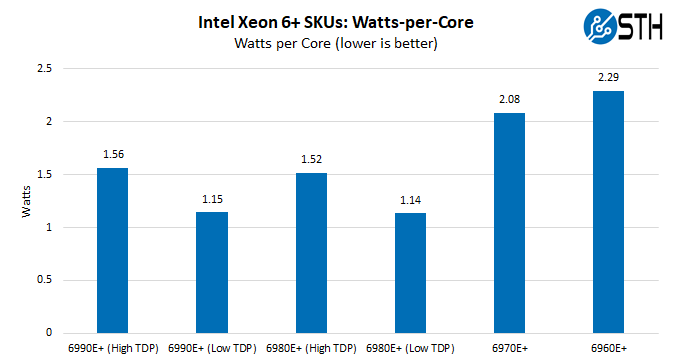
Alternatively, the chip can run in low-TDP mode, which drops all-core turbo speeds by 14% to 2.4GHz, while the TDP drops by 27% (120W) to 330W. Coincidentally, this also matches the top TDP of Intel’s previous-generation Xeon 6E (Sierra Forest) chips, though those are Xeon 6780E parts with fewer memory channels in a smaller socket.
With all TDPs at 300 Watts or higher, this means the high-core-count chips in their low-TDP modes offer the best overall efficiency on a watts-per-core basis. The low-TDP 6990E+ is just 1.15W/core, and the 6980E+ in low-TDP mode slides in right under that at 1.14W/core. For some sense, a 192-core AMD EPYC 9965 ranges between 2.34W/core and 2.60W/core. AMD’s core is a P-core not an E-core with its same Zen 5 instruction set and two threads per. So if you were counting threads/ vCPUs, Intel’s parts are in a similar ballpark.
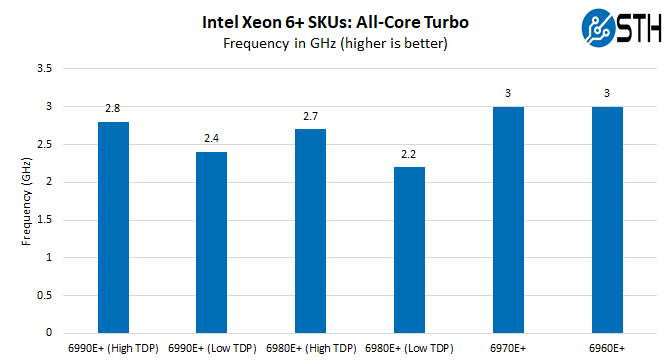
The advantage of going with smaller core count chips, in turn, is that the more energy-efficient chips have higher average clock speeds, especially at lower TDPs. By the time we get to the 144-core 6960E+, this chip will guarantee a base clock speed of 2.4GHz with an all-core turbo of 3.0GHz at 330 Watts, several hundred MHz (~25%) better than the 6990E+ at the same clock speed. Consequently, for workloads that need many cores but cannot scale to 288 cores, this is a sweet spot for the highest per-core performance in the Xeon 6+ family.
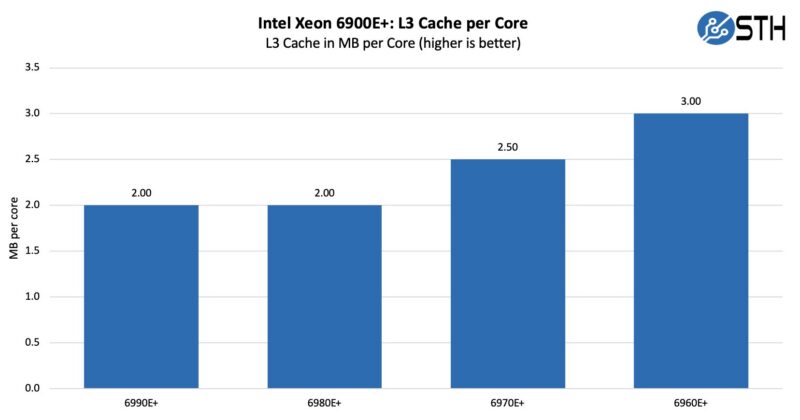
The smallest SKU is also the best point for L3 cache per core. While the amount of L3 cache scales down with core count (with Intel using salvaged base dies here), it does not scale down on a 1-to-1 basis with core count. As a result, while the 6990E+ has 2MB of L3 per core, that rises to 2.5MB per core for the 6970E+, and finally 3MB per core on the 6960E+.
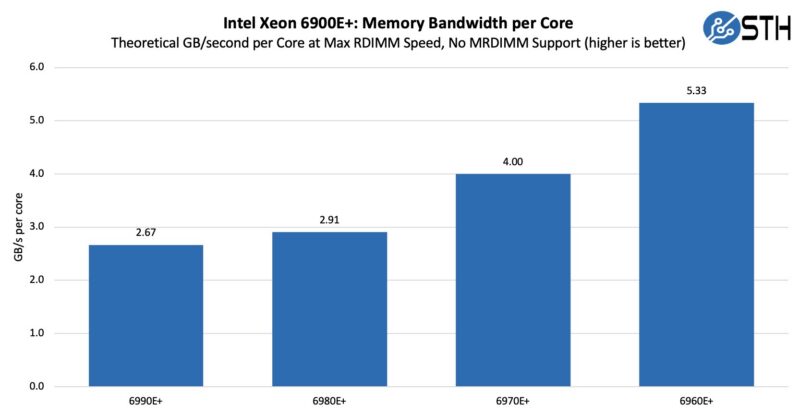
Meanwhile, the relationship between cores and bandwidth is even greater as you go down the stack. As noted earlier, all chip SKUs get the same memory support. So, assuming 12 channels of DDR5-8000 MRDIMMs, this spans from 2.67GB/second of memory bandwidth per core for the 288-core SKU to 5.34GB/second for the 144-core SKU.
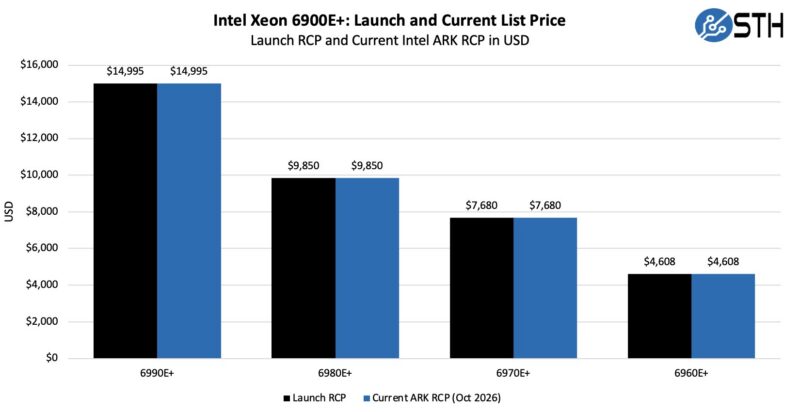
Finally, how does all of this look with pricing in mind? With the caveat that Intel’s list prices for server CPUs are traditionally discounted, this is how many cores $1000 buys you:
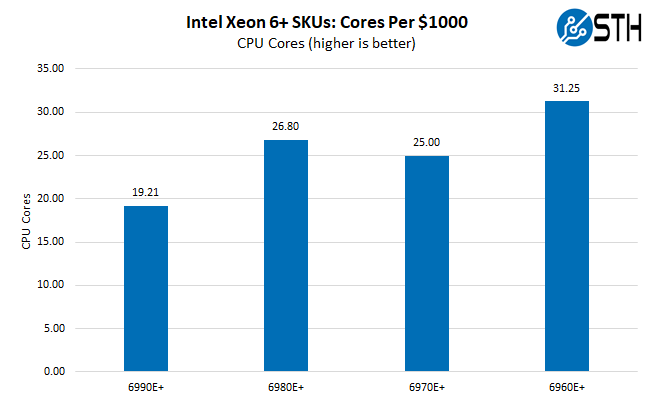
That means there is a very solid progression in both total cost and cost-per-core as you move up Intel’s Xeon 6+ SKU stack.
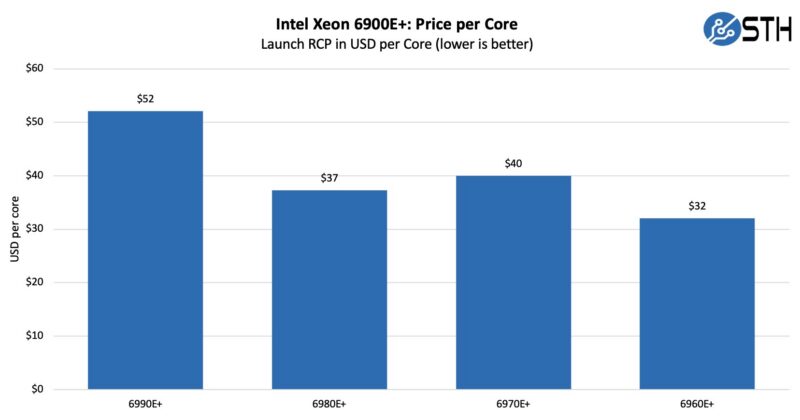
As you would expect, the 144-core Xeon 6960E+ is the cheapest chip, at a list price of just over $4600. That is followed by the 6970E+ at around $7700, the 6980E+ at $9900, and finally the flagship Xeon 6990E+ at just shy of $15,000. The number of cores you get per $1000 decreases much faster than the core counts increase. By the time you reach the Xeon 6990E+, that is around a 63% premium on per-core costs. Though a 144-core Xeon 6960E+ will not come anywhere close to the flagship Xeon 6990E+ chip’s total throughput in throughput-bound scenarios, the higher-cost chips still serve an important role in servers.
Final Words
Intel has kept the SKU stack for the Xeon 6+ family relatively simple for a server chip. That also makes decision-making easier for Intel’s customers.
The Xeon 6990E+ is bar none the fastest chip in the series in terms of total (on paper) compute throughput, thanks to its 288 cores. It is also the least cost-effective chip on a cost-per-core basis. Of course, the chip is just one part of the equation since memory costs often dominate server pricing these days. The smaller-core-count chips cannot push the same total throughput, but they can have more cache and memory bandwidth per core, plus slightly higher clock speeds. Thanks to Intel’s low-TDP SST-PP modes, the high-core-count chips are technically the most energy efficient on a per-core basis.
This underscores the importance of understanding the workload that will run on a Xeon 6+ server. Even with just 4 SKUs, the wide range in core counts (and fixed aspects elsewhere) means optimizing for compute, memory, and cost all have different optimal points. For Intel, that means the Xeon 6+ lineup can serve a wide range of customers, but customers need to do their homework to figure out what they need.