

Kioxia CD9P Performance by CPU Architecture
Now that we are firmly in the PCIe Gen5 era, we have a number of AMD, Intel, and even AmpereOne platforms to test the drives in to see the differences in performance based on architecture. These are small, but important.
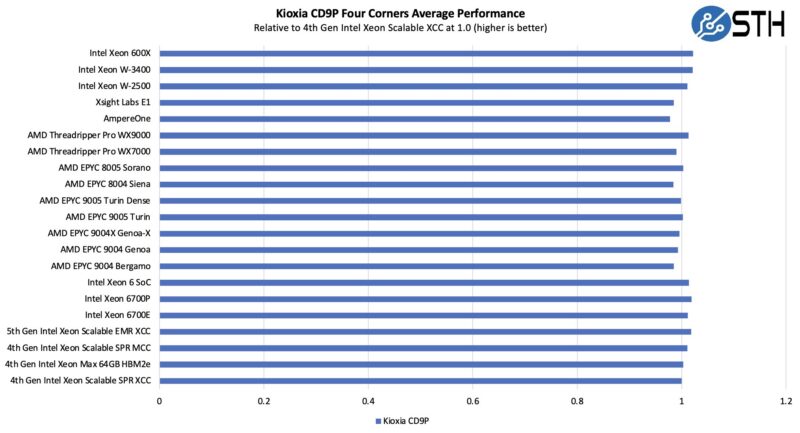
Since that is hard to read, we have a zoomed-in view below without a 0 X-axis.
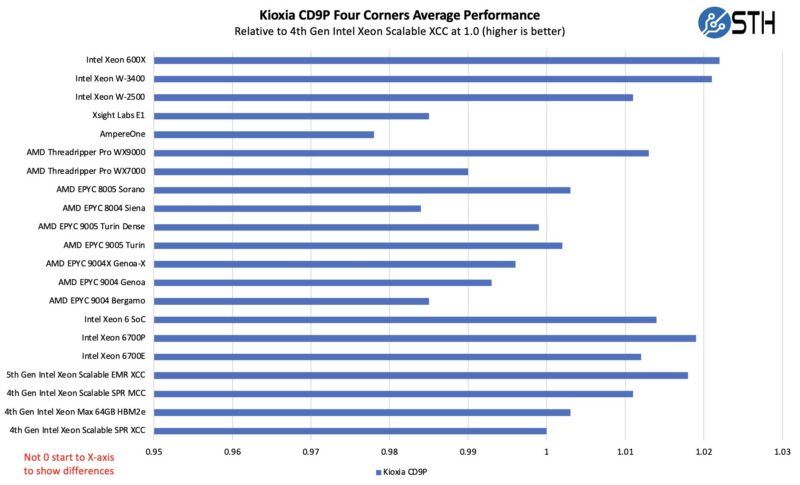
New for this edition, and notable, was the Xsight Labs E1 DPU. We also added the Intel Xeon 6 generation, and the AMD EPYC “Sorano” and Threadripper WX9000 series. Still, the Xsight Labs E1 DPU was perhaps the most exciting because part of what we did was actually work with the firmware team there to get it running. The DPU is designed to put 8x PCIe Gen5 NVMe SSDs over its 800Gbps links, as we saw with the Xsight Labs E1 800G 64-Core Arm DPU Shown for Hammerspace AI Storage.
We also have some numbers for the NVIDIA Grace CPU, but want to validate them. They should be right around 1.000 for Sapphire Rapids here. When we started doing multi-architecture testing years ago, it was a mostly Intel Xeon world with some AMD EPYC. Now, with so many architectures, and more coming every quarter, this is becoming even more important.
Final Words
Overall, the Kioxia CD9P is a great read-intensive drive. It performed slightly above its spec sheet for us, which is always great to see. It was also nice to test such a modern drive among so many PCIe Gen5 platforms and see how it would handle them. Examples like the Xsight Labs E1 DPU platform are ones where Kioxia and Xsight probably have not tested. We think NVIDIA and Kioxia have likely tested a Grace CPU with the CD9P, but it was still great to try it on so many platforms.
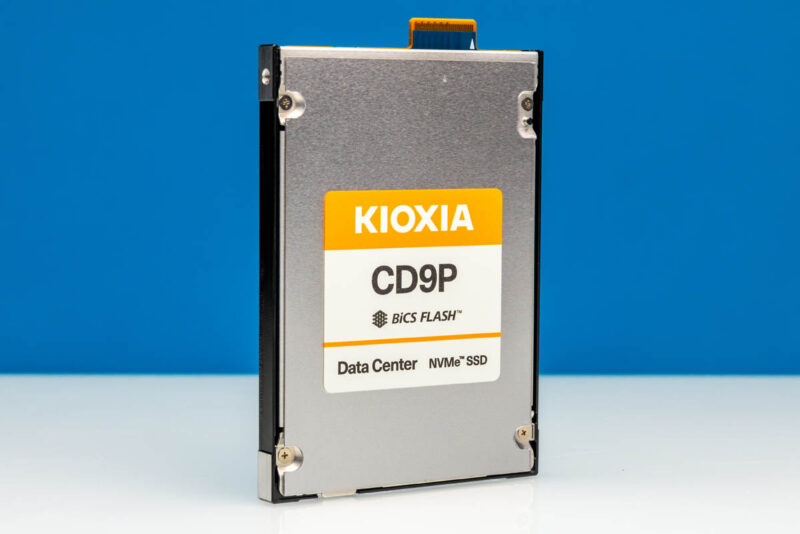
Overall, if you are looking to get NVMe storage for your traditional or AI servers, the Kioxia CD9P-R is a really neat option.
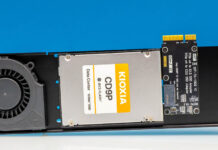
 in its 7.68TB E3.S configuration to see how the new PCIe Gen5 NVMe SSD performs on different architectures)
STH uppin’ its game on SSD testing biggly
Storage prices have increased far too much today.