

Kioxia CD9P-R Throughput, IOPS, and Latency
For our comparison set, we are using a newer version of our old scripts, so we have back-tested some drives that we thought would be interesting to compare to, including the Kioxia XD6, CM7-R, CD8P, Samsung PM1743 and PM9A3 (a very popular Gen4 drive), the Solidigm D7-PS1010 and Phison Pascari X200.
Moving to some of the more traditional testing, here is what a sequential 128K read and write workloads look like:
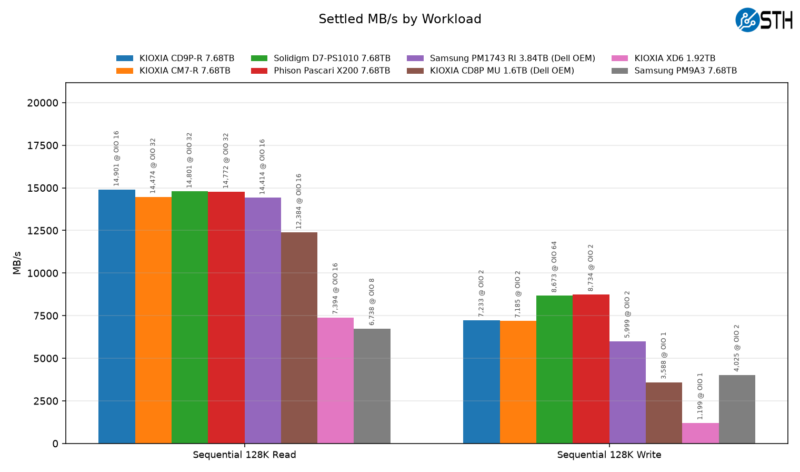
14.9GB/s and 7.2GB/s are slightly above the rated speeds, so that is a good start.
Moving to 4K random workloads, we have a 50/50 and 70/30 read/ write split as well as 100% read and 100% write.
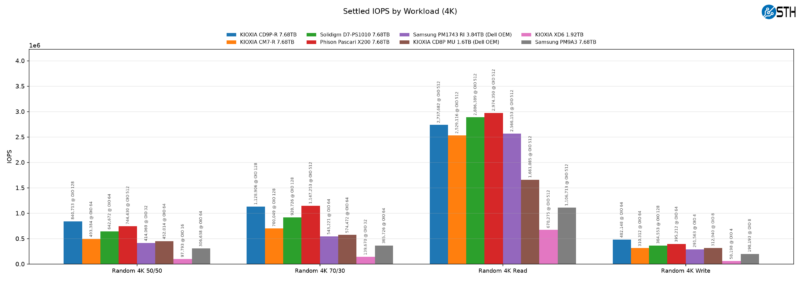
The Kioxia CD9P-R performed at or near the top of our comparison set for these read-focused drives.
On the 8K, we generally saw similar results:
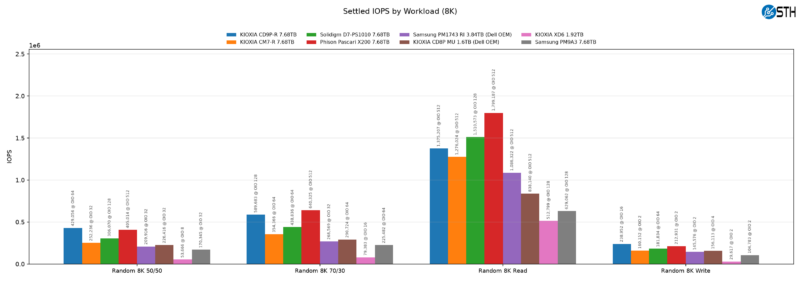
Only in the 100% random 8K read did the Phison Pascari X200 drive perform extremely well, almost as an outlier, but otherwise the CD9P-R is a strong contender.
Moving on to the latency distribution, we wanted to see the latency distribution, so we will start with 4K random reads.
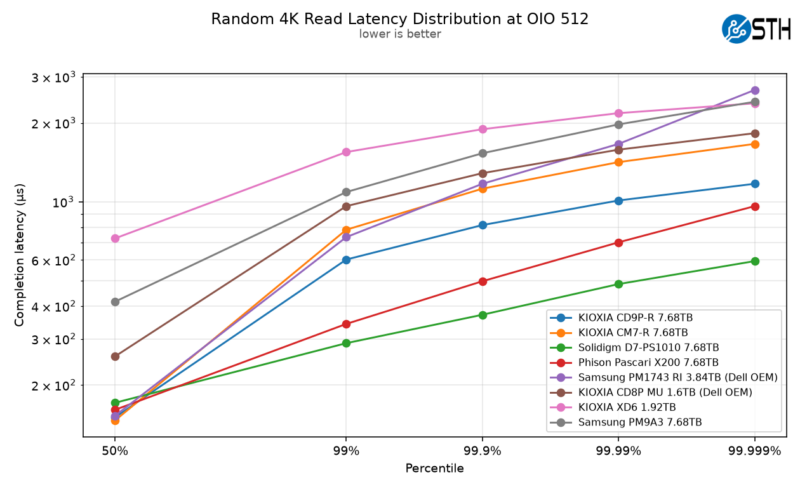
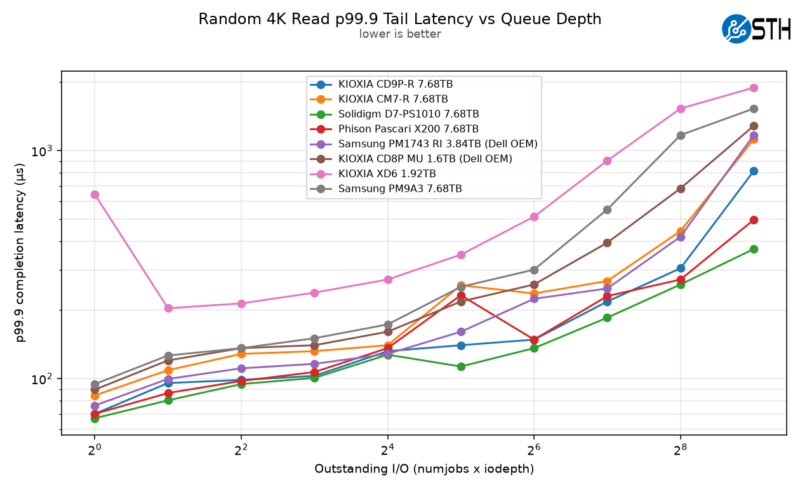
Slicing this another way, here is the 99.9% tail latency at different queue depths.
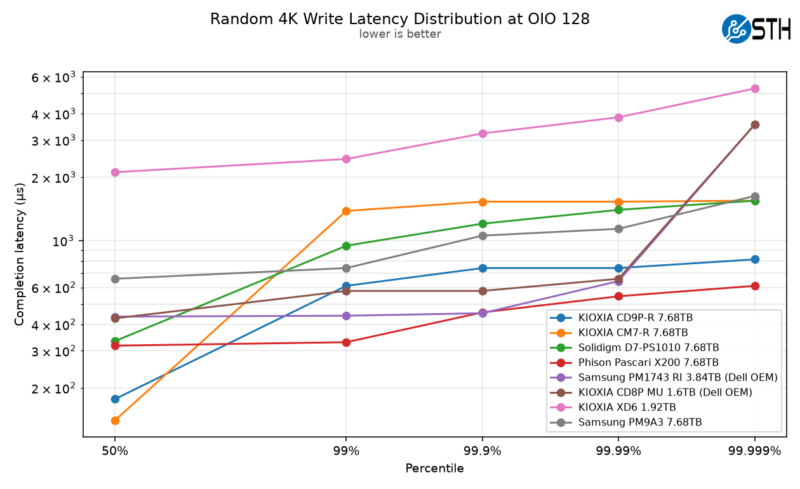
Moving to the write side, here is the 4K latency distribution:
Here is the corresponding 99.9% tail latency at different queue depths.
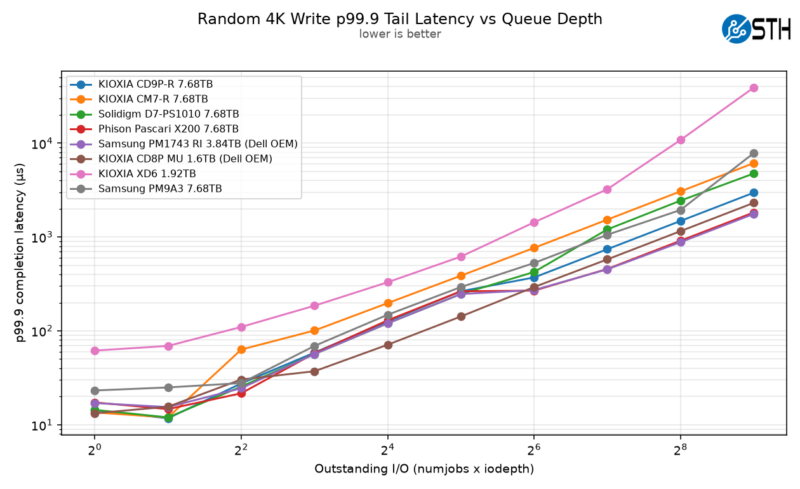
At this point, you may be noticing a trend. The Kioxia CD9P-R performs relatively well here. Also, the older XD6 is showing its age. To be fair, that Kioxia XD6 was an early Gen4 drive in 2020, and in the E1.S form factor it is also tuned almost for being a more local cache/ boot drive.
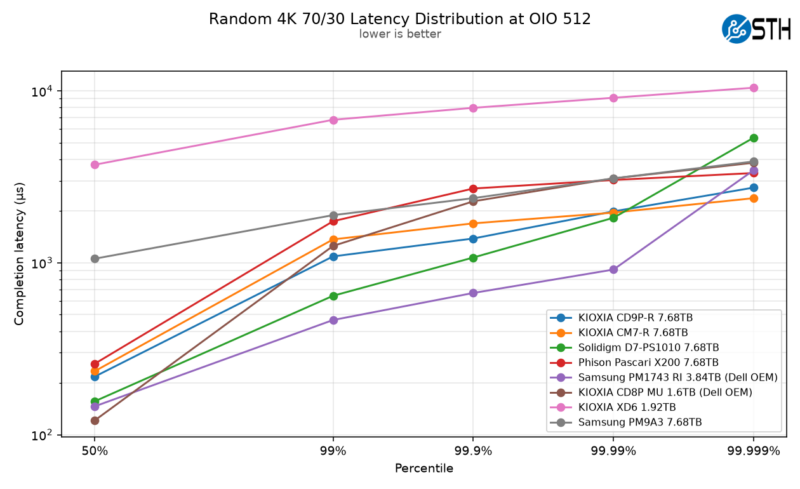
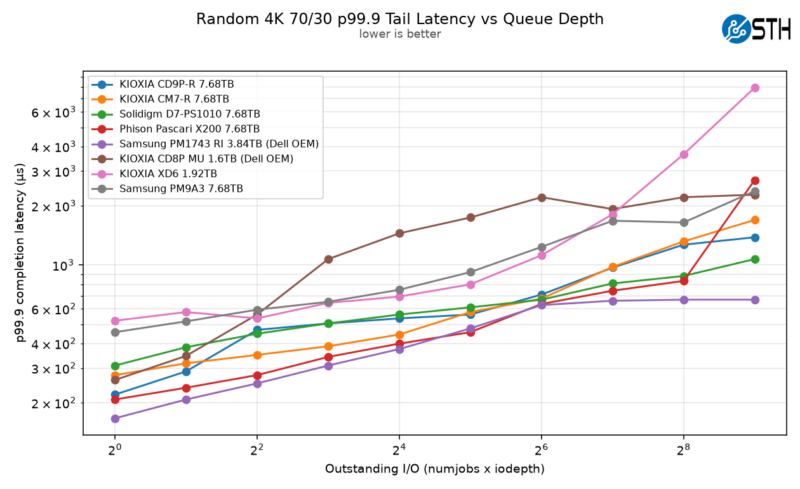
On the random 4K 70/30 mix here is what that looks like:
Here is the tail latency versus queue depth with the 4K 70/30 mix:
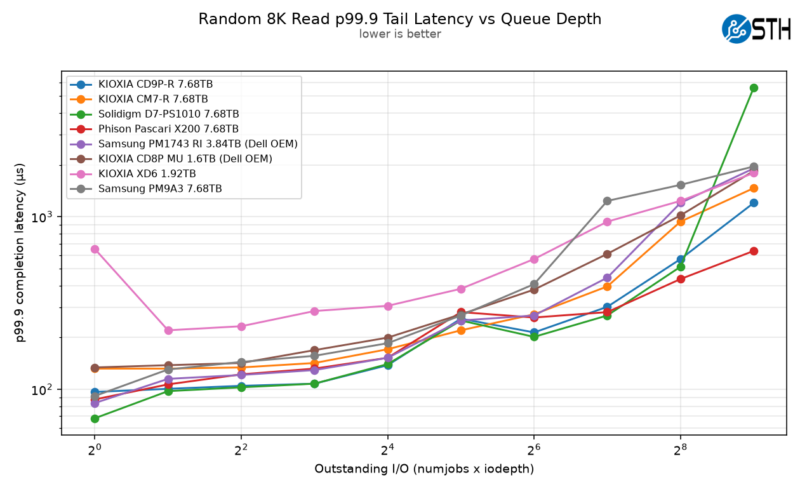
Moving to a larger 8K block size, you can see the Solidigm drive jump at the 99.9%, which was interesting since that drive did very well on the 4K read side.
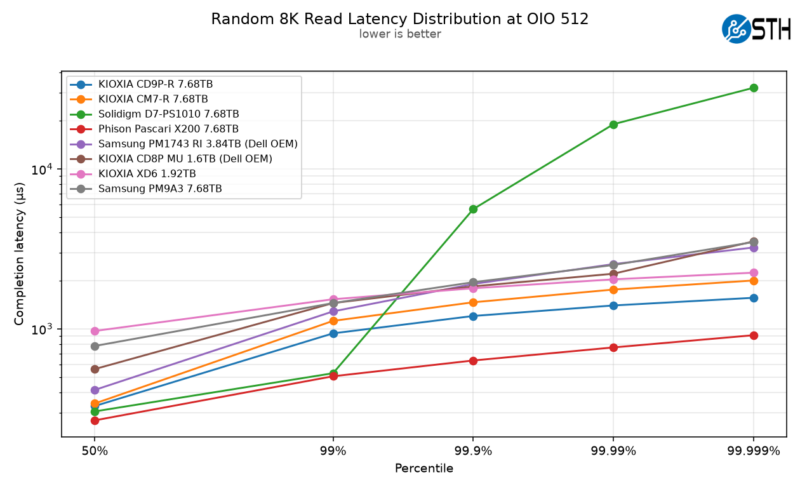
When we zoom out a bit and look at why, it looks like the Solidigm drive is hitting that high tail latency only at the 512 outstanding I/O point because otherwise it is actually good. The Kioxia CD9-P does well here, just like on the
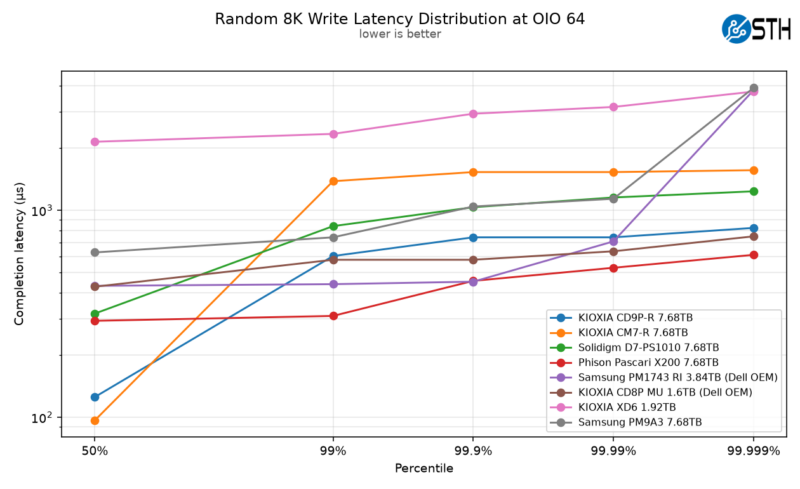
Looking at the write side, which we are showing at OIO 64, the picture is different for the Solidigm, but Kioxia’s CD9P-R is still doing very well.
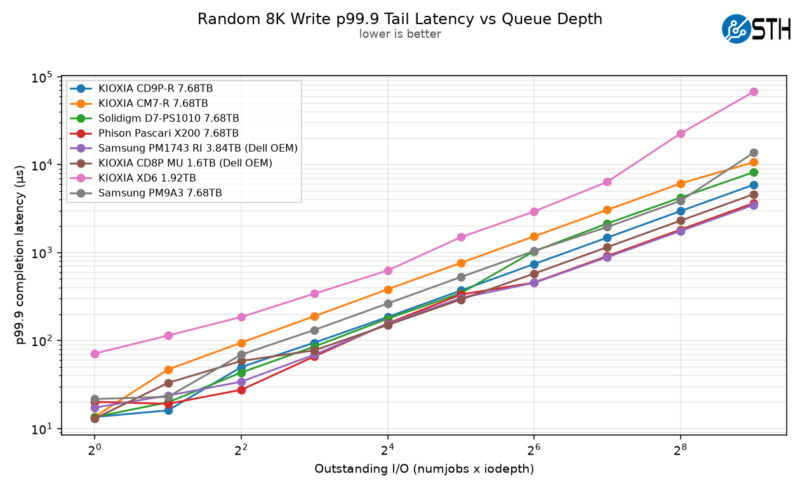
Here is the sweep of tail latency and queue depth for 8K writes.
Overall, the Kioxia CD9P-R shows just how mature PCIe Gen5 drives have become with BiCS8 NAND. That is common as we head into a PCIe transition, and Kioxia has already announced the Kioxia CM10 Series of PCIe Gen6 SSDs. Still, when a new PCIe generation hits, we tend to see the outgoing generation drive the majority of unit sales for several quarters, which is why it is neat to review the CD9P-R now.
Of course, since this is STH, we wanted to see how the drive would fare using a number of different architectures.
 in its 7.68TB E3.S configuration to see how the new PCIe Gen5 NVMe SSD performs on different architectures)
STH uppin’ its game on SSD testing biggly
Storage prices have increased far too much today.