

A Word on Thermal Performance
Before we get too far in this, I wanted to point out that you may have seen a recent piece by STH where we tested this drive in the ADT R27A-BK3 EDSFF E1.S and E3.S to PCIe Slot Adapter.
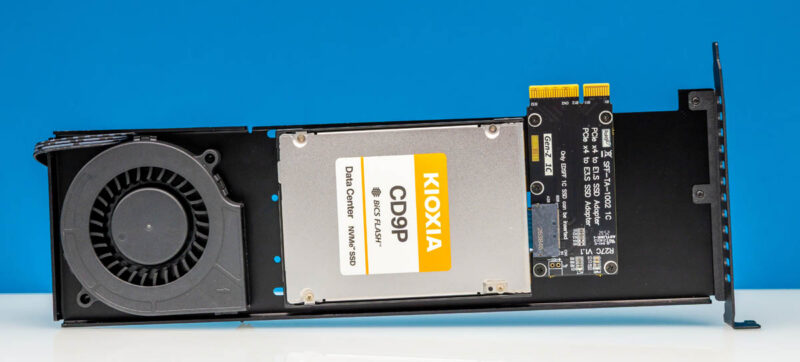
When we did that, we found that the adapter was not able to keep the drive cool enough, and we actually saw thermal throttling.
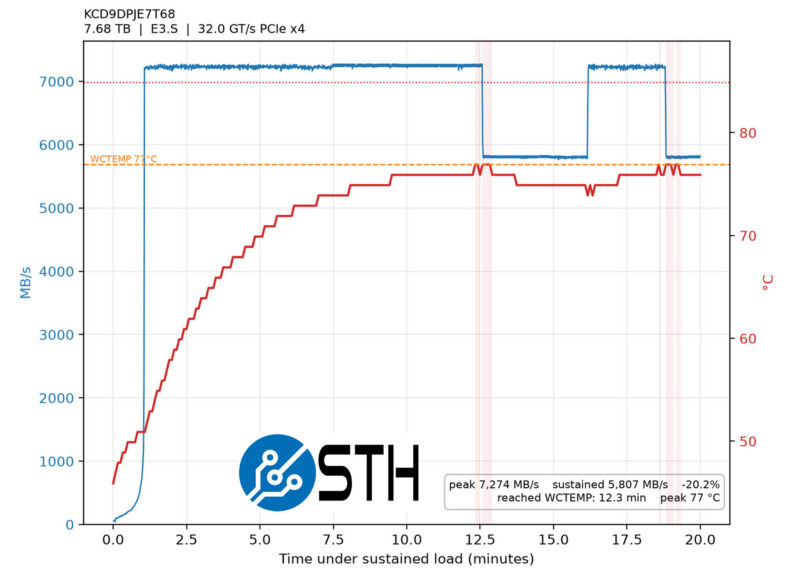
The drive hit 77C, then dropped performance by roughly 1400MB/s sequential write speed, then as the drive cooled it fought back to bring the higher level of performance. Here is the sequential write in a properly cooled slot where you do not see the same dips.
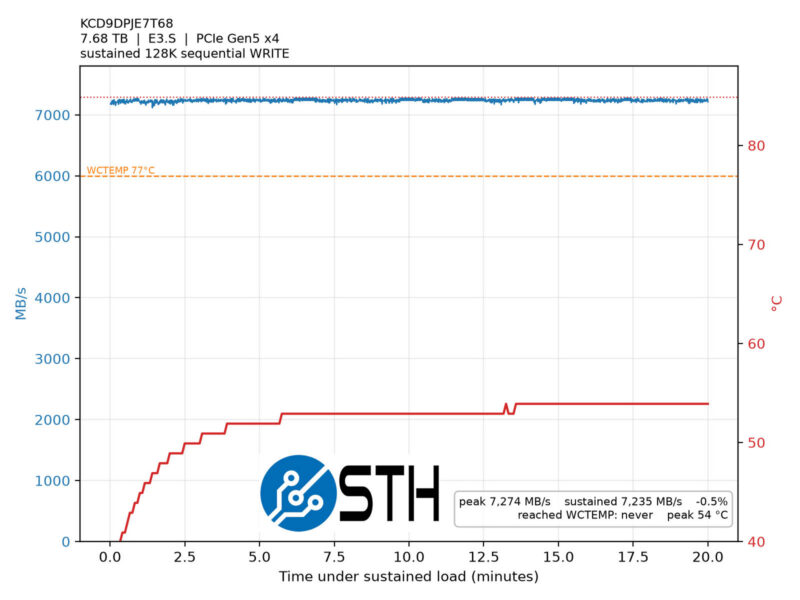
As you can see, cooling SSDs is important, and this was a really great example of an adapter we thought could cool this drive (and many others) but ultimately fell short. Needless to say, given those results, that was an adapter issue rather than a drive issue. Still, it let us observe thermal throttling in action. We had another drive that lost almost half of its performance in this same adapter, so Kioxia’s thermal throttling is actually fairly good. We were going to turn this into a standard test given the early results, but logistically it is not something we can support right now. With that said, let us get back to the testing.
Kioxia CD9P Performance
For this, we are going to do some expanded charting compared to what we normally do. Starting with what happens when looking at the drive in a fresh state versus when it is full when trying to write to it. Here we are going to fill the drive once, then look at the second fill loop to see if there is a major change. Starting with sequential fills at 128K block size:
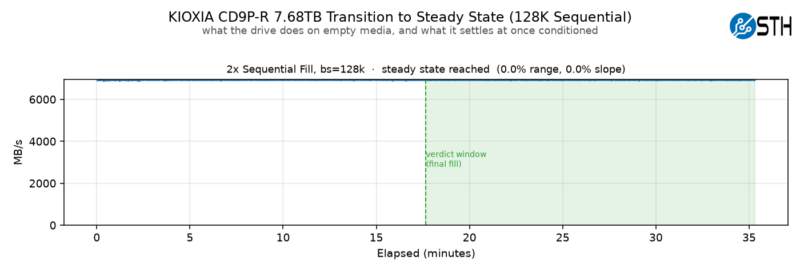
You can see that the CD9P-R is just cruising here since this is relatively easy for a modern NAND controller.
Getting to a much harder case, here we are filling at 128K with the random conditioning at 4K size.
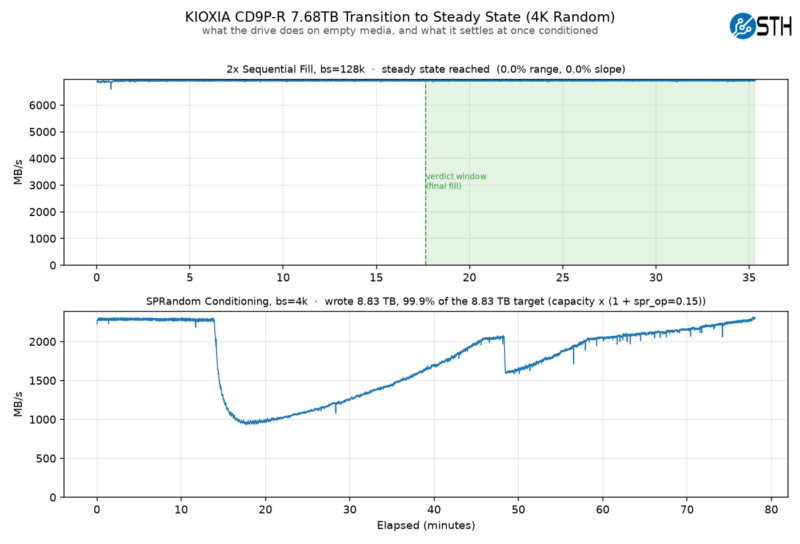
Here you can clearly see the impact of the drive reaching its full state and then needing to perform garbage collection. Just for some context, the Kioxia CD9P-R does really well here.
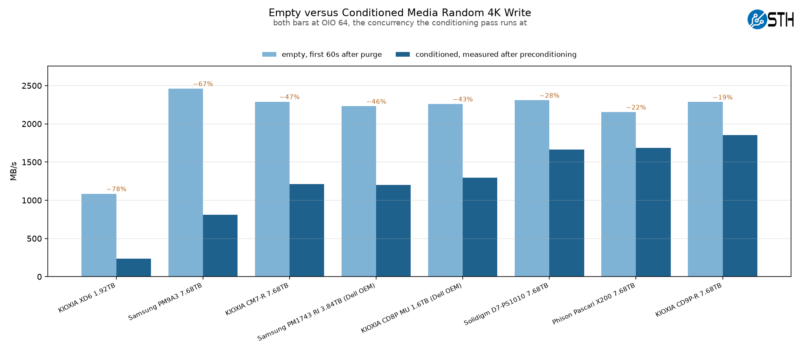
While some drives in our test set can be a bit faster when empty, after the drive is preconditioned, the Kioxia does extremely well.
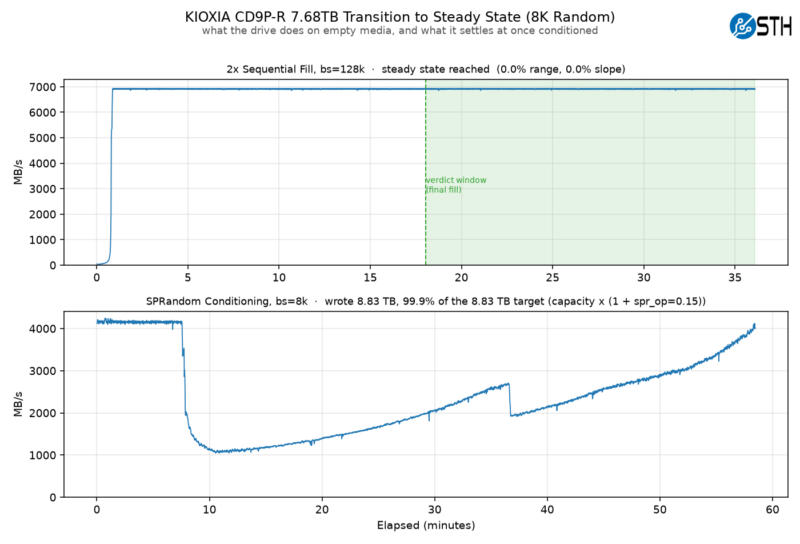
Something similar happens at 8K block sizes, but at much higher speeds:
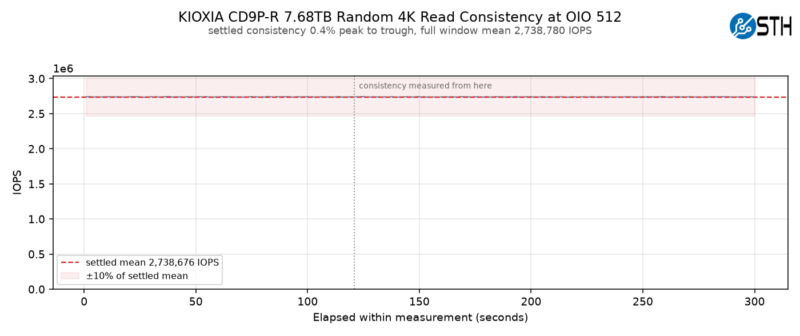
Just taking a quick look at the IOPS consistency here, the CD9P-R did really well on the read side.
On the write side, as we would expect, things get a little bit more exciting, but these results are relatively good as well compared to other drives we have tested.
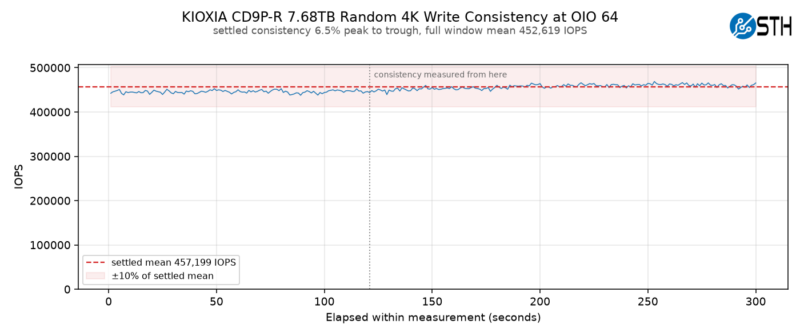
We are using a 2-minute warm-up here to get a mean just to show what happens hitting a more steady-state.
Next, let us get to some of the more traditional sequential and random benchmarking.
 in its 7.68TB E3.S configuration to see how the new PCIe Gen5 NVMe SSD performs on different architectures)
STH uppin’ its game on SSD testing biggly
Storage prices have increased far too much today.