
Gigabyte TRX50 AERO D Cooling
While cooling is not strictly a function of the motherboard itself, while we were testing Gigabyte’s TRX50 AERO D, we wanted to get a quick look at what the assembled system is like, to see just what it takes to keep a TRX50 board and companion 64 core processor cool.
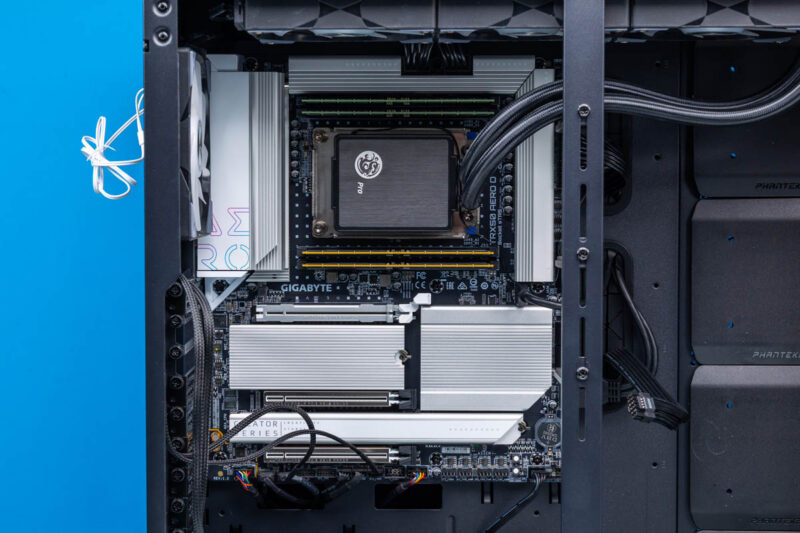
In this case, it is a full 360mm AIO liquid cooler. While the 350 Watt TDP processor can be air cooled, at these energy levels it is easier in some respects to just go with liquid cooling, especially for acoustic considerations. This does require that the motherboard features an extensive heatsink system for its own VRMs, however, as there is not any airflow coming off of the CPU itself to help cool these components. Gigabyte has no trouble here, thanks to the hefty heatsink plus heatpipe system used on the board.
Gigabyte TRX50 AERO D Final Words
Though the HEDT market is not what it once was, in the AMD ecosystem it is still a niche that the company and its partners like to fill. For this generation, that is the vanilla Threadripper 9000 processor family, as well as its associated TRX50 chipset.
To that end, the Gigabyte TRX50 AERO D is a solid example of what a TRX50 motherboard is meant to do, and what such a motherboard needs to do. Gigabyte has aimed to build a true desktop motherboard here as opposed to building a workstation motherboard, and it shows throughout its design. What you will not find are BMCs or relatively exotic I/O connectors; what you will find is a plethora of USB ports – including 40Gbps Type-C ports – as well as ample heatsinks for both the board’s power MOSFETs and as its quartet of M.2 slots. It is a desktop motherboard scaled up to meet the needs of the HEDT market, and it shows throughout.
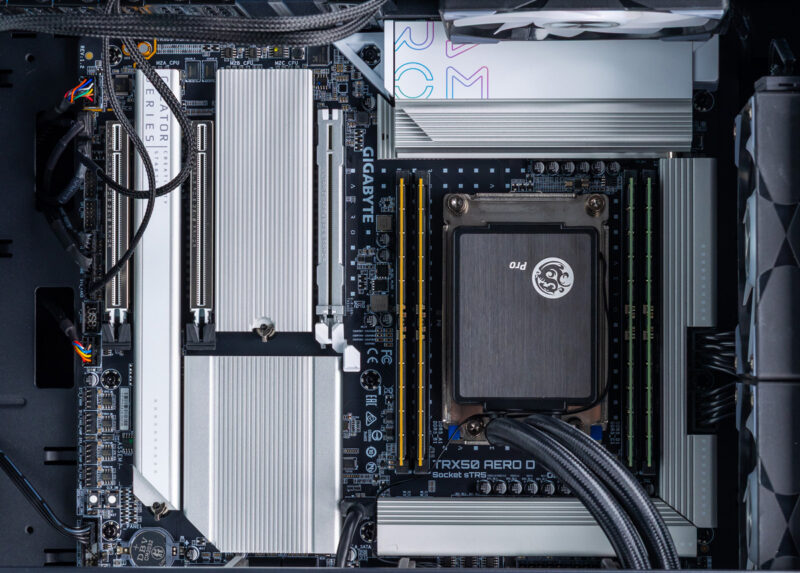
The end result is that the Gigabyte TRX50 AERO D is built to do precisely what it needs to, while it does not waste any precious board space (or BoM costs) on going beyond those goals. In that respect, the AERO D is something akin to the Threadripper equivalent of an entry-level motherboard – where “entry-level” means putting 80 lanes of PCIe bandwidth to good use. It is none too surprising then that with street prices on the board running for around $550, this board is cheaper than some high-end socket AM5 (Ryzen 9000) motherboards, which goes to show what can be accomplished with keeping things simple and succinct even for a low-volume product like an HEDT motherboard.
Where to Buy
If you wanted to find the Gigabyte TRX50 AERO D online, here is an Amazon Affiliate link.