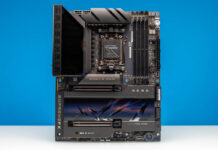
Gigabyte TRX50 AERO D Block Diagram
Here is the block diagram for the Gigabyte TRX50 AERO D.
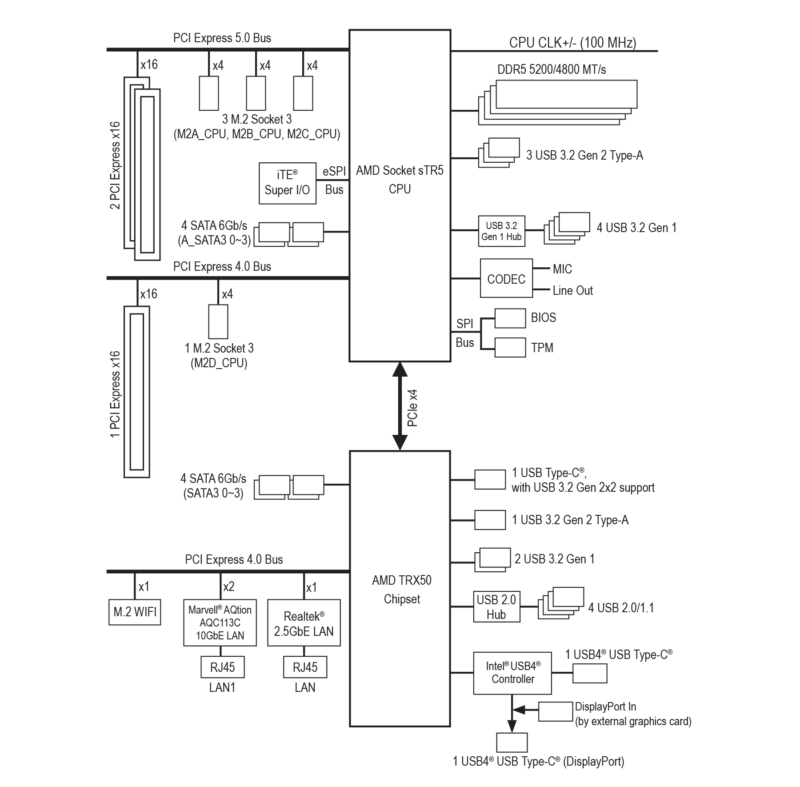
Though the board can accommodate Threadripper Pro processors, the TRX50 platform is designed first and foremost for vanilla Threadripper processors, and the various I/O lanes are allocated accordingly.
Here we see two PCIe x16 slots and three M.2 x4 socket hanging off of the PCIe Gen5 bus for the CPU. Meanwhile another PCIe x16 lane and a final M.2 socket hang off of the PCIe Gen4 bus.
With the exception of the CPU’s built-in USB lanes, everything else hangs off of the TRX50 chipset, which has a PCIe Gen4 x4 link back to the CPU. This includes all of the NICs, some of the USB-A ports, and all of the USB-C ports – including the 40Gbps ports powered by the Intel JHL8540 controller.
Gigabyte TRX50 AERO D Performance
For our TRX50 motherboard testing, we have AMD’s Ryzen Threadripper 9980X on hand. The most powerful of AMD’s Threadripper 9000 parts, this 64-core part gives us the best possible look at the performance of the TRX50 AERO D motherboard, all the while putting Gigabyte’s board in the hot seat as far as power delivery goes.
As luck would have it, we also recently reviewed one of Intel’s Xeon 600 series of workstation processors: the Xeon 658X. So for our look at the performance of Gigabyte’s TRX50 board, we have a contemporary workstation platform to compare it to. So without further ado:
Estimated SPEC CPU 2026
The recently released 2026 edition of the SPEC CPU benchmark suite offers a fresh look at the performance of the Threadripper 9000 platform – and offers a workload stressful enough to properly put a Threadripper system through its paces.
Just a note: we are using Ubuntu 26.04 LTS with LLVM 22 and are only using -O3 optimizations, so these scores are much lower than official benchmark runs. We are using that just to differentiate our estimated results from the official scores you may see from vendors that use highly optimized flags/configurations.
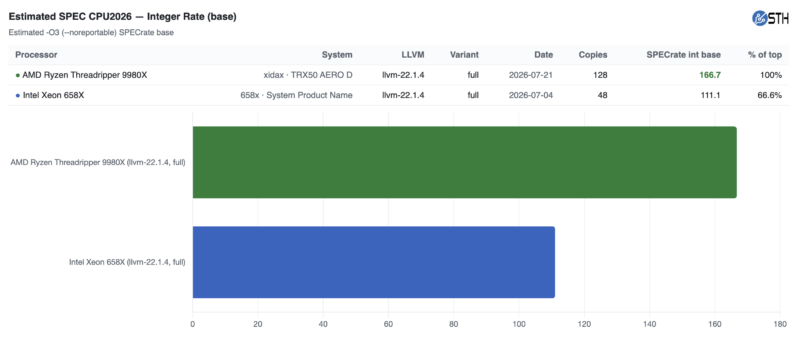
In full rate multithreaded testing under SPEC CPU 2026’s suite of integer workloads, the Threadripper platform – and the Gigabyte motherboard it is built around – fares rather well here thanks in big part to the large number of CPU cores at its disposal. The Threadripper 9980X system is a full 50% ahead of the 28-core Xeon 600 system. Though as SPEC CPU is a comprehensive throughput benchmark, we are likely leaving some performance on the table with respect to the CPU cores by only having 4 channels of memory on a TRX50 motherboard.
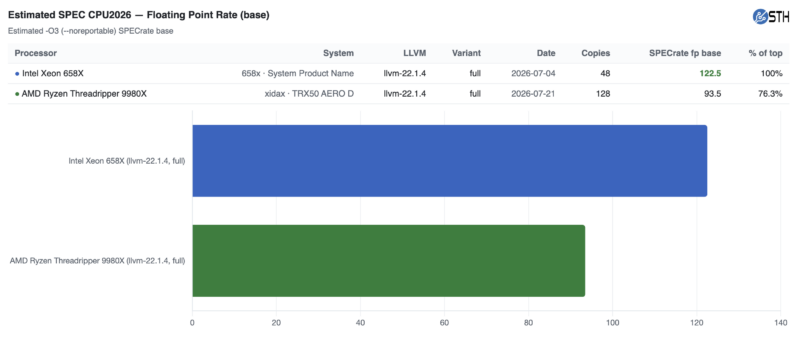
Shifting over to floating-point performance, this becomes more obvious. While the Threadripper platform offers more than twice as many cores as the Xeon, it ends up trailing in performance by about 24%. Which, given the even more memory-heavy nature of SPEC CPU’s floating-point benchmarks (there are a lot of good opportunities here for SIMD usage), the non-Pro Threadripper seems to be running headlong into its memory bandwidth limitations here. 64 cores is a lot to feed on just 4 channels of memory.
AgentSTH V7
After months of profiling agentic AI workloads and systems, we developed AgentSTH V7. This is a suite of tests that represents the types of agentic AI workloads we see in many trace runs, performing real-world tasks ranging from coding and infrastructure management to creating financial models and more. We also focus on running different shapes on processors to stress the CPU in ways that traditional benchmarks do not. Since we are not testing the LLM side here, it turns out that much of this looks very similar to how multi-tenant server CPUs are used outside agentic AI workflows.
Since we have so many disparate platforms here, we have opted to keep things capped at 16 cores rather than letting AgentSTH fill out every single core.
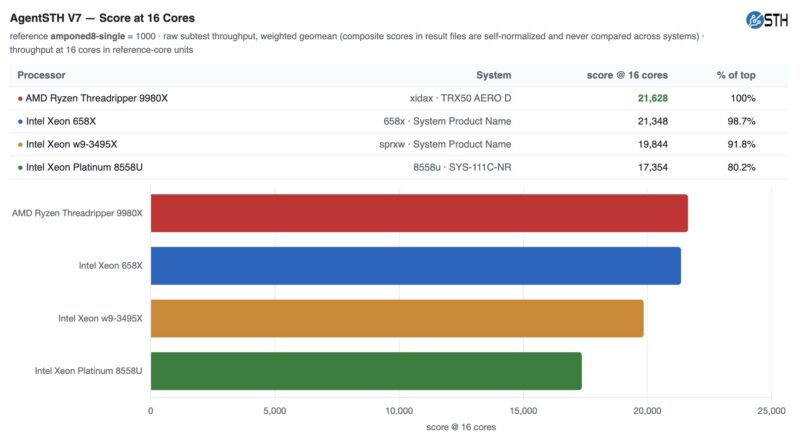
But even then, the Threadripper 9980X platform tops the chart. It is just enough to edge out the Xeon 600 system, with a composite score of just over 21,600.
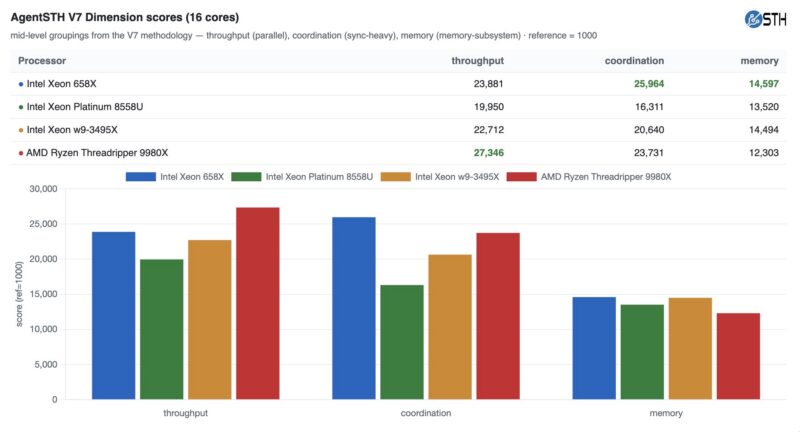
Digging into these results further by grouping workloads and results by dimensionality, we find the Threadripper platform strongest in total throughput, reflecting AMD’s CPU core architecture and its emphasis on fast, cost-effective CPU horsepower. However, the Threadripper loses its edge in coordination and memory performance. On the former, AMD’s core-complex configuration is one trade-off in the Threadripper design that enables its throughput, but it leaves it weaker when more than 8 cores must work together on a task. Meanwhile, memory performance is largely reflective of the smaller number of memory channels on a non-Pro Threadripper platform, though the AMD platform ultimately does not trail by too much here given the overall memory bandwidth gap.