

ASRock Industrial NUC BOX-358H Performance
Under the hood, the NUC BOX-358H is powered by the namesake Intel Core Ultra X7 358H processor, part of the Core Ultra Series 3 Panther Lake family. This is Intel’s premier mobile-focused, mid-power silicon, offering 16 CPU cores, Intel’s most powerful Arc B390 integrated graphics (Xe3 architecture), and a modest number of PCIe lanes for additional expansion.
As a full-fat version of the Panther Lake 12Xe chip, the 358H gets access to all the hardware offered in Panther Lake, with the four performance (P) cores topping out at 4.8GHz. Meanwhile, backing P cores for highly threaded workloads is a further eight efficiency (E) cores. And finally, four low-power-efficiency cores (LP-E), which are essentially always-on cores designed to handle light tasks so the other cores can sleep when not in use.
Being a full-fat chip also means the 358H has access to Intel’s most powerful integrated GPU, the Arc B390. This is a full 12 Xe core configuration of the company’s new Xe3 GPU architecture, and its high performance is one of the primary selling points for Panther Lake, offering massive gains over its predecessor’s top configuration, and making it competitive with entry-level laptop-grade discrete GPUs. And while no one is presumably going to be gaming on a NUC BOX (ed: unless someone sneaks in a quick Quake break at work), in an industrial setting, all of that GPU horsepower is free to drive other tasks, such as AI inference.

As noted earlier, however, the B390’s integrated GPU will be held back a bit by ASRock Industrial’s memory configuration. The trade-off for the additional flexibility of using DDR5 SO-DIMMs in place of soldered LPDDR5X is reduced overall memory bandwidth, and that bandwidth, in turn, is primarily to support the powerful iGPU.
Speaking of AI matters, Panther Lake also incorporates a newer version of Intel’s NPU architecture. Though not as performant overall as the GPU, the NPU is far more efficient in both power and space. But most notably, the 5th generation NPU adds support for FP8 models, which brings much faster performance to inference on AI models suitable for use with low-precision floating point.
In fact, the whole chip is more efficient and lower-power overall. On the manufacturing side, Intel is producing the Panther Lake CPU tile on its cutting-edge 18A process. Meanwhile, on a generational basis, the Core Ultra Series 3 chips all have lower TDPs than their Core Ultra Series 2 (Arrow Lake) counterparts. Case in point: the 358H is rated for a maximum turbo TDP of 80W, while the similar 255H boosts to 115W.
Finally, because this is a barebones system that ships without any storage or RAM, for our testing, we have installed 96GB of DDR5-5600 in a 2x48GB configuration, as well as a 1TB Crucial P3 Plus SSD.
Geekbench CPU
Given that we have reviewed so many iterations of the NUC BOX family over the years, it is only appropriate that for our CPU performance overview, we see how the new BOX-358H stacks up to its predecessor, the BOX-255H. With virtually identical chassis and features, this is very close to an apples-to-apples comparison between the Panther Lake and Arrow Lake platforms, on which the two NUCs are built.
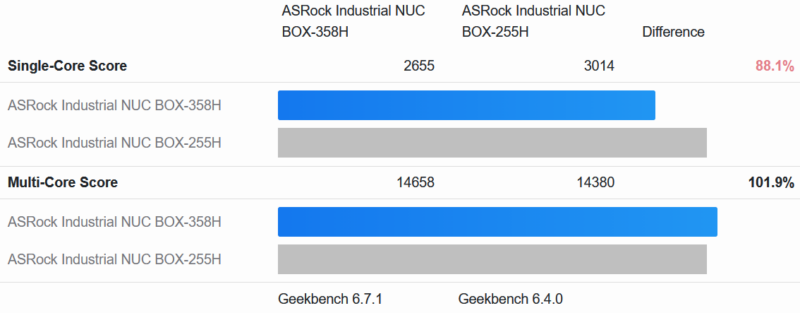
Unexpectedly, we see the newer BOX-358H actually regress in CPU performance in single-threaded testing. We say “unexpected” because of all of the Panther Lake systems we have reviewed so far, this is the first time we have seen this outcome occur.
There are a couple of different factors at play here, driving these results. The first is that the 358H is clocked lower than the 255H right off the bat, with a peak P-core clock speed of 4.8GHz versus 5.1GHz, which works against the architectural IPC gains since Arrow Lake. The second thing is that the 255H is allowed to turbo higher, peaking some 25 Watts higher at 115W, versus the 80W limit of the 358H. The final difference is that the 255H system was working with slightly faster memory, having been paired up with DDR5-6400 memory instead of DDR5-5600.
No matter the causes, the net result is that the BOX-358H loses about 12% on single-threaded performance. Meanwhile, it fares better in multi-threaded performance, where, despite the aforementioned deficits, it manages to ever so slightly edge out the BOX-255H by 2%. Which, with fewer P cores and more E cores than the 255H, is actually a more significant win than it would first appear, and helps to validate Intel’s claims that a larger number of LPE cores is more beneficial overall than a larger number of P cores, particularly with the newer Darkmont CPU core architecture.
Geekbench GPU
As for GPU performance, unfortunately, our previous review of the BOX-255H predates our use of the Geekbench 6 Compute test. So instead, we will use the Core Ultra Series 2 265H-powered Lenovo ThinkPad P14s Gen 6 as our reference point.
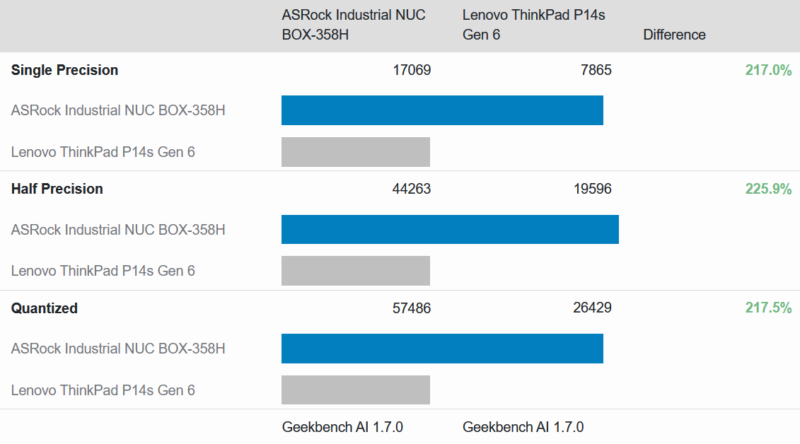
In the Geekbench AI benchmark, the Arc B390 iGPU on the BOX-358H is leaps and bounds ahead of the Arc 140T GPU in the 2565H-powered Lenovo system. At every precision, it delivers over twice the performance, despite the NUC’s modest memory bandwidth compared to what an LPDDR5X-based system could provide.
This massive boost in GPU performance is arguably the selling point for the BOX-358H over its predecessor, as it is the single biggest performance gain that Panther Lake can provide.
Now, how does this SoC’s performance translate to power consumption and noise? Let us find out.



I’m just flummox that at this price point that a 10G ethernet point isn’t provided.
The system is pretty awesome. but the fan i very poor quality. i’ve had several of the older version NUC BOX-255h and NUC BOX-155H running 24/7 and the fans only last about 1½yr before they start to fail. the chassis on the new one is the same so my guess is that the fan is also the same shit.
The replacement fan is both expensive and hard to obtain en EU