
ASRock Creator Radeon AI Pro R9700 Graphics Performance
Shifting gears, because the R9700 is not just an inference accelerator, but a graphics card as well, here is a quick look at the card under some workstation graphics workloads.
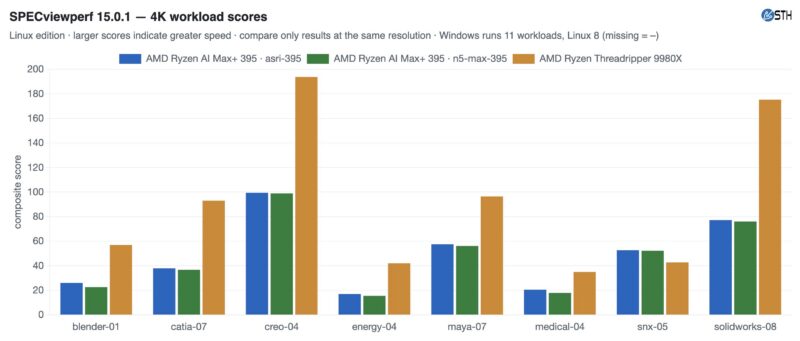
As AMD’s most powerful RDNA 4 architecture workstation card, the R9700 has little trouble tearing through the SPECviewperf 15.0.1 suite under Linux. Composite scores vary widely by workload, but even the Tuvok (medical) workload scores at least 37 points, while PTC Creo is just shy of 200 points.
More importantly, it is a massive improvement over the integrated GPU in the Ryzen AI Max 395+ SoC, a chip with one of the fastest integrated GPUs on the market, with the R9700 typically doubling the SoC’s performance. The one exception being the Siemens NX 2406 workload, which shows an unusual affinity for the integrated GPU.
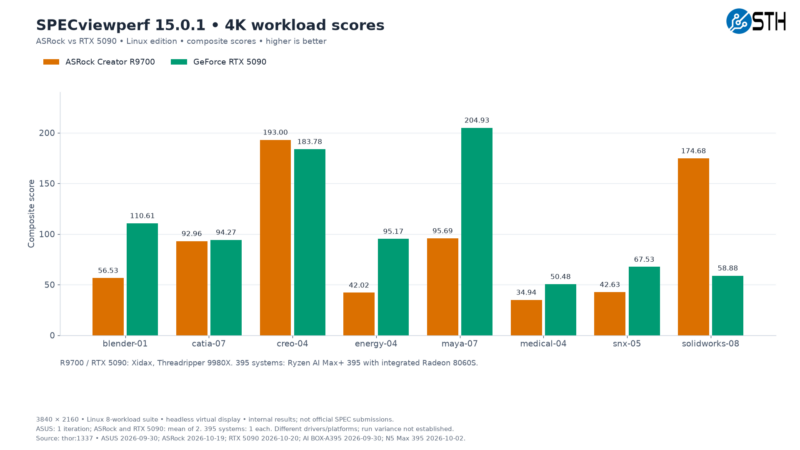
As for how things look versus the GeForce RTX 5090, it is actually closer than you may have expected. The R9700 holds its own in Catia and Creo, and even takes a major win in Solidworks. However, this leaves the RTX 5090 to handily sweep the other five workloads, leaving the R9700 at around half the NVIDIA card’s performance in Maya and OpendTect’s “energy” seismic visualization.
Final Words
Wrapping up, with current heavy demand for AI hardware, the Radeon AI Pro R9700 fills an important role in AMD and ODM partner ASRock’s product lineups. In the last few years, AMD has developed a full stack of AI hardware from mini-PCs to servers, and while servers admittedly get much of the attention due to their sheer scale and scale-out abilities, there is still a need for AI hardware to fill out workstations and other desktop environments. The R9700 slots nicely into that role.
Despite that overall demand, the larger workstation video card market is still competitive, and the R9700 has needed to carve out its own niche. The underlying Navi 48 hardware is quite capable, thanks in no small part to the performance enhancements AMD introduced with the RDNA 4 architecture. But it cannot match either the sheer performance or sheer memory capacity of NVIDIA’s RTX Pro cards.
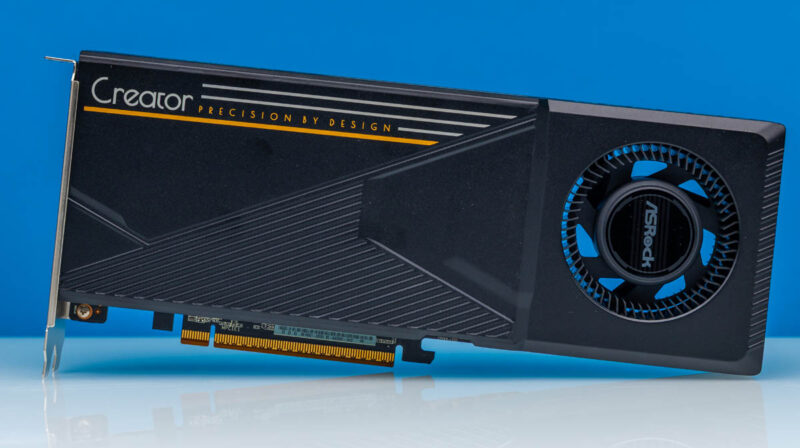
Instead, AMD and ASRock have largely positioned the R9700 as a budget play, at least by AI standards. The card launched at $1300, and even with price hikes from upstream component and memory price increases, the going price for R9700 cards today is still only $1700. Which, for a 32GB AI inference card, is a relative steal, especially when NVIDIA’s comparable 32GB cards are more than twice that price. It is something of a classic move from AMD’s playbook, but it has one that has served them well over the years, and serves them well on the R9700 as well.
Finally, with the ability to place up to 4 cards in a single desktop system – and with power requirements low enough to make that readily viable – the value proposition for the R9700 is just as much about what a whole fleet of cards can do as it is a single card. 32GB is already enough for 30B+ models; four cards working in concert for 128GB of pooled VRAM allows for far larger models still. With GPU memory bus width being a critical bottleneck to memory capacity on a single video card, scaling out over multiple cards is an important tool in making inference viable on the desktop to begin with.
Where To Buy
If you want to find the ASRock Creator Radeon AI Pro R9700 online or check the current price here is an Amazon affiliate link.