

AMD Ryzen AI Halo Power Consumption
The system comes with a nice Delta 240W power supply with a Type-C output. Between the high-quality Delta fans inside and the Delta power supply externally, AMD did a solid job using a well-known manufacturer for these components.
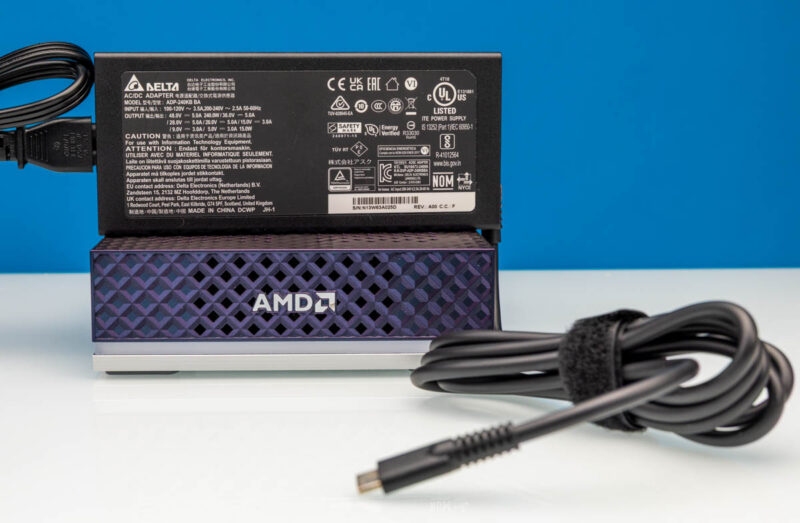
Idle in Debian, we often ranged in the 11-13W at the outlet. Depending on the workload, we generally saw 98-144W as peaks, but we certainly exceeded that during our testing. Overall, though, this system used about as much power as we would expect from a Strix Halo box.
Key Lessons Learned
There are perhaps two good ways to look at this machine. First, you can take the perspective of this being a hardware platform. The second is that you can view it as AMD’s base developer platform that it will support and use going forward. I spoke with AMD about this at Computex 2026, and that felt more like the vision. AMD plans regular software releases and easy-onboarding recipes to help users get onboarded to its ecosystem, all in a little box you can throw in your backpack.
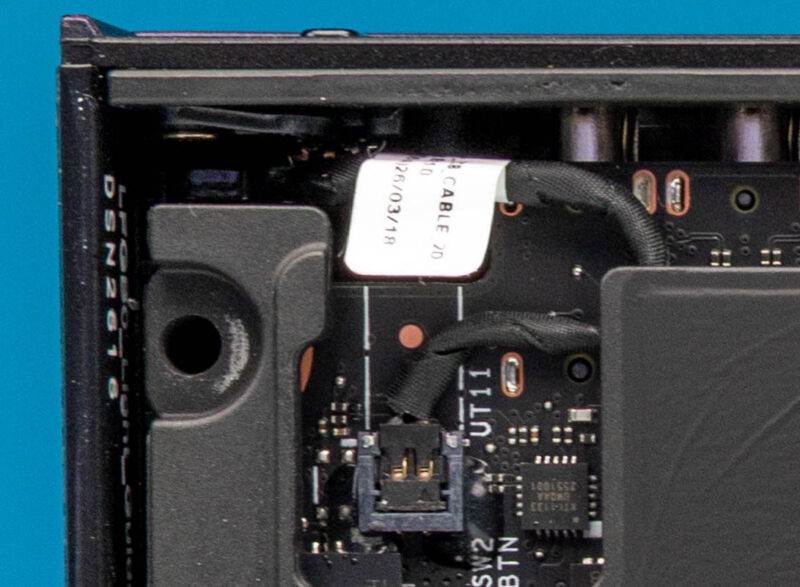
From a hardware perspective, this is probably one of the higher-quality implementations under the hood, save for the internal LED strip and the wire/connector that has been giving me nightmares for a week. Realistically, folks do not need to open the system, so this power button connector should not be an issue for many. The fix is also very simple. AMD should just have restore power on AC set to enable by default in the firmware.
Now, let us get to the elephant in the room: pricing. This is a $3999 system, which puts it right in the range of the 1TB NVIDIA GB10 systems like the Asus Ascent GX10 (Amazon affiliate link). My big challenge with the setup and networking. It is one that a new user is unlikely to encounter, but we have been reviewing these Strix Halo systems for over a year now. We have something like nine NVIDIA GB10 systems, and our eighth AMD Ryzen AI Max+ 395 system should arrive later this week (we buy a lot of these as well). With the NVIDIA systems, it may not be wildly efficient, but we have them all in a switched RDMA cluster and can run everything from Kimi K2.5 1T class models down to Qwen3.6-35B-A3B models.
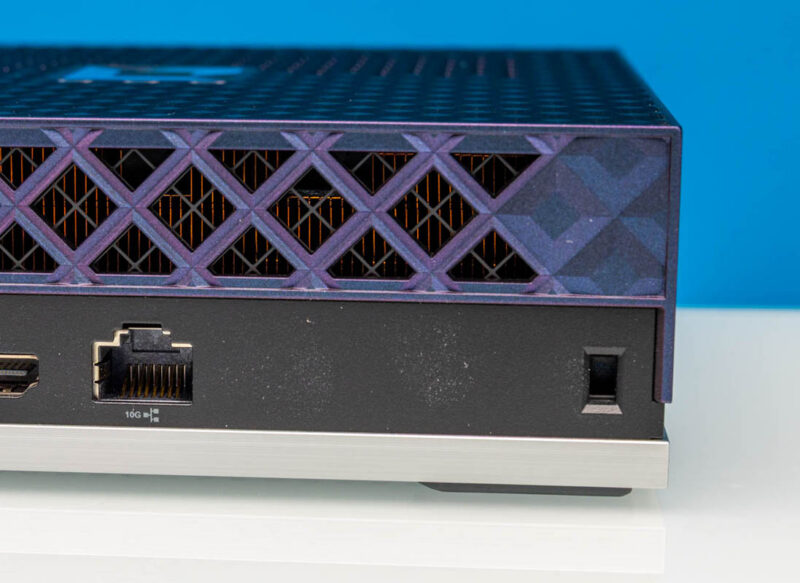
In contrast, we hook all of the Strix Halo systems up, but they are sharing 2.5GbE, 5GbE, or 10GbE links to shared storage. The lack of a higher-speed RDMA NIC means that, at best, the two USB4 ports get used to scale to perhaps three units, or you do a lower-speed external RDMA NIC. In either case, I am not sure how you get to a “good-adjacent” AMD Ryzen AI Halo cluster. Of course, if you are sitting in AMD’s shoes, they probably know that, like 97% of GB10 users have one machine, 2.5% have two machines, and 0.5% have more than two, so USB4 networking will be fine if they implement it. Those splits are totally made up and are likely generous to multi-node GB10 clusters. On the other hand, you are stuck with a 10GbE model loading from a NAS, and you do not have a scale-up path. It just feels like at $3999, especially having operated clusters of both NVIDIA and AMD 128GB LPDDR5X systems, that NVIDIA is providing value with the NIC for those that want to go bigger. Heck, even just having a PCIe slot option so people can add high-speed networking would be a value-add. Part of the NVIDIA GB10’s value is not just in the compute and memory, but also in that you can work with NCCL and the scale-out stack using datacenter-grade components.
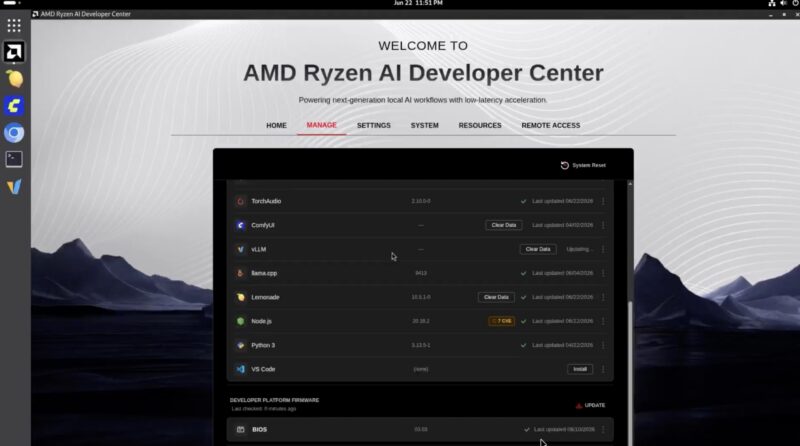
On the developer side, I had a preview of the vision at Computex 2026, and this is really good. AMD is making it easy to get started and run things from text LLMs to ComfyUI. To be frank, this is exactly what AMD needs. AMD is also supporting Windows, which we did not test on this box. NVIDIA will soon have its entrant into this space running Windows and without a high-speed onboard NIC, but AMD has that configuration now.
I completely get the value for folks who want AMD. AMD has built a high-quality baseline for developers to use. AMD’s plans to support the platform help mitigate the risk of getting some of the lower-volume platforms out there. Also, many smaller mini PC vendors are not big enough to secure DRAM supply directly, but AMD is a big enough player that it can. In this supercycle, that matters since if you are deploying Strix Halo at your company, the last thing you want is for the mini PC you are using to go out of stock.
Final Words
I was talking to someone on our team last week, and they asked what was special about this box versus others on the market. Clearly, the Minisforum MS-S1 Max has more expandability and better networking. To me, the real answer is that this is AMD’s standard. The expectation is that this box will perform as expected if you buy it. You will expect AMD to provide regular updates not just to the drivers but also to the firmware and the recipes, so you can run the best-known stacks. Now, AMD needs to deliver on that vision, but it is also very important for the company to execute on it.
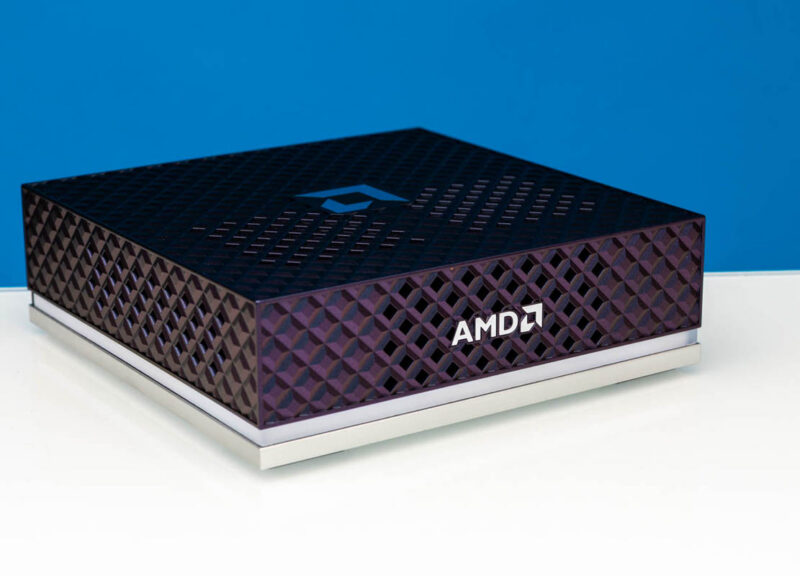
To be completely fair, after testing and using so many of these 128GB LPDDR5X systems over the past year, I think this is a nice system, and I understand the value proposition. I also could not shake the thought that what I really want is the upcoming Gorgon Halo (AMD Ryzen AI Max+ 495) version with 192GB of slightly faster LPDDR5X. That will undoubtedly cost a lot more just because of the 50% more memory, but it also means larger models can run on the device, which is exciting. For now, AMD has a nice little box that fits in your backpack and runs agentic AI and creator workflows from just about anywhere.




Does AMD really even have a >10Gb NIC that they can put into these at a reasonable price point, even if they had enough free lanes? I see that they make a AMD Pensando Pollara 400, but they’re not really available on the open market so I can’t tell if it makes sense to put one into a $4k computer. The only one that I can see for sale anywhere is $3,500 on eBay. The bulk of the >100G NICs that get announced these days are DPUs, which really don’t make much sense in this context, and I just can’t see AMD shipping a Mellanox or Intel NIC in this sort of thing.
I really wish they’d included a PCIe slot or, better yet, an OCP slot for BYONetworking. That would let them enable clusters without having to force the connectivity cost onto every customer that doesn’t use it. Does Strix Halo have spare PCIe lanes or is it so narrowly focused that it only allows for an NVMe or two?
It would be nice to compare benchmarks with medium size (20B-50B) dense LLM on this thing to similarly priced Apple offerings with M4 MAX, M5 Pro and/or M5 MAX, alongside a GB10.
I couldn’t see from the pictures, but is the power USB-C wired up for data? My dream device would be compatible with a dock so I could move it around to different sites and only plug in a single cable. I know there was some AI box (one of those DGX Spark boxes, maybe the HP one) that actually listed a data speed on the power port, but I don’t have one to test it with a high power dock.
I couldn’t see from the pictures, but is the power USB-C wired up for data? My dream device would be compatible with a dock so I could move it around to different sites and only plug in a single cable. I know there was some AI box (one of those DGX Spark boxes, maybe the HP one) that actually listed a data speed on the power port, but I don’t have one to test it with a high power dock.
To reinforce Frank’s comment: What would have made this review really useful is a performance comparison with Apple and nVidia boxes.
I’m going to go a step further than Frank and justsomeguy and say that this review is actually useless without performance comparisons against other hardware.
and when you decide to add comparative llm inference benchmarks, may I suggest that you use MLX on Apple hardware, CUDA on NVIDIA and both ROCm and Vulkan on AMD (the results can sometimes be surprising)?
IMHO, this box is a little bit weird, I guess they’re testing the waters for Gorgon Halo and they can do a respin. But releasing a reference platform a year into production is weird. Just buy a Bosgame, GMKTEC or Minisforum, or wait for Medusa Halo.
@Scott Laird
Broadcom do a respectable line of >25G NICs, although they wouldn’t be cheap, or there’s Marvell DPUs.
Or be really weird and follow the methodology of the Mikrotik CCR2004 which is a switch chip with PCIe.
The other Strix Halo machines had dual NVMe, so there’s upto ~40G of PCIe bandwidth available.
This was an amazing review, the hardware part is fantastic and so brave. I don’t care for RGB but if I messed up that flat cable I would cry! 3999 USD for 128GB of ram pretty much. I don’t see how it’s any better than the mini pcs with the same specs.