

AMD Ryzen AI Halo Internal Hardware Overview
Removing the bottom panel, and you see this. It is clean and functional, but for most, this is the ideal place to stop.
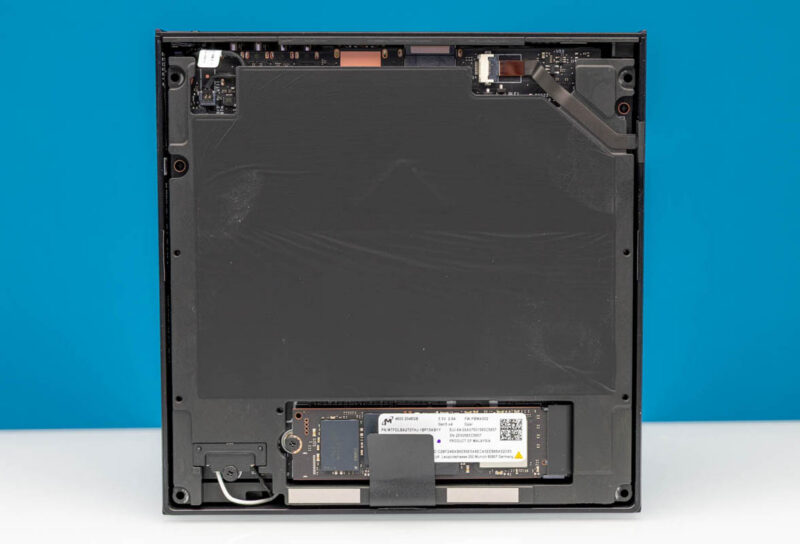
On the bottom, we have our WiFi antenna wires and then the M.2 SSD. Here we have a 2280 M.2 SSD, which is a 2TB Micron model.
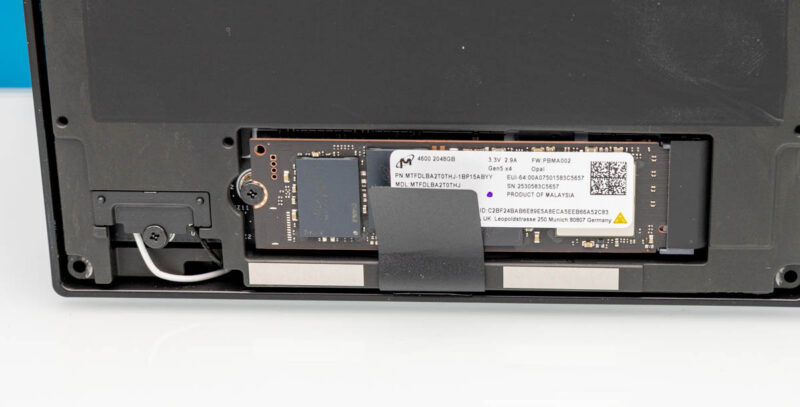
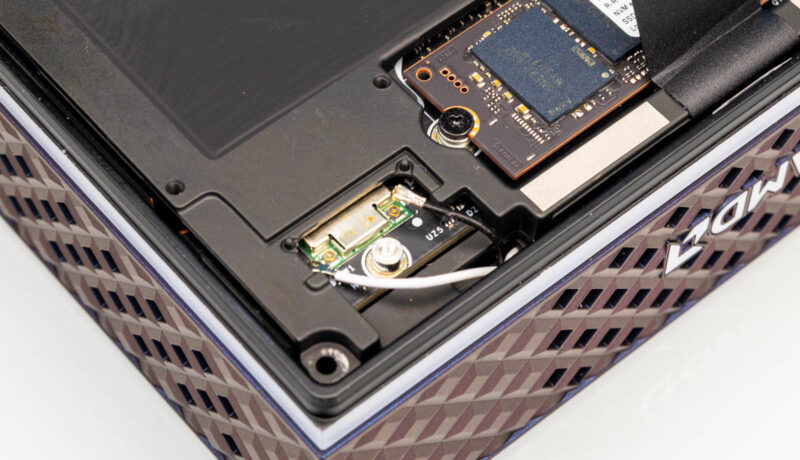
Like many of the GB10 units, there is a little cover over the WiFi solution, so you can have an easier time re-attaching if need be.
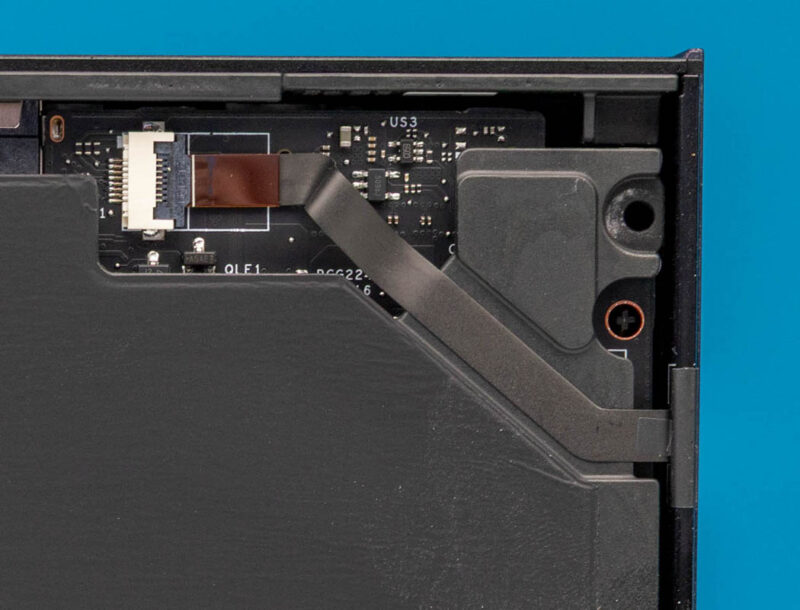
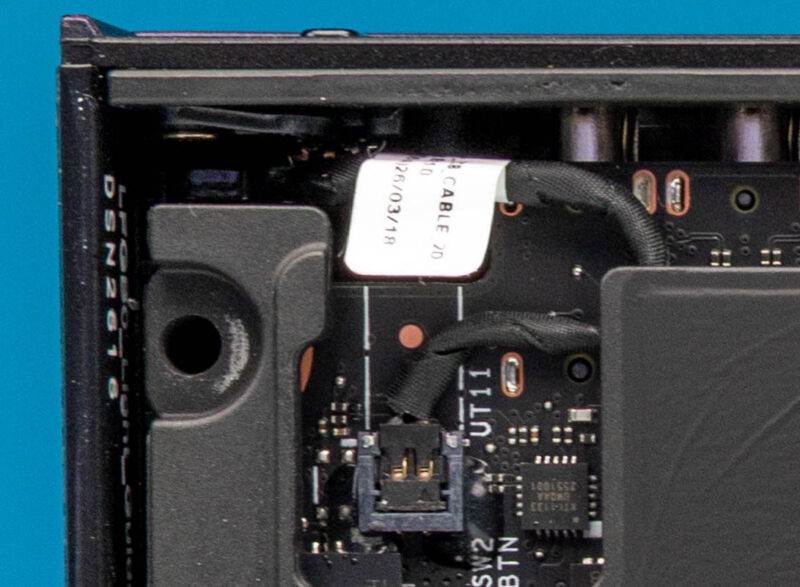
This flat cable goes to the outer ring. Our sense is that it controls the RGB ring around the chassis. Part of that sense comes from when we pulled on the pull tab near the SSD. Doing so, we severed this cable without realizing it, which turned off the RGB ring. If you enjoy the RGB ring, carefully remove this before disassembling the system.
Then comes the connector that gave us the most strife. This little connector has wires that go to the power button. AMD’s power button design is very good. This little connector, however, saw the wires pull out easily. We were not able to easily reseat the wires. That might seem like a minor issue, but the BIOS was not set to power on with AC power by default. As a result, we physically pushed the wires back into this connector, started the system, then flipped that BIOS setting so we could power on the system.
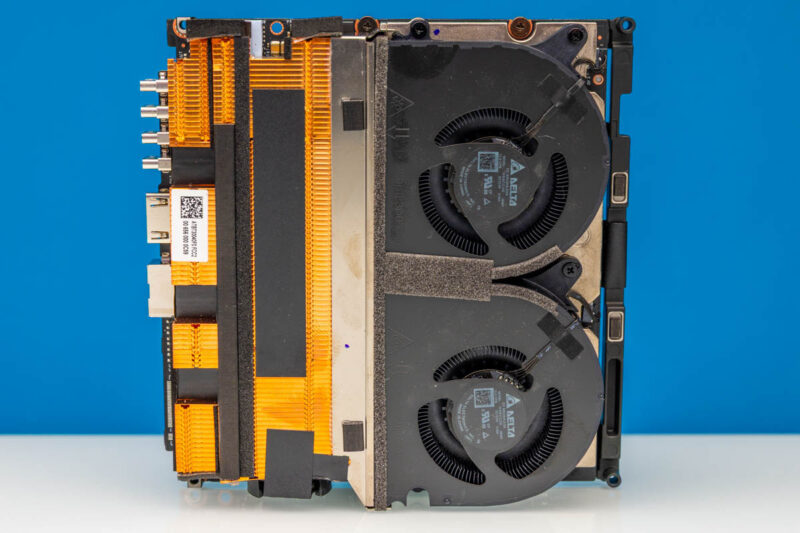
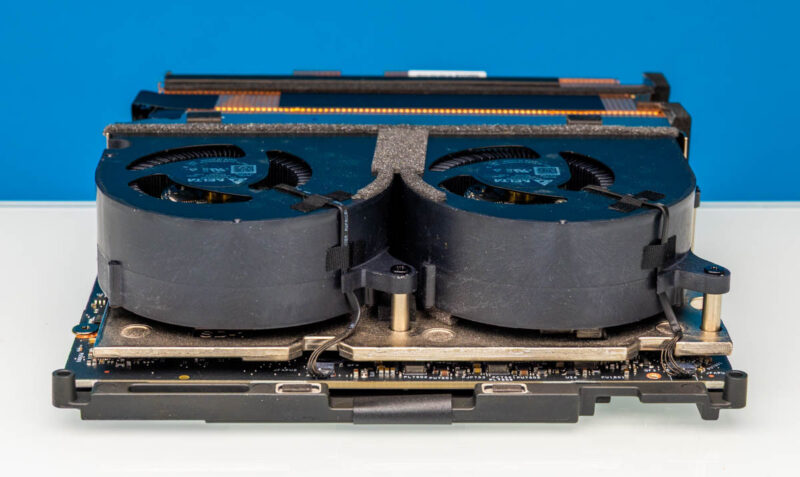
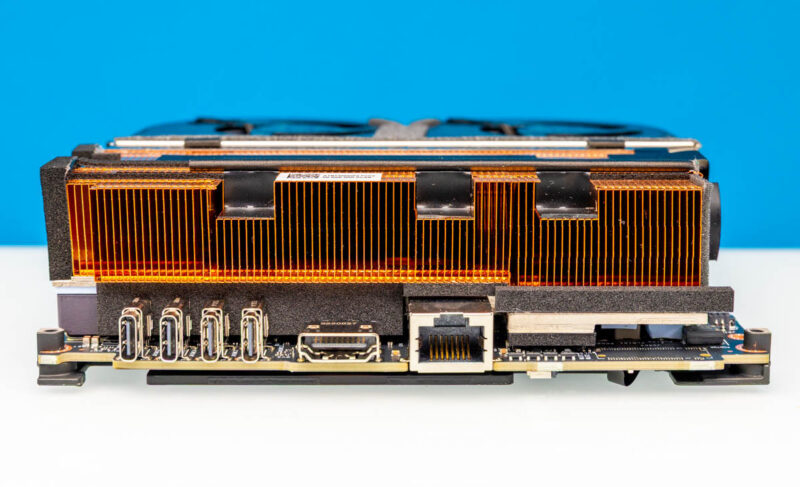
Once we got the board out, however, the assembly was great. Two big Delta fans, a copper (at least it feels like copper) heatsink. There is also plenty of padding around the heatsink.
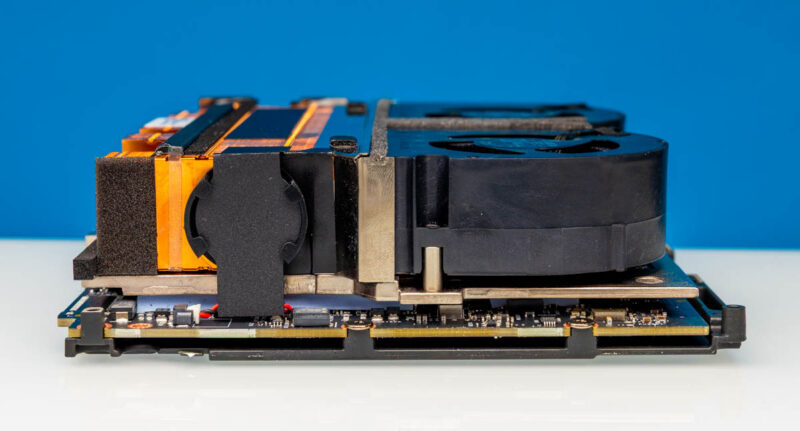
On the side, you can see the CR2032 battery.
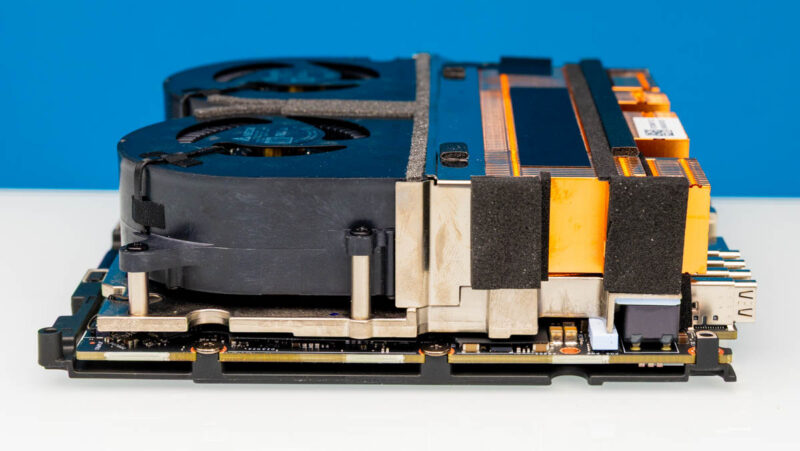
Here is the other side.
Here is another view of the front with the two fans. If you remember the two top chassis vents, and then look at the fans, it should make more sense.
Here is the rear view of the cooler with the heatsink fins.
As a quick note, this is the AMD Ryzen AI Max+ 395 with 128GB of LPDDR5X memory. Since there is nothing socketed other than the M.2, realistically, you do not need to go this far, as there is nothing to service. Still, we opened it up so you did not have to.
Next, let us get to the topology and the developer experience.




Does AMD really even have a >10Gb NIC that they can put into these at a reasonable price point, even if they had enough free lanes? I see that they make a AMD Pensando Pollara 400, but they’re not really available on the open market so I can’t tell if it makes sense to put one into a $4k computer. The only one that I can see for sale anywhere is $3,500 on eBay. The bulk of the >100G NICs that get announced these days are DPUs, which really don’t make much sense in this context, and I just can’t see AMD shipping a Mellanox or Intel NIC in this sort of thing.
I really wish they’d included a PCIe slot or, better yet, an OCP slot for BYONetworking. That would let them enable clusters without having to force the connectivity cost onto every customer that doesn’t use it. Does Strix Halo have spare PCIe lanes or is it so narrowly focused that it only allows for an NVMe or two?
It would be nice to compare benchmarks with medium size (20B-50B) dense LLM on this thing to similarly priced Apple offerings with M4 MAX, M5 Pro and/or M5 MAX, alongside a GB10.
I couldn’t see from the pictures, but is the power USB-C wired up for data? My dream device would be compatible with a dock so I could move it around to different sites and only plug in a single cable. I know there was some AI box (one of those DGX Spark boxes, maybe the HP one) that actually listed a data speed on the power port, but I don’t have one to test it with a high power dock.
I couldn’t see from the pictures, but is the power USB-C wired up for data? My dream device would be compatible with a dock so I could move it around to different sites and only plug in a single cable. I know there was some AI box (one of those DGX Spark boxes, maybe the HP one) that actually listed a data speed on the power port, but I don’t have one to test it with a high power dock.
To reinforce Frank’s comment: What would have made this review really useful is a performance comparison with Apple and nVidia boxes.
I’m going to go a step further than Frank and justsomeguy and say that this review is actually useless without performance comparisons against other hardware.
and when you decide to add comparative llm inference benchmarks, may I suggest that you use MLX on Apple hardware, CUDA on NVIDIA and both ROCm and Vulkan on AMD (the results can sometimes be surprising)?
IMHO, this box is a little bit weird, I guess they’re testing the waters for Gorgon Halo and they can do a respin. But releasing a reference platform a year into production is weird. Just buy a Bosgame, GMKTEC or Minisforum, or wait for Medusa Halo.
@Scott Laird
Broadcom do a respectable line of >25G NICs, although they wouldn’t be cheap, or there’s Marvell DPUs.
Or be really weird and follow the methodology of the Mikrotik CCR2004 which is a switch chip with PCIe.
The other Strix Halo machines had dual NVMe, so there’s upto ~40G of PCIe bandwidth available.
This was an amazing review, the hardware part is fantastic and so brave. I don’t care for RGB but if I messed up that flat cable I would cry! 3999 USD for 128GB of ram pretty much. I don’t see how it’s any better than the mini pcs with the same specs.