

AMD Ryzen AI Max+ 395 AgentSTH V7 Performance
After months of profiling agentic AI workloads and systems, we developed AgentSTH V7. This is a suite of tests that represents the type of agentic AI workloads we see running on many trace runs, doing real-world tasks ranging from coding to infrastructure management to creating financial models, and more. We also focus on running different shapes on processors to stress the CPU in ways that traditional benchmarks do not. Since we are not testing the LLM side here, it turns out that a lot of this actually looks very similar to how multi-tenant server CPUs are used outside agentic AI workflows.
Let us start with single-core results:
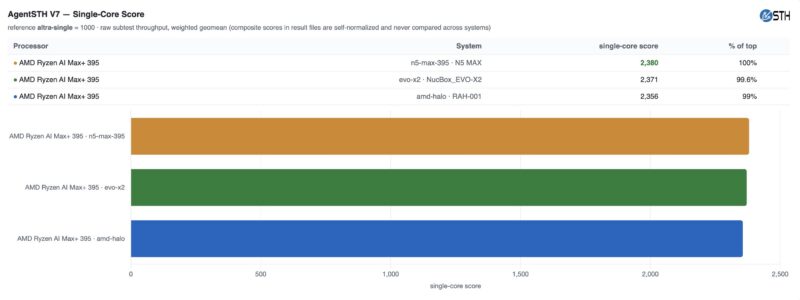
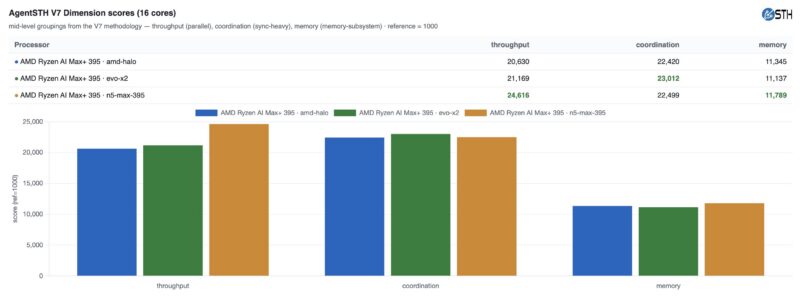
The cores end up relatively close together, which is what we would expect given that these are the same processors, just in different systems. We also broadly categorize these results into three main buckets: throughput, coordination, and memory.
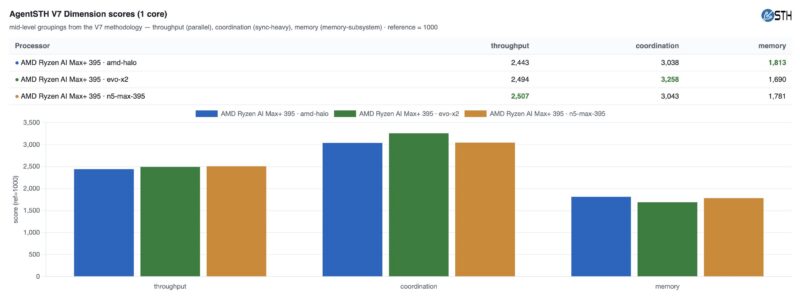
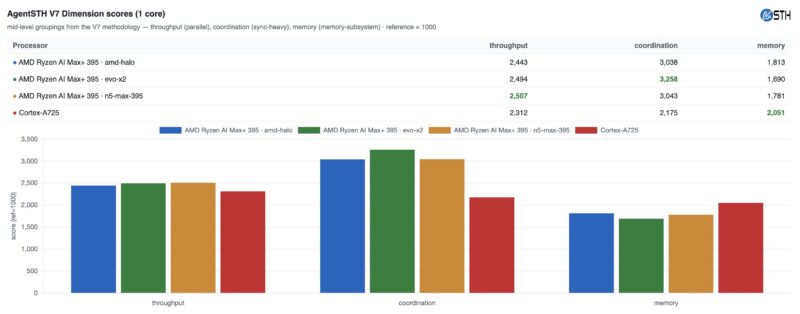
Just to give you some sense, we pulled in the NVIDIA GB10 result, which is labeled as the “Cortex-A725” just because the parser pulls information that way. Here you can see that the core is perhaps a bit slower. As we would expect, however, in workloads that are more memory bandwidth bound, the GB10’s slightly higher memory bandwidth helps it quite a bit. That is where we would expect to see gains in the future with Gorgon Halo moving to faster LPDDR5X.
Scaling the test out to 16 cores, we see that the Minisforum continues to perform well, which is more similar to the shape we saw with the SPEC CPU2026 results:
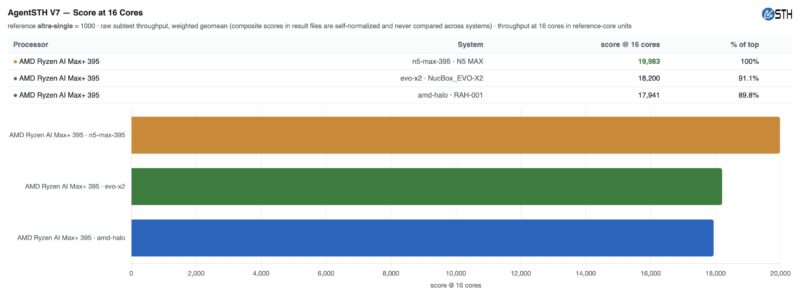
Here again, we see the throughput results do well at 16 cores on the Minisforum.
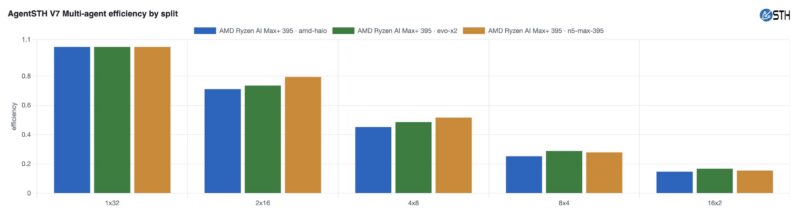
Next, we split the CPU into running a single workload across all 32 threads, then test various instance sizes, aiming to fill the CPU with up to sixteen 2-thread workloads. Realistically, if you are running an agentic AI workflow, a system like this has the CPU performance to run multiple agents at a time. So we test to see what those splits might look like when the processor is juggling multiple agents running in parallel.
In terms of scaling efficiency, here is a quick look at what it looks like as we add cores/ threads over a single-core result. As a fun aside, we defined looking at the 1, 2, 4, 8, 16, 32 core splits actually for server CPUs, where we would expect 32+ cores these days. It just so happened to fit the Strix Halo’s thread count.
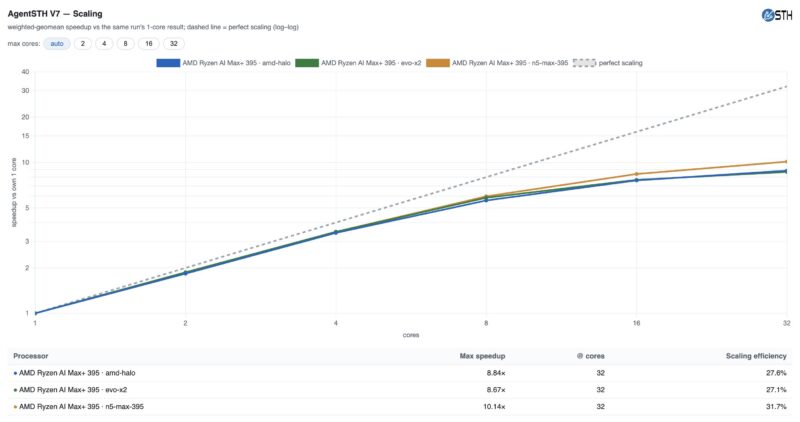
As a neat thing here, you can see fairly good scaling across eight cores. Through sixteen, we see OK results. Once we go from 16 to 32 cores, we see a fairly notable drop-off in scaling because those are SMT threads rather than full cores, so comparing them against a single-core result logically means we should see lower incremental performance for the additional threads.
AMD Ryzen AI Halo GPU AI Performance
At some point, it feels like we have done many AMD Ryzen AI Max+ 395 systems. We have looked at ones from GMKtec, Minisforum, Framework, Beelink, and so forth. Since we are currently testing the Minisforum N5 Max, we used that for the CPU benchmarks. We also had data from the Minisforum MS-S1 Max, and we are swapping it in so we can run 128GB on three machines. The EVO-X2 was the first system we tested, the MS-S1 Max is our current recommendation for Strix Halo, and now there is the Ryzen AI Halo:
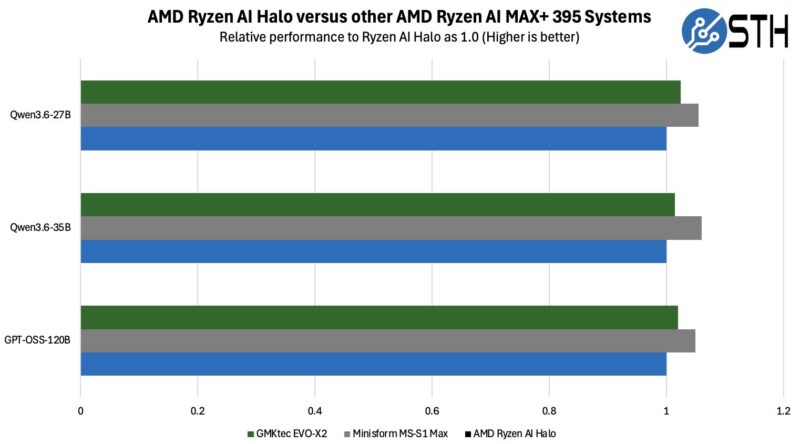
Just at a high level, GPT-OSS-120B at MXFP4 is roughly 45t/s on the Ryzen AI Halo, which is quite a bit. Qwen3.6-27B is a great model, but as a dense model, it runs at more like 14t/s. Qwen3.6-35B runs at 62t/s using Q4. Overall, if you are looking to generate 1M tokens/day with capable models, this can do it.
Worth noting here that AMD has also been doing a lot of work on its software stack, so the EVO-X2’s performance today is much better than it was a year ago. The nice aspect here is that, as new models come out, there are enough AMD Ryzen AI Max+ systems available that optimizations come out fairly quickly. We used GPT-OSS-120B a lot earlier this year, and now Qwen3.6-35B-A3B is a workhorse. Remember that you need about 11.6t/s to be able to generate 1M tokens/ day if you had a box just generating tokens 24/7 and not doing anything else. Realistically, you will want much higher than that if you want to generate 1M tokens/ day, because few individuals have a constant generation stream that runs linearly 24/7.
Next, let us discuss power consumption.



Does AMD really even have a >10Gb NIC that they can put into these at a reasonable price point, even if they had enough free lanes? I see that they make a AMD Pensando Pollara 400, but they’re not really available on the open market so I can’t tell if it makes sense to put one into a $4k computer. The only one that I can see for sale anywhere is $3,500 on eBay. The bulk of the >100G NICs that get announced these days are DPUs, which really don’t make much sense in this context, and I just can’t see AMD shipping a Mellanox or Intel NIC in this sort of thing.
I really wish they’d included a PCIe slot or, better yet, an OCP slot for BYONetworking. That would let them enable clusters without having to force the connectivity cost onto every customer that doesn’t use it. Does Strix Halo have spare PCIe lanes or is it so narrowly focused that it only allows for an NVMe or two?
It would be nice to compare benchmarks with medium size (20B-50B) dense LLM on this thing to similarly priced Apple offerings with M4 MAX, M5 Pro and/or M5 MAX, alongside a GB10.
I couldn’t see from the pictures, but is the power USB-C wired up for data? My dream device would be compatible with a dock so I could move it around to different sites and only plug in a single cable. I know there was some AI box (one of those DGX Spark boxes, maybe the HP one) that actually listed a data speed on the power port, but I don’t have one to test it with a high power dock.
I couldn’t see from the pictures, but is the power USB-C wired up for data? My dream device would be compatible with a dock so I could move it around to different sites and only plug in a single cable. I know there was some AI box (one of those DGX Spark boxes, maybe the HP one) that actually listed a data speed on the power port, but I don’t have one to test it with a high power dock.
To reinforce Frank’s comment: What would have made this review really useful is a performance comparison with Apple and nVidia boxes.
I’m going to go a step further than Frank and justsomeguy and say that this review is actually useless without performance comparisons against other hardware.
and when you decide to add comparative llm inference benchmarks, may I suggest that you use MLX on Apple hardware, CUDA on NVIDIA and both ROCm and Vulkan on AMD (the results can sometimes be surprising)?
IMHO, this box is a little bit weird, I guess they’re testing the waters for Gorgon Halo and they can do a respin. But releasing a reference platform a year into production is weird. Just buy a Bosgame, GMKTEC or Minisforum, or wait for Medusa Halo.
@Scott Laird
Broadcom do a respectable line of >25G NICs, although they wouldn’t be cheap, or there’s Marvell DPUs.
Or be really weird and follow the methodology of the Mikrotik CCR2004 which is a switch chip with PCIe.
The other Strix Halo machines had dual NVMe, so there’s upto ~40G of PCIe bandwidth available.
This was an amazing review, the hardware part is fantastic and so brave. I don’t care for RGB but if I messed up that flat cable I would cry! 3999 USD for 128GB of ram pretty much. I don’t see how it’s any better than the mini pcs with the same specs.