

Final Words
As the latest and greatest member of the Ryzen 9000 family, AMD’s new Ryzen 9 9950X3D2 Dual Edition chip finds itself rounding out the CPU family on a high note. AMD’s Zen 5 architecture has performed well for the company across the board, and in some respects, that is even more the case for AMD’s desktop chips. So anything that AMD can do to add a bit more performance to those chips makes the flagship of the line shine a little bit more.
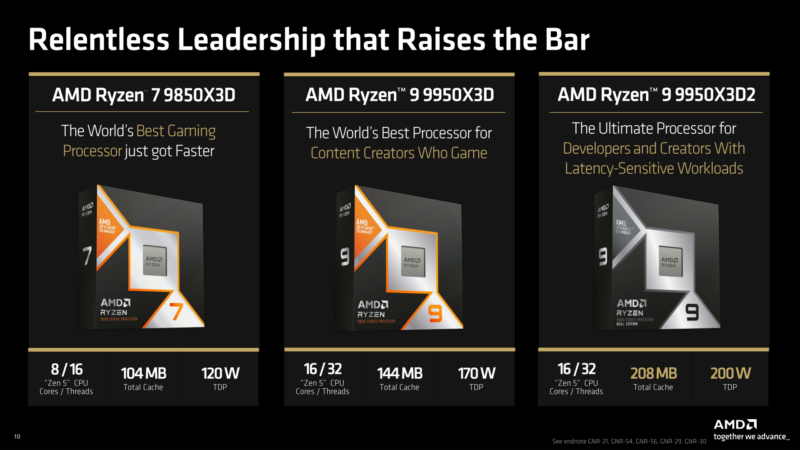
And “a little bit more” is going to be the operative word here for the 9950X3D2. When AMD announced the chip last month, they were quick to get on top of expectations management. Adding another 64MB of L3 cache to the 9950X3D’s second CCD would improve performance, but it would not do so by a ton. With cache and power limits being the only significant changes from the earlier chip, there are no broader architectural changes to drive performance uplifts. Instead, it is all about filling the bubbles in the Zen 5 execution pipeline to ensure the CPU cores are always working on something whenever possible, as high a clockspeed as possible.
The end result is that, in our benchmark results, the 9950X3D2 does end up being a few percent faster on average, helping to elevate AMD’s Ryzen 9000 chips to slightly higher highs than ever before. But only just. It is not a massive performance difference, and this is not another X3D (1) moment for AMD. At best, it is a further refinement of what throwing V-cache on a single CCD was getting them.
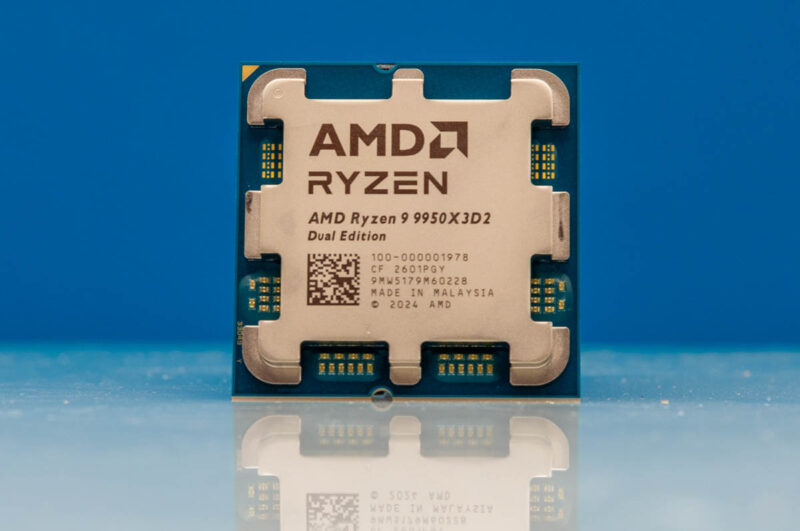
Coupled with the chip’s hefty $899 MSRP, the 9950X3D2 is on the whole a classic flagship chip scenario. Within AMD’s product stack, this is the fastest Ryzen 9000 series chip, bar none. But the marginal cost of those performance gains is far higher than the performance gains themselves. Adding V-cache to two CCDs means adding a lot to the bill of materials for the chip, and ultimately the retail price of the chip as well.
In short, the 9950X3D2 is not a good value, and it is not meant to be. Rather, like other flagship chips before it, it is a chip you splurge on in order to buy the very best thing available at the time. Or perhaps, the more impactful difference is that because it is a balanced chip, you no longer need tools like Process Lasso or others to ensure the right applications are pinned to high L3 cache cores. While it may seem insignificant at first, just not having to even think about that will make it a worthwhile upgrade for many.
Ultimately, the modest performance gains for the not-so-modest price increase are not going to meaningfully change the status quo in the PC ecosystem. For 95% of the market, nothing changes. For the few who can justify spending $899 on a desktop CPU, the 9950X3D2 is a good way for the Ryzen 9000 platform to cement its time at the top. Otherwise, for all the techies out there, it will be good discussion fodder for the benefits and trade-offs of processor design and larger L3 caches, finally answering the question of just how a dual-V-cache consumer chip would perform.
Where To Buy
With reviews going out today, the chip will go on sale at retail and in OEM systems tomorrow. If you would like to buy it, you can find it at this Amazon affiliate link.



So, is it a 14 core with x1 management core per ccd? mb
You didnt do gaming benchmarks but still wrote, “games are not the type of workloads that benefit from the additional L3 cache on the second CCD.”
Why? Getting anything out of RAM to cache is always a 100x speed improvement. Its not a coincidense 9800x3d is the best gaming cpu with its large cache
@Alex
Games are typically very “chatty” between threads. This means that if the major threads for a game get split between the CCDs, they will take a sizable performance hit from the high CCD-to-CCD latency. A larger L3 cache in turn makes this worse in some respects, as it means there’s more data in the L3 cache on the other CCD.
Putting extra cache on the *first* CCD is fantastic for games. Putting extra cache on the second CCD is neutral at best – and if not for AMD’s utilities that keep games on a single CCD, it would make things worse.