

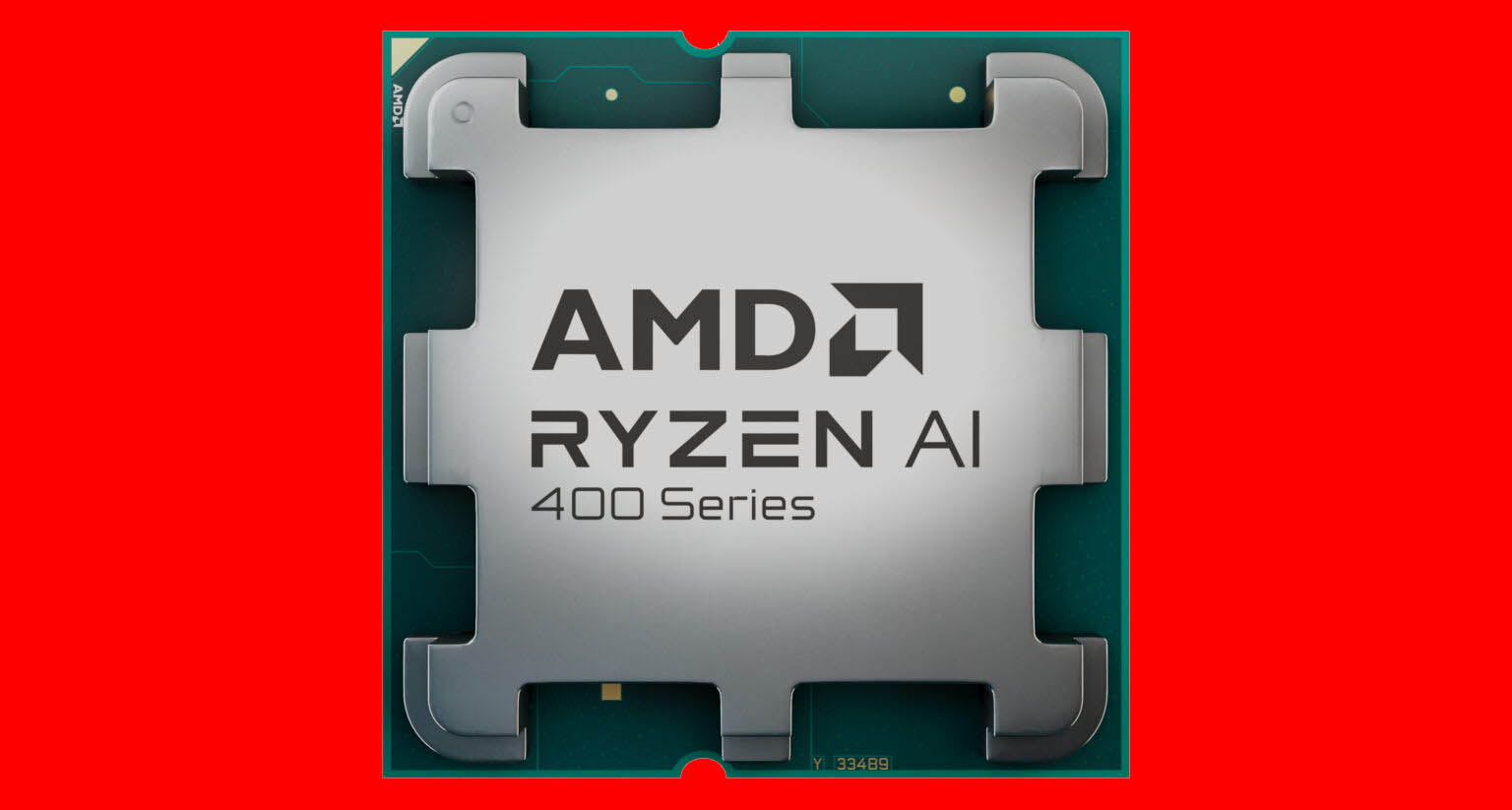
Amid a slew of telecom and commercial client announcements today designed to align with the opening of Mobile World Congress 2026, AMD is using the show as a backdrop to launch the desktop versions of their Ryzen AI 400 chips. First teased back during CES 2026, the company is finally giving them a proper launch at MWC, releasing both the traditional and Pro versions of the chips for the consumer and corporate desktop markets.
Like their Ryzen AI 400 mobile counterparts that were launched back at CES 2026, the Ryzen AI 400 desktop series combines AMD’s latest hardware SoC architectures, building around a base of Zen 5 CPU cores with RDNA 3.5 GPU cores/CUs, and AMD’s XDNA 2 NPU architecture. Notably, this marks the first time that RDNA 3.5 and XDNA 2 have been available in a desktop form factor, as they have previously only been found on AMD’s Ryzen AI 300 and Ryzen AI 400 mobile chips.
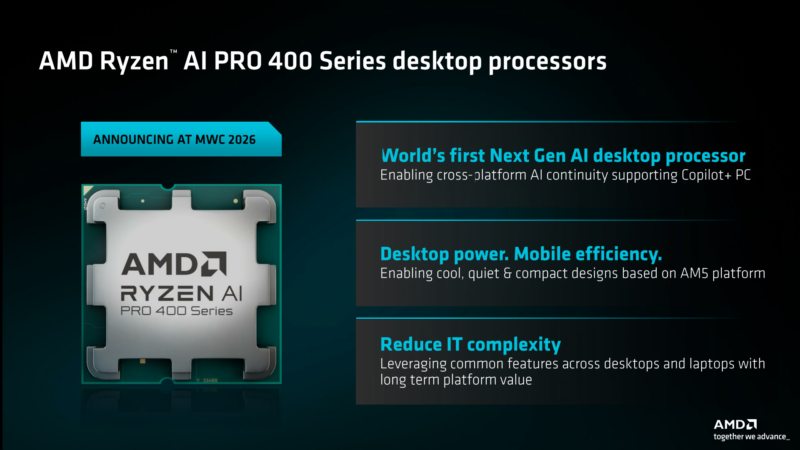
Form factor aside, the desktop Ryzen AI 400 chips are essentially identical to AMD’s existing Ryzen AI 400 mobile chips. In regards to AMD’s hardware lineup, they are meant to fill the spot for lower-cost and lower-power chips, slotting in alongside and below AMD’s existing Zen 5 based Ryzen 7 and Ryzen 5 tier chips. And in practice, these are the successor chips to AMD’s Ryzen 8000G desktop lineup.
Under the hood, all of the new Ryzen AI 400 desktop chips are based on AMD’s latest Gorgon Point silicon. Specifically, AMD is using the cut-down configuration that many of our readers are likely more familiar with as Krackan Point. AMD’s cheaper chip offering, Krackan Point offers up to 4 Zen 5 CPU cores, 4 Zen 5c CPU cores, 8 GPU compute units, and the 50 TOPS XDNA 2 NPU. These new desktop chips use AMD’s tried-and-true AM5 socket, so they can quickly be integrated into existing commercial system designs.
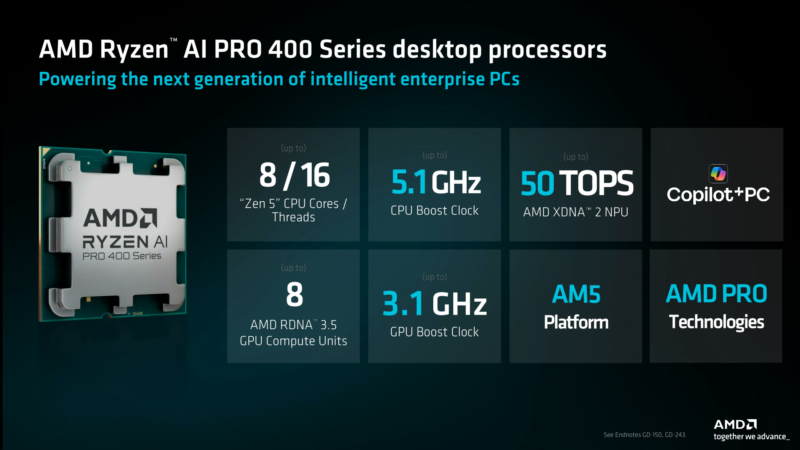
Compared to AMD’s existing Ryzen 9000 (Granite Ridge) processors, the Ryzen AI 400 processors are going to have lower CPU performance due to their use of weaker Zen 5c CPU cores versus the pure Zen 5-based Ryzen 9000 series, but better GPU performance due to the newer RDNA 3.5 GPU architecture and the larger number of CUs overall. As well, this marks the first desktop offering of a Zen 5 chip with an NPU, which is important for Microsoft’s ongoing Copilot+ local AI inference efforts.
Still, it is notable that unlike the Ryzen 8000G generation, AMD is not bringing any of their higher-end Ryzen AI 400 chips to the desktop market. As a result, we will not be seeing socketed desktop equivalents of the likes of the Ryzen AI 9 HX 475, which features a larger number of CPU cores and twice as many GPU cores as the top desktop Ryzen AI 400 chip.
The trade-off, at least, is that the Ryzen AI 400 desktop series is a fairly low-power offering. The nominal TDP on the regular chips is 65 Watts – matching AMD’s current lower-power Ryzen 9000 SKUs – but AMD is also going to be offering versions of these chips with 35 Watt TDPs. As is traditional for AMD’s naming system, the 35 Watt SKUs will all carry the E suffix – e.g. Ryzen AI 7 450GE.
Altogether, AMD is launching 6 chip SKUs for the Ryzen AI 400 desktop family. This will essentially be an 8 CPU core configuration and two 6-core configurations, with all of those configurations available in both 65 Watt and 35 Watt options. Only the 8 CPU core configurations (450G/450GE) will get an 8 CU integrated GPU; otherwise, the 6-core configurations are all paired with a weaker 4 CU GPU, and the weakest 6-core options will further halve their L3 cache to 8MB.
| AMD Ryzen AI 400 Desktop Chip SKUs | |||||||
| Zen 5 Cores | Zen 5c Cores | Max Boost | L3 Cache | NPU | GPU | TDP | |
| Ryzen AI 7 (PRO) 450G | 4 | 4 | 5.1GHz | 16MB | 50 TOPS | 860M 8 CUs |
65W |
| Ryzen AI 7 (PRO) 450GE | 35W | ||||||
| Ryzen AI 5 (PRO) 440G | 3 | 3 | 4.8GHz | 16MB | 840M 4 CUs |
65W | |
| Ryzen AI 5 (PRO) 440GE | 35W | ||||||
| Ryzen AI 5 (PRO) 435G | 2 | 4 | 4.5GHz | 8MB | 840M 4 CUs |
65W | |
| Ryzen AI 5 (PRO) 435GE | 35W | ||||||
Finally, alongside the traditional desktop chips that will be sold under the Ryzen AI 400 branding, AMD is also going to be simultaneously launching the PRO versions of their chips for commercial client use – and indeed, it is the PRO chips that are AMD’s primary focus at MWC. As with past generations of PRO chips, these chips enable AMD’s suite of IT management and security technologies, such as AMD Memory Guard and cloud-based recovery.

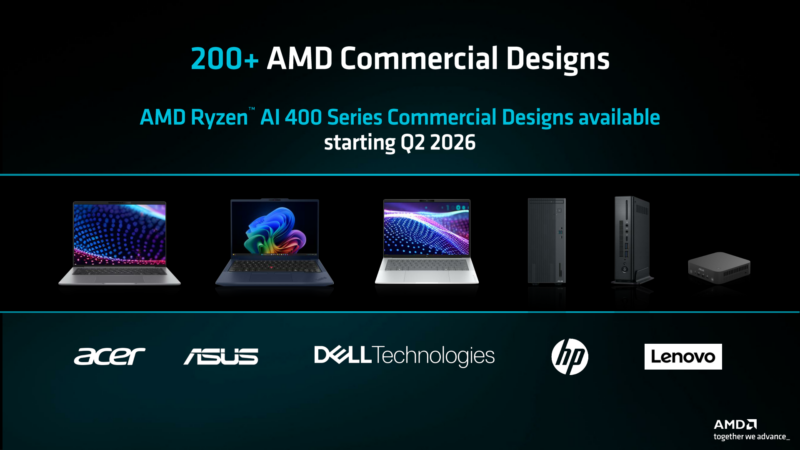
Wrapping things up, AMD tells us that the first Ryzen AI 400 desktop systems should be available shortly. Apparently, some systems are already shipping now, while the rest of these systems will land in Q2 of this year.

You didn’t cover memory differences – the mobile ones mostly shipped with llpddr5? What do these support? They might end up being slower.
The desktop chips lack the mobile chips’ LPDDR5 support, due to the AM5 socket. So you’re limited to DDR5 memory. AMD’s official spec is DDR5-5600, but that is for 4 DIMMs (they don’t provide a spec for 2 DIMMs).
@slope 2 I’d be curious to know how much commitment it represents. The die area the NPU occupies isn’t free; but, presumably, the engineering costs are lower if they reuse the existing laptop design as much as possible. I just don’t have any real sense of how big those opposing costs are. That leaves me unsure of where it stands from ‘not worth removing until the next time we redesign for other reasons’ to ‘including it allows us to participate in marketing incentives’ to ‘we are genuinely seeing uptake’.
I think it’s probably about reusing existing chips. Those few extra sqmm probably won’t add a lot to the manufacturing costs, remember they’ll need to be sliced, tested and packaged just the same. And being able to use chips that they may already have for both mobile and desktop paltforms, depending on how they package them, is a definite advantage as well.
The cache L3 is incorrect, it’s 24MB for 450G/450GE, 22MB for 440G/440GE and 14MB for 435G/435GE
AMD has released in same time non-PRO variant of this CPU
@flo
The values AMD supplies is total cache (L2+L3). My preference is to list just the L3 cache, because the L2 cache is always 1MB per core on Zen 5.
These APUs only have 12 usable PCIE Gen4 lanes among PCIE and M.2 slots.
12 accessible lanes down from 16 on the
8600G and 8700G.
Board manufacturers will probably want to add some PCIe multiplexer(s) to redistribute the bandwidth over M.2 slots, wifi, LAN, maybe more usb4, sata?
@Frank
Those kinds of multiplexing typically comes from the Prom21 chipset.
12 CPU-connected PCIE lanes (excluding x4 to the chipset) means x8 for PCIE slot and x4 for M.2. Any additional slots will use lanes from the chipset.
so you effectively lose a second M.2 slot that would have worked without bandwidth sharing, for example present on the Asrock Deskmeet X600