A couple of months back AMD launched their EPYC 8005 “Sorano” lineup of processors, which brought AMD’s Zen 5 architecture to its mid-tier SP6 platform. With up to 84 CPU cores and 96 lanes of PCIe Gen5, Sorano is a balanced EPYC offering with all of the Zen 5 architecture’s features, just in a smaller serving. And as a replacement for AMD’s earlier EPYC 8004 “Siena” processors, Sorano is especially remarkable, as it replaces the former’s Zen 4c cores with full-fat Zen 5 cores, allowing Sorano to hit far greater performance levels.
While Sorano is fully backward compatible with existing SP6 motherboards after a BIOS update, a few board manufacturers have opted to launch new boards specifically to align with the newer SP6 EPYC processor, and ASRock Rack is among them. For Sorano, the company has released the plainly named SORANOD8-2L2T, a basic server and workstation motherboard that brings all of Sorano’s key features to bear.
| ASRock Rack SORANOD8-2L2T Key Specs | |
| Processor Family | AMD EPYC 8004/8005 |
| Socket | SP6 |
| Memory | 8x DDR5 RDIMM Slots (2DPC*) Max Speed: DDR5-5200 |
| PCIe Slots | 4x PCIe x16 (Gen5 x16 Electrical) 1x PCIe x8 (Gen5 x8 Electrical) |
| Storage | 2x M.2 22110/2280 (Gen5 x4) 2x MCIO x8 (Gen5 x8/SATA 6Gbps x8) |
| Ethernet | 2x 10GbE (Intel X710-AT2) 2x 1GbE (Intel I210) |
| Rear USB | 2x 5Gbps USB-A |
| Front USB | 2x 5Gbps USB-A |
| Video | VGA (DB15) |
| BMC | ASPEED AST2600 |
| Form Factor | “ATX-like” (12-inch x 10-inch) |
The SORANOD8-2L2T is essentially an upgraded version of ASRock Rack’s earlier SIENAD8-2L2T, with a slightly larger board and minor I/O changes. In addition to exposing all of Sorano’s I/O for server use, the other notable aspect of the SORANOD8-2L2T is its networking capabilities. The “2L2T” in the name refers to the two pairs of network adapters built into the motherboard. It includes a pair of 10GbE adapters and a pair of 1GbE adapters, giving the motherboard strong network capabilities out of the box. As a result, the SORANOD8-2L2T is a simple yet highly flexible motherboard for server or workstation deployments.
ASRock Rack SORANOD8-2L2T Hardware Overview
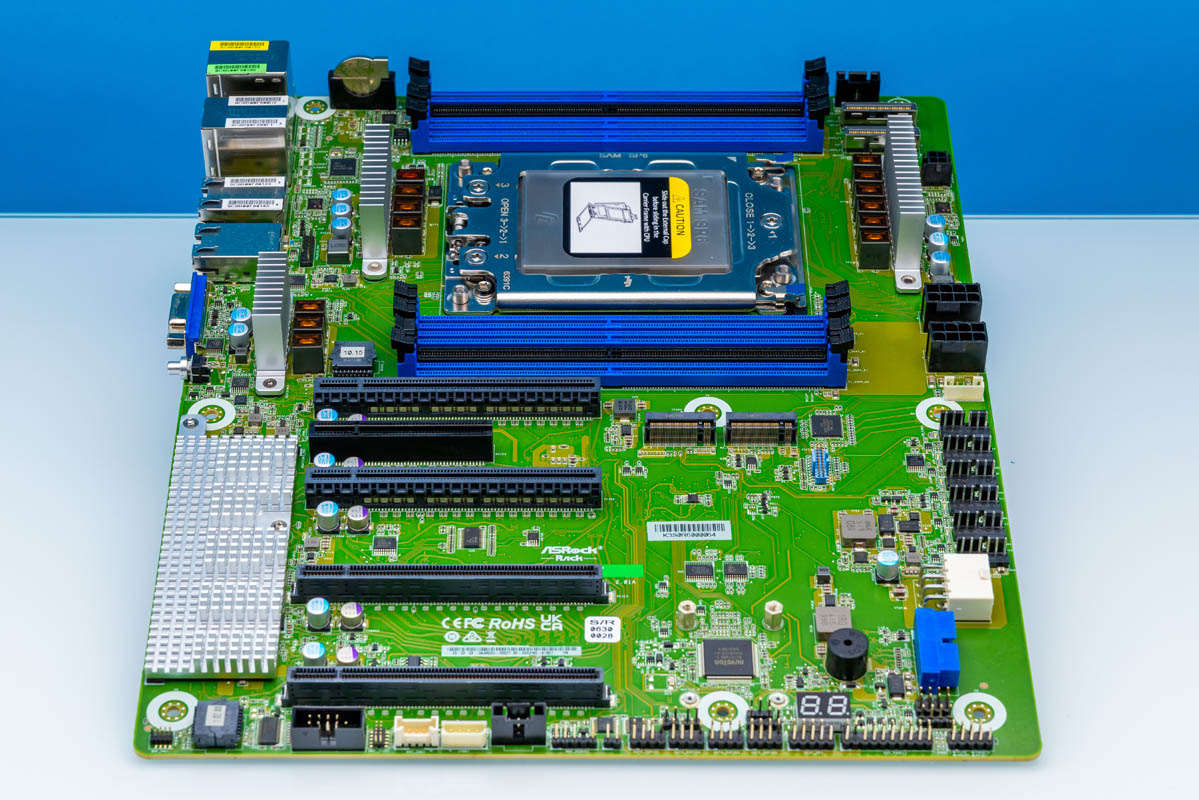
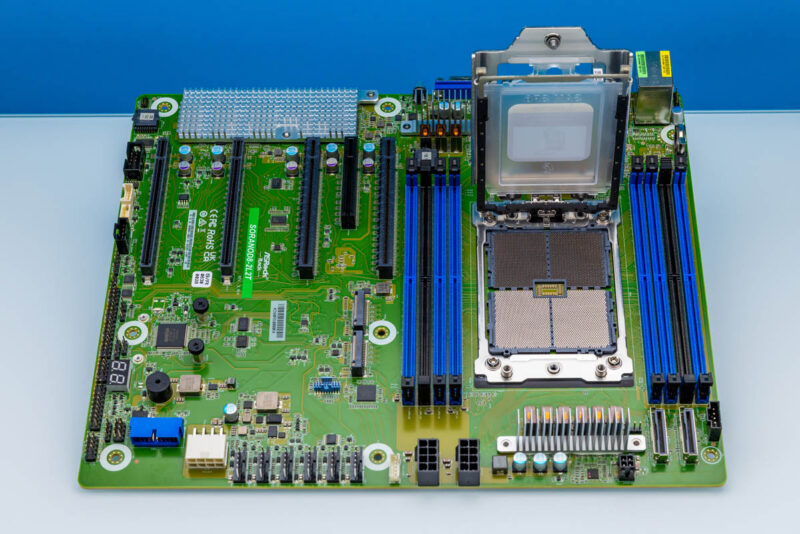
ASRock Rack has a well-earned reputation for simple and rock-solid server motherboard designs, and the SORANOD8-2L2T lives up to that pedigree. Other than networking controllers, there is very little extra hardware on the motherboard. This is a board designed to run a CPU, run it well, and expose all of that I/O so that the server builder can do with it as they please.
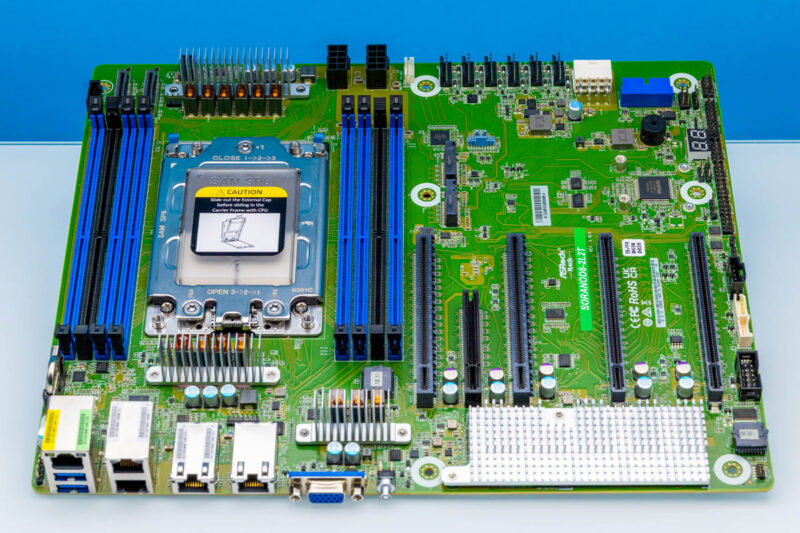
In terms of size, the SORANOD8-2L2T is what ASRock Rack classifies as an “ATX-like” motherboard. With dimensions of 12-inches x 10-inches, the board is ever so slightly too wide to meet the ATX specification. Few cases should have an issue with this, especially as the even larger EEB form factor is routinely used in this space. But it is notable since it can present an issue in cases that accept a regulation ATX motherboard – and no larger.
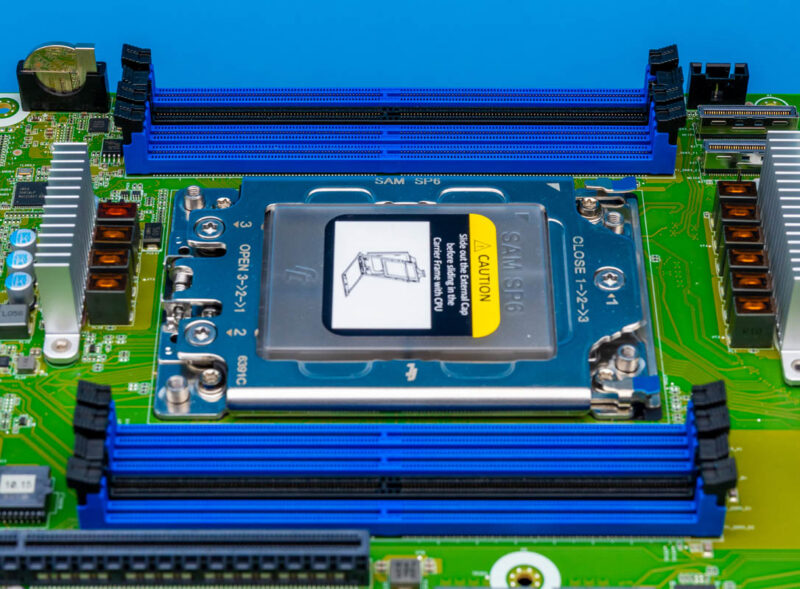
As always with server boards, a good chunk of the SORANOD8-2L2T’s space is dominated by the CPU socket and RDIMM slots. While the SP6 socket is smaller than the mighty SP5 (with over 1000 fewer pins), it is by no means a small socket. And 8 RDIMM slots take up a good amount of space on their own.
Those 8 RDIMM slots are designed to be eye-catching, and for a good reason: SP6 is natively a 6-channel platform. So we would usually expect to see either 6 or 12 RDIMM slots on a motherboard, for 1DPC or 2DPC operation respectively. But for all of their SP6 motherboards, ASRock Rack has taken things in an interesting direction by installing 8 RDIMM slots, effectively making this a 2DPC-ish motherboard.
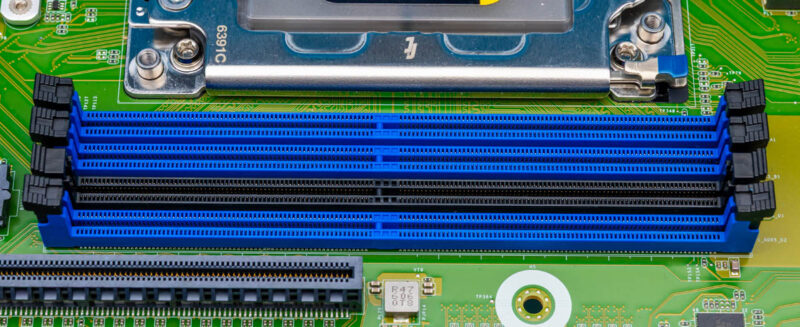
The RDIMM slot coloring, in turn, is meant to signify which channel each slot belongs to. The blue slots are all the first RDIMMs for their respective channels, and are the slots that should be filled first. Meanwhile the black RDIMM slots are the second RDIMM slots on two of SP6’s six channels, and as such need to be the last slots filled. Two-tone DIMM slots are nothing new, of course, but ASRock Rack’s unusual organization means that there will never be any doubt about which color is for the first RDIMM versus the second RDIMM.
As for the purpose behind 8 slots, it is meant to balance the memory capacity of the board versus how much size the RDIMM slots take up. A traditional 7 PCIe slot layout does not afford enough space for 12 DIMMs, but it does for 8. And thus this is the direction ASRock has gone, squeezing in an extra two RDIMM slots in order to increase the amount of memory the board can address to 2TB.
The trade-off, however, is that this means the SORANOD8-2L2T is meant to function like a 2DPC motherboard through and through, and that means taking the memory frequency penalty. While a 1DPC board can clock as high as DDR5-6400, the SORANOD8-2L2T tops out at DDR5-5200 in exchange for its extra memory capacity.
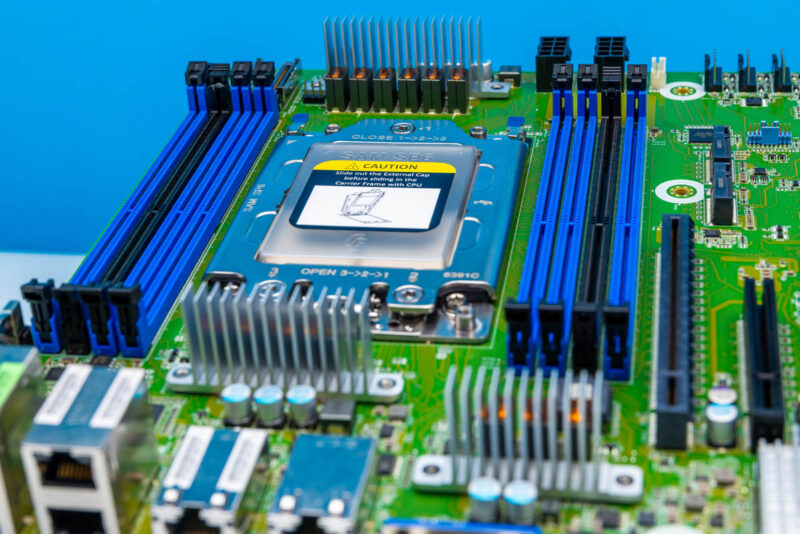
Memory matters aside, looking around the CPU socket and DIMM slots we find the usual collection of chokes and MOSFETs that make up the board’s VRM system. The MOSFETs are under some very basic heatsinks here. As SP6 chips top out at 225 Watts (and presumably no one is going to be throwing liquid nitrogen at them), the power delivery system does not need to be too exotic. By the same token, however, server boards are designed around significant airflow, so the heatsinks do not need to be massive to be fit for purpose.
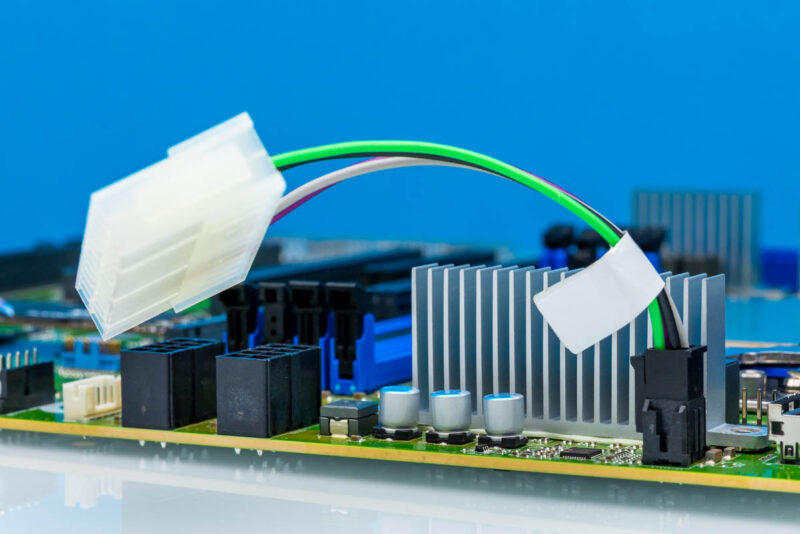
Speaking of power, we find a trio of ATX12V connectors spread out over the board, and these are where the SORANOD8-2L2T draws its power from. Curiously, ASRock Rack has built two of them as vertical connectors, and a third as a right-angled connector. All three are necessary for the board’s operation, so they are functionally equivalent. Presumably, the right-angled connector is meant to better fit server vendors’ needs, though we have seen plenty of server boards without such an angled connector.
Being that this is a server board first and foremost, ASRock Rack also eschews a full 24-pin ATX connector. In its place is a simple 4-pin micro-fit connector that only provides signaling.
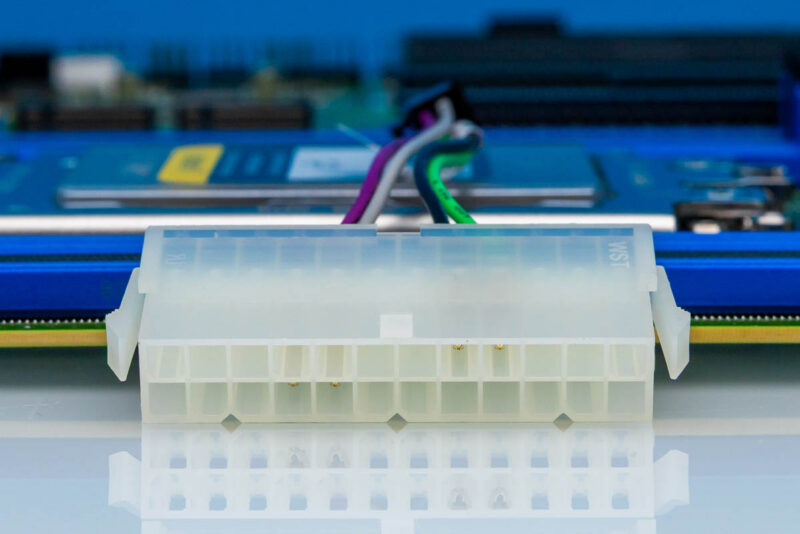
Since you do not get a standard ATX power header, you plug the 24-pin ATX power supply connector into the included adapter, and into the 4-pin connector on the motherboard. We tend to prefer full-size ATX connectors to this solution on larger boards, though in the case of the SORANOD8-2L2T, the edges of the board are already pretty packed.
Moving on, let us talk about I/O and storage expansion, as the SORANOD8-2L2T provides a lot of it.
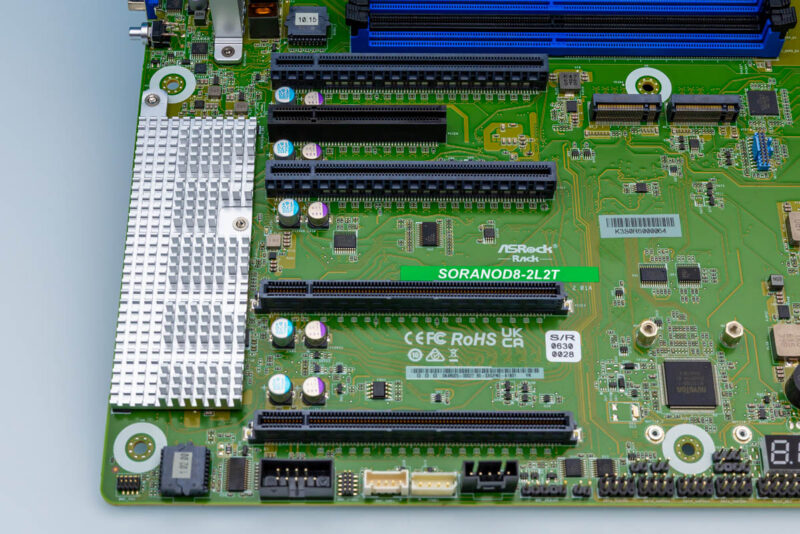
First and foremost, ASRock Rack has equipped the board with 5 PCIe slots. Four of these are full PCIe Gen5 x16 slots, while the final is an open-ended PCIe Gen5 x8 slot. This accounts for 72 of SP6’s 96 PCI Gen5 slots right here, and provides a great deal of flexibility with PCIe expansion cards. All of the x16 slots are double-spaced, though using the x8 slot will cut into the space for the top slot.
The top slot is a particularly special slot here since, alongside PCIe (and CXL) connectivity, it can also be switched over to providing 16 SATA 6Gbs connections. This does require a special riser card – ASRock Rack recommends their own 1U2G-RB1U2SL-G4 – but in effect it allows switching the PCIe lanes over to SATA connections.
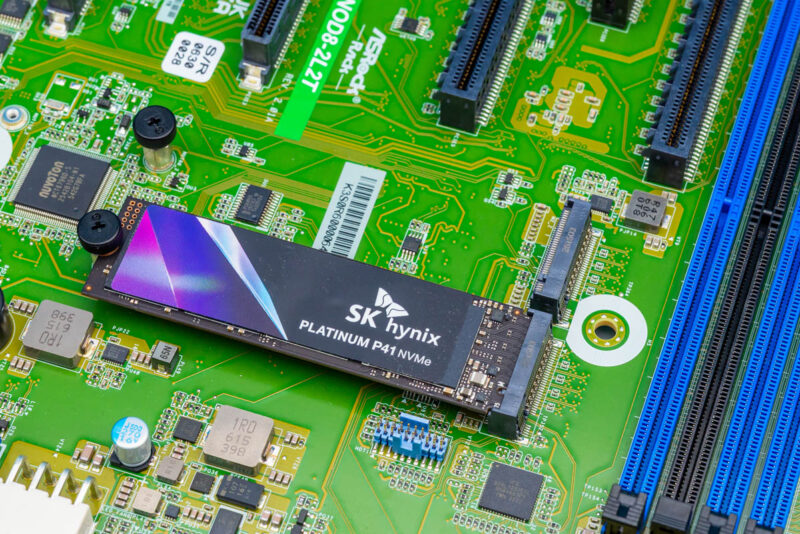
For more fixed storage needs, the SORANOD8-2L2T also provides for a pair of M.2 Gen5 x4 slots. Both of these slots are designed to accept either M.2 22110 or M.2 2280 SSDs, with movable standoffs used to adjust the slot.
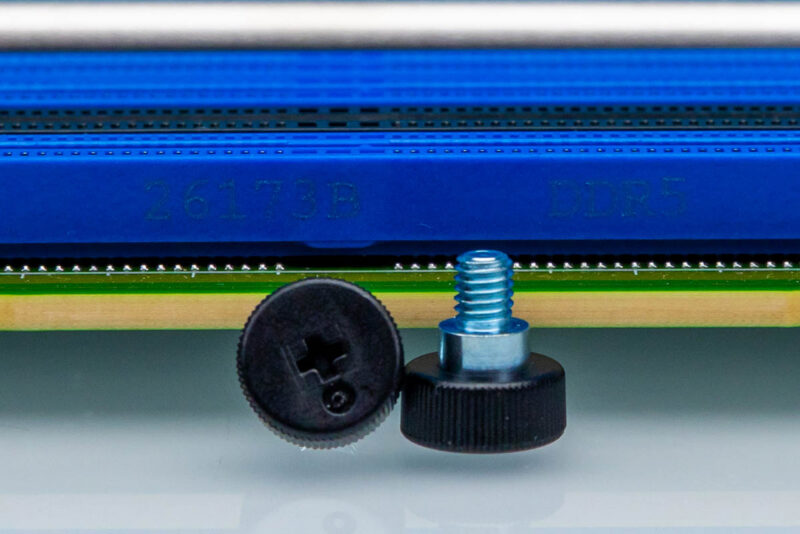
As is usually the case for ASRock Rack motherboards, the company also provides for a pair of thumbscrews to secure the SSD slots. We cannot say enough nice things about how much we appreciate thumbscrews here.
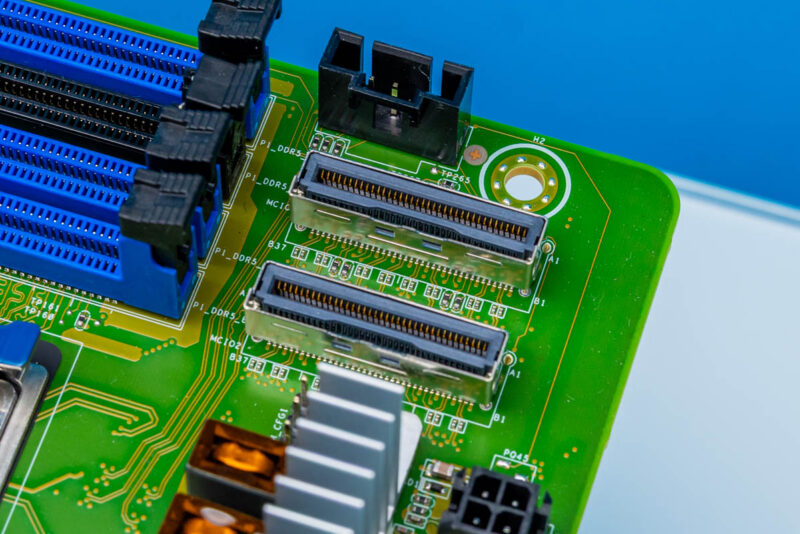
For the final set of storage options, towards the top corner of the motherboard, ASRock Rack has placed a pair of MCIO x8 connectors. These connectors normally carry 8 lanes of PCIe Gen5 each (accounting for the final 16 lanes provided by the CPU), which in turn is normally split up among two EDSFF SSDs each. However, in a feature that is new to the SORANOD8-2L2T and sets it apart from its Siena predecessor, these MCIO slots can also be configured to carry SATA signaling instead. This converts each MCIO connector into an eight-port SATA 6Gbps host, allowing for up to (another) 16 SATA drives, ideal for high-density storage servers.
As for external I/O, the SORANOD8-2L2T goes heavy on Ethernet ports, and light on everything else.
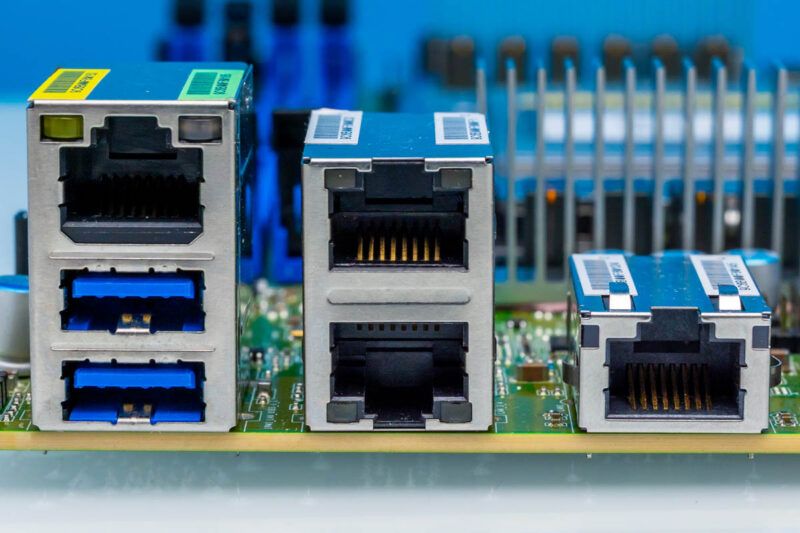
On the rear I/O panel for the motherboard, we find no less than 5 different RJ45 ports. These cover a pair of 10GbE ports, a pair of 1GbE ports, and finally an IPMI management port.
Farthest to the left is the IPMI management port, which is attached to the ASPEED AST2600 BMC. The AST2600 continues to this day to be the most prevalent BMC we see in boards that cross our labs.
To the right of that, the stacked RJ45 ports are 1Gb Ethernet ports. These are hanging off of a pair of Intel I210 Ethernet controllers.
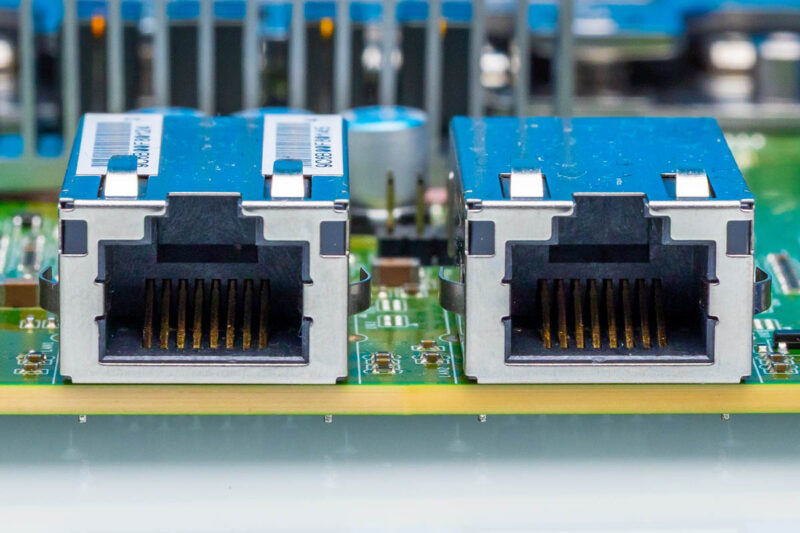
Meanwhile, farther to the right and spread out over two rows are the 10GbE ports. These are powered by an Intel X710-AT2 controller, which provides for full 10Gbps bandwidth in each port along with the ability to negotiate to 5Gbps, 2.5Gbps, 1Gbps, and lower speeds.
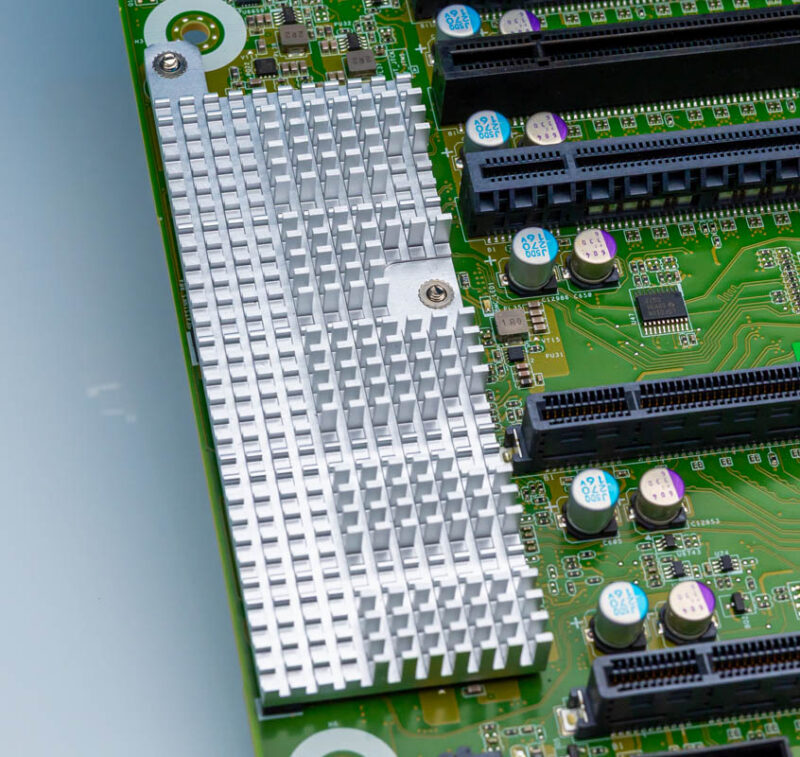
All of the network controllers, along with the BMC, are located under a heat sink at the edge of the board, behind the PCIe slots. None of these components is particularly hot, but the 10GbE controller in particular is just hot enough to require some extra cooling, which the low-profile heatsink supplies.
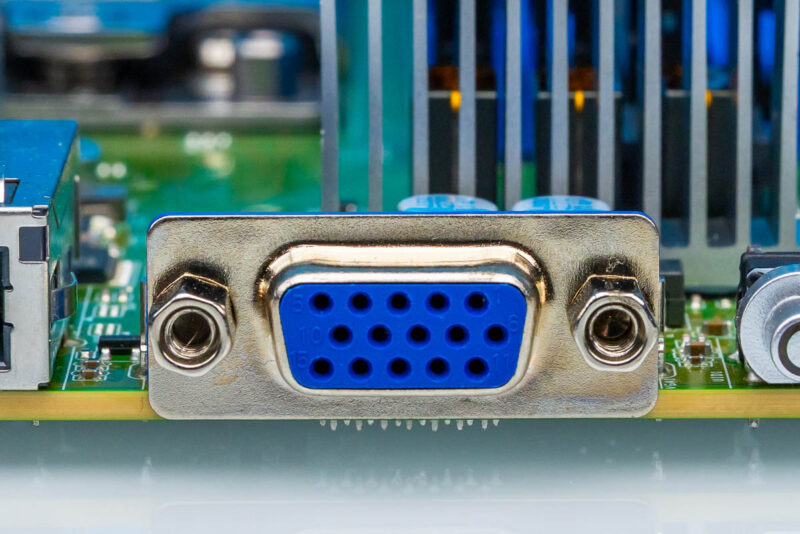
Finally, farthest to the right is an old-school DB15 VGA port, which is part of the BMC and provides video output from the management controller. Given that the SORANOD8-2L2T is a brand-new motherboard, it is a bit odd to see a VGA port in 2026, but even with the AST2600 supporting DisplayPort for digital displays, VGA still sees significant use in data centers.
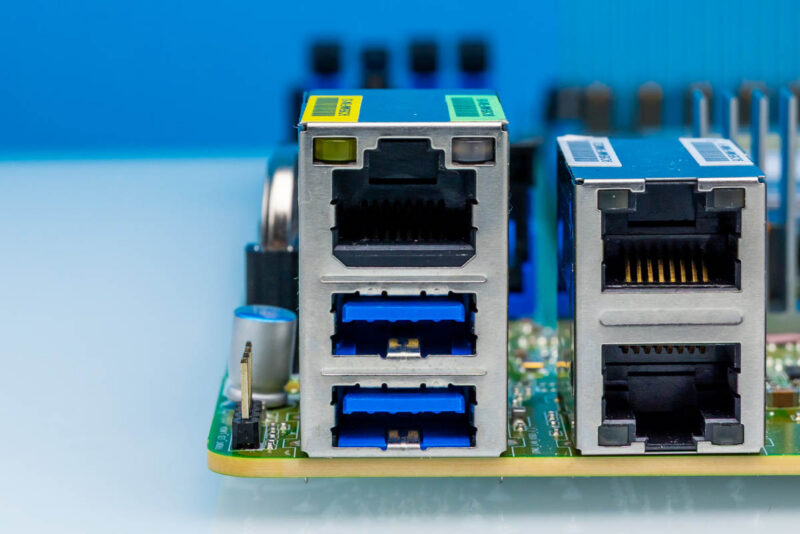
For all of those Ethernet jacks, what you will not find on the SORANOD8-2L2T is much in the way of USB ports. The rear of the motherboard has only two USB ports, both 5Gbps USB-A ports.
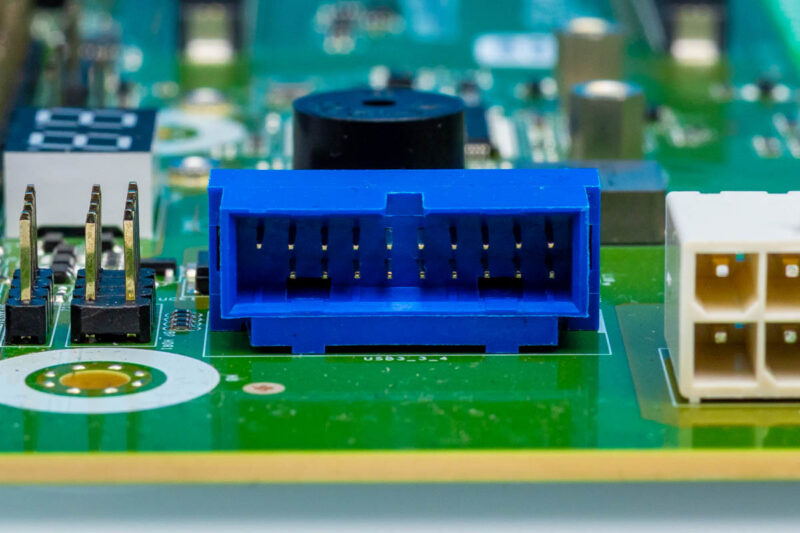
For the front panel connector, there is a single 20-pin USB connector to provide another pair of 5Gbps USB-A ports.
For a server installation, this is fine, as it is rare for more than a couple of USB ports to ever be in use. It also means that although ASRock Rack pitches the SORANOD8-2L2T as both a server and a workstation motherboard, you would look to fill more USB connectivity via PCIe for the workstation role. This is very clearly a server motherboard first and foremost.
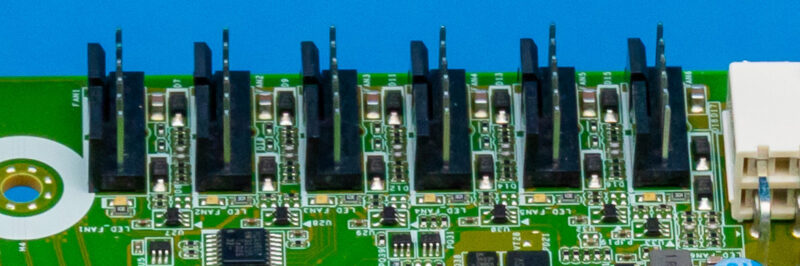
The number of fan headers further drives this point home. Towards the front edge of the motherboard, there are six 6-pin fan headers, with the 6-pin variant being something of an ASRock Rack specialty.
Next, let us get to the block diagram.