ASRock Rack SORANOD8-2L2T Block Diagram
Here is the block diagram for the SORANOD8-2L2T:
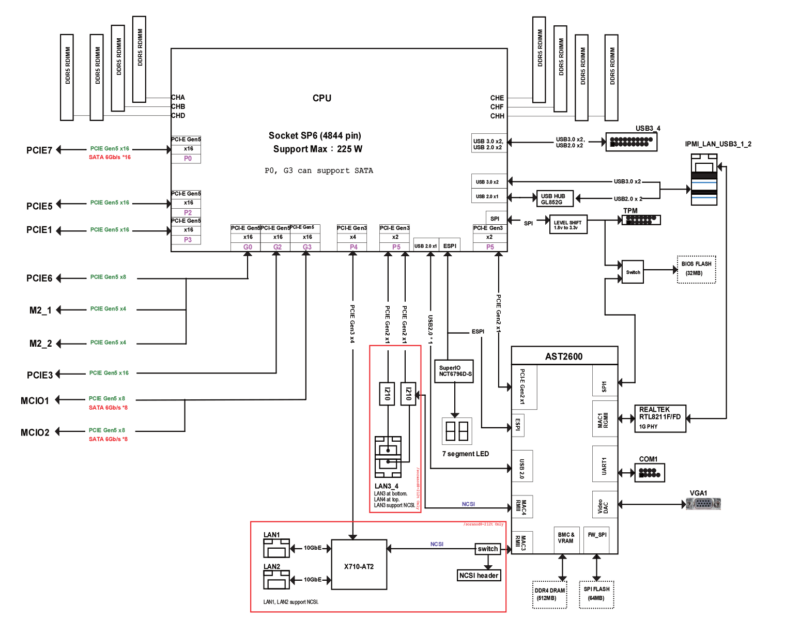
SP6 CPUs provide 96 lanes of PCIe Gen5 connectivity, and ASRock Rack is putting all of those lanes to good use. 72 lanes go to PCIe slots, another 8 go to M.2 slots, and finally 16 lanes go to the MICO connectors. The dual-feature nature of some of the PCIe Gen5 root complexes is also where the board’s SATA capabilities come from, with ASRock Rack routing those to the MCIO and top PCIe slot.
The remaining devices are hanging off the CPU’s PCIe Gen3 controller blocks. This includes the 10GbE and 1GbE Ethernet controllers, and the BMC.
ASRock Rack SORANOD8-2L2T Management
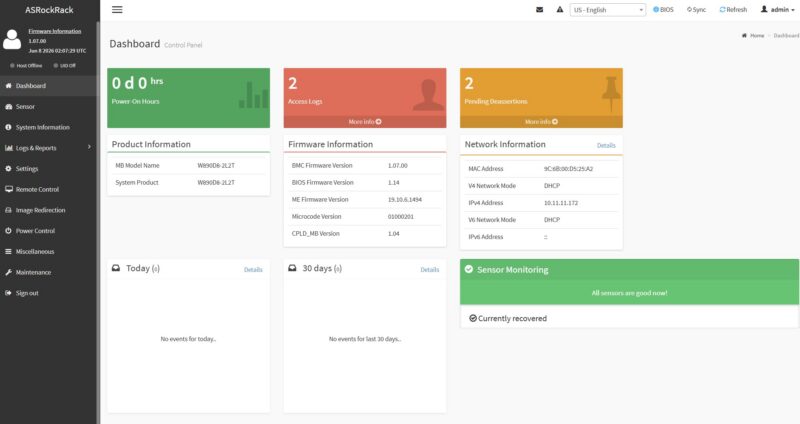
With an onboard ASPEED AST2600 BMC, we get a familiar ASRock Rack IPMI management interface. We just covered this in the ASRock Rack W890D8-2L2T Review so we are just going to give that same overview here.
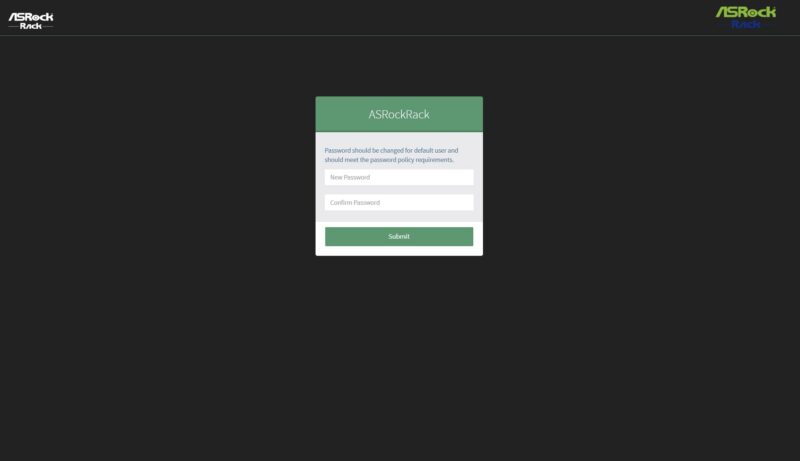
This appears to be based on the industry standard MegaRAC SP-X platform, so we get a familiar dashboard.
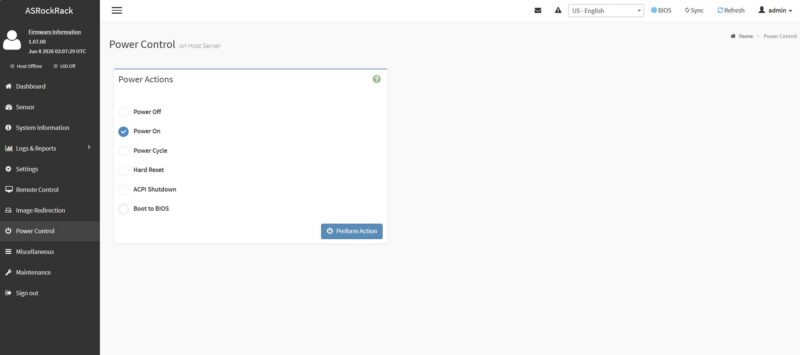
One small, but nice, feature of the ASRock Rack solution is that you get the ability to Boot to BIOS directly from the power control page. That may seem small, but if you have ever had to wait a few minutes for a system to POST only to miss the keystroke for entering BIOS, you will understand why this is so exciting.
There is an HTML 5 IPMI management interface with the ability to remotely mount media.
Next, let us get to the board’s performance.
ASRock Rack SORANOD8-2L2T Performance
In terms of performance, we have tested a number of AMD EPYC 8005 platforms in our big AMD EPYC 8005 Sorano Completely Changes AMD SP6 piece. A question I had, along with the team, is that, looking at higher-end and lower-end SKUs, would building a system based around this ASRock Rack motherboard have appreciably different performance versus using a system like an HPE ProLiant? That is a common question we get, so let us get to it.
ASRock Rack SORANOD8-2L2T AgentSTH V7 Performance
When setting this up, the first thing we tried was a single-core AgentSTH V7 run on a single core, with both threads running on the SMT core across the agentic CPU benchmark.
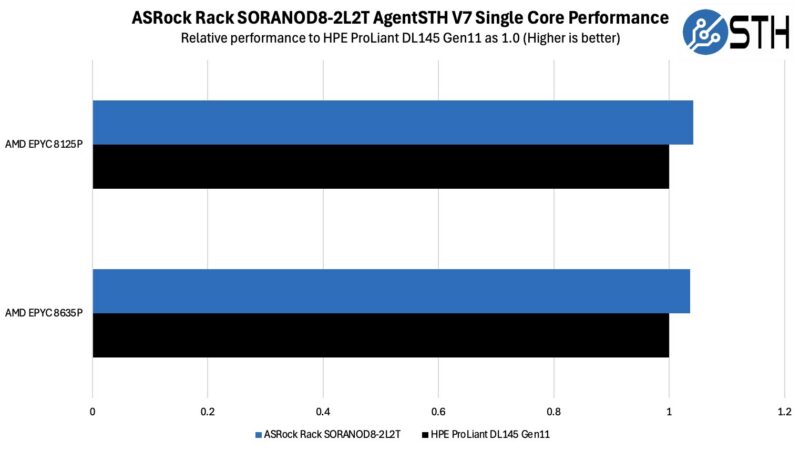
We then scaled across all cores on both platforms with both CPUs.
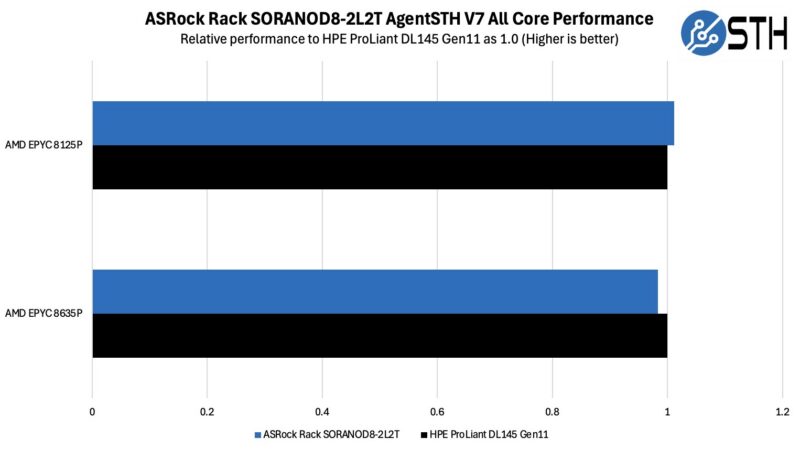
On the lower-core-count part, we fared slightly better, but on the higher-core-count part, we fared slightly worse. Still, I am not sure the gap is big enough in either direction for us to pick one over the other.
ASRock Rack SORANOD8-2L2T Estimated SPEC CPU2026 Performance
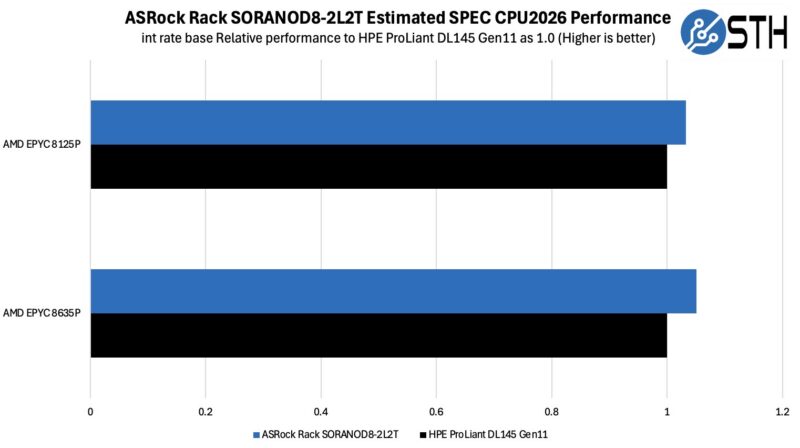
The next step was to run our estimated SPEC CPU2026 runs on both machines with both processor sets. Keep in mind, these are all LLVM22 runs using -O3, so they are not comparable to the official runs on the SPEC website. These are lower optimization runs purposefully done to create a different dataset. Here, we have the int rate base results:
Here are the fp rate base results:
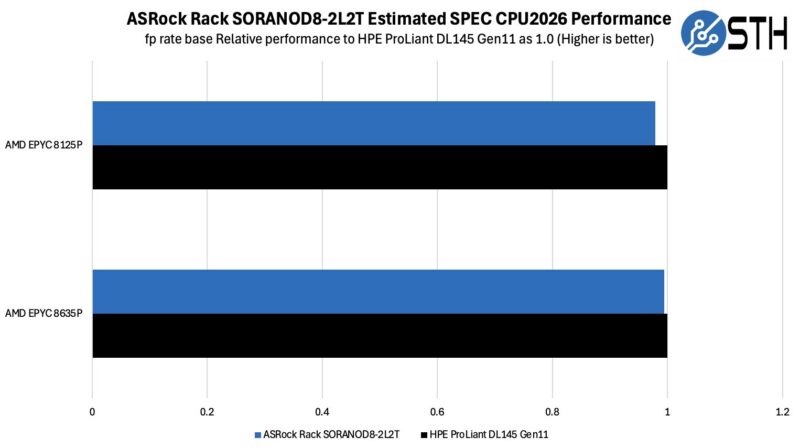
This one was interesting since on AgentSTH V7 there was more of a gap between higher and lower core counts. On the estimated SPEC CPU2026 runs, the gap was more around the integer versus fp performance. Again, these are close, but it was just interesting to observe.
Based on what we have seen, I think performance is very similar at both the higher and lower ends of the SKU stack on the platform. Answering our original question, it seems like building on this ASRock Rack platform gets you into the same ballpark as the HPE ProLiant system.