

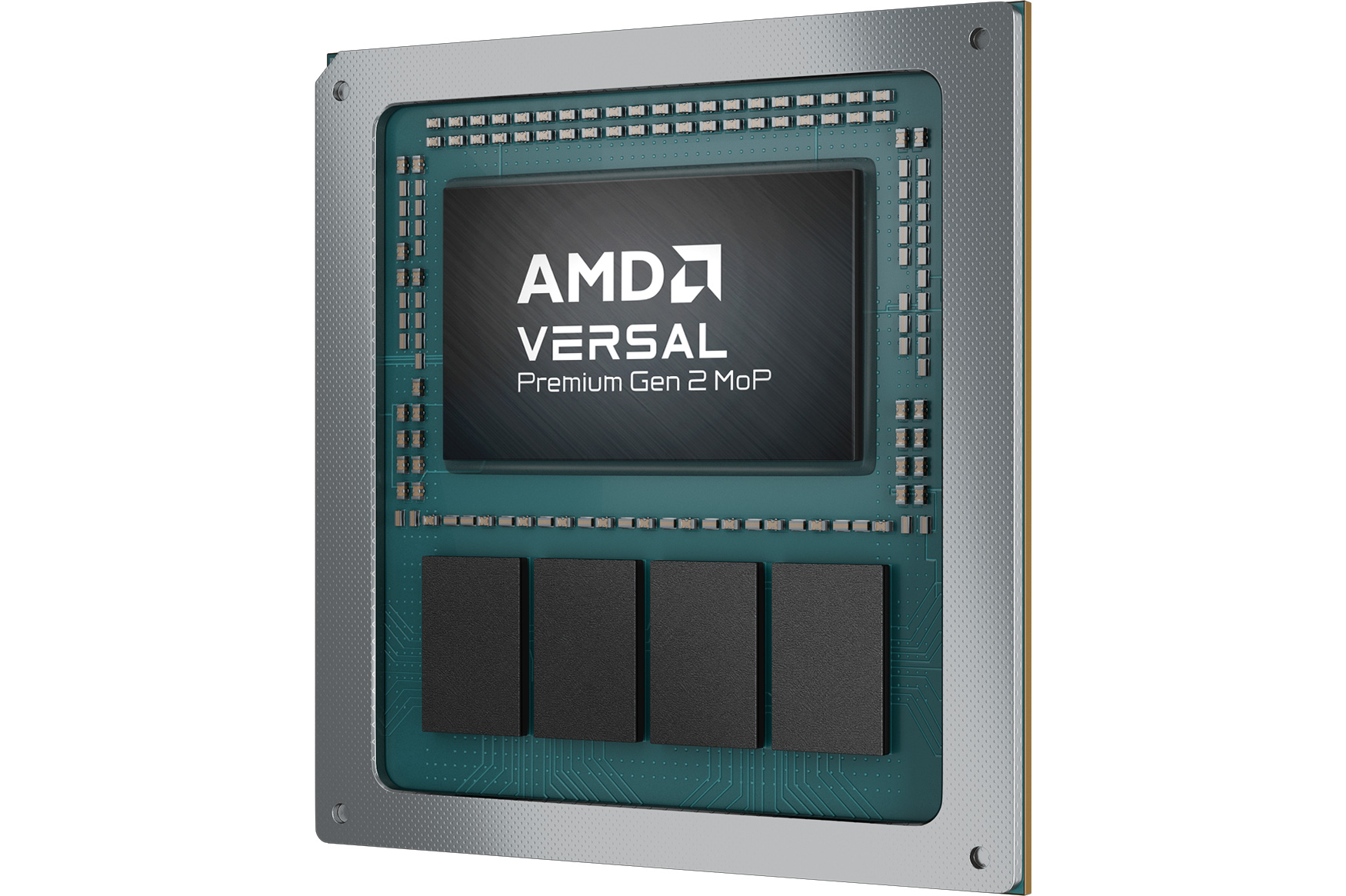
AMD this morning is announcing a new family of their Versal Premium adaptive SoCs, the Versal Premium Gen 2 Memory on Package lineup. These latest designs are a further evolution of AMD’s existing Versal Premium Gen 2 silicon, which bring LPDDR5X memory on board the chip package to make the resulting chip a more integrated (and self-contained) product. The memory on package chips, in turn, are being aimed at AMDfs adaptive SoC (FPGA) customers who are after a smaller and more turn-key solution for faster product development – essentially addressing many of the limitations of off-package memory with the regular Versal Premium Gen 2 parts.
Under most circumstances, the Versal Premium Gen 2 Memory on Package announcement would be a fairly low-key reveal that does not attract much attention outside of a few dedicated hardware engineering circles. But, in a reflection of the current times and the ongoing memory capacity crunch, the use of on-package memory makes this a far more notable product than it otherwise would be. The release of the Versal Premium Gen 2 Memory on Package is not just a new product family for AMD’s ex-Xilinx division, but it marks a major pivot in AMD’s on-package memory strategy for their FPGA chips.
In short: HBM is out, and LPDDR5X is in. And that alone comes with quite the story.
AMD Programmable Logic Pivots to LPDDR5X as HBM Supplies Dry Up
To properly understand this story, one must first understand AMD’s previous adaptive SoCs and FPGAs with on-package memory.
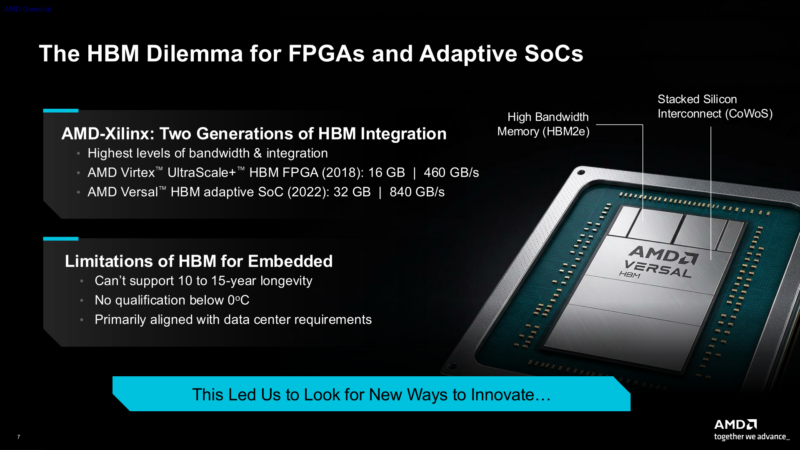
Even before being acquired by AMD, Xilinx was already offering FPGAs with on-package memory with their Virtex UltraScale+ HBM FPGAs, which were launched in 2018 and offered up to 16GB of the high-density, high-performance HBM (1) memory. This was followed by the Versal HBM series of adaptive SoCs, which were a variation of the Versal Premium lineup with up to 32GB of HBM2e memory onboard. In both cases, Xilinx/AMD was targeting customers who were after a highly integrated chip that not only came with the necessary memory already on the chip package, but chips that were wired up to far more memory bandwidth than the DDR memory solutions of the time could reasonably provide. In other words, FPGAs with all of the benefits that HBM brings.
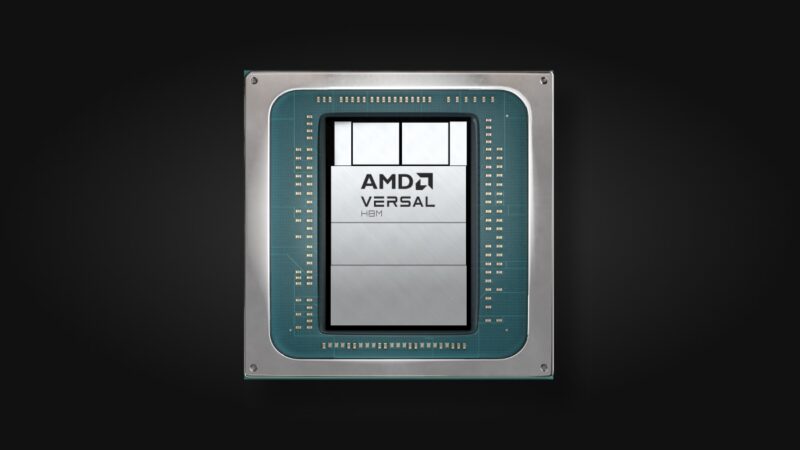
For Xilinx and AMD, offering HBM-equipped chips gave them a unique product set that addressed several customer needs, but supplying them was always going to be a tricky proposition because of the HBM supply chain. One of the defining qualities of Xilinx/AMD’s FPGAs and adaptive SoCs has been how long the chips are offered – for example, earlier this year AMD announced that they’re going to be offering the normal UltraScale+ FPGAs until 2045. But bringing memory on-package means that chip production is now reliant on both logic fabs (i.e. TSMC) and memory providers to supply the necessary HBM. Ultimately, SK hynix was the only manufacturer to produce the first generation of HBM memory, while Samsung and Micron came on-board with the HBM2 generation.
Meanwhile a broader issue despite the presence of all three of the major memory manufacturers was the rate of progress of the technology. Not counting the ‘E’ variations, HBM went through three major specifications in just the first nine years of its existence, and manufacturing operations have closely followed. With HBM intended to be used with cutting-edge, high-performance processors, chip designers and memory manufacturers have been quicker to phase out the use and production of older HBM memory types than they have DDR memory technologies, as the demand for the latter has a far longer tail.
As a result of the smaller and faster market for HBM, Xilinx/AMD was never going to be able to offer their HBM-equipped programmable logic products for quite as long as they have their traditional stand-alone chips. So offering HBM-equipped chips was a bit of a gamble for the company, but one they expected to work out in their favor by still allowing them to provide the high-performance chips for long enough to meet customers’ needs.
For several years it was a bet that AMD was winning. Right up until the AI boom took off.
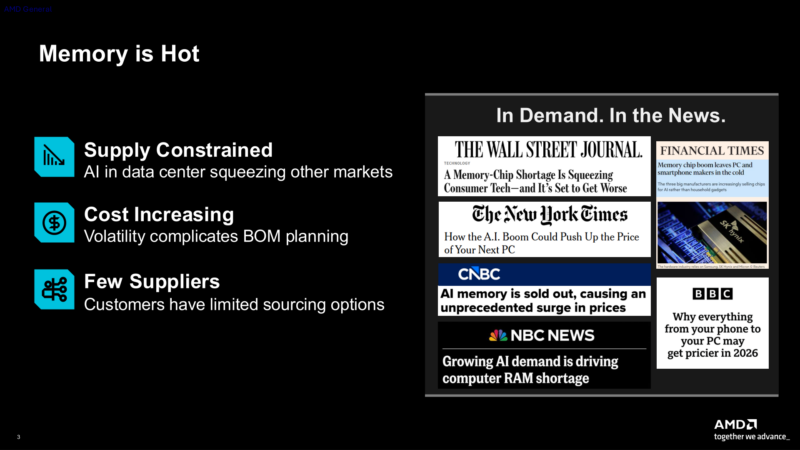
The explosion in demand for computing hardware for AI crated a massive shift in demand for processors. AMD itself has been a major beneficiary of this thanks to the leap in demand for both their Instinct accelerators (which make heavy use of HBM) and even their EPYC CPUs to help feed those accelerators. But AMD’s programmable logic division was a loser in this shift as the HBM they needed became scarce before finally becoming unavailable altogether. Barely two years after the Versal HBM series went into production, AMD began the process to discontinue the chip family in September of 2025 for a lack of HBM2e supply. The big three memory manufacturers were already in the process of winding down their HBM2e production in order to shift those production lines over to HBM3, and with it went AMD’s ability to produce more Versal HBM chips.
Consequently, today’s announcement from AMD – which incidentally falls on the final day to place orders for Versal HBM chips – marks a rather hard pivot for the company. With HBM turning out to be both harder to come by and shorter lived than AMD could have ever imagined, their adaptive SoC division is switching from using HBM to LPDDR5X for their on-package memory technology.




In my 52 years of IT related work, I think this is the first era where IF I had a DeLorean & a Flux Capacitor, I could go back in time 18 months buy a lot of DIMMs and bring them to the present at great economic advantage…In my data center decade (ending in 2021) I was used to trying to sell 8 – 10 year old DIMMs and finding that they weren’t even worth the cost of shipping!
What’s known about expected pricing for those new Versal Premium Gen 2 models ?