As part of our foundational networking series, we are running through some more concepts that we will use in future product reviews. One is the 400G-SR8 optics, which we think folks will use more frequently in the future, especially with switches like the MikroTik CRS812 DDQ 400GbE Switch Launched CRS812-8DS-2DQ-2DDQ.
What are 400G-SR8 Optics and Why Do They Matter
First off, let us start with 400G-SR8. Here is the breakdown:
- 400G tells us that we have a 400Gbps device.
- SR means that we have a short-range optic for a 100m reach.
- 8 means that we have eight communication channels.
Practically, that means that we have 400Gbps over 8 channels for 50Gbps per channel. Each channel in an SR8 optic utilizes a send and receive pair of fibers, resulting in a total of eight send and eight receive fibers (or 16 total.) At first, this may seem inconsequential, but it means that if you have LC cabling or MPO-12 installed in a data center, the SR8 optics will require MPO-16 APC cabling.
One example of this is the FS 400Gbase-SR8 400GbE QSFP-DD Optical Transceiver we reviewed some time ago.
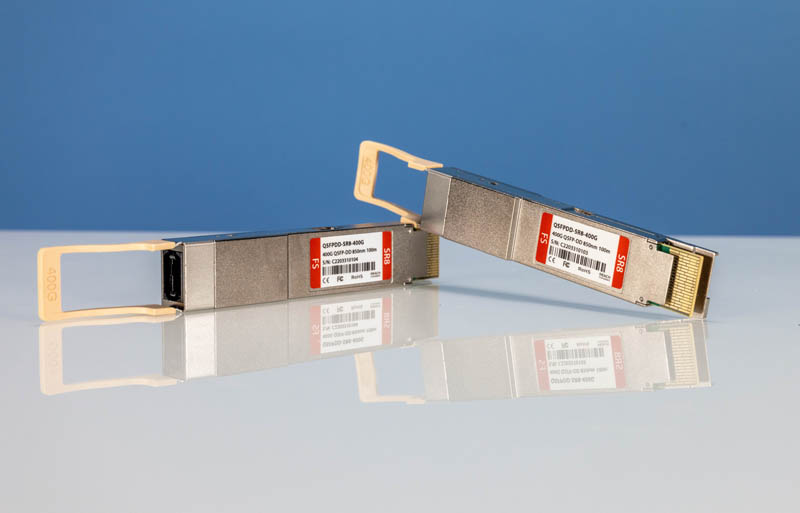
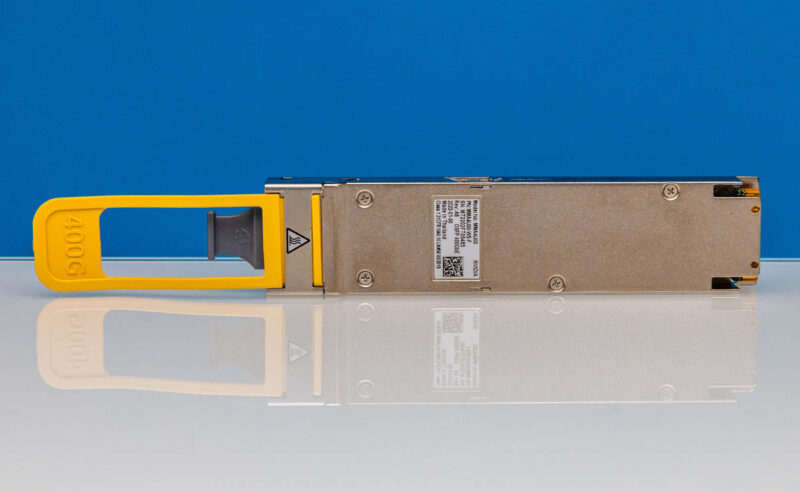
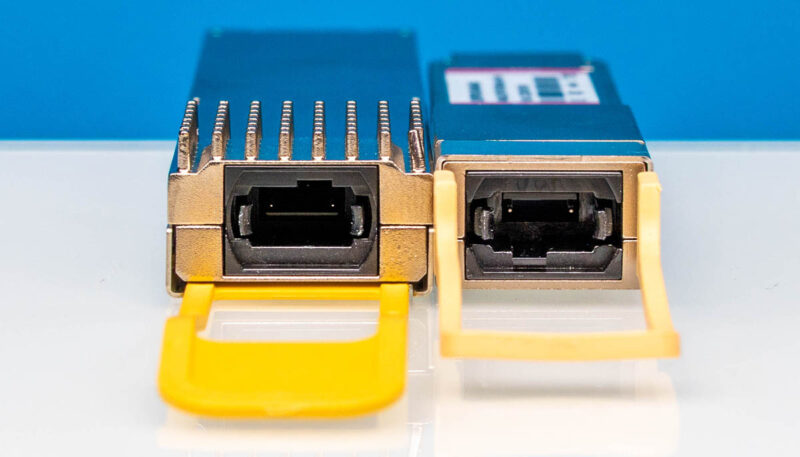
Those are in the QSFP-DD form factor which we need to do a quick refrerence piece on as well. Still, we also wanted to show a NVIDIA MMA4U00-WS-F. This is an OSFP 400G-SR8 optic from the ConnectX-6 era.
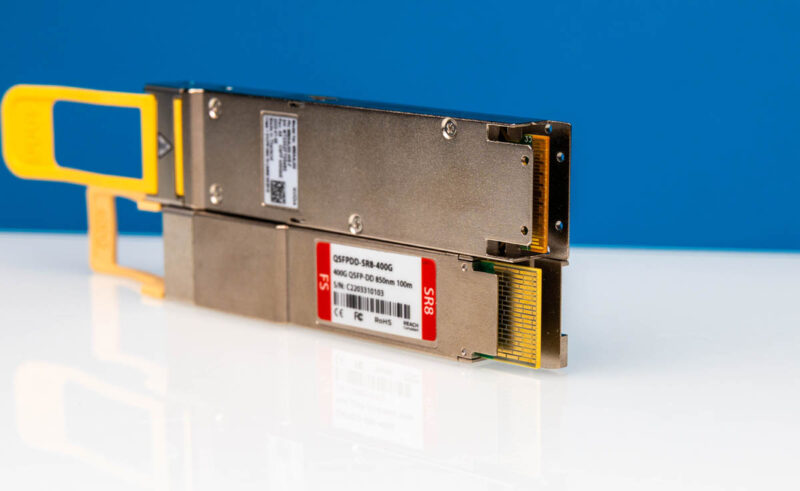
If you do not know NVIDIA’s naming convention, then you would probably have to lookup the fact that this is a SR8 optic.
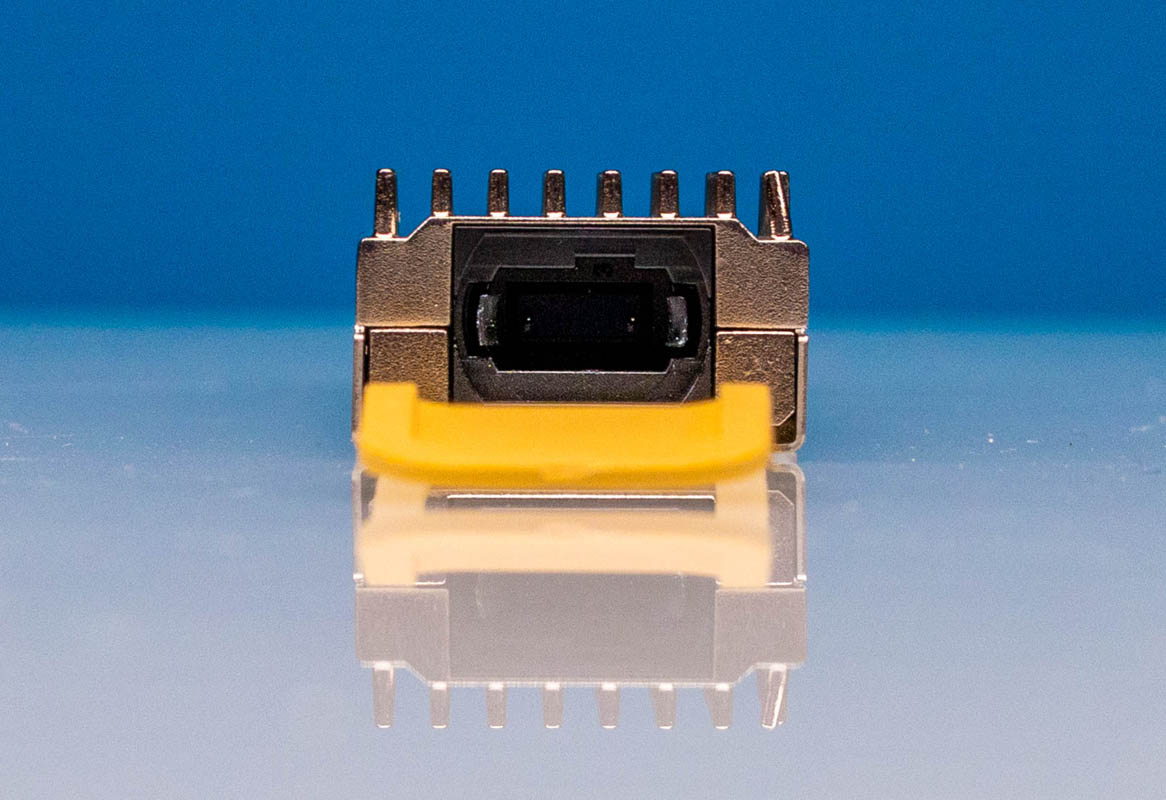
Another way to tell, however, would be to look at the connector.
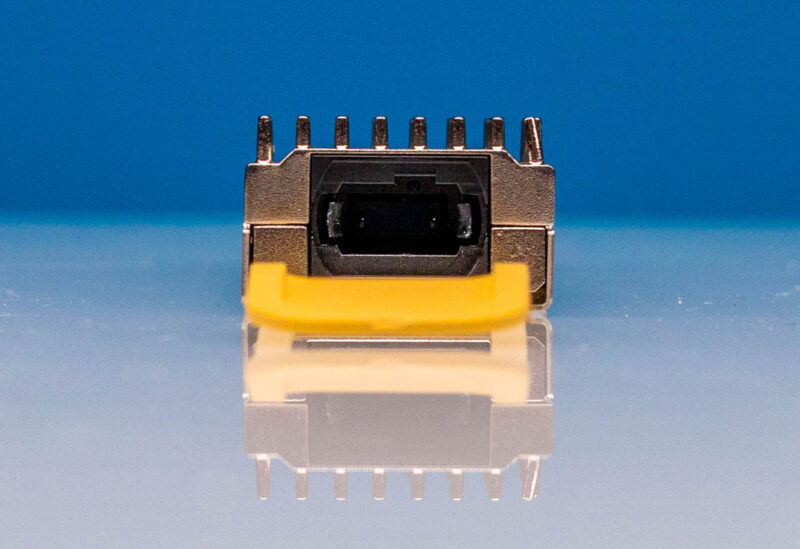
Here we can see the connectors of both the NVIDIA optic and the FS optic.
A little lighting later, and here you can see the 16 fibers between the two guidepins on the optical connector side. Since this is a SR8 optic, we need 16 fibers, and these are the actual fibers we use for communication.
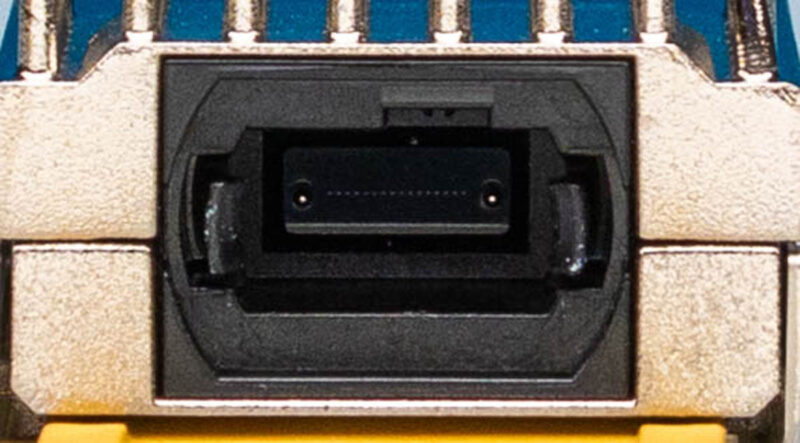
There are a few SR8 designs that use 24-fiber cabling instead of 16, even though only 16 fibers are needed. Most of what we have seen is 16 just because there is less waste than running 24 fibers and only using 16 of them.
A topic for another day is the electrical side of these modules. At a high-level, we often see these SR8 modules with 56Gbps PAM4/ 50G PAM4 electrical sides since that can be mapped directly to the 50G optical channels. While this may sound trivial, in the 400G and faster generations, it starts to matter quite a bit when designing connectivity.
Still, the SR8 optics are useful because although we have an OSFP and a QSFP-DD module that are different sizes, we can connect two SR8 optics together.
Final Words
Unlike in QSFP28 100G and earlier generations, physically linking devices is perhaps more difficult once we get to 400G/800G. Not only do we have multiple form factors such as QSFP112, QSFP56-DD, and OSFP, but then the optical side often has corresponding cable complexity. Given we know our readers are excited for the QSFP56-DD in the MikroTik CRS812 DDQ, we thought it would be important to show what these are and some other options out there.
The benefit of SR8 is that since it is only running at 50Gbps per lane and it uses individual fibers, it can use lower-cost optics. While these 400G-SR8 modules are 100m, there is a very short range (VSR8) optic that is only 50m in reach.
We actually started our project connecting high-speed network devices for testing with 400G-SR8 optics, but after a bit of time we realized that that was not the optimal setup for us to standardize on given the variety of devices we want to test. For most data centers, this will be fine to standardize on since they have a much more limited scope of what needs to be connected.