

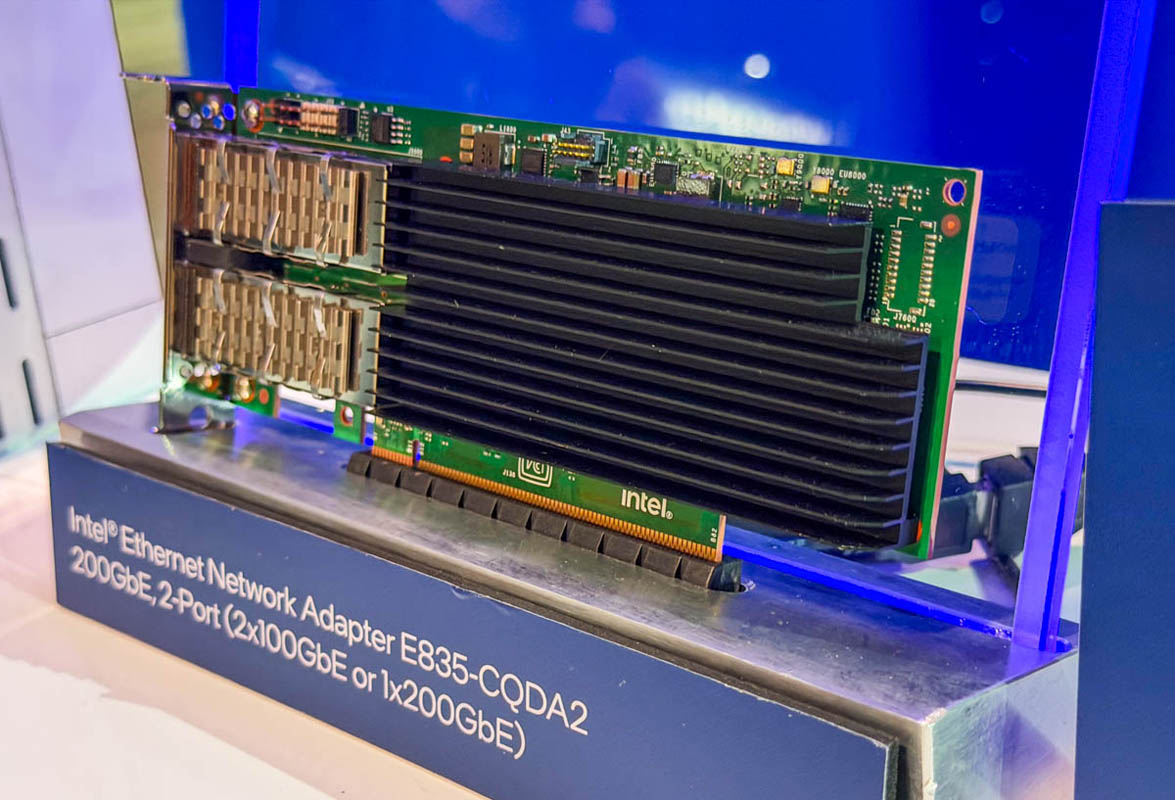
At HPE Discover 2026, I found Intel’s newest NIC lineup. I think the line was at Computex 2026 in an off-site suite, but neither Ada nor I made it there. I think it may have also been at Dell Tech World, but I did not get a chance to see it. Luckily, yesterday afternoon, as the show floor quieted down at HPE Discover 2026, I managed to take a few photos of the Intel E835.
What is the Intel E835?
It seems a bit strange that in mid-2026, we are getting a 200GbE network adapter launch, but here we are. The Intle E835 is optimized for lower power consumption, providing a new network controller for basic connectivity. In AI clusters, we are transitioning from 400GbE to 800GbE and even 1.6TbE links. A 200Gbps-capable NIC that can run 2x 100GbE at line rate is useful for some lower-cost servers connecting to older networking infrastructure rather than the high-end AI build-out networks we are seeing today.
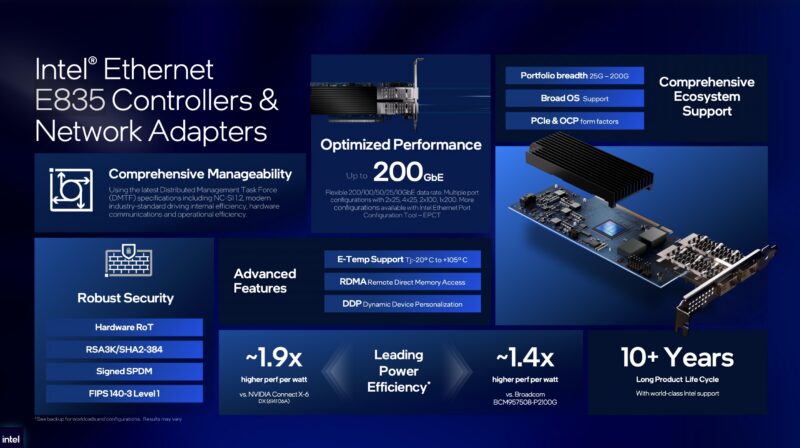
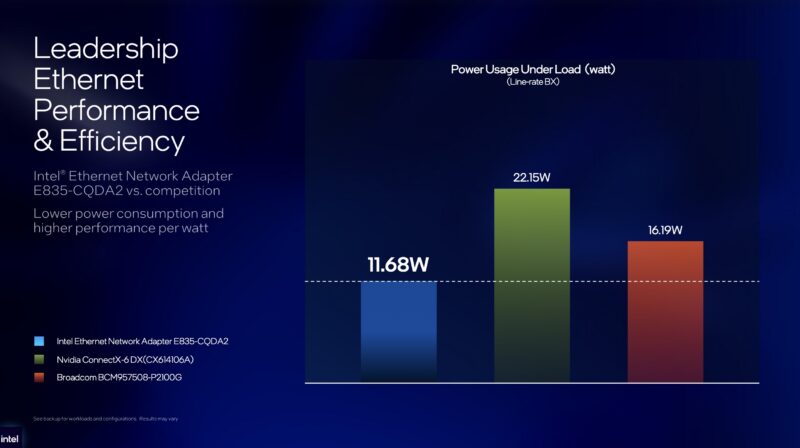
That comes to Intel’s key value proposition. It is comparing its solution to the popular NVIDIA ConnectX-6 Dx and is saying that it can use roughly half the power. To be fair, the ConnectX-6 Dx was launched in the second half of 2019. What Intel is really doing is just providing a newer technology NIC to a market where Mellanox-NVIDIA has been focusing on pushing the top-end. It stands to reason that using 7-year newer technology, Intel can cut the power consumption significantly.
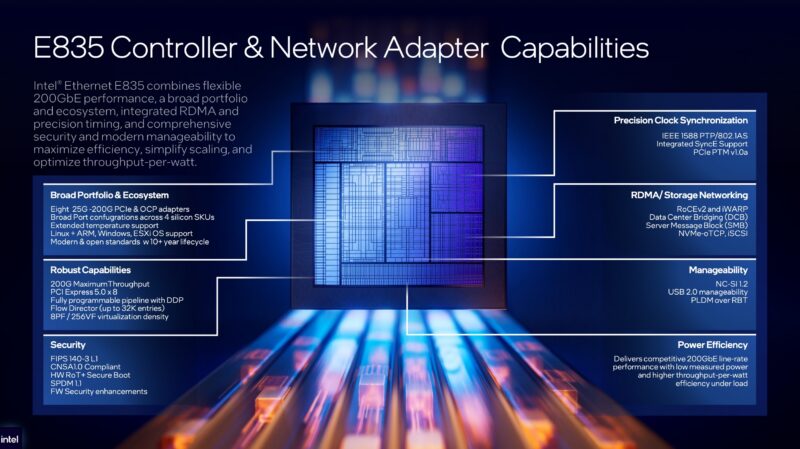
Here is the capabilities slide that we will just leave here, but we get common features like RoCEv2 and iWARP, DCB, and more.
Now, let us see some NICs.
Intel E835-CQDA2 200Gps NIC
Here is the Intel E835-QCDA2. The C tells us we have 100GbE class ports. Next, the QDA2 tells us we have two QSFP ports.
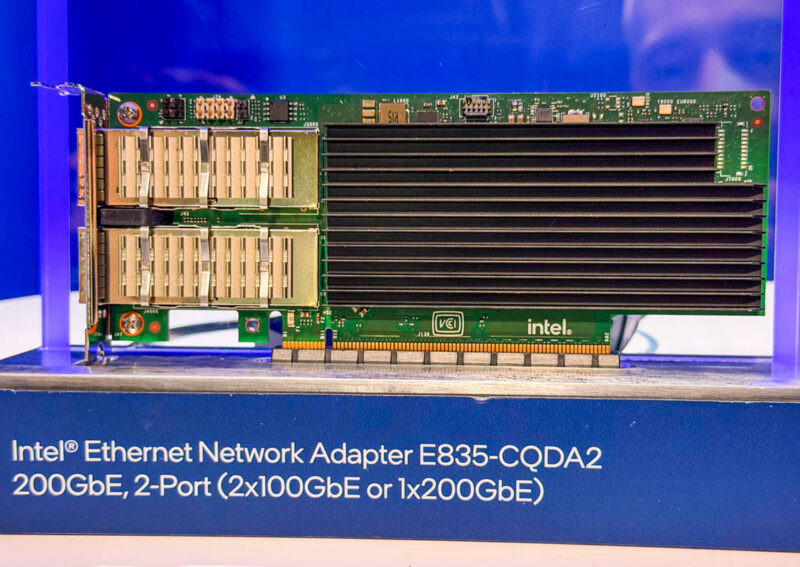
Something interesting is that the spec page says QSFP28, which makes sense for 2x 100GbE. I am not exactly sure how you get a 200GbE port from one of these if you have QSFP28 (28 x 4 = 112). Notably, even the single-port cards are 200GbE from QSFP28 ports like this E835-CQDA1, so Intel seems to be doing this without using QSFP28-DD or QSFP56.
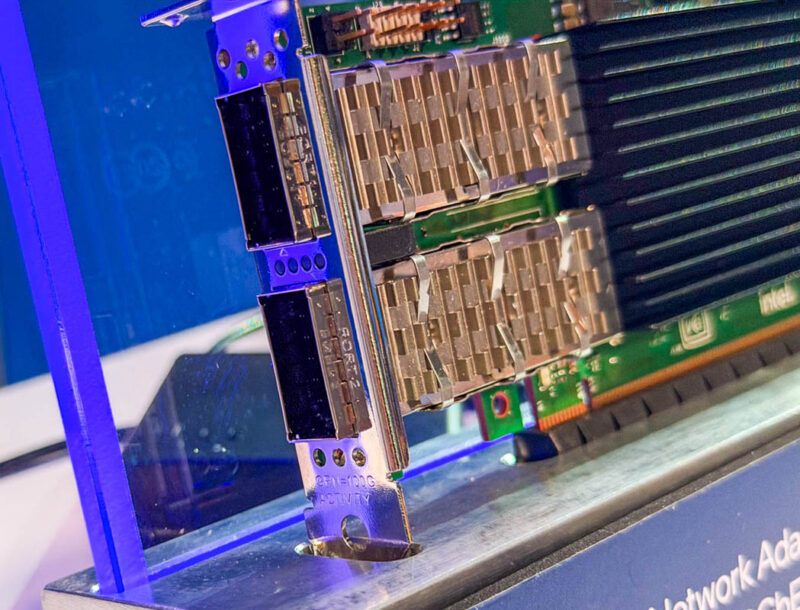
Still, the card is a low-profile form factor, making it easy to integrate. Also, these cards are sub-$600 at recommended prices, so they are much lower per-Gbps cost than many other adapters.
Intel E835-XXVDA2 2x 25GbE Adapter
We also saw the Intel E835-XXVDA2. This is a dual-port 25GbE adapter.
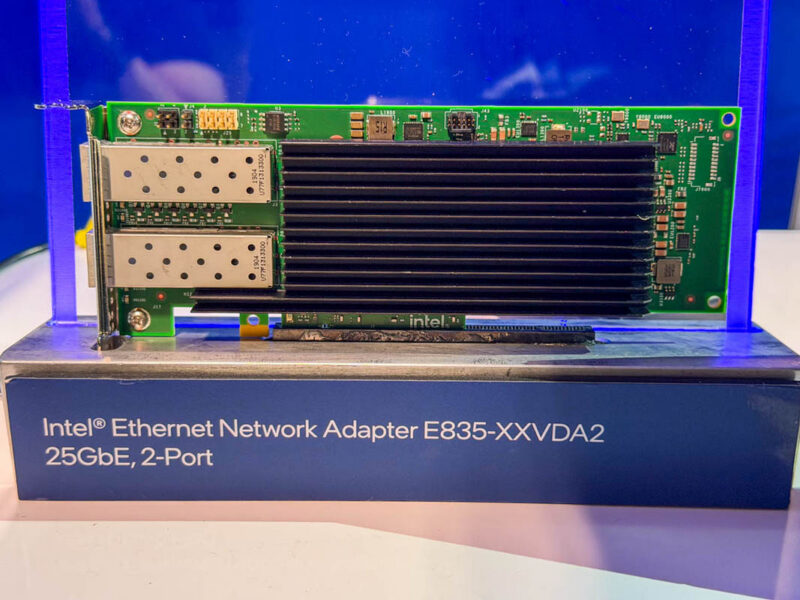
The recommended price for these cards when new is $216 or less, so perhaps this brings lower-cost 25GbE as well.
Intel E835-XXVDA4 4x 25GbE Adapter
Again, with XXV, we get 25GbE. With DA4, we get four SFP28 ports. As a result, we get the Intel E835-XXVDA4 quad port 25GbE card.
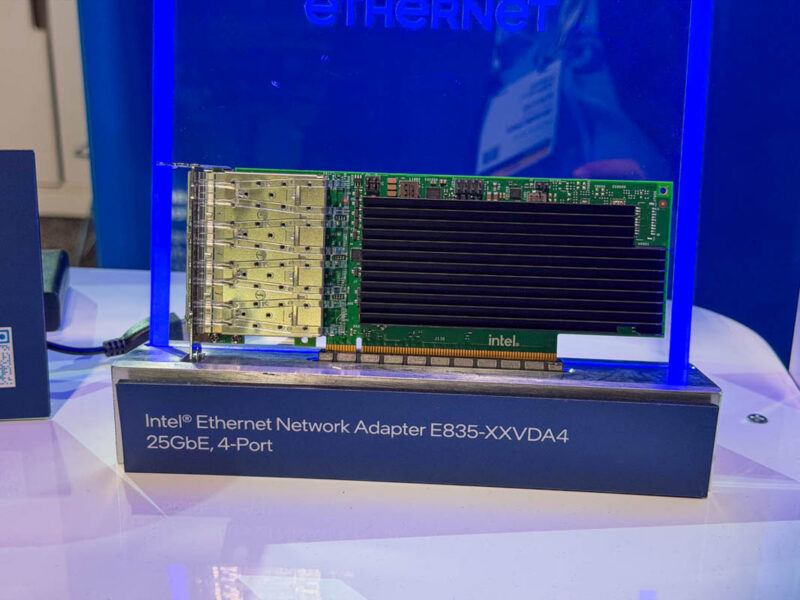
If you did not know this, fitting four SFP cages on a low-profile card is mechanically challenging, so Intel has a special bracket to handle the mounting.
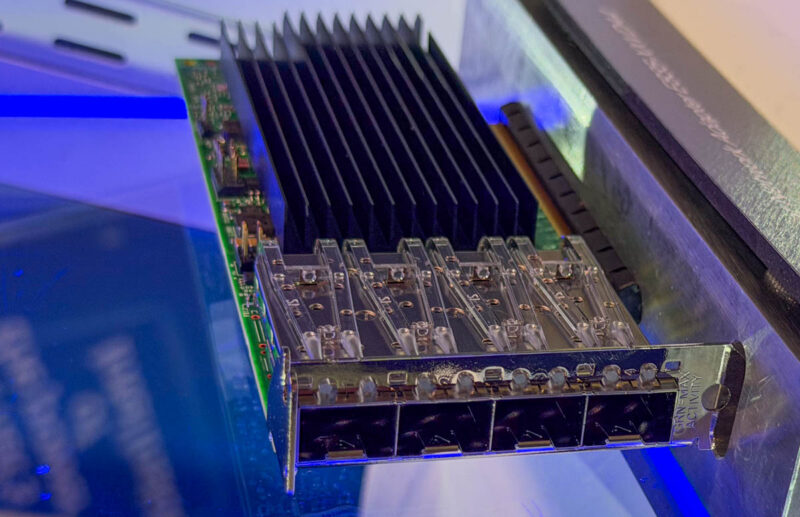
These have a recommended price in the mid-$500 range.
Intel E835-XXVDA4F 4x 25GbE
If you wanted a larger card, there is the Intel E835-XXVDA4F, a full-height 4x 25GbE adapter.
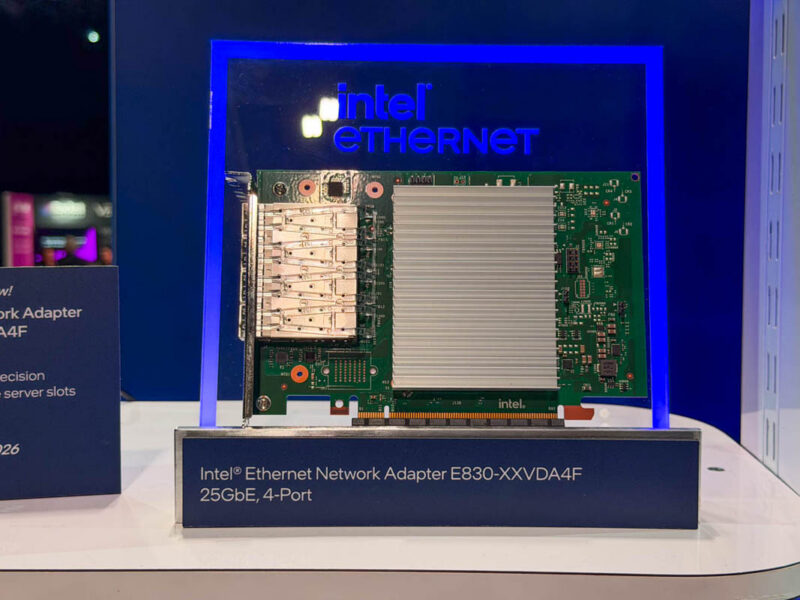
Here, we have plenty of room for a full-height bracket and the 4x SFP28 ports.
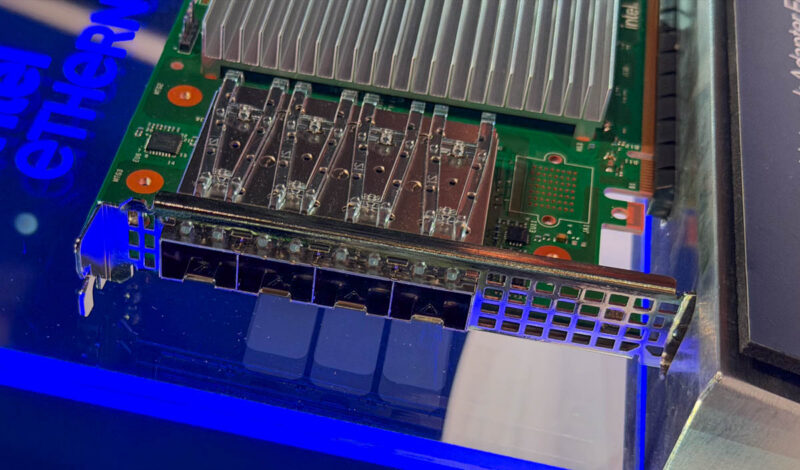
This one, we could not find a price for. It also hits home as we used the Intel X710-DA4 full-height in many servers over the years.
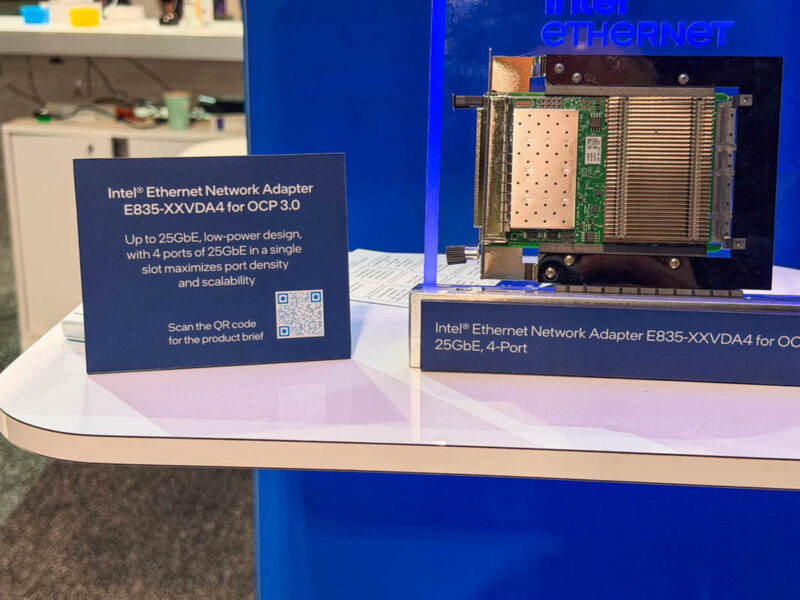
Intel E835-XXVDA4 OCP NIC 3.0 4x 25GbE
Given that this is the lower-speed NIC option, we found the card also in an OCP NIC 3.0 form factor.
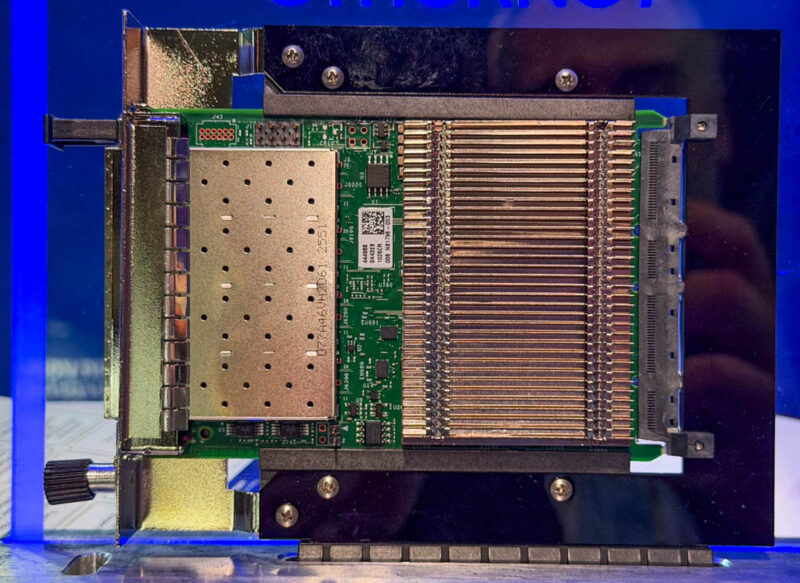
Intel showed off our favorite OCP NIC 3.0 format, the SFF with pull-tab design.
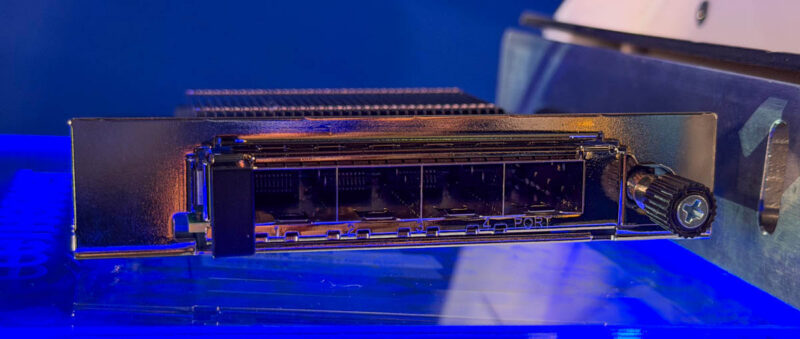
This one is in the low-to-mid $500’s in terms of cost.
Final Words
There are probably two ways to look at these cards. First, if you just want to add a new server to a lower-speed network, these make sense. In AI data centers, 25GbE is more of a management interface speed. For many data centers, and especially as you get out to the edge 25GbE is very popular. Many of those applications are also power-constrained, so saving 10W on a NIC can be very useful.
Hopefully, we can get one of these to try out. We bought an Intel E610 4-port card new from distribution that ended up not working in five different servers, but we likely just got a bad card. Maybe we will try again with the E835 series.

Does anyone else think that the marketing weenie who decided “roman numerals are a great idea!” should be fired… out of a cannon?
Really insane.
Other than that, it’s good we have new more efficient tech for this. Not everything is AI; for regular DCs this may be exactly what you’re looking for.
Could someone explain why Intel isn’t launching any 400gbe or greater nics? It’s not that these are bad products or don’t have a place in the market but it seems strange that intel doesn’t seem to have a 400gbe or greater offering in addition.
Anyone else read this in Patrick’s voice? lol :) Good stuff as usual.
@M – Probably because some parts of Intel are sucking less these days, but other parts… really aren’t.
I remember when intel came into the market strong, and very quickly became the top provider. the 82576, I think, because the standard for gbe. That was a long time ago. A little more recently, like pretty much every other part of Intel, they coasted for way too many years.
Hopefully this is another step towards rebirth. They still have a long way to go though.
Argh typos. And missing capital letters. Sorry. “because” should be “became”.
A little more research… I was right about the model number but that wasn’t the chip I was thinking about, actually. I was thinking about their 100mbps chip, in the late 90s (? maybe 2000?). They kept crushing it for well over a decade though, and the 576 came out in 2008. That wasn’t their last big hit, though, as they also had great (but not cheap!) 10gbe cards.
Anyway that’s all distant history at this point. Hopefully, they can regain some relevance.
A little more research… I was right about the model number but that wasn’t the chip I was thinking about, actually. I was thinking about their 100mbps chip, in the late 90s (? maybe 2000?). They kept crushing it for well over a decade though, and the 576 came out in 2008. That wasn’t their last big hit, as they also had great (but not cheap!) 10gbe cards.
Anyway that’s all distant history at this point. Hopefully, they can regain some relevance.
A little more research… I was right about the model number but that wasn’t the chip I was thinking about, actually. I was thinking about their 100mbps chip, in the late 90s (? maybe 2000?). They kept crushing it for well over a decade though, and the 576 came out in 2008. That wasn’t their last big hit, as they also had great (but not cheap!) 10gbe cards.
Anyway that’s all distant history at this point. Hopefully, they can regain some relevance.
I had another post with more corrections that the site appears to have eaten. In brief, the 82576 was real and important but not Intel’s first big win; they made a big splash with 100mbps almost a decade before that, and had a number of other big winners over the years.
It’s been a long time since then, though.
What’s sad to me is that Intel used to be known as the “stable” networking solution. 1GbE, 10GbE, etc. Intel was the gold standard for stability. Realtek was always considered the lower cost, unstable solution that companies used to save money. In the years since, I don’t think Realtek has gotten better, but Intel just kind of gave up on networking.
The E610 seems like it would mark a return to form for Intel, but I haven’t seen it showing up much outside of the announcement at last years HPE Discover event.
I get that 5-10 companies are consuming all the hardware and spending all the money on their AI and cloud solutions. But for anyone not at those companies, designing and powering functional hardware solutions still requires “low to mid range” solutions like 10, 25, 40, 100, 200 GbE designs.
“In AI data centers, 25GbE is more of a management interface speed.”
Maybe I’m unclear on what exactly is involved in server/platform management in an AI datacenter. But what exactly would require 2.5GB/s of bandwidth for “management”?
Are AI datacenters running uncompressed 4K video output on their BMCs or something?
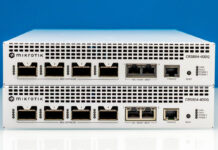
Only thing missing is a cheap NIC that can do single lane 56G signalling, so that one can use it with that insane Mikrotik’s switch CRS812-8DS-2DQ-2DDQ-RM
As the things are now, one needs CQDA2 card ust to use a single fast lane, which ain’t cheap.
The product brief linked form the spec page explains that they also do 200GbE QSFP56 – 1 Port and 50GbE SFP56 – Up to 4 ports with breakout cables (2 per port, or 4 from the first port). So its not just QSFP28 its either.
So yes, you can use it for single lane 56G signalling too, eg with that switch @Goofy_Nick
@Justin Cormack:
But those versions are EXPENSIVE.
And big overkill for this.
If one has a bunch of one server and bunch of lean clients, having one expensive 200GbE NIC on server is one thing, but paying the same for each client just to have 50GbE instead of 25GbE kind of kills it.
Disappointing to see Intel still missing the mark here. We’re already at PCIe 6.0, with PCIe 7.0 on the horizon, yet these NICs are still constrained by PCIe 3.0/4.0-era thinking.
A 200GbE card could realistically be PCIe 5.0 x8, dual 25GbE could fit on PCIe 4.0 x4 or even PCIe 5.0 x2, and a single-port 100GbE NIC on PCIe 5.0 x4 would be perfect for where Thunderbolt 6 is heading with PCIe 5.0 x4.
And outside of large workstation/server boards, almost nobody has spare PCIe slots where you can run x8 without sacrificing GPU lanes. So instead of making practical, modern cards that fit real systems, we keep getting these oversized, over-laned designs that feel stuck in the past.
@Aurimas Niekis
WTH are you talking about ? E835 can do PCIe5.
The great thing about these cards is that they run on PCIE 5.0.
That means PCIE 5.0 x4 (eg M.2->PCIE adapter) is sufficient to saturate a 100G link.
A great overview of Intel’s latest E835 networking lineup and its potential impact on modern data centers. The article does an excellent job highlighting how higher bandwidth, improved power efficiency, and flexible deployment options can help organizations prepare for increasingly demanding AI, cloud, and enterprise workloads. An insightful read for anyone following the evolution of high-performance networking.
@justsomeguy – I’m convinced both marketing and product management at Intel are now run by AI