

Intel Core 3 N355 vs Core i3-N305 Performance
Please keep in mind as we go into this that we have a 2.6% turbo clock difference, so we are expecting a meager gain. At the same time, 100MHz at 3GHz would be a 3.3%. In the recent Qotom review, we showed the comparison between the N355 and N305:
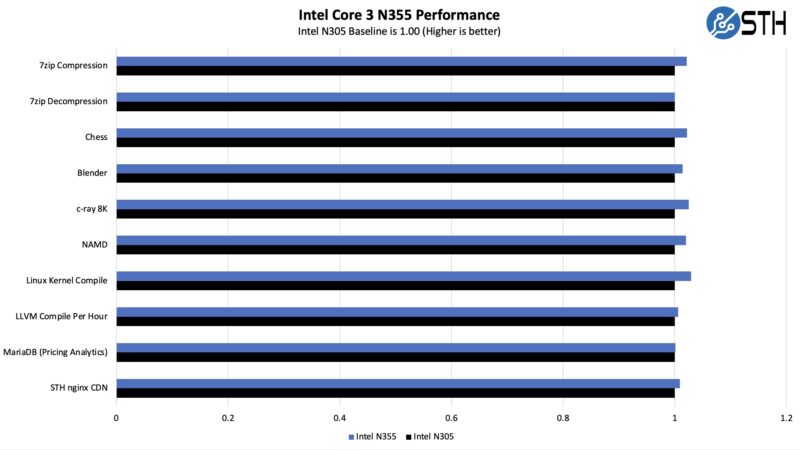
Here we saw only 1-3% higher performance out of the N355. While that is a step in the right direction, it was a very meager performance bump. As a result, we decided to try Geekbench 5.
Geekbench 5 Comparisons
Geekbench 5 shows raw performance of the CPU cores across a number of tests. With the same underlying architecture, we expect this to be mostly biased to the higher clock speed.
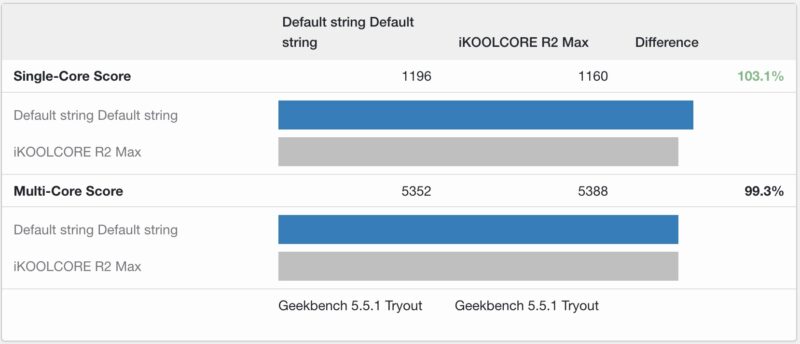
Compared to the two year old N305, the N355 is very close in terms of performance as we see even more results in the 0-3% performance bump range.
Final Words
The power consumption on platforms seems close, but the different NICs we had and different power means that it is a bit hard to show. At the same time, it feels worth pausing for a moment and just thinking about the progress in the industry. When we were doing the Qotom Intel Core 3 N355 system review, we kept coming back to the small performance increase. These are SoCs that are built and sold two years apart. The N305 is a useful chip, and does not make for a rough desktop experience like previous generations like the Intel J4125. At the same time, for a two year refresh 1-3% more CPU performance seems minor at best.
In the end, maybe the bigger takeaway is that for many of our readers, the N355 may be better since it is the update. At the same time, if the N305 is less expensive, that might be an area worth saving a few dollars. It feels strange that the N355 is so close. Since we are going to look at a few more N355 platforms, it was something we wanted to address as a piece to reference.


This is just a “look, we’re not totally inactive” part
How can this possibly be strange to a CPU reviewer? It’s the same silicon. Are you missed by the marketing name?
If it were the N306, you wouldn’t write articles bemoaning 1-3% change when the only difference is a 100mhz turbo bump.
I (used to) expect better out of servethehome. Patrick, does this really help your long term value as a site?
Gutless to complain anonymously.
This article very clearly says that both are the same silicon and just have a different clockspeed. Based on that nobody is surprised.
Still it’s fair that John complains about the only 1-3%. It is expected due to what Intel did, but that two years later we just get a refresh instead of a real new generation is disappointing.
“100MHz at 3GHz would be a 3.3GHz gain”
wut
I think
-100MHz at 3GHz would be a 3.3GHz gain
+100MHz at 3GHz would be a 3.3% gain
Yes, please revise first paragraph of page 2.
The lstopo image shows the PCIe lanes go to the CPU, but if I remember correctly, those PCIe lanes are connected to an integrated chipset which connects to the CPU through an internal bus called OPI (on package DMI). Has anyone verified what is the bandwidth available through OPI?
Time for some thermalpaste hygiene ! :-)
cw824 and michaelp – Yes. Swapped to percentage. I am behind quite a bit today since I was up at 6:30am to get the HPE Keynote at the Sphere and am sitting down for my first time
Not given – This is the 2-year refresh. Intel has done these before, but I thought it made sense that John wanted to point out that in two years, this segment is only seeing a 1-3% increase. To be fair, we are at 9 quarters at this point, so it is more than two years. Some may see a N305 and N355 and think they are getting something much faster, when in reality, it is such a small difference that it is hard to perceive or even measure in most cases. Remember, there are folks who do not keep up with the industry every day and the N300 to N305 difference is greater than a 10% performance delta. If N300 to N305 was 10%, one might think that N305 N355 is more than 1-3% just based on that model number.
I think that is a very fair point.
cw824 and michaelp – Yes. Swapped to percentage. I am behind quite a bit today since I was up at 6:30am to get the HPE Keynote at the Sphere and am sitting down for my first time for 5 min today.
Not given – This is the 2-year refresh. Intel has done these before, but I thought it made sense that John wanted to point out that in two years, this segment is only seeing a 1-3% increase. To be fair, we are at 9 quarters at this point, so it is more than two years. Some may see a N305 and N355 and think they are getting something much faster, when in reality, it is such a small difference that it is hard to perceive or even measure in most cases. Remember, there are folks who do not keep up with the industry every day and the N300 to N305 difference is greater than a 10% performance delta. If N300 to N305 was 10%, one might think that N305 N355 is more than 1-3% just based on that model number.
I think that is a very fair point.
To me it seems like Intel did an update to include Intel® Trusted Execution Technology ‡, as it seems like this isn’t in the N305 chip. I don’t know how relevant this feature is for most people but it seems like the only change besides a very minor bump in speed so I assume that at least someone at Intel believe it is an important feature…. I wish the article would address this feature change – seems like it has been completely missed ?
Yah, it does seem like the marketing department is just being overly active, thinking that people will choose the new part and hopefully pay more for it, simply because 355 > 305. But of course, in reality, the difference is going to be imperceptible.
I mean, the bottom line is that for most use cases, either is going to be fine and just buy the cheaper one, which is exactly what the article concludes.
Here we go again, Intel produce low end garbages increase insignificant speed improvement, more like a stealthy CPU dumping into market help bump up it’s hardly sold high-end CPU bait in AI demanding age.
It’s not a refresh, which refers to a change in silicon, often the same microarchitecture ported to a new node, or at least with a few optimizations to take advantage of the existing node.
It’s a rebadge of the same silicon on the same process.
It’s not a refresh, which refers to a change in silicon, often the same microarchitecture ported to a new node, or at least with a few optimizations to take advantage of the existing node.
It’s a rebadge of the same silicon on the same process.
Bystander/ Not Given – Intel uses refresh not for changes in silicon and new nodes, but for SKU updates in an existing line. Here you go https://www.servethehome.com/big-2nd-gen-intel-xeon-scalable-refresh-brings-competition-anew/
And what about thermals of CPUs?