

Supermicro SYS-E403-14B-FRN2T Power Consumption
Power is provided by redundant 800W 80Plus Platinum power supplies, but there are options for a single PSU as well.

Loading this CPU up, we saw 225W package power consumption, so we knew that we would be using a decent amount of power.

At idle, we were under 200W, but under load, we were closer to 400W.

From a noise perspective, do not expect this configuration to be silent.
STH Server Spider: Supermicro SYS-E403-14B-FRN2T
In the second half of 2018, we introduced the STH Server Spider as a quick reference to where a server system’s aptitude lies. Our goal is to start giving a quick visual depiction of the types of parameters that a server is targeted at.

This is not the densest system, but it offers a good base platform to customize using the PCIe slots. Often, you would see either a high-end NVIDIA GPU, several lower-end inferencing GPUs, or a bunch of network cards/ DPUs in here. With three PCIe Gen5 x16 slots, you have a lot of options, but not as many built in.
Final Words
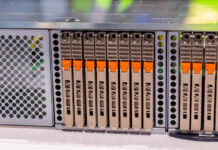
This is going to sound strange, but one of the great features of this platform is really the front I/O, and the three PCIe slots. The ability to customize this system with up to three 400Gbps NICs, or to use a dual slot GPU plus a high-speed NIC, or just add lots of lower-speed ports, there is a lot you can do with that PCIe block.

In previous generations, with the Intel Xeon D, this was often a more network-focused box. Now, with the Intel Xeon 6, you can get both QAT acceleration, lots of memory bandwidth, and ample PCIe connectivity. For some reason, as much as we have used systems like the HPE ProLiant MicroServer Gen11, as the MicroServer has gotten more expensive, it starts to make this type of system look extremely attractive. It is slightly larger, it is more expensive, but with up to a 144 E-core processor, eight RDIMMs, and lots of PCIe Gen5 slots, you can do a lot with the E403 well beyond what you can do with smaller socket systems. If you have been looking at a MicroServer Gen11 and been frustrated by still using 1GbE and non-hot-swappable 3.5″ drives, and limited expandability, this, in many ways, becomes a great option.

After wanting to review the Supermicro E403 systems for years, we finally had the chance. At some point, we will likely pick one of these up for the lab, just because it is a fun form factor. At some point, we hooked up 800Gbps of networking using two NVIDIA ConnectX-7 cards, and that was just a neat configuration for an edge box. Overall, this is a cool little server.

And how many ports would you like? Answer = YES!
Is there any way to determine how loud they are? A nice heavy duty machine would be a nice upgrade but for an apartment the noise is my biggest factor.
Love this, looking forward to buying a used one n a few years.
Its got a real physical SERIAL PORT!!! someone knew what the nerds and geeks need!
very nice indeed, but wondering why the hot swap fans are not rear swappable
Thanks for the review. This is a system good idea, but needs a bit more development.
a) The power cable spaghetti needs to go. This is horrible, and also impedes cooling.
b) USB Type-C for video output and keyboard/mouse
c) On board 2x SFP28
d) option to remove the normal drive and PCIE raisers, and put 4x 3.5 inch drives instead. Would be amazing. Yes, not useful for telco or some edge uses, but I would really like that.
Even better if this can be done in a half of the normal rack width – could be tricky without moving the PSUs to a different location.