
Qotom Q51551UT Performance
Under the hood, the Qotom Q51551UT runs on Intel’s Core Ultra 5 125H processor, part of the Core Ultra Series 1 (Meteor Lake) family. Though a couple of generations behind the cutting edge now, Core Ultra Series 1 is still common in the market, as it was the first major overhaul of Intel’s mobile lineup in a few years when it launched in early 2024. That is, many designs were rebuilt or recreated for the platform and are still in use today, which is a good summary of the industrial PC market overall.
The 125H SKU in particular is Intel’s entry-level part for mid-powered (H-series) devices. The chip offers 4 P cores based on the Redwood Cove architecture, which are augmented by 8 E cores and 2 low-power E cores, both based on the Crestmont architecture. The chip has a somewhat modest peak clock speed of just 4.5GHz for the P cores, as higher speeds are reserved for the higher-end chips. Meanwhile, on the GPU side of matters, 125H gets a slightly cut-down Arc Graphics (Xe-LPG) integrated GPU, with 7 Xe cores enabled.
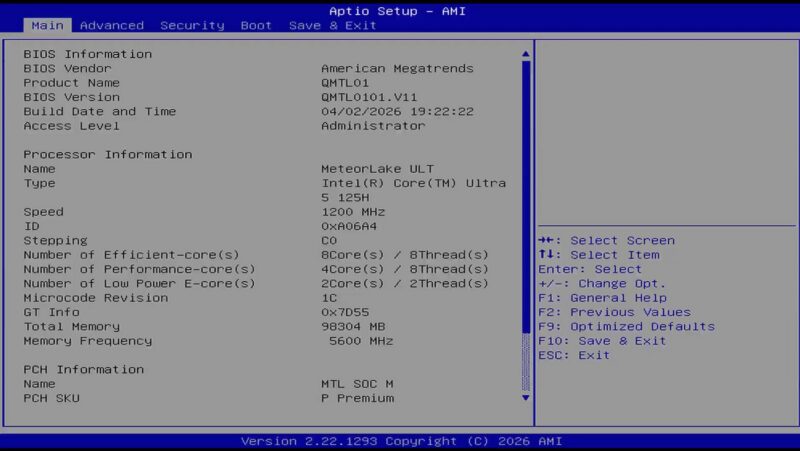
Core Ultra Series 1 chips can use either LPDDR5X or DDR5, and Qotom has gone the latter route to allow removable/upgradable memory. The upshot is that the system is not only configurable by the end-user, but can also be packed with up to 96GB of DDR5, which we dutifully tested to see what this mini-PC can do. The system arrived with 8GB of memory, but we needed 2GB/ thread, and with 18 threads that means at least 36GB plus a bit for the OS. For I/O, Series 1 chips support 8 lanes of PCIe Gen5 and another 20 lanes of PCIe Gen4, which Qotom uses to enable its expansive array of networking ports, plus a PCIe Gen5 slot tucked away in the system.
Latency Tests
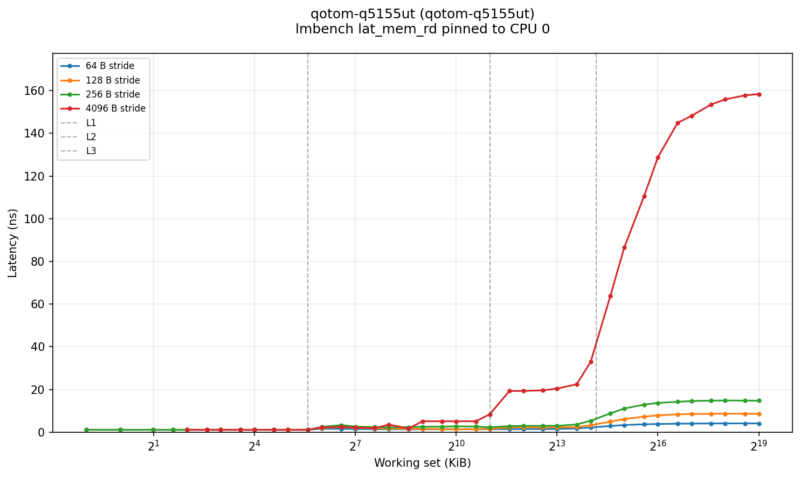
You may notice that in the raw tool output, someone named the system “qotom-q5155ut” rather than q51551ut, and that carried into our screenshots and the raw tool outputs, so it is a fun Easter egg. Here is a quick lmbench sweep of the system.
Here is the core-to-core latency view:
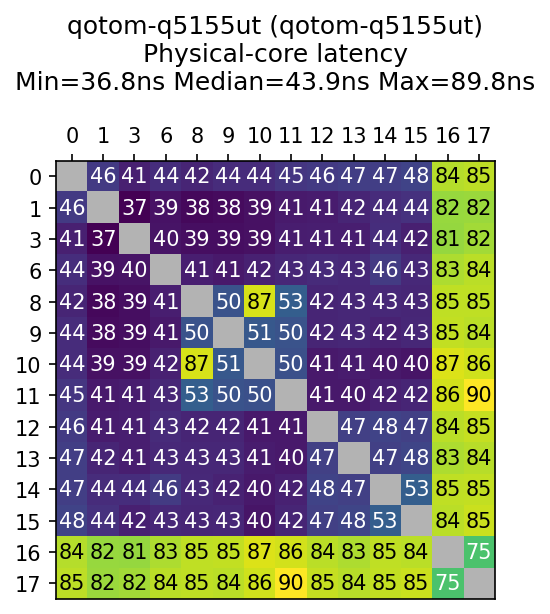
For the video version, we are trying a different visualization than the raw tool output.
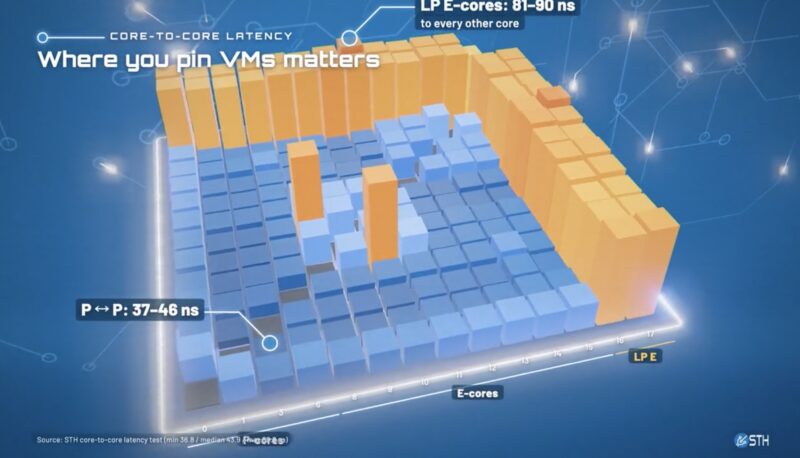
The out-of-the-box visualization has more/better data, but with the P-core, E-core, and LPE cores, the video one looks pretty neat, so we thought we’d show you that.
Geekbench 7 Results
For our look at system performance, we will be comparing the Qutom Q51551UT to a similar industrial PC from the company that we are also looking at: the Q30952UE. The latter is a low-end system based around Intel’s 8th Gen Core i5-8260U (Coffee Lake) platform. Suffice it to say, while the Core Ultra Series 1 chip in the Q51551UT is a bit dated itself, it is far newer than the low-end chip used in the other Qotom mini-PC.
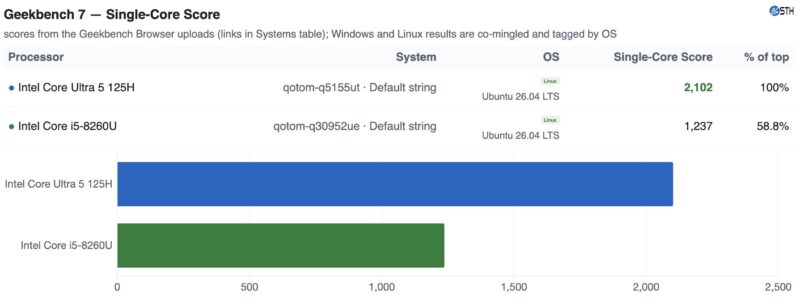
Starting with single-threaded performance under Geekbench 7, the Q51551UT tops out at just over 2100 points. This is some 70% faster than the low-end Qotom system. The newer system benefits from both a moderate increase in clock speeds, as well as a more significant increase in P-core IPC in the intervening years.
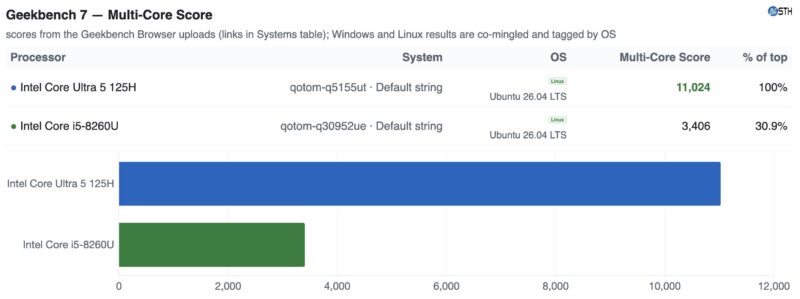
Meanwhile, multi-threaded performance shows the Q51551UT scoring 11,000 points, over 320% faster than the low-end Q30952UE. At a total of 14 CPU cores versus just 4, this scenario is a reminder of just how quickly the CPU core counts have ramped up over the last decade for mobile processors, thanks in big part to Intel’s shift to heterogeneous CPU designs with E cores. The space-efficient cores shine in workloads such as these thanks to their combination of reasonable performance and rather high core counts.
AgentSTH V7 Results
Shifting gears, we are also in the process of rolling out our new agentic AI benchmark suite, AgentSTH V7, across our device benchmarking workflows. This suite of tests reflects the agentic AI workloads we see in many trace runs, performing real-world tasks ranging from coding and infrastructure management to creating financial models and more. We also focus on running different shapes on processors to stress the CPU in ways that traditional benchmarks do not. Since we are not testing the LLM side here, much of this looks very similar to how multi-tenant server CPUs are used outside agentic AI workflows.
As part of that process, we have also been benchmarking a slew of older hardware with the benchmark suite, which gives us a great look at how recent hardware compares to older systems.
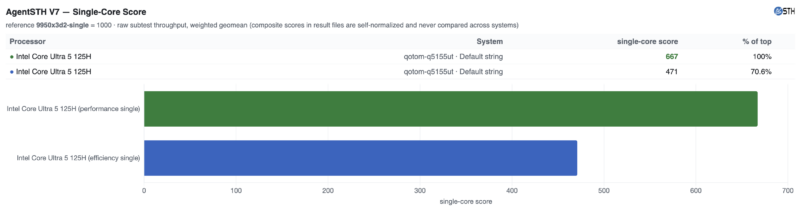
Let us start with single-core results, looking at the P versus E-cores in the system:
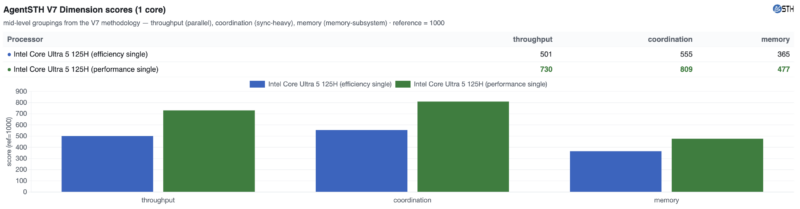
Here, we split it into throughput, task coordination, and memory-focused dimensions. As a quick reminder, memory-focused is not just STREAM. It includes workloads that depend more on memory bandwidth than raw compute performance.
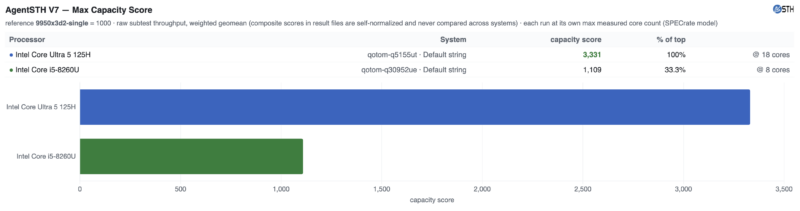
Taking this a step further, we can look at the all-core performance versus the Intel Core i5-8260U that was in our other recent Qotom 10G system review:
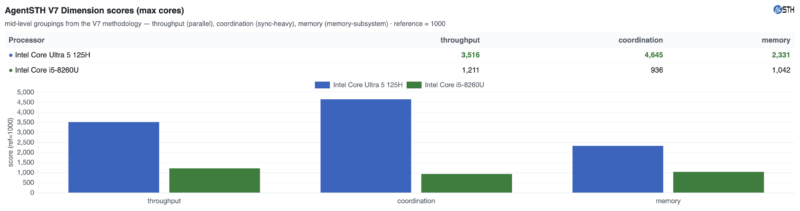
Here you can see a much bigger impact from having more and faster cores, while the memory subsystem did not necessarily keep pace with that scaling:
We are using the Core i5-8260U here because it was the CPU in the Qotom Q30952UE we reviewed alongside this system.
Here is what it looks like when we scale the number of agents across the threads in the systems:
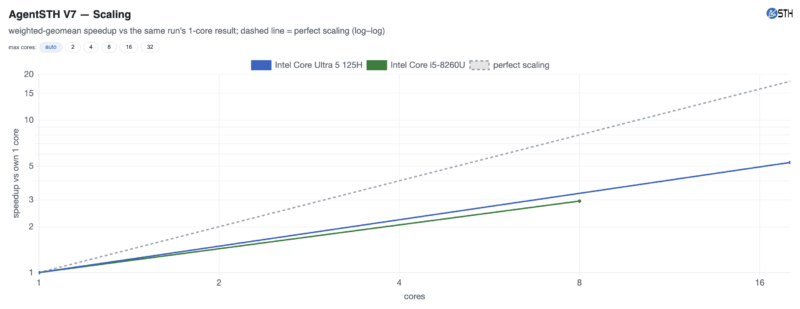
You will notice that, beyond having more and faster cores, the newer CPU scales better across the range, even as the Core Ultra 5 125H transitions from P-cores to E-cores. Next, we ran multiple AgentSTH V7 runs at a time on the CPUs since we expect many will run workloads on portions of processors either using containers or virtualization.
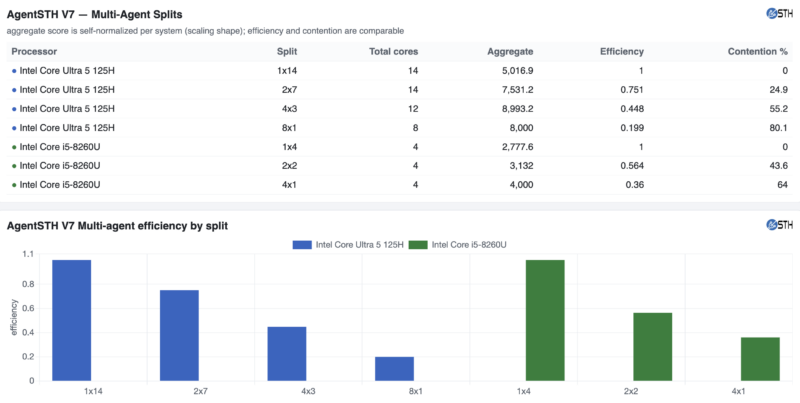
Meanwhile, the Core Ultra 5 125H processor in the Q51551UT sees some so-so performance scaling moving up from a single core. The heterogeneous nature of the chip means that once it moves past 4 threads’ worth of work, threads have to start spilling over to the E cores. These are good for high-throughput workloads, but less useful for agentic workloads. As a result, even going to 14 threads of work, the Q51551UT only achieves a speedup of 4.58x. Keeping in mind as well that just because there are 14 CPU cores does not mean there is enough memory bandwidth to keep all of them fed.
SPEC CPU2026 Estimates
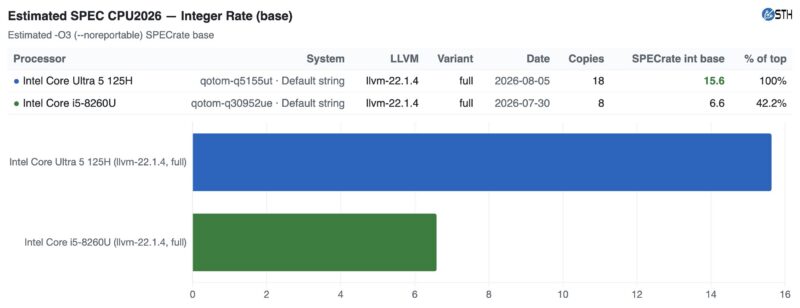
Finally, we are also taking a look at SPEC CPU 2026 performance on both recent and historical systems. As with AgentSTH, this gives us a broad overview of performance in a wide variety of workloads, though with a heavy emphasis on CPU and memory-bound workloads here. Like AgentSTH V7, we have been reviewing some of our older systems to build our results database and better illustrate how newer and older systems compare.
Here is the detail behind that one:
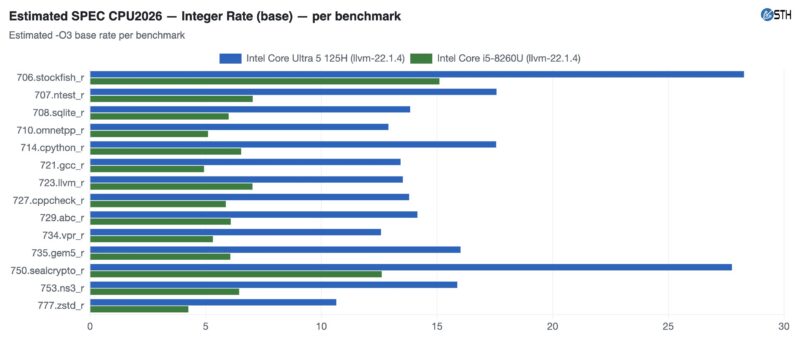
Being that these are multithreaded (rate-N) tests, our SPEC CPU 2026 data is more heavily weighted towards the total throughput of a system than it is the strength of a handful of CPU cores. That means that even with the ability to run 18 threads, the Core Ultra 5 125H in the Qotom system is relatively fast.
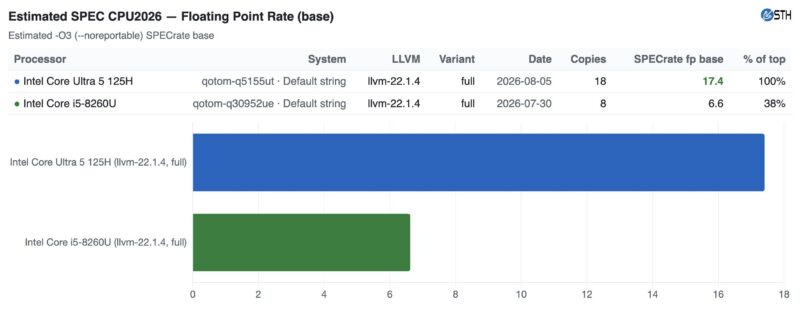
Meanwhile, the relative floating-point performance of the Q51551UT is much the same.
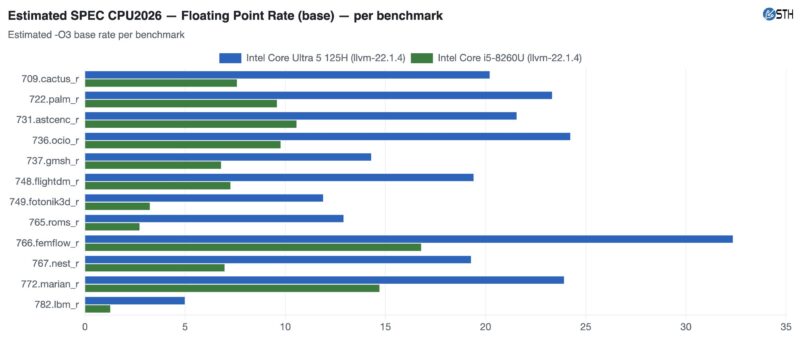
It was a bit strange testing these chips back-to-back since the performance delta was so large. Then again, on a networking-focused system, you often do not need that much CPU performance.
Next, let us check out that network path.