

AMD Ryzen AI Max+ 395 AgentSTH V7 Performance
After months of profiling agentic AI workloads and systems, we developed AgentSTH V7. This is a suite of tests that represents the type of agentic AI workloads we see running on many trace runs, doing real-world tasks ranging from coding to infrastructure management to creating financial models, and more. We also focus on running different shapes on processors to stress the CPU in ways that traditional benchmarks do not. Since we are not testing the LLM side here, it turns out that a lot of this actually looks very similar to how multi-tenant server CPUs are used outside agentic AI workflows.
Let us start with single-core results:
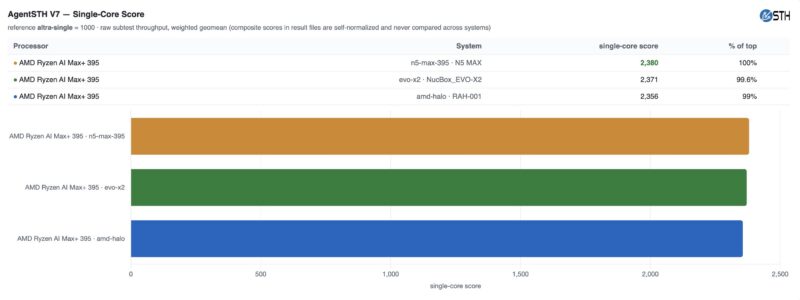
The cores end up relatively close together, which is what we would expect given that these are the same processors, just in different systems. We also broadly categorize these results into three main buckets: throughput, coordination, and memory.
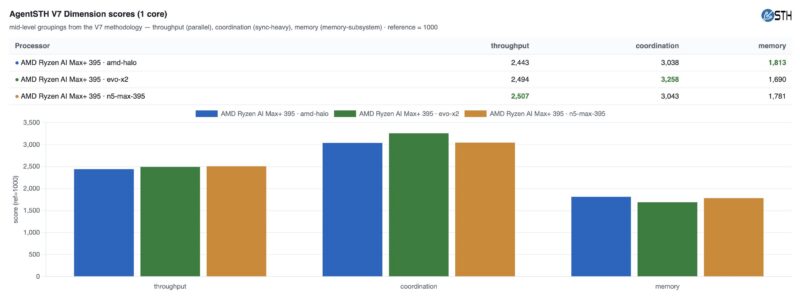
At one core, the cooling and memory allocation benefits show a lot less than they did during the estimated SPEC CPU2026 results. If you want to see something more akin to those, scroll down.
We pulled in the NVIDIA GB10 result, which is labeled as the “Cortex-A725” just because the parser pulls information that way. Here you can see that the core is perhaps a bit slower. As we would expect, however, in workloads that are more memory bandwidth bound, the GB10’s slightly higher memory bandwidth helps it quite a bit. That is where we would expect to see gains in the future with Gorgon Halo moving to faster LPDDR5X.
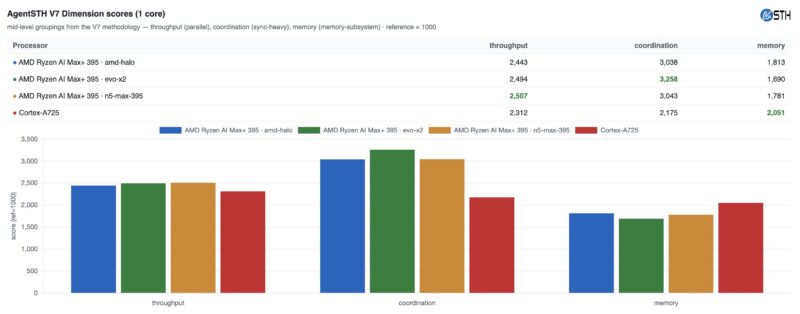
When people say that the AMD Ryzen AI Max+ is a faster CPU core than the GB10’s Cortex cores, this is what they mean. Also, we are not using the lower performance cores on this one.
Scaling the test out to 16 cores, we see that the Minisforum continues to perform well, which is more similar to the shape we saw with the estimated SPEC CPU2026 results:
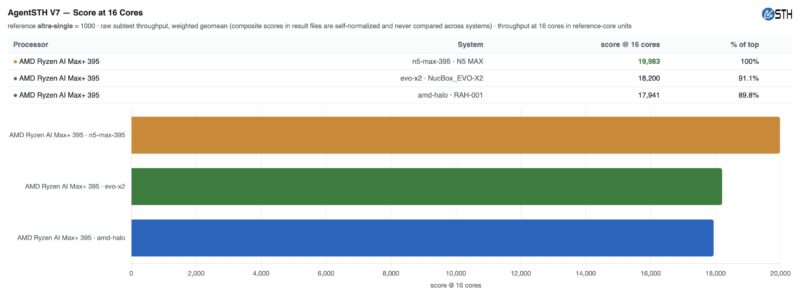
Here again, we see the throughput results do well at 16 cores on the Minisforum.
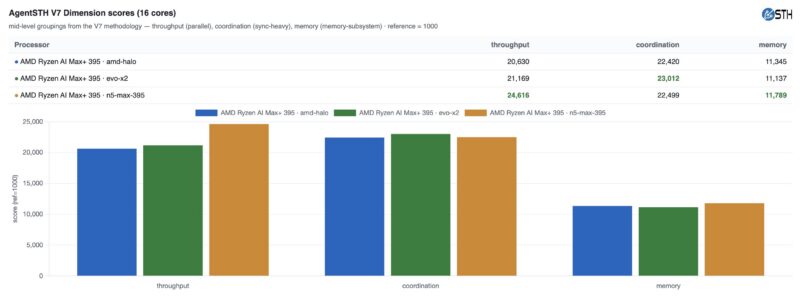
Here you can see what we would expect from having better cooling as well as the shifted memory allocation. The throughput and memory tests are wins for the N5 Max while the coordination tasks are much closer.
Next, we split the CPU into running a single workload across all 32 threads, then test various instance sizes, aiming to fill the CPU with up to sixteen 2-thread workloads. Realistically, if you are running an agentic AI workflow, a system like this has the CPU performance to run multiple agents at a time. When we talk to major inference providers they are often talking about agentic AI VMs and sandboxes in the 1-4 core range, and rarely in the 32 thread range. So we test to see what those splits might look like when the processor is juggling multiple agents running in parallel.
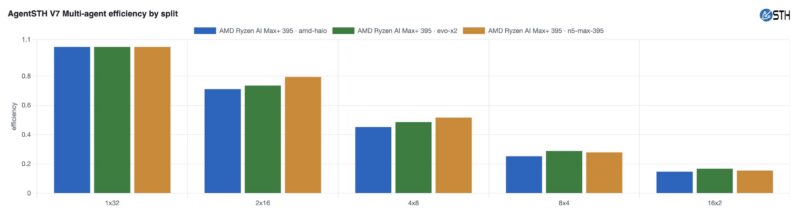
This is a more interesting result since it shows the single result the 2×16 and 4×8 splits offering the biggest gains for the 64GB configuration.
In terms of scaling efficiency, here is a quick look at what it looks like as we add cores/ threads over a single-core result. 1, 2, 4, 8, 16, 32 core splits were defined for server CPUs, where we would expect 32+ cores these days. It just so happened to fit the Strix Halo’s thread count.
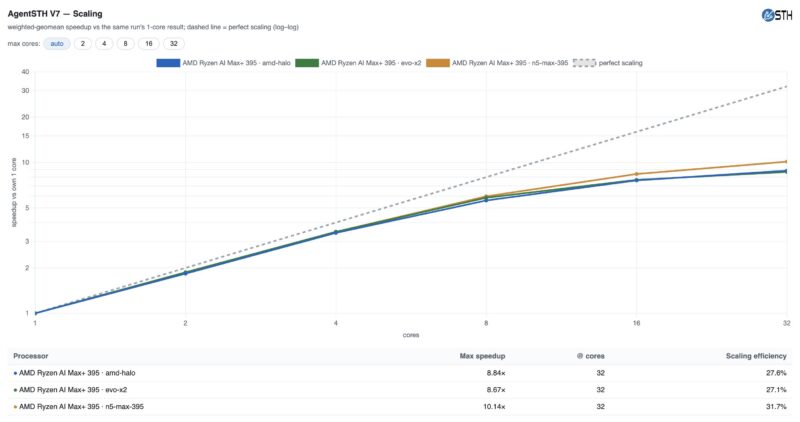
Generally, we see good scaling on the physical cores, and we also get benefit from the 16 SMT threads, but those are more muted because they are SMT threads instead of physical cores.
AMD Ryzen AI Halo GPU AI Performance
At some point, it feels like we have done many AMD Ryzen AI Max+ 395 systems. We have looked at ones from GMKtec, Minisforum, Framework, Beelink, and so forth. One challenge with the 64GB configuration is that you can only allocate a limited amount of GPU memory for the AI model and context. As a result, you end up with maybe 16GB of CPU and 48GB of GPU, perhaps a bit more with Linux driver tuning. Still, 48GB gives you enough to run Qwen3.6 27B or Qwen3.6 35B-A3B locally, which is awesome (until Qwen3.8 comes out, perhaps by the time you read this.)
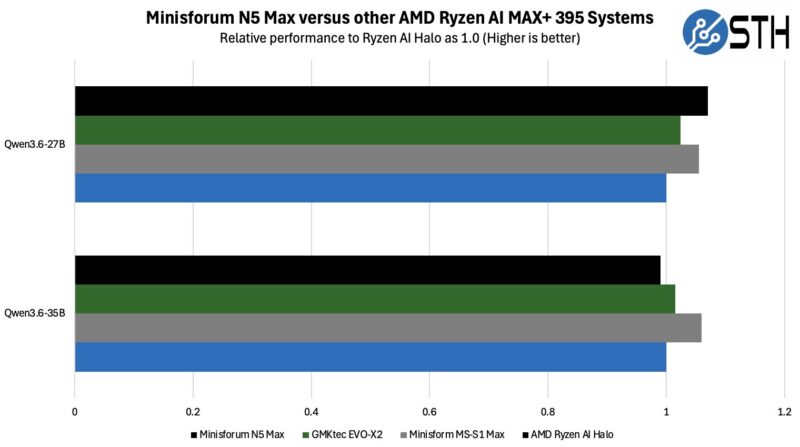
Overall, the performance is very competitive. Being able to run FP8 is a big win for this class of system. A 48GB GPU will, of course, run Qwen3.6 much faster, but this system can use less power than that entire GPU. Turning on MTP and other features can also help a lot with performance, but running Qwen3.6-35B-A3B is usually the sweet spot, as out of the box folks can get 45T/s using FP4 weights and FP8 KV cache. Running the 27B dense model at FP8 weights and FP8 KV cache is usually sub 10T/s just due to being severely memory bandwidth bound. It may look like a win here, but really, we would run the 35B-A3B model on this class of device.
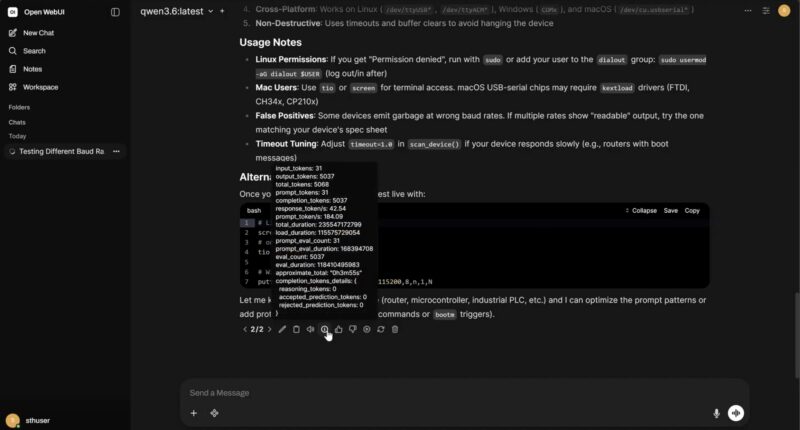
You may note that we do not have normal GPT-OSS-120B results. Our test sweep goes OOM on that one because it is a much larger model.
Next, let us discuss power consumption.


This will still make a killer lab server regardless of the AI shortfalls
A fascinating review of the Minisforum N5 Max. It’s impressive to see how much performance can be packed into a compact system, especially with the Ryzen AI Max 395. The combination of CPU performance, AI capabilities, and small-form-factor design makes this an interesting option for power users and homelab enthusiasts.
Strix Halo is made to run large AI models and if anything these require a large storagepool so having one right out of the box is not a bad idea.
35W idle and with disks spun down? Isn’t that a bit too much?
I take a different view to the previous speakers. I think this device is too specialized and will therefore probably not find many buyers.
There are many reasons for this; let’s just take the noise level, for example. Who would want a device with lots of built-in hard drives sitting on their desk? As far as I’m concerned, a noisy NAS belongs in a separate room.
Furthermore, there are already many companies in the NAS sector that handle this area much better and have more to offer in terms of both hardware and software. This includes, among other things, more RAID levels, iSCSI, and a wide range of services.