

Minisforum N5 Max Performance
This Performance section follows the same AgentSTH V7 layout used in the AMD Ryzen AI Halo developer system review, with the Minisforum N5 Max as the focus of each chart. A 128GB AMD Ryzen AI Halo reference system and the GMKtec EVO-X2 stay on the charts as comparison points, which puts the 64GB N5 Max directly beside two other AMD Ryzen AI Max+ 395 Strix Halo machines.
Minisforum N5 Max LM Bench
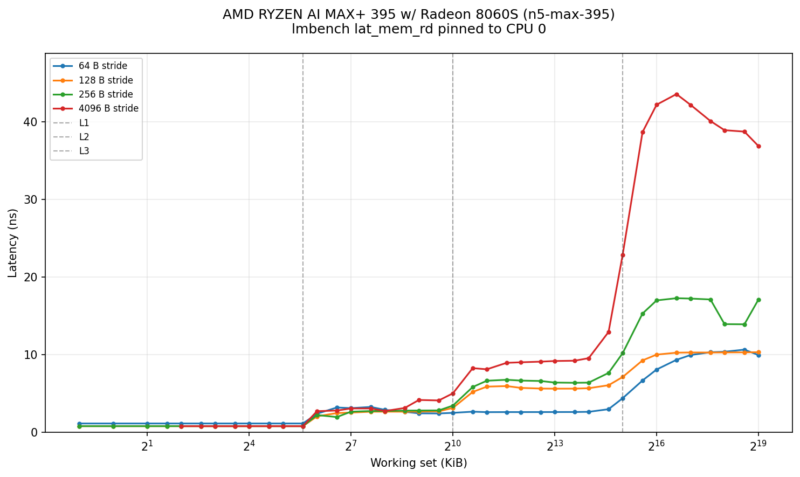
LMbench has been around forever, so here is what that looks like on the N5 Max’s implementation of the AMD Ryzen AI Max+ 395 with 64GB of LPDDR5X:
Just to give you some perspective, here is a comparison to both the AMD Ryzen AI Halo (AMD’s own system) and the GMKtec Evo-X2, the first one we reviewed.
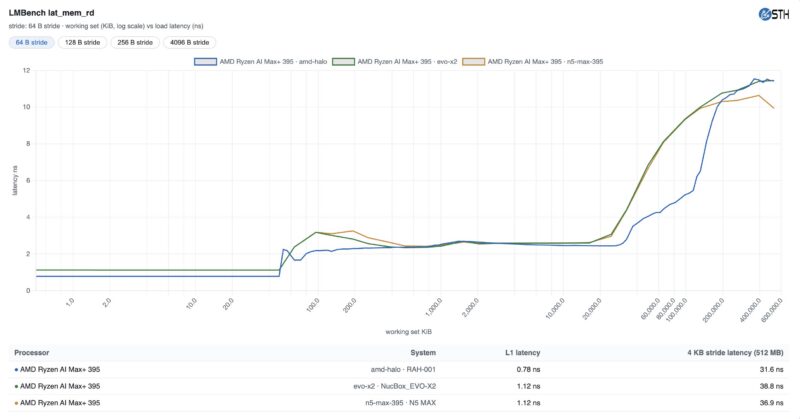
Across the sweep, all three platforms track closely through the cache and main-memory regions. None of the machines produces a meaningful outlier at this stride. Maybe the most interesting, however, is just how close the N5 Max and EVO-X2 are.
This chart plots LMBench memory latency with 128 B stride.
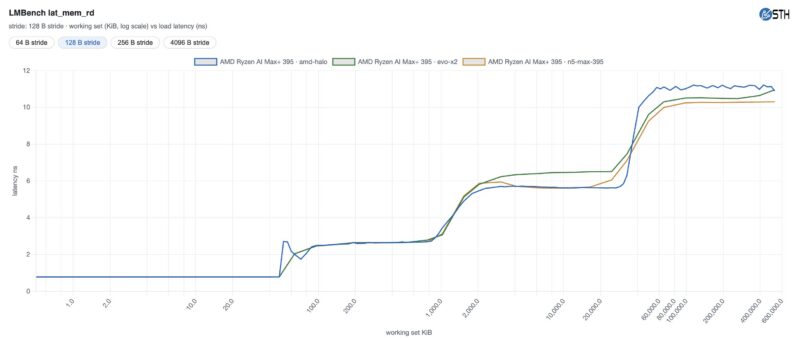
Even at the deepest part of the sweep, the three Ryzen AI Max+ 395 systems stay within a few nanoseconds of one another. That close grouping matches the pattern seen across the same stride settings in the reference walkthrough, and it keeps the N5 Max squarely inside Strix Halo expectations on the memory side.
Minisforum N5 Max Core-to-Core Latency
Thread-to-thread communication latency matters for scheduler behavior and tightly coupled workloads, so a quick core-to-core latency test covers all three systems. Here the N5 Max posts a mean core-to-core latency of 68.573 ns, essentially level with the GMKtec EVO-X2 at 68.602 ns and the AMD developer system at 69.147 ns.
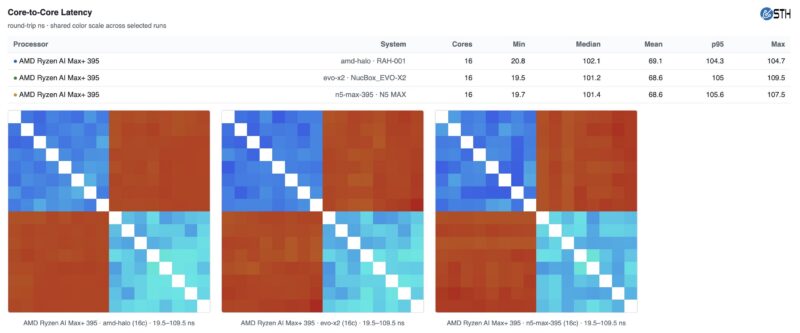
A core-to-core mean of 68.573 ns for the N5 Max sits within a fraction of both comparisons. With mean figures clustered near 68.6 ns across the board, nothing points to an unusual interconnect penalty on the N5 Max. This machine shares the same die and fabric as its Strix Halo peers, so a close result here is expected before moving on to the larger SPEC CPU2026 runs.
Estimated STH SPEC CPU2026 Performance
SPEC CPU2026 is the suite that succeeds SPEC CPU2017, and STH runs it with open-source compilers at -O3 optimization to produce estimated results. Those figures are only comparable to other STH runs, not to official SPEC submissions.
This estimated STH SPEC CPU2026 integer rate summary puts the N5 Max at 66.473, with the AMD developer system at 49.595 and the GMKtec EVO-X2 at 54.004.
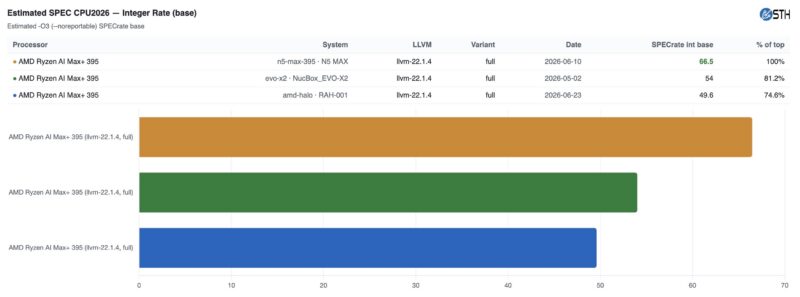
That is a wide lead from a NAS-style chassis rather than a bare developer reference board. It echoes the single-core advantage Minisforum showed in the same suite during the reference coverage.
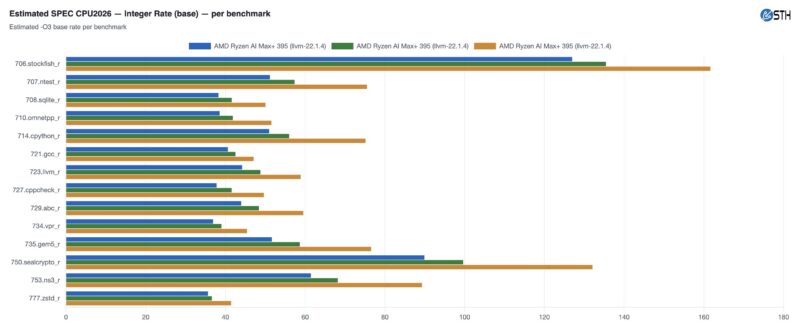
Only a few integer workloads keep the N5 Max from running clean across the whole set, with 777.zstd at 41.427 and 734.vpr at 45.403 among the lower end.
This estimated STH SPEC CPU2026 floating-point rate summary shows a similar picture:
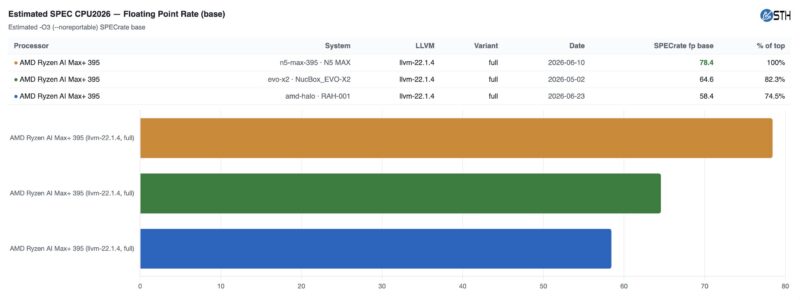
In absolute terms the floating-point margin is wider than the integer lead, and the N5 Max again finishes ahead of both reference platforms. We are going to get into what the magic is here after we show you the numbers.
This estimated STH SPEC CPU2026 floating-point rate detail shows the per benchmark rates for the N5 Max.
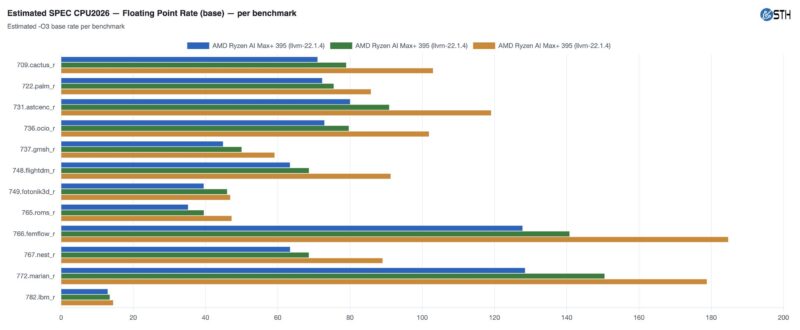
We see a similar pattern here to what we do on the integer side.
Let us get into what is actually going on here because it is twofold. First, the N5 Max’s new cooling in a redesigned chassis allows it to run at higher boost levels longer. Second, and something that gets little coverage, is the memory configuration. SPEC CPU2026 uses about 1.8GB/ thread, so in a 16-core system, you have 32 threads and thus need roughly 57.6GB of memory. On the 128GB systems, that leaves 64GB for the GPU and AI workloads. On 64GB systems, that leaves very little for the GPU. We have shown this a few times in previous reviews, but allocating more memory to the CPU side tends to give us better CPU performance. For example, on the 128GB Strix Halo system, doing a 32GB CPU/ 96GB GPU split is common and actually hurts CPU performance a bit.


This will still make a killer lab server regardless of the AI shortfalls
A fascinating review of the Minisforum N5 Max. It’s impressive to see how much performance can be packed into a compact system, especially with the Ryzen AI Max 395. The combination of CPU performance, AI capabilities, and small-form-factor design makes this an interesting option for power users and homelab enthusiasts.
Strix Halo is made to run large AI models and if anything these require a large storagepool so having one right out of the box is not a bad idea.
35W idle and with disks spun down? Isn’t that a bit too much?
I take a different view to the previous speakers. I think this device is too specialized and will therefore probably not find many buyers.
There are many reasons for this; let’s just take the noise level, for example. Who would want a device with lots of built-in hard drives sitting on their desk? As far as I’m concerned, a noisy NAS belongs in a separate room.
Furthermore, there are already many companies in the NAS sector that handle this area much better and have more to offer in terms of both hardware and software. This includes, among other things, more RAID levels, iSCSI, and a wide range of services.