

Minisforum MS-02 Ultra Performance
Before we get too far into performance, let us quickly touch upon TDPs. While Minisforum runs the Core Ultra 9 285HX chip with a TDP (PL1) of 100 Watts (and 140W for PL2), this is only valid for systems without a discrete video card installed. If a video card is installed, then the BIOS will automatically dial down those limits to 90W for PL1 and 110W for PL2, respectively. Which is to say that CPU performance in both bursty and sustained multi-threaded workloads will take a hit if a video card is installed.
It is an important distinction since, although the MS-02 Ultra does not come with a video card, the system is specifically designed to accommodate one (and indeed, it is one of the system’s distinctive design features). So many (if not most) users in Minisforum’s target market will be impacted by these TDP limits. It is an AI system, after all, and it needs a good discrete GPU in order to be one.
Geekbench 6 CPU
Since we are looking at a system that is primarily being marketed as an AI system, we will go ahead and compare it to a similar AI system: Minisforum’s own MS-S1 Max, their Ryzen AI Max+ 395-based system. This offers us an apples-to-apples comparison between the highly integrated AMD platform and the more discrete Intel platform that Minisforum is using here.
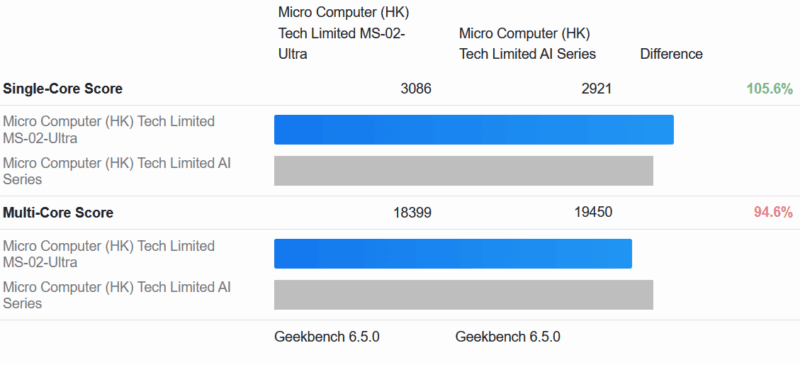
Starting things off with a look at the high-level Geekbench 6 cores, the two systems trade blows depending on whether it is a single-threaded or multi-threaded workloads. The 285HX-powered MS-02 Ultra holds a ST lead by about 5%, but then it trails the AMD-based MS-S1 Max by around 5% as well.
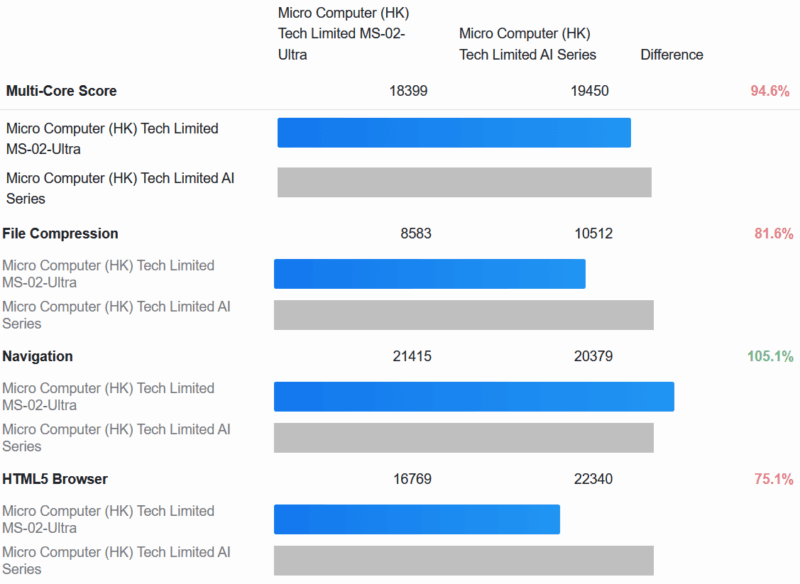
A look at the sub-scores shows that these results are pretty consistent across the individual benchmarks as well.
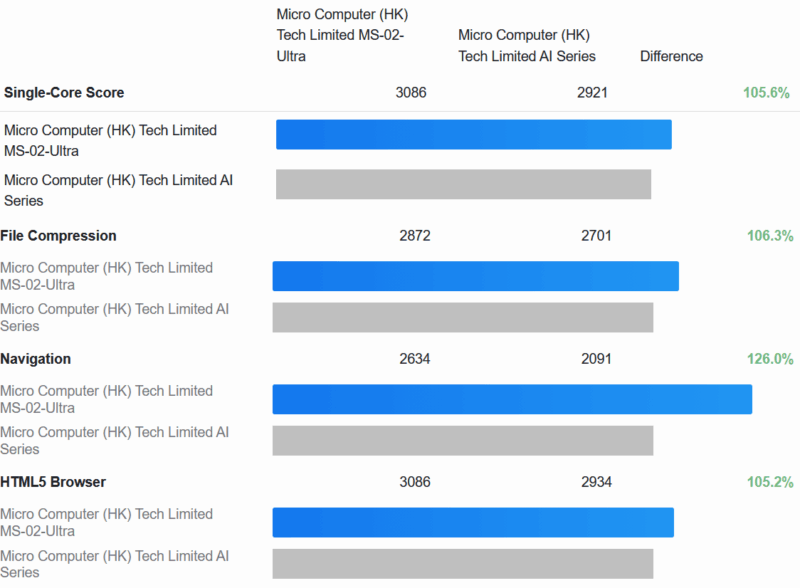
The MS-02 Ultra is pretty consistently ahead in ST workloads. But more often than not is behind in MT workloads.
Geekbench 6 Compute
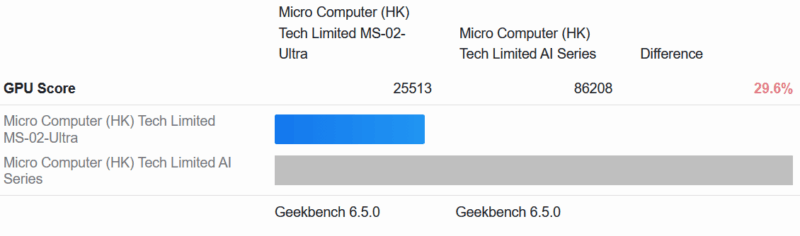
The Geekbench 6 Compute scores are nowhere close, however. The integrated GPU on Intel’s 285HX is not meant to stand up to the Ryzen AI Max+ in either memory bandwidth or compute throughput, and sure enough, it does not.
MLPerf 1.5
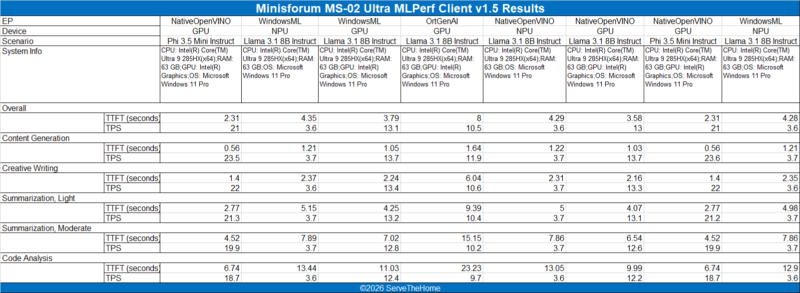
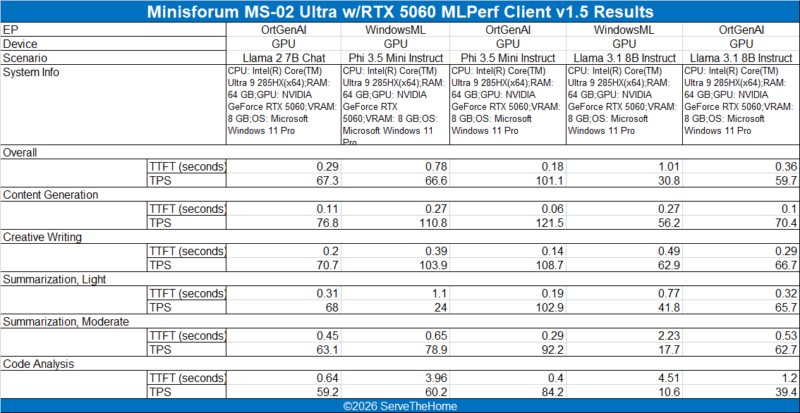
We have also run MLPerf to get a better look at machine learning/AI performance. For these tests, we have run it once with just the integrated Intel GPU available, and a second time with a low-profile GeForce RTX 5060 card installed. This is a prime example of the type of card that can fit in the system’s double-wide HHHL PCIe bay.
Here are the results with the Gigabyte NVIDIA GeForce RTX 5060 OC LP card. (Amazon Affiliate)
The integrated GPU doesn’t fare all that poorly here. Still, it is a step below even a discrete RTX 5060-class card. Which is a big part of this system’s reason to be: to have the space to install such a card.

I wish they’d have managed to make this fit into 2U so you could fit 2 of them side-by-side in a rack (via a presumably-optional bracket). As it is, it’s about 8mm too tall.
The MS-01 has a similar problem, where it’s ~3.5mm too tall for 1U.
These are slick. Wish I had a use case for one.
I would love to see a comparison between native Intel ECC memory support and the software based ECC capabilities offered on some of the mini platforms. I have soft ecc enabled via bios on 4x alderlake mini boxes and they have been stable for 1 yr+.
I wonder when MCIO pinout and cable finally landed in SFF or normal desktop mainboard? So many benefits come from it.