

Lenovo ThinkStation P3 Ultra SFF Gen 2 Performance
As noted earlier, the P3 Ultra SFF Gen 2 can come with one of several Intel Core Ultra 2 Series CPUs. Our specific model uses the top-end Core Ultra 9 285, an 8 P core and 16 E core chip that is the pinnacle of the Arrow Lake platform, and allows the P3 Ultra SFF to put up some very competitive numbers.
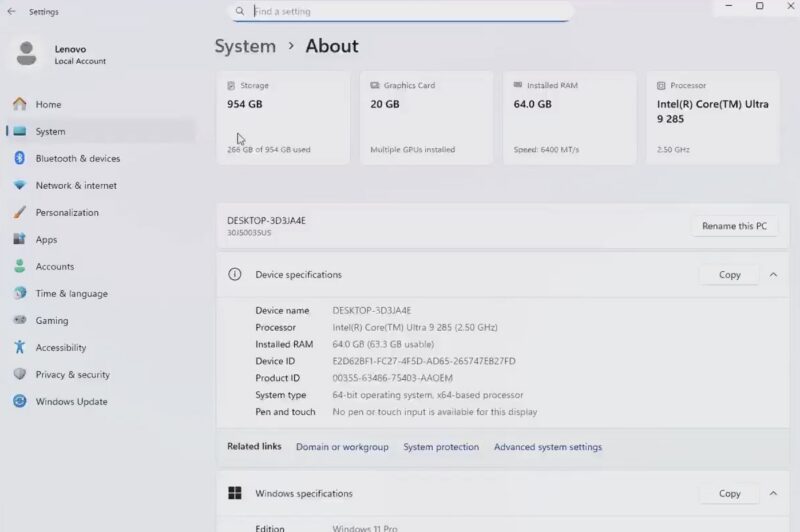
One of the perks of using desktop hardware here is that the Lenovo system gets access to more hardware resources overall. Whereas a mini-PC based on mobile hardware would top out at 6 P cores and 8 E cores (and 2 LPE cores), the desktop chips get access to another 8 CPU cores altogether. As a result, so long as the system can keep the more powerful and power-hungry desktop chip cool, it can easily outrun the more power-efficient mobile chips.
Meanwhile, to give Lenovo credit where credit is due, this marks one of the handful of times in recent years that we have had one of their mini-PCs come into our labs with a fully populated memory configuration. Unlike the P3 Tiny, this system gets access to its full 128-bit DDR5 memory bus, which means there are no configuration quirks here that will hobble the P3 Ultra SFF’s performance.
Geekbench 6 Results
For our look at system performance, we will be comparing the ThinkStation P3 Ultra SFF Gen 2 to its tiny counterpart: the ThinkStation P3 Tiny Gen 2. Both systems are based around an Intel Core Ultra 285 processor, giving us a fairly even playing field in terms of the SoC, while giving the P3 Ultra SFF a chance to show off what the larger system brings to the table in terms of performance.
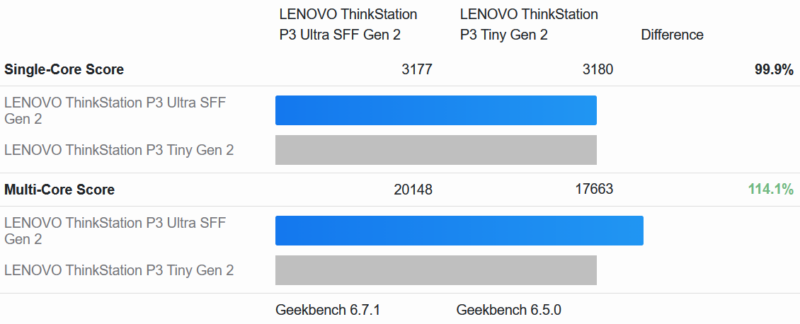
Under Geekbench 6, the two Lenovo P3 mini-PCs are effectively in a dead heat for single-core performance. It is only with multi-core performance that the larger P3 Ultra SFF pulls ahead, thanks to a combination of its greater cooling capacity and its greater memory bandwidth. The net impact of those changes is 14% more multi-core performance.
Diving into the multi-core scores a bit more, here is how things pan out.
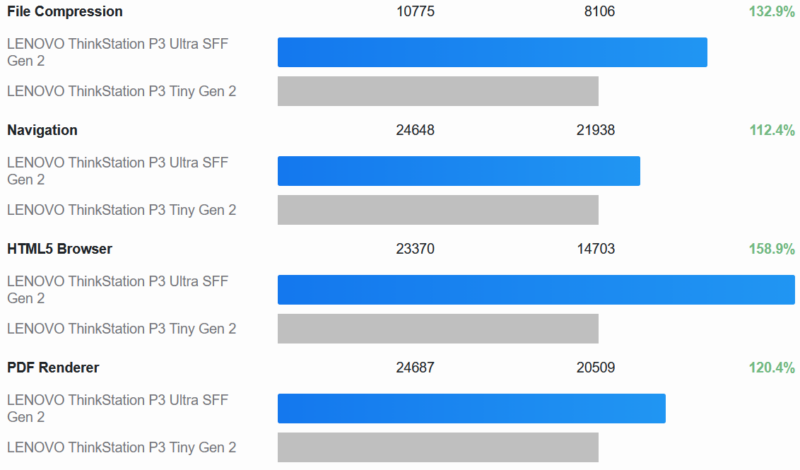
All four of the top multi-core tests put the larger system meaningfully ahead. Navigation shows the smallest uplift at 12%, meanwhile, the HTML Browser sub-test picks up a hefty 59%.
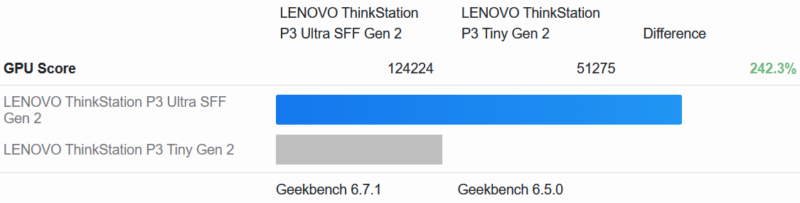
Meanwhile, Geekbench’s compute benchmark gives us a quick look at how the respective systems’ NVIDIA RTX video cards compare. The RTX 4000 Ada in the P3 Ultra SFF is twice as thick as the RTX A1000 in the P3 Tiny; it is also over twice as fast. 142% faster, to be precise. Lenovo pitches the P3 Ultra SFF Gen 2 in part as an AI system, and having a decent video card is a necessary part of that. Though everything here is relative, and there is no escaping how much faster a high-powered desktop RTX Blackwell video card would be in a full-size tower. So there is still a GPU performance trade-off here to bring this mini-PC to life.
MLPerf 1.6.1
We ran MLPerf Client v1.6.1 on the system as well.
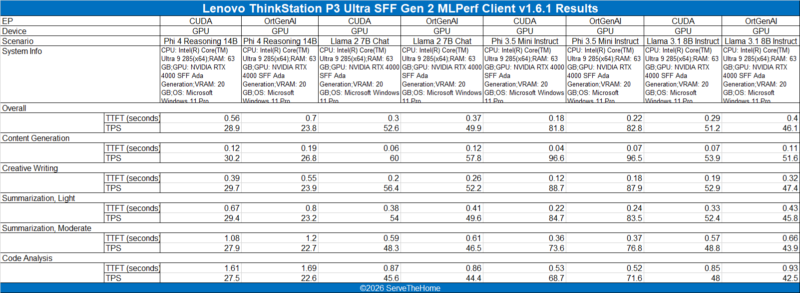
The RTX 4000 Ada Generation SFF fares well here, given the circumstances. In all but two tests, it is able to deliver the first token in under a second, while all of the CUDA-based tests see token rates of 27 TPS – and often far better. The Arrow Lake CPU possesses an NPU that can be used here as well, but the discrete video card is at least several times more powerful, and since this is a desktop system, the energy efficiency advantage of an NPU has little practical benefit.

It is a bit disappointing to see no Thunderbolt/USB 4/5 ports by default, as they seem to be rather standard on most chinese vendors’ mini PCs in this price range, and Lenovo is still trying to charge extra for a single port at the back.
This whole Lenovo ThinkStation P3 Ultra SFF G2 (not so great name!) looking like a cheap clone of Minisforum.
What are the benefits of having socketed CPU in such a tiny package?
Front panel having “P3 Ultra” text rotated 90 degrees while all other text is normal. Look like an afterthought.
Did Lenovo pay you not to compare performance with the GB10?
Shipped mine back .. loved size n got it when mem was cheap end of 2025. 4-5 tech visits for event log issues lots of guessing with three mb changes the last allowed all memory to be seen but couldnt stop pcie errors thousands in system event logs then they couldnt get a replacement nic for months and no refund on the optional nic the provided at $400 so shipped back only option for full refund 😭 Built my own .. might have kept it if i was smarter and had spent extra 400 for the two 64gb modules instead of 10gb nic. 128gb for 2800 looks like such a deal now
Dan – I am not sure I follow? Very different segments, no? What is the Windows performance of the GB10?
Worth noting that due to the chipset, this supports ECC sodimms. It is a slight differentiator from some other systems of a similar size.