

GL.iNet GL-BE3600 Slate 7 Software and Setup
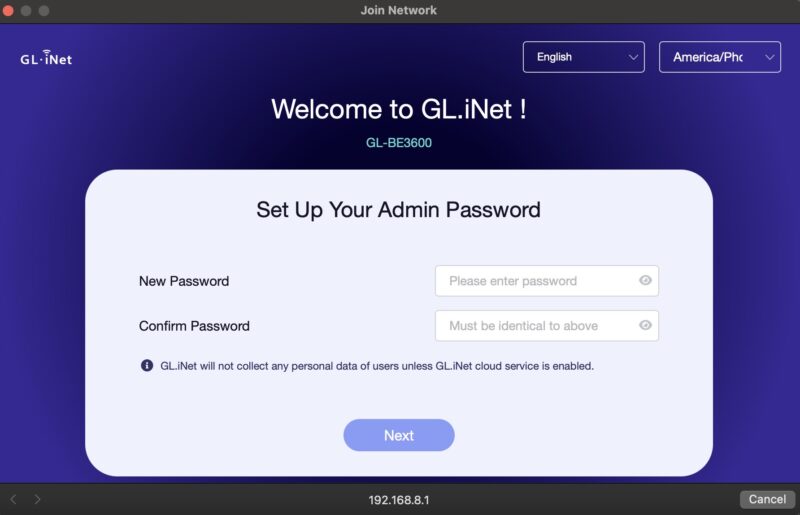
On the software side, we get a reasonably easy user interface on this OpenWRT router. I actually did this remotely logging into the WiFi 7 hotspot that the unit creates from a Mac we have in the lab and then going through the steps. The first step was to create a password.
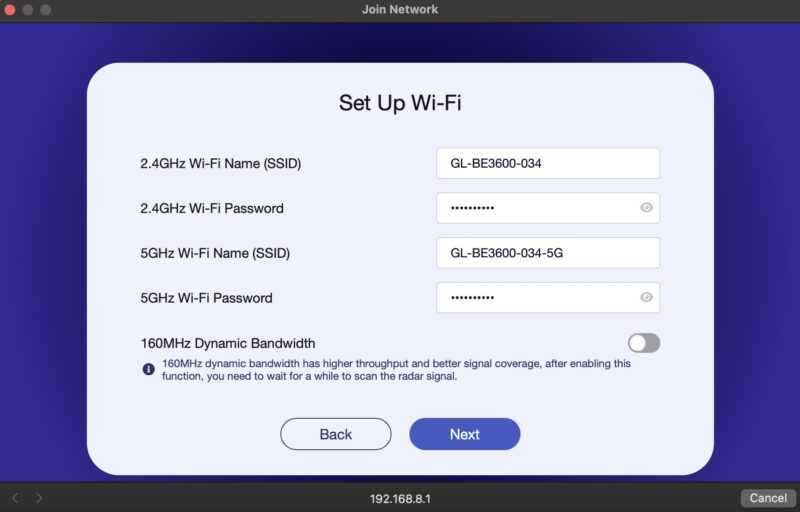
Next, the WiFi setup had options to pick 2.4GHz and 5GHz SSIDs and passwords.
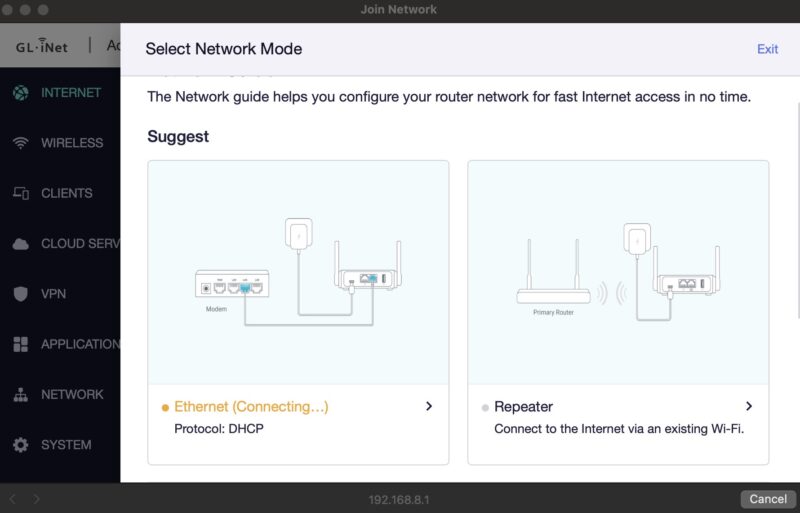
After that, the setup asked for what type of topology you want. The choices here were Ethernet where you would connect the WAN port to a wired port. Then there was a Repeater mode for a WiFi repeater.
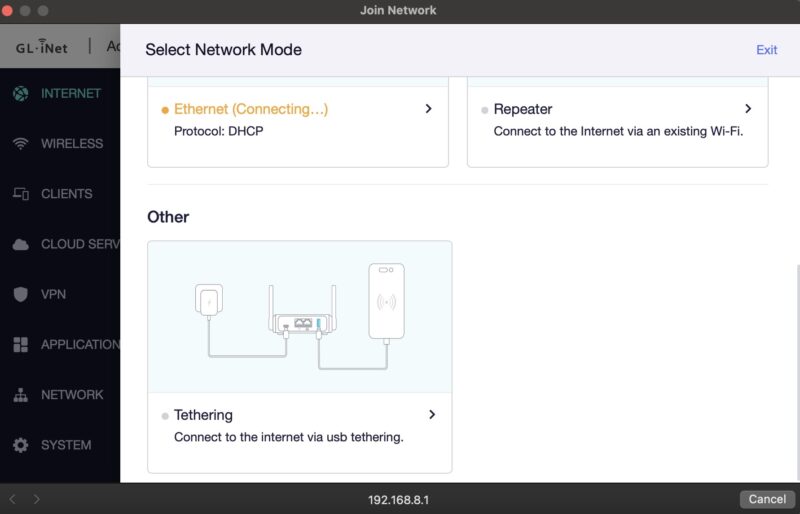
There was also a Tethering mode where you can USB tether and use that as the WAN connection.
We set this up in Ethernet mode, and it tried to auto-configure itself using DHCP.
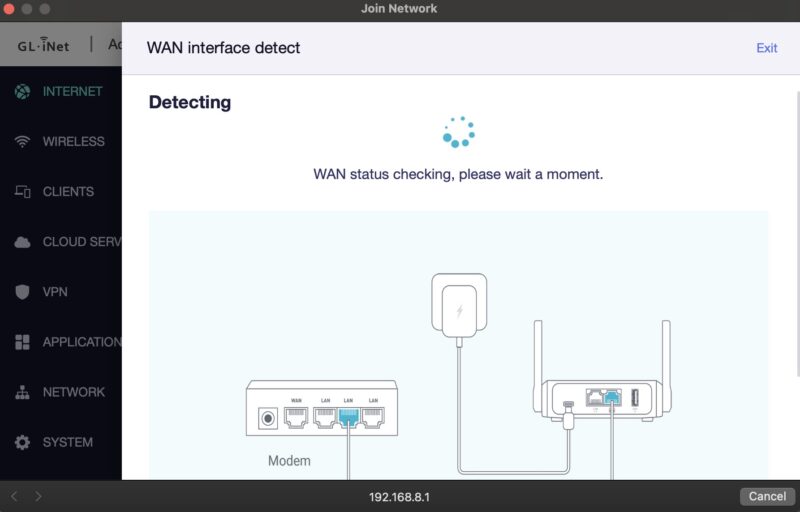
You can also set this up manually if, for example, you wanted to hook this up to a traffic generator via a static IP setup.
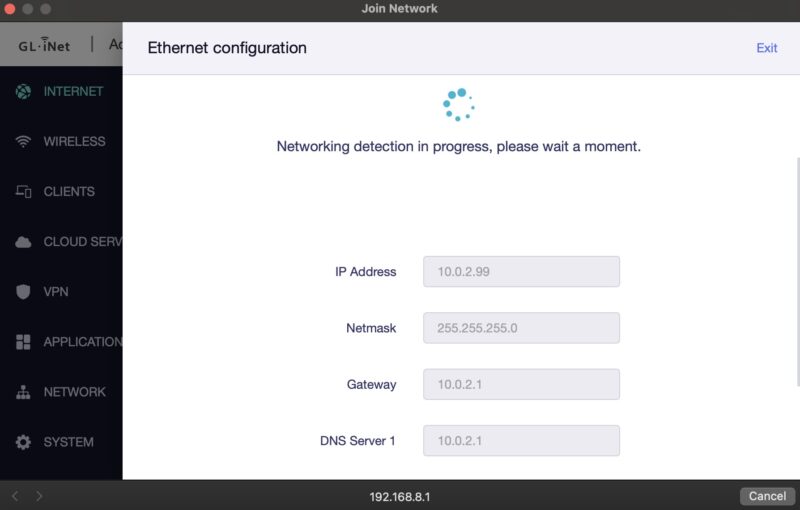
On the LAN side, there were fairly simple options like picking the address, AP isolation, and the DHCP server, but it you want to do PXE boot with lots of options, you are going to be better off with another solution. Again, this seems to be optimized more for simplicity rather than for maximum configurability.
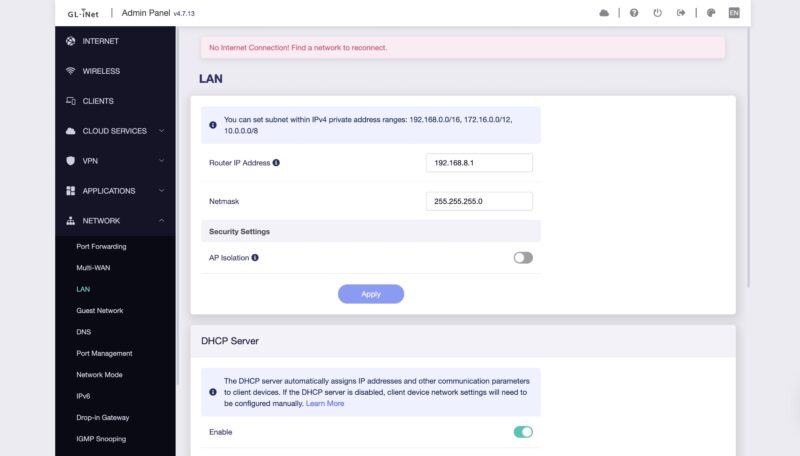
With all of that, there were features like Tailscale, ZeroTier, a host of VPN providers, AdGuard, and more built-into the device. For a lot of folks, having these built-in with easy wizards to guide through the setup is going to be a nice feature.
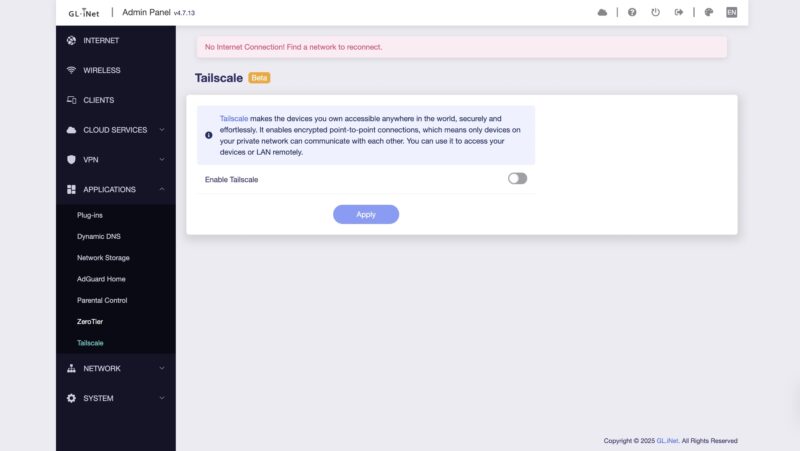
On the WiFi side, you can setup your WiFi networks including guest networks.
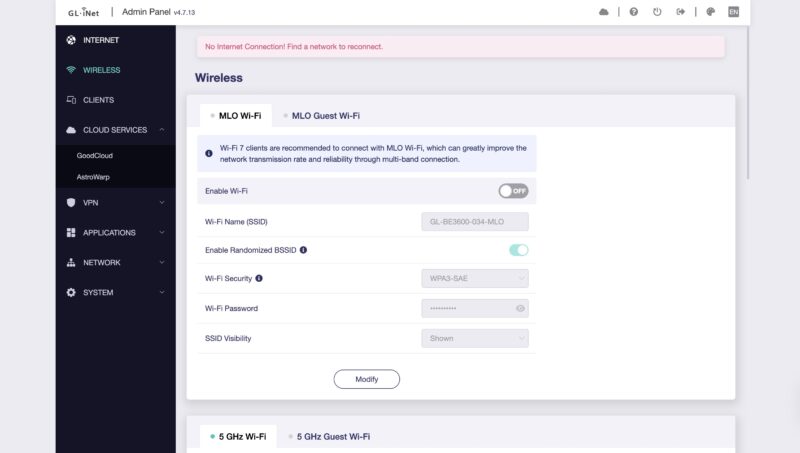
This felt quite simple if you have been accustomed to OPNsense or pfSense for years, or even MikroTik RouterOS. At the same time, it worked well and if I was putting on a hat of someone who just wanted an easy setup to use a portable router, this is probably all that you would need. Our more advanced readers are going to take issue with that, but it is also worth remembering that even what is presented here is more advanced than 99% of users will need.
Next, let us get to the performance, and that is going to be exciting.


I had the GL-MT3000. The user interface is really nice for it’s use case and the software was regularly getting updates which is a plus. Especially with Wireguard running a Cloudflare Warp config it really helped me out.
Can this model tether wifi on the same band it connects to an AP? That was the one missing feature I had experienced before
Your new testing is sick. I’d still like to see the flat line charts tho
How might one connect this to cellular?
If it isn’t too difficult to plug in a 4G/5G/LTE modem in, or connect it to a spare phone somehow, that could be very cool.
What I would like to point out is that this router has a fan and that fan is constantly running, even when there is minimal traffic being routed (sub-100Mbps). It is also compeletely inaudible, but it does mean that I wouldn’t personally recommend using it in dusty environments or where a potential outage due to a fan failure would cause serious problems.
Also, there is a very nice traffic graph feature on the front screen, but that only works if you disable hardware acceleration.
I’ve also had some weird issues when I used mine with a Nintendo Switch PSU (I know, that’s not entirely standard USB-PD) where it would sometimes just freeze and I would need to physically unplug and replug the power to make it work again. Needless to say, it took me a while until I figured out what was causing the issue.
All in all, would buy again, but if you don’t have any space constraints or you don’t need the portability of the device, just go with their full sized routers.
Also, while the Beryl AX does have a fan too, it doesn’t seem to run it all the time, which might be a plus in some scenarios.
> Danny:
You can either use an android phone (an iphone would likely work too) and connect it via USB or use a 4G/5G modem via USB. Or just create a wifi hotspot with your phone and allow this to connect and essentially rebroadcast that network.
The other thing that the review forgot to mention is that alongside of the basic interface, you also have full access to LuCI, so this is essentially a full-fledged OpenWRT router, which is really cool in such a tiny package.
I’m curious if there’s an option to combine the 2.4ghz and 5ghz radios into a single SSID. This is one of the features that seems to actually work on recent Asus routers.
I use some lighter glinet travel routers to connect other family member’s TV to my home network so they can stream plex media and use paid streaming services from a common IP. Luckily, I have bandwidth for days and rarely lose connectivity.
Glinet stuff is simple to setup and build wireguard VPNs to my UDM Pro. I’ve setup 4 of these and none has required tinkering since deploying.
I have one of their older models. It’s great for a VPN appliance. The review is great and that testing is another level. I’ve always been upset at your iperf3. I don’t care if others use it but this is STH
“We were able to get into the 2-2.5Gbps range, largely due to the Netflix and YouTube streams pushing a lot of data. Still, even with 16 users, we were getting connection issues.”
So all those folks who run beefy, full-fledged Xeons/EPYCs as home routers were after all making the right choice? Or is it just SQM-related and there was none in use?
I have the 1st Slate. Is it just me or are they getting away from their actual purpose?
The new thing seems huge. I love to have them as a travel router when I am on events or Hotels. But with the new sizes of those things and all cables and stuff I would get to lazy to actually take them. Smaller == better.
I feel like without a sim slot, it really limits the usefulness of a device like this to me – if I’ve already got to whip out my phone and hotspot it in order to have a source wifi connection, I may as well just use the phone to route the traffic too.
Lack of sim is a missed opportunity IMO.