
ASUS Turbo Radeon AI Pro R9700 Graphics Performance
Shifting gears, because the R9700 is not just an inference accelerator, but a graphics card as well, here is a quick look at the card under some workstation graphics workloads.
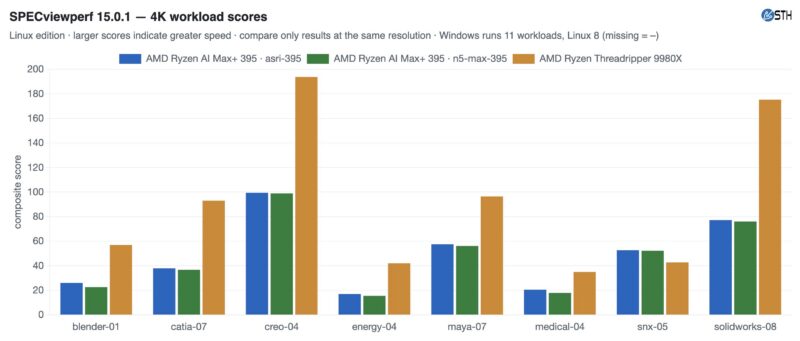
As AMD’s most powerful RDNA 4 architecture workstation card, the R9700 has little trouble tearing through the SPECviewperf 15.0.1 suite under Linux. The composite scores vary heavily from workload to workload, but even the Tuvok (medical) workload scores at least 37 points – all the while the PTC Creo is just shy of 200 points.
More importantly, it is a massive improvement over the integrated GPU of the Ryzen AI Max 395+ SoC – a chip with one of the fastest integrated GPUs on the market – with the R9700 typically doubling the SoC’s performance. The one exception being the Siemens NX 2406 workload, which shows an unusual affinity for the integrated GPU.
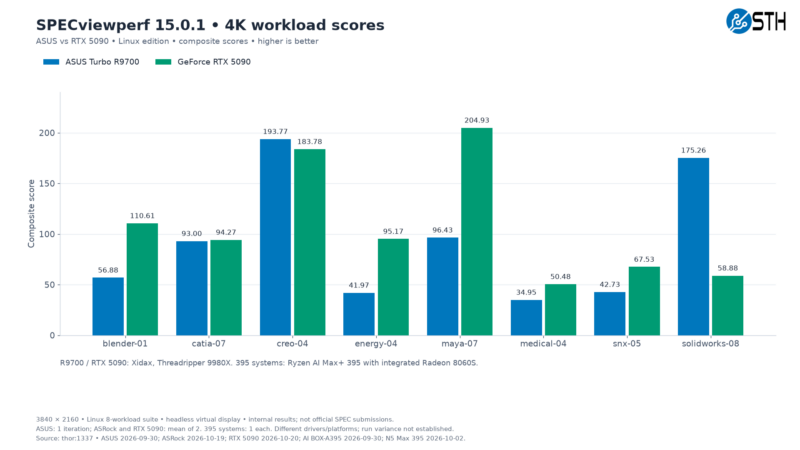
As for how things look versus the GeForce RTX 5090, it is actually closer than you may have expected. The R9700 holds its own in Catia and Creo, and even takes a major win in SolidWorks. However, this leaves the RTX 5090 to handily sweep the other five workloads, leaving the R9700 at around half the NVIDIA card’s performance in Maya and OpenText’s “energy” seismic visualization.
Final Words
Wrapping things up, the Radeon AI Pro R9700 finds itself filling an important role in AMD and ODM partner ASUS’s product lineups. In the last few years AMD has developed a full stack of AI hardware from mini-PCs to servers, looking to serve as many markets as is reasonably possible. For workstations and other desktop environments there is the R9700, a role that the card nicely slots in to.
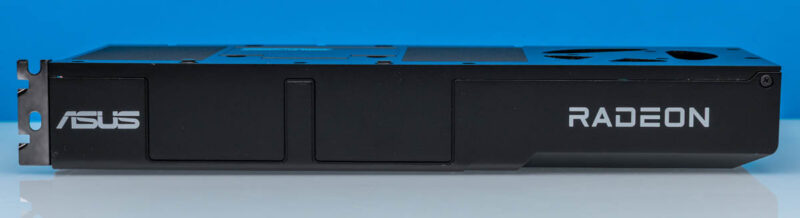
As the second Radeon AI Pro R9700 card we have reviewed in the past few weeks, ASUS’s card has helped to paint a better picture of the larger R9700 ecosystem. And that picture is one of consistency. With AMD keeping close control over card designs, the reality is that the ASUS R9700 is minimally different from the ASRock R9700 we previously looked at. Which is not a slight against either firm, as both are high-quality cards, and the kind of cards that AMD’s user base has come to expect from the Radeon Pro brand. Though it means there is little to differentiate one R9700 partner card from another; in ASUS’s case, the biggest factors are a slightly shorter size, and the inclusion of an HDMI port for some more display output flexibility.
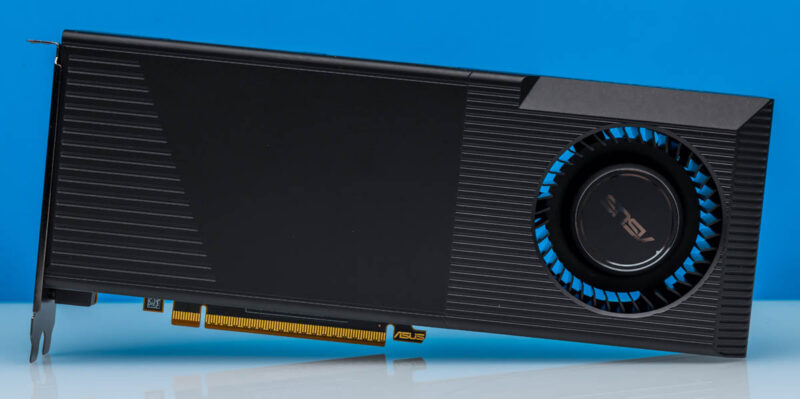
Looking at the R9700 market overall, AMD and ASUS have largely positioned the R9700 as a budget play, at least, by AI standards. The card launched at $1300, and even with price hikes due to upstream component and memory price increases, the going price today for R9700 cards is still under $2000. Which for a 32GB AI inference card is a relative steal, especially when NVIDIA’s comparable 32GB cards are more than twice that price. It is something of a classic move from AMD’s playbook, but it has one that has served them well over the years and serves them well on the R9700 as well.