
ASUS Turbo Radeon AI Pro R9700 AI Performance
Being that the ASUS Turbo Radeon AI Pro R9700 is promoted first and foremost as a card for AI inference, that is where we will start, with a look at performance of a couple of different Qwen models.
Qwen3.8-27B
Qwen3.8-27B is very popular since it is a dense model that, frankly, is very useful. It is also one where using a GPU over a shared memory 250-300GB/s device pays dividends. Just as a quick note, we are running these without draft models and some of the more optimized serving engines just to provide a baseline across reviews.
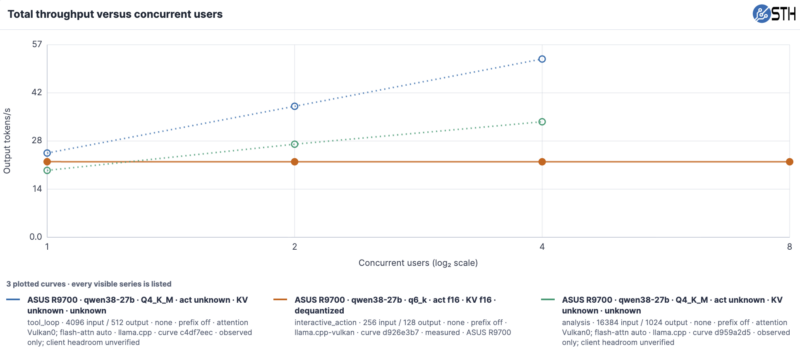
Starting off with a look at throughput versus concurrent users, we have a few different workloads (phases) with Qwen3.8-27B quantized down to 4 bits and 6 bits of precision. All three of the workloads start at around 22 tokens/second, which, if nothing else, goes to show how heavy of a workload Qwen3.8 is. But like most inference workloads, we do see performance improve as the number of concurrent users is ramped up and more of the workload is shifted to decode. Both the tool loop and analysis phases see significant improvements even ramping up to 4 users, with the tool loop surpassing 50 tokens/second by that point in time. Meanwhile the interactive action phase stays flat throughout.
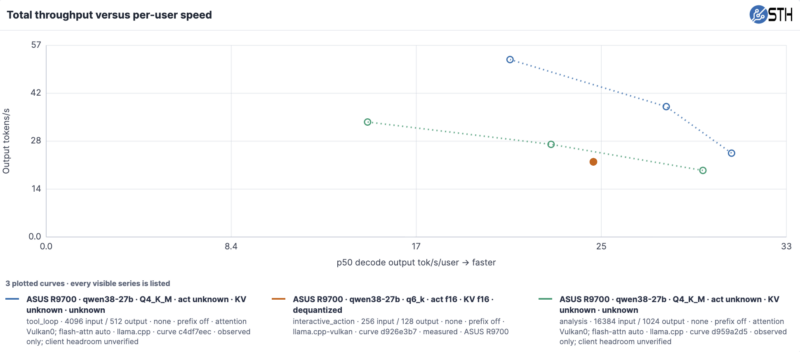
The trade-off to that, of course, is that while the overall token throughput generally increases, it is not fast enough to keep up with the increase in users, resulting in a drop in tokens generated on a per-user basis per second. Looking at the p50 (median) throughput on a per-user basis, both the tool loop and analysis phases see the total output token rate falls as the per-user rate increases.
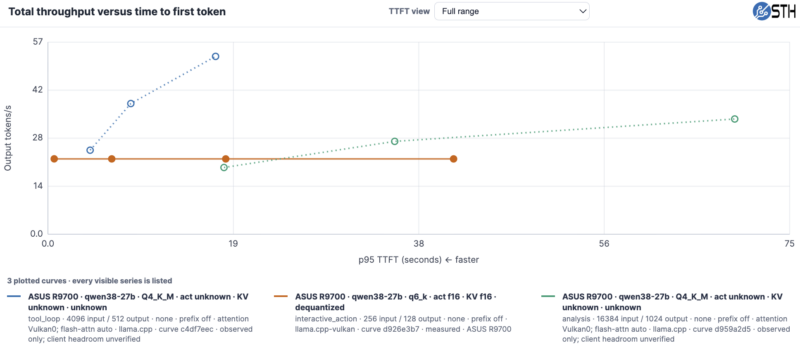
For that matter, we see a similar set of tradeoffs with throughput versus the time to first token. Both the Total loop time and the analysis phase time show significant increases when ramping up the overall performance. The analysis phase is especially extreme. While the TTFT is only 18 seconds at its lowest throughput rate (~20 tokens/second), the TTFT increases to almost 70 seconds if we want to push the token rate over 30 tokens/second.
Qwen3.6-35B
Meanwhile we also have the slightly older Qwen3.6-35B-A3B. Here we are using the 35 billion parameter mixture-of-experts model that has been quantized down to 4 bits, and further changes things up by only having 3 billion active parameters at a time. This is a very popular model because it is large enough to be useful and the MoE 3B active size makes it go fast.
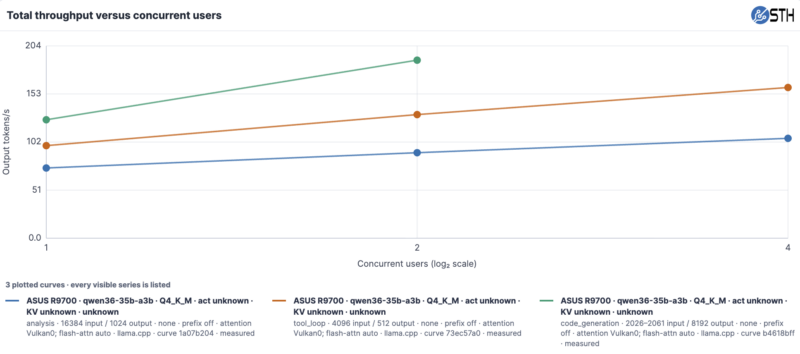
The smaller number of active parameters that need to be processed provides for some immediate gains in performance. Here every phase starts with a token output rate of at least 75 tokens/second, with code generation starting at a blistering 125 tokens/second. Scaling up the number of concurrent users, in turn, pushes performance even higher, though not by an extensive degree. By the time we are at 4 concurrent users, the analysis phase is generating about 105 tokens/second, while the total loop is a bit past 155 tokens/second; an increase of around 36% and 50%, respectively.
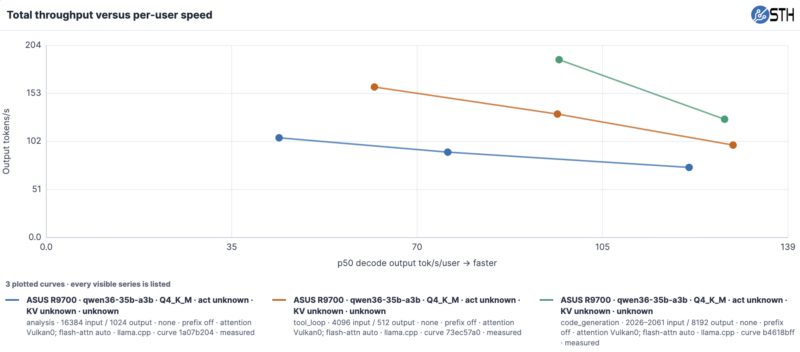
But we also see that familiar performance degradation curve when looking at performance on a per-user basis. The median total token rates drop by upwards of 35% as we shift the emphasis to higher token rates for each individual user.
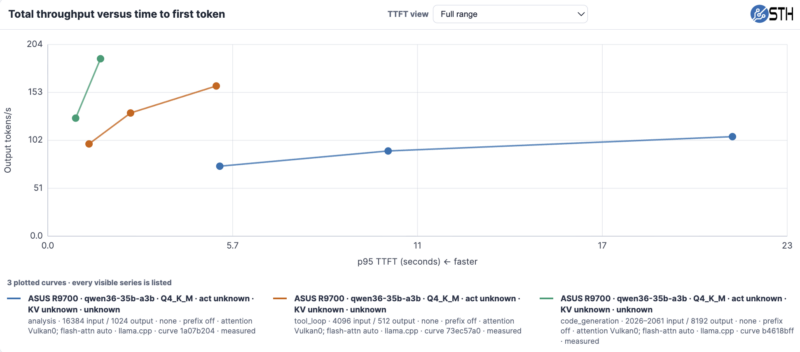
Finally, here is a look at TTFT with Qwen3.6. Allowing for longer TTFTs affords us quite a bit more total throughput. And for the analysis and total loop phases, while the increase is significant on a relative basis, the absolute increase still keeps things to under 5 seconds even at the fastest output rate. The analysis phase is once again the biggest outlier and takes the biggest penalty: the TTFT quadruples to over 20 seconds by the time we cross the 100 tokens/second mark for total throughput. Though this is still almost four times faster than what we saw for TTFT in the same scenario with Qwen3.8-27B.
AMD Radeon AI Pro R9700 Versus the Rivals
As this is the second Radeon AI Pro R9700 card we have had the opportunity to take a look at, we also wanted to see how the card compares to ASRock’s Creator Radeon AI Pro R9700, and what performance differences may exist between the two cards.
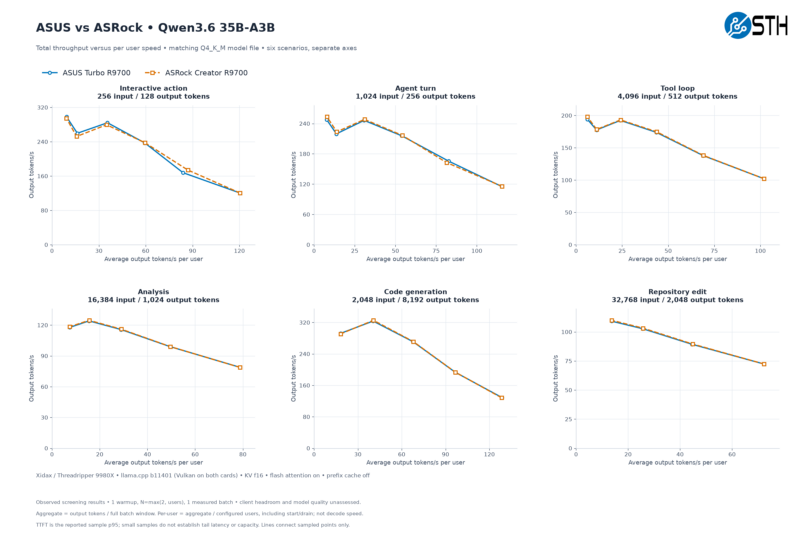
The answer to that question is: not much. With AMD enforcing some very tight design guidelines for R9700 cards, as well as identical clock speeds and cooler styles, these cards are one step removed from reference cards. That makes them very consistent from one another in performance in virtually every metric. It means that ASUS’s card is in lockstep with the ASRock card as far as R9700s go. Next, we are going to have two of these in the system, so we wanted to validate that if you had an ASRock R9700 32GB for example.
This is very much not the case if we compare things to NVIDIA’s flagship GeForce RTX 5090, however. This is not an especially fair comparison here, as the RTX 5090 is several times the price. The common thread is that both cards have 32GB. We just wanted to quickly see if we could show what those extra dollars are buying, or rather in this case, saving by not going with a far more expensive NVIDIA video card.
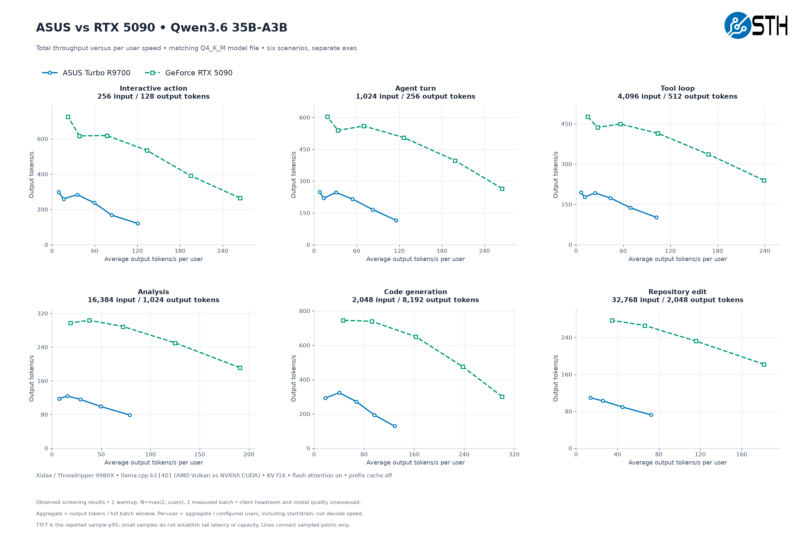
Our graphs for Qwen3.6-35B comparing total throughput to per-user token speeds is a useful visualization here. At peak throughputs the performance gap between the RTX 5090 is around 3-to-1 in favor of the NVIDIA card with high user counts, and at low user counts this can drop to as low as 2-to-1, such as in the code generation phase. Overall, the RTX 5090 starts off at a much higher level of performance, and as a result can sustain a larger number of users before per-user performance drops off too far. If you have the power, then two of the R9700’s becomes and interesting option versus the RTX 5090, especially given current pricing.
We have a fairly huge number of scenarios tested, but the one that got more interesting was putting two cards in a machine. Stay tuned for that.
This hints that the R9700’s strength as a value card may be in low user concurrency workloads, where it comes the closest to a card multiple times its price. Though as models are changing all the time (and even Qwen 3.6 will quickly become dated), this is definitely something that large buyers should tested first before making any major purchasing decisions.