

ASRock Rack AMPONED8-2T/BCM Cooling
Fully assembled, an AmpereOne setup is no lightweight system. That goes both figuratively, thanks to all of its performance, memory bandwidth, and I/O, but also literally, thanks to the power consumption of the chip. With power usage topping out at 400 Watts for the fastest 192-core SKU, an AmpereOne chip calls for a good-sized cooler.
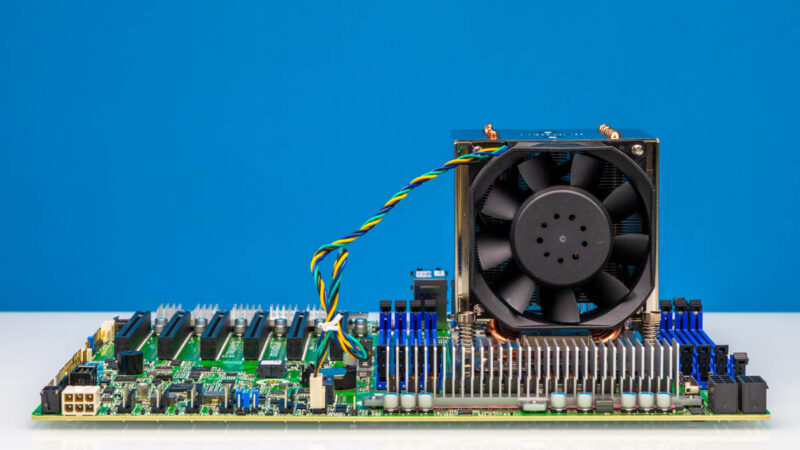
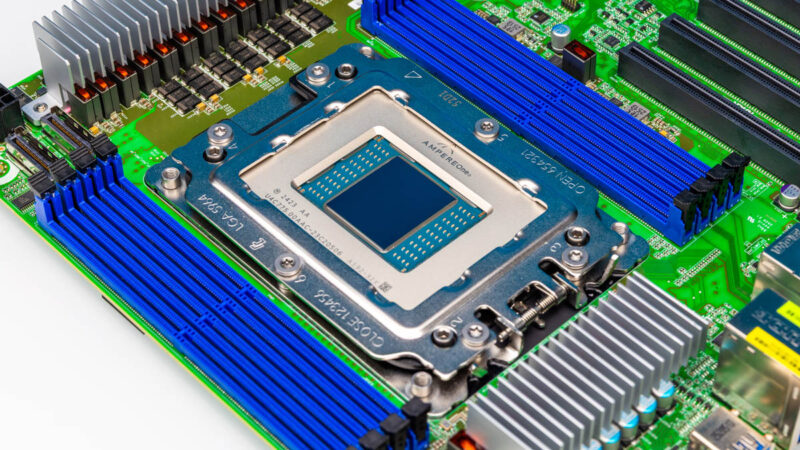
In this case, we went with Dynatron’s W23 cooler (eBay Affiliate link), a 3U cooler designed specifically for the AmpereOne platform and its 5964-Pin FCLGA socket. Something fun about the design of AmpereOne coolers is that they have different depths for the CPU core die and then the memory controller and PCIe heat spreader.
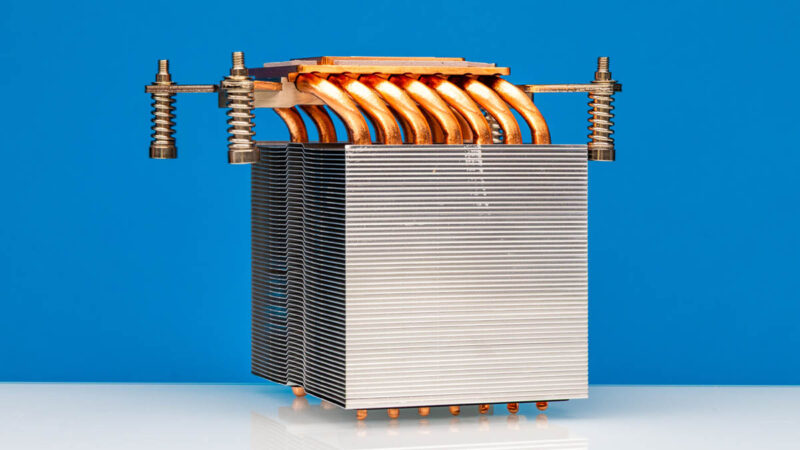
The hefty copper and aluminum cooler comes with a single 80mm fan, with a maximum airflow of 115 CFM, and a maximum noise level befitting a server CPU cooler.
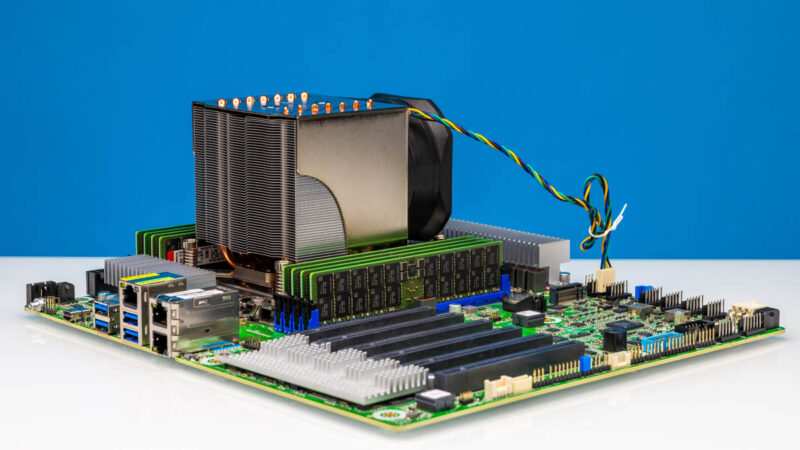
The design of the socket and cooler basically forces the issue anyhow, but with heatsinks flanking the CPU socket on the left and right sides, the AMPONED8-2T/BCM badly wants to be cooled in a front-to-back fashion, rather than circulating air bottom-to-top.
We will just note that there is not the widest selection of AmpereOne coolers. At the same time, we wanted a 3U cooler for a project idea, so the W23 was a good option for us.
ASRock Rack AMPONED8-2T/BCM CPU Support List
Taking a very quick look at the CPU support list for the AMPONED8-2T/BCM, it is all very straightforward. Ampere offers eight AmpereOne SKUs, and ASRock Rack’s motherboard supports all of them – from the basic 96 core model up to the flagship 192 core A192-32X which we are using here. Soemthing you may also notice is that dropping clock speeds from 3.2GHz to 2.6GHz (~18.75%) lowers the power by 33% to 300W. 192 Arm cores in 300W is great.
| Socket | Family | Model | Core | Frequency | Power | Since BIOS |
|---|---|---|---|---|---|---|
| 5964 | AmpereOne | A96-36X | AmpereOne X | 3.6GHz | 350W | 1.20 |
| 5964 | AmpereOne | A144-26X | AmpereOne X | 2.6GHz | 350W | 1.20 |
| 5964 | AmpereOne | A144-24X | AmpereOne X | 2.4GHz | 250W | 1.20 |
| 5964 | AmpereOne | A128-34X | AmpereOne X | 3.4GHz | 390W | 1.20 |
| 5964 | AmpereOne | A144-27X | AmpereOne X | 2.7GHz | 275W | 1.20 |
| 5964 | AmpereOne | A192-32X | AmpereOne X | 3.2GHz | 400W | 1.20 |
| 5964 | AmpereOne | A192-26X | AmpereOne X | 2.6GHz | 300W | 1.20 |
| 5964 | AmpereOne | A160-28X | AmpereOne X | 2.8GHz | 300W | 1.20 |
You might also be looking at this, and wondering about the AmpereOne M we previewed earlier this year. With 12 channels of DDR5, you would generally use a different motherboard for that chip, but stay tuned for AmpereOne M on STH.
Final Words
This might seem like an odd comment, but we have already shown this platform off to some folks because it might end up with a niche but important part of the ecosystem. The NVIDIA push with its Grace, and soon Vera Arm-based CPUs and BlueField DPUs in the market, is having a big impact. Likewise, the cloud providers have their own Arm-based CPUs. If you want to do development for those platforms, either just having an Arm server to run locally that is compatible with the cloud provider offerings, or if you want to develop something for the NVIDIA ecosystem, then ASRock Rack has just about the perfect platform with lots of PCIe slots.
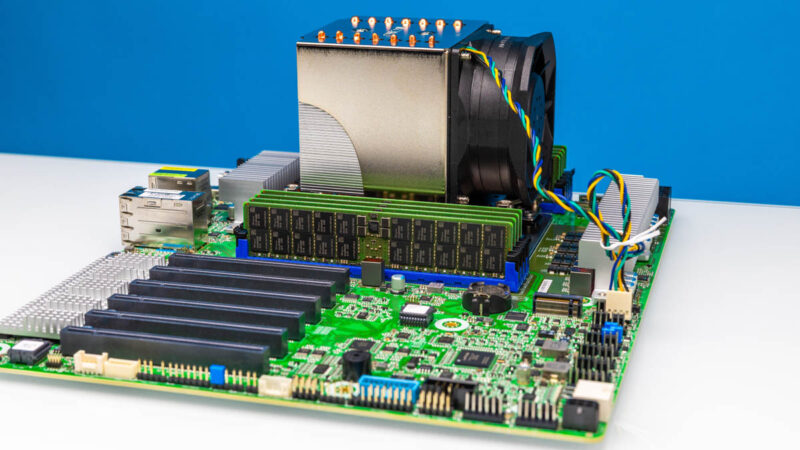
Something fun about this platform is that while it started out its life as a lower-cost per core alternative to Intel Xeon, it might end up with a different use case with the AMPONED8-2T/BCM. This might be the lower-cost Arm alternative to a NVIDIA Grace CPU. What is more, Ampere can bifurcate its PCIe lanes to provide storage connectivity making it a more useful connectivity development platform.
In 2026, we will be at the 10-year mark of Arm servers being viable as that is when Ubuntu 16.04 LTS brought Arm onboard as a first-class citizen. Over the last decade, Arm servers have become relatively seamless to use. Since we have folks out for the holiday’s, I installed Ubuntu 24.04.3 LTS on this board myself over the HTML5 iKVM interface, and it just worked, just like on an x86 platform. To many, that may not be exciting, but having used Arm servers for over a decade, just being able to do that without any drama still brings back memories of earlier days where that was not the case. The idea of being able to buy a CEB sized motherboard, plug in a M.2 SSD, some RAM, and a 192 core Arm processor and then having a system with lots of PCIe Gen5 connectivity and little hassle is exciting. That is what the AMPONED8-2T/BCM delivers.
Next up for this one, we are going to try building an exciting server platform around this one.

Patrick, I think you need to test again: your CPU jumper (number 15 on the motherboard layout diagram) is set to the wrong VREF voltage, which (according to ASRock) can have an impact on performance.
Thanks Jeff. We have different folks taking photos, testing, writing, and so forth. Usually, when Sam is taking photos/ B-roll, it is before we get things formally set up for testing, because if we take photos after, we end up getting too many fingerprints/ scuffs on gear.
This board is around $4700.
My experience is that asrock rack hardware is cool, but they are really horrible about long term software support (bios updates, etc) which makes them a bit of a crapshoot. Would be cool if sth made a habit of going back after a year or two and report how things are going in that respect.